
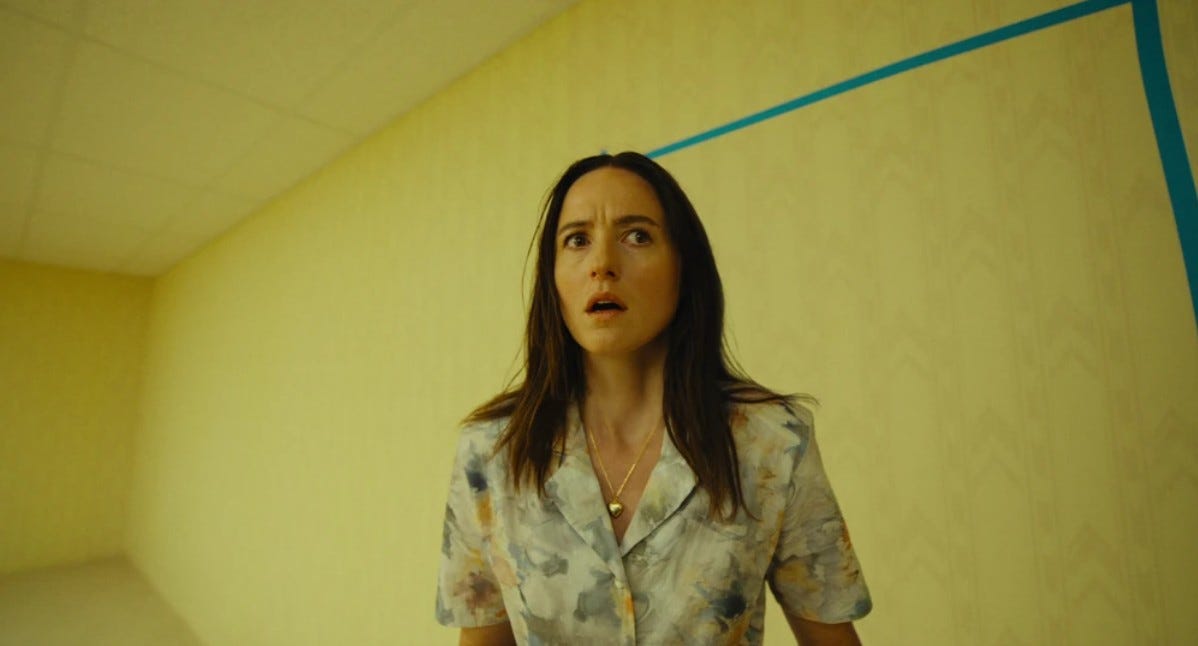
Catching up on stuff I didn’t get to write in June. This is still in some theaters!
In late 1990 Tim Berners-Lee, a British computer scientist at CERN — the Geneva physics laboratory that, today, is home to the Large Hadron Collider — launched the world’s first web browser. It was proof-of-concept for a proposal he submitted the previous year: a network of hypertext documents that could be shared and viewed by researchers at different institutions. He called it “WorldWideWeb.”
Within five years the software had gone global and the Web commercialized, giving birth to the modern Internet and, it turned out, a new world.
Backrooms, the new(ish) film directed by Kane Parsons based on his YouTube series, is also set in 1990 and involves portals opening to a seemingly infinite alternate world that reveals itself to be a cesspool of grievance, distortion, and poisoned memory. And while the film might not textually be about the Internet, it’s still a very online movie.
Metatextually, it’s all anyone can talk about. With Backrooms and Curry Barker’s Obsession1 smashing the box office last month, there’s a lot of discussion about whether YouTubers are the future of the film industry. Like most things, the answer is probably going to be “yes and no:” some of these folks (likely including Barker and Parsons) will go on to have Hollywood careers, but others will make some really disposable studio movies over the next year or two before the execs decide to move onto whatever the Next Next Big Thing is (probably Catholic writers in their 40s on Substack).
Backrooms specifically is also steeped in some very specific Internet subcultures and obsessions. The series was inspired by a creepypasta shared in a 4chan thread in 2019. If that last sentence read like gibberish to you, please know how much I envy you. The “Backrooms” concept taps into the uncanniness of “liminal spaces,” particularly those created by the slow collapse of American capitalism. It’s that creepy feeling you get when you walk through a “dead mall,” the sense that you’re not alone in an empty hallway. Backrooms makes that literal: it’s possible to accidentally wander into the back hallways of reality. No, you’re not alone in there. Yes, you should be very concerned.
The creepiness of liminal spaces may be elemental, but the particular fixation on the creepiness of liminal spaces — the sharing of pictures and videos, the very proliferation of the word “liminal” — is an online thing. We’ve had horror movies based on urban legends, books, video games, and weird dreams David Lynch had once. As far as I know, this is the first horror movie based on a meme.2
But it’s the particular story that Backrooms the film tells that has me thinking of the Internet. Depressed, recently-divorced Clark (Chiwetel Ejiofor) discovers a portal to the Backrooms in the basement of his faltering discount furniture store. Rendered here, the Backrooms are an endless series of sterile, yellow hallways with fluorescent lighting. Imagine purgatory, but it’s just the hallways between a hotel lobby and some remote suite of conference rooms, forever. He becomes obsessed with exploring the space, despite getting hints that there’s something else lurking there. Eventually he disappears and his therapist, Mary (Renate Reinsve), investigates, ending up in the Backrooms herself.
Without getting too deep into the lore/plot, the Backrooms seem to be a psychic space as well as a literal one. Things from the “real world” appear there in twisted, uncanny forms; there are several, let’s say, “creatures” that look a lot like the sort of horrors that the first generation of generative AI software would spit out. When Mary finds Clark, he’s gone native and the Backrooms have only exacerbated his worst tendencies: his anger, his sense of entitlement, his resentment towards women.
I mean, you don’t have to squint too hard to see the Internet metaphor there.
Now, if only that metaphor was hitched to a better screenplay. Creepypasta are the online version of campfire stories: they’re meant to make you shiver, not to support a whole narrative. Parsons’ original series has recurring characters and builds lore, but it’s most successful (as I understand it) as a delivery system for spooky vibes and imagery. The movie, consequently, is much more effective when you’re following the characters down upsetting hallways, and much less effective whenever those characters start talking about feelings or themes.
The film reaches for profundity but ends up just recycling the same “this horror movie is about trauma” thing that you’ve seen a million times. In outline, you can see where these characters’ stories might be really resonant with this setting; in practice, it all feels pretty phony. It’s up for debate how much of the blame falls on Parsons, who wrote the story, and how much falls on Will Stoopik, who wrote the screenplay. (But I will say, the dialogue isn’t great).
There’s also the critical issue that it’s not terribly scary. Creepy, yes… but eventually you actually have to see the scary thing that’s lurking around corners (lit by those ubiquitous fluorescents) and, like everything else, it’s more interesting than terrifying.3
Fortunately the film has two saving graces. First, it’s got two great leads in Ejiofor and Reinsve, who can make even the flimsiest material engaging in the moment.4 Second is Parsons’ obvious skill behind the camera. The Backrooms are, by design, a pretty boring environment, but Parsons keeps finding interesting (and chilling!) ways to shoot it. There are, admittedly, some amateurish aspects to the pacing as well as the writing (Parsons takes three opportunities to show different characters having their minds blown by walking through the same wall, the sort of thing a more experienced director might realize they only had to show once). But he’s got a better grip on filmmaking fundamentals than some well-established journeymen directors (you may have read my review of Craig Gillespie’s Supergirl) and a distinct, confident visual style. I’m really interested to see what he does in the future.
One of the creepiest ideas in Backrooms is that it’s expanding: a scientist (Mark Duplass) studying the dimension notes that they’re finding more portals all the time. With most haunted house movies, you can rest secure in the knowledge that — unlike these suicidally stupid characters — you simply would Not Go In There. But what if the haunted house comes to you? What if you don’t even know you’re inside until it’s too late?
That’s an arresting idea, especially as we navigate a moment in history where daily life can, and is, impacted by inscrutable online subcultures. You can be blissfully ignorant of the manosphere or whatever, but that won’t keep you safe. At the same time, venture too deep into the labyrinth as you try to understand it and you end up getting lost; it will poison you long before you’ve comprehended it. Maybe there’s no way out. Maybe the only choice is to wander those haunted hallways without becoming a monster yourself.
Obsession, in fact, is even more successful! I haven’t seen it yet because I’m a wimp about gore on the big screen.
But, sadly, not the last.
Spoiler-ish: That being said, in the hours after watching one of the images I returned to most frequently was The Scary Thing’s big, sad, vulnerable eyes. There’s definitely something there, even if the execution isn’t spectacular.
I don’t want to ramble about this, but this film has definitely been a victim of what I’m calling Kane Parsons Derangement Syndrome, in which even some film critics I really respect can’t help but be extremely dumb about it because, I gather, it breaks their brains a little that he’s so young. One of the goofiest expressions of this is people claiming confusion as to why Renate has an accent even though her character is American. Really???
No posts
Comments
Nothing yet. Say the first thing.
Sign in to join the conversation.