
“If anyone asks, tell them you’re Irish.”
I was told this a few times ahead of my footballing tour of Argentina this year. I had the time of my life over ten days in Buenos Aires, going to seven football matches, ticking off the big two stadiums of Boca Juniors and River Plate.
All the locals I met were brilliant and I never felt the need to pretend I’m anything other than very English.
The reason people said it, of course, is the Falklands War, a shadow hanging over Wednesday’s match between England and Argentina.
I studied politics and spent several years working as a political journalist, so of course I know about the war, and the ongoing tension involving the islands that Argentines call the Malvinas, but it frankly all feels a bit niche from a UK vantage point.
I certainly had no idea what the outline of the islands looked like before visiting Argentina.
But everywhere you go there — especially in football stadiums — you see the shape of the islands, usually accompanied by the slogan “las Malvinas son Argentinas”.

I spotted the outline of the islands, which look somewhat like angels’ wings, on banners in every stadium I went to, on murals, on stickers, just everywhere.
I even saw it tattooed on a few calves as I waited in a queue to get through a police cordon ahead of watching Nueva Chicago, a lower league team known as the “Millwall of Argentina”.
I was grateful that nobody clocked my Englishness because this is a live issue, a matter of deep emotion, in a way that is difficult for an Englishman to comprehend.
I recently enabled paid subscriptions. If you like my work and want to help ensure I can keep doing this, please upgrade for just £6 a month or £60 a year. Annual subscribers get a free signed book, posted anywhere in the world.
A quick reminder: both countries claim the islands which lie 300 miles east of the Argentine coast. Almost two centuries ago, Britain took control of the sparsely inhabited islands, after first claiming sovereignty a few decades earlier.
Over time this developed into an issue of national importance for Argentina which saw the situation as an imperial outrage.
Things came to a head in 1982, a time Argentina was ruled by military dictatorship and the economy was crumbling. Wanting to stoke nationalist support, the junta invaded the islands, which by this point had a proudly British population.
They made the bet that Britain, its military power in decline since the Second World War, would not expend energy defending these windswept islands so far from home. It was an epic miscalculation. Britain retook the islands in a ten-week war that killed 900 people, 650 of them Argentine.
Defeat ended up destroying the junta. Democracy was re-established. But this is all still a huge hot-button issue in Argentina and politicians raise it constantly.
Most Argentines today feel incredibly strongly about all this.
The curious thing is that it is very asymmetric. I was born in England a decade after the 1982 war and it is simply not something people talk about very much.
Meanwhile, videos have been circulating of Argentine players singing in the changing room:
Por Malvinas, por el Diego, por la última de Leo…
For the Falklands, for Diego, for Leo’s last one…
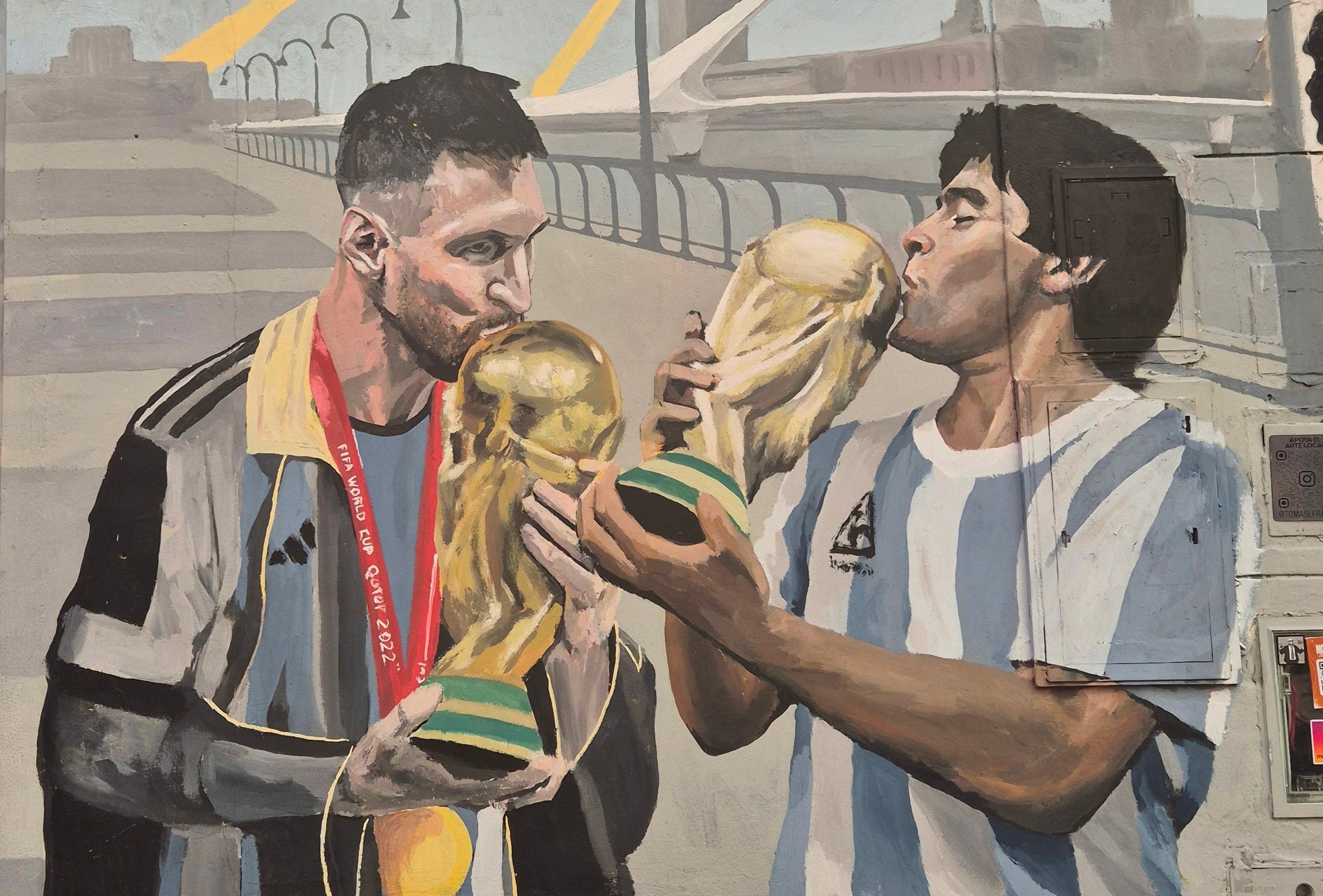
The idea of English footballers singing about the conflict — or even having an opinion on it at all — is faintly absurd. The issue simply does not loom large in the English national consciousness.
Just before I went there earlier this year, an Argentine diplomat in France had been speaking in front of a world map which labelled the islands as British, so he covered it up with a post-it note.
In Argentina this was front-page news. While the football rivalry is felt just as strongly in England, the political tension is not.
There are reasons for this imbalance. Most obviously, Britain won the war and Argentina lost. The British government is content with the status quo, while Argentina’s is not.
Second, more Argentines died, including notoriously when a ship, the General Belgrano, was sunk, accounting for half of all Argentine deaths. Given the country’s significantly smaller population, Argentines are more likely to have a personal connection than Brits.
Third, the war looms larger in the Argentine folk consciousness because the country has only had one major war in the last century. In Britain the numbers are miniscule compared to the two world wars, and have since been usurped by the conflicts in Iraq and Afghanistan. Britain is a very old country that has had a lot of wars. Argentina is a pretty young one.
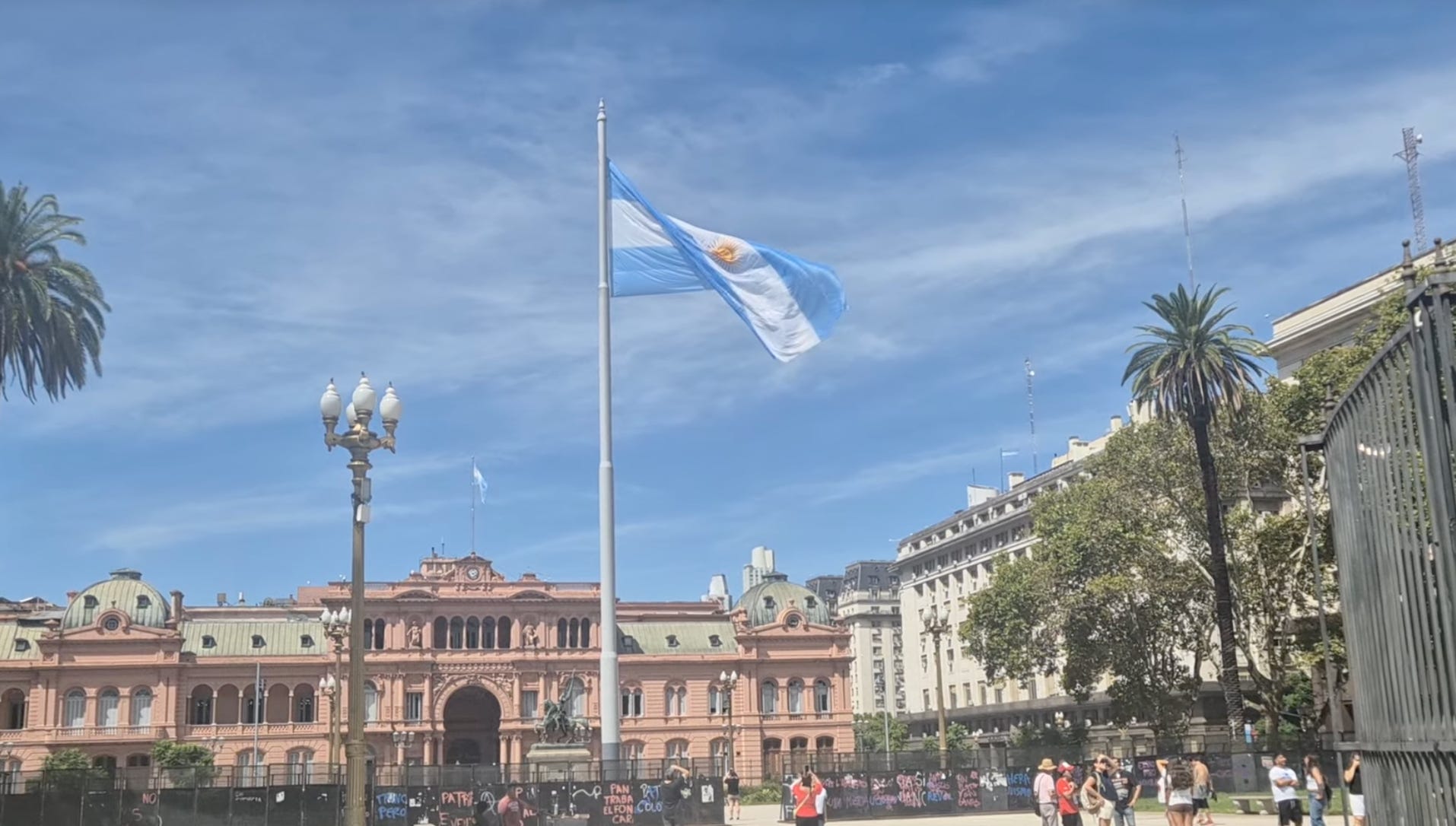
While Argentina whipped itself into jingoistic fervour, the truth, that they were losing the war, did not get through. The war was still raging when the national team arrived in Spain a couple of months later for the 1982 World Cup. Before travelling to Spain, the team paraded in front of a banner saying ‘Las Malvinas Son Argentinas’.
General Galtieri turned up at the team’s training camp, hugging Diego Maradona in front of the cameras. But the Argentina squad got a nasty shock when they read the news in Spain, written in a language they could read, and not filtered through the junta’s propaganda machine.
“We were convinced we were winning the war, and like any patriot my allegiance was to the national flag,” Maradona later said. “But then we got to Spain and we discovered the truth. It was a huge blow to everyone on the team.”
While in Argentina, I experienced no hostility whatsoever, even though I have no doubt pretty much all the people I met had strong views on the islands.
I actually encountered a deep Anglophilia among Argentines. Frequently I would get in a taxi and hear 1980s British rock music familiar from my childhood.
This was not necessarily the obvious international big hitters like the Beatles and Rolling Stones, but things like Depeche Mode, The Police and The Smiths, specifically from the early 1980s, the time of the Falklands War. The apparent reason is linked to the war though — when the dictatorship crumbled after the failed military campaign, the country opened up to outside influences, and British rock flooded the Argentine airwaves, and is still loved four decades later. Argentines love English football too.
But not on Wednesday night. In the air-conditioned stadium of Atlanta, Lionel Messi’s first ever game against England and the sixth World Cup meeting between the two, at the most advanced stage ever in a tournament.
England won 1-0 in the group stage in 2002 with David Beckham smashing in a penalty in the Sapporo Dome. Four years earlier in Saint-Étienne in France, the same Englishman got a silly red card for kicking Diego Simeone, as England lost to Argentina on penalties — my earliest World Cup memory.
Most totemically of all came the Hand of God game of 1986, when Diego Maradona outrageously punched the ball into the net, minutes before scoring one of the greatest individual goals in the history of football, the ultimate encapsulation of the Argentine spirit of viveza criolla, the cunning and the sublime. England won in 1962, as well as 1966, when Argentine captain Rattín, who died last week, was sent off in an incident Argentines still remember bitterly, considering it a pro-English stitch-up.
Even though England are 3-2 up in the head-to-head race, Argentines have won three World Cups to England’s one, as well as winning the two recent knockout games.
Argentina coach Lionel Scaloni was asked this week about the history of this fixture but insisted “this is a football game. That is what I can say.”
A lot of Argentines — and somewhat fewer of the English — will disagree.
No posts
Comments
Nothing yet. Say the first thing.
Sign in to join the conversation.