
TL;DR: Brandolini’s Law states that it takes an order of magnitude more energy to refute bullshit than to produce it. Nowhere is this more visible than in endurance sports technology, where devices confidently display numbers that are, at best, educated estimates — and where the marketing effort to sell these numbers dwarfs the effort required to scrutinise them.
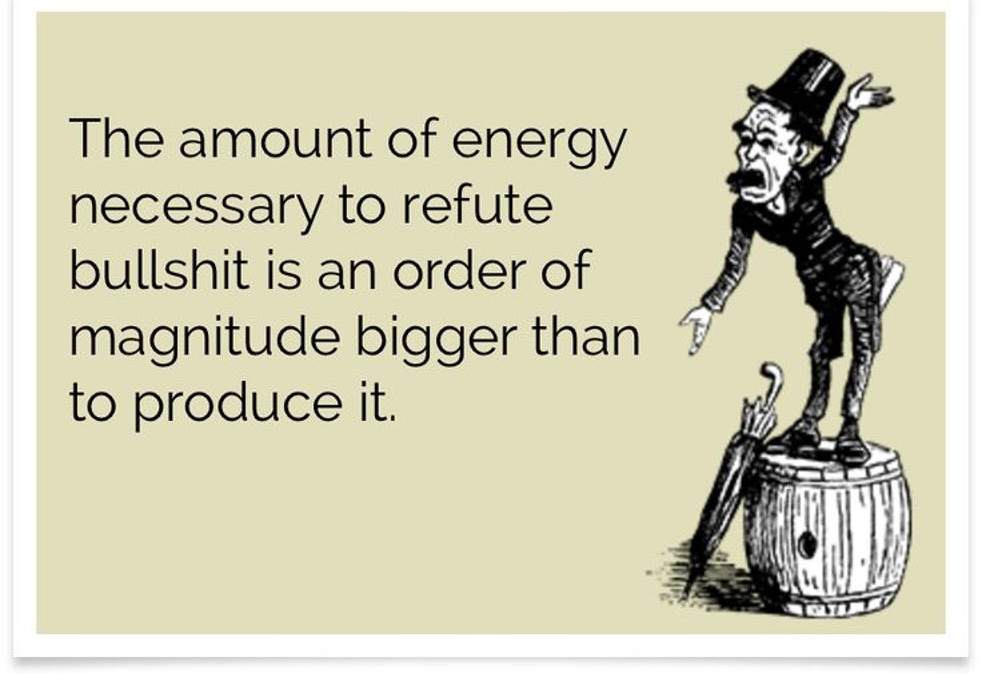
There’s a principle in epistemology that doesn’t get nearly enough awareness in coaching circles. It’s called Brandolini’s Law, or the “Bullshit Asymmetry Principle,” and it goes like this:
The amount of energy needed to refute bullshit is an order of magnitude larger than to produce it.
Think about that for a moment. One tweet, one product launch, one confident graph on a sales page — and you’ve created something that takes hours to properly unpack. The asymmetry is brutal, and it compounds. By the time the nuance catches up, the claim has already been absorbed, repeated, and embedded into how thousands of athletes train.
In a recent conversation with Iñaki de la Parra, I said that one of the most important skills a coach can develop today is a good bullshit detector. But we can go further, because the problem isn’t just that there’s a lot of noise in the endurance sport space but that much of the noise comes dressed in the language of precision.
That’s what makes it so hard to push back against.
The wearables revolution has been genuinely useful in many ways. The ability to easily capture and communicate training data between athlete and coach has changed what’s possible in both remote coaching and analysis for all coaches. The basics - time, distance, pace, power on the bike, heart rate — give us what we need at the highest levels of performance. That’s the real progress.
But something crept in alongside it: the assumption that because a device produces a number, that number reflects reality.
Let me give you three examples where that assumption falls apart:
Running power. Stryd is the best-known running power meter (although many sports watches now incorporate some kind of similar running power metric), and plenty of coaches use it meaningfully. But here’s what the marketing doesn’t lead with: running power cannot be directly measured the way cycling power can. On a bike, a strain gauge in the crank measures the actual force you apply. On your feet, there is no equivalent. What Stryd does is collect data from an accelerometer, gyroscope, altimeter, and wind sensor, then runs it through a proprietary algorithm to estimate power. The algorithm is a black box. Independent validation has found accuracy varies across speeds, that terrain causes systematic errors, and that the true gold standard — a force-plate treadmill — simply isn’t available to 99.9% of athletes. “Running power” is an estimate, not a measurement, and those two things are not the same.
Sleep staging. Oura and Whoop both confidently display your nightly breakdown of REM, deep, and light sleep. Athletes and coaches make real decisions based on this. But the only gold standard for measuring sleep stages is polysomnography — electrodes on your scalp reading actual brainwave activity. What these wearables measure is a proxy: heart rate and HRV via a light-based skin sensor, from which an algorithm estimates sleep stage. Oura's REM sensitivity sits around 76-79% against PSG in validation studies — which sounds reasonable until you consider that a 20%+ error on sleep architecture produces meaningfully wrong data. WHOOP overestimates REM by around 21 minutes on average. Displaying estimates as fact, with no indication of the uncertainty involved, is a design choice that favours confidence over accuracy.
Oura and WHOOP take that already-estimated sleep data, combine it with overnight HRV collected continuously via a light-based skin sensor — a method that HRV researcher Marco Altini argues misses the orthostatic morning measurement that makes HRV actually useful — and resting heart rate, to produce a single recovery percentage that is an estimate built on estimates. Athletes may end up skipping training based on it, and/or feeling doubt about what they are doing or their recovery. The compounding abstraction from underlying physiology to a single confident number is the Brandolini point made even more concrete.
Core temperature. The CORE sensor’s name is itself the misleading claim. It doesn’t measure core temperature. It measures skin temperature and heat flux, then applies an algorithm — the manufacturer calls it “AI-powered” — to estimate core body temperature. The limitations matter: accuracy degrades when skin temperature drops below 34°C, and there’s a lag of five to thirty minutes between a real change in core temperature and what the sensor detects. The limitations compound in a hot triathlon specifically: independent research found the sensor underestimates core temperature at hyperthermic temperatures — above 38.5°C — which is precisely when you'd most want accurate data. And then there's the cold water: dumping it over yourself at every aid station, the standard intervention for managing heat stress, instantly corrupts the skin temperature input the algorithm depends on.
These aren’t edge cases. These are among the most hyped and widely adopted tools in endurance sport right now. And they all follow the same playbook: find a physiological variable athletes care about, measure something adjacent to it, run it through a black box, and present the output with confidence. The marketing then emphasises what the device calls the measurement rather than what it actually does.
Now here’s where it gets worse. Those product claims often reference peer-reviewed research as their foundation. But Dr. Joe Warne and the Sports Science Replication Centre in Dublin have been doing something both interesting and uncomfortable: systematically testing whether published sports science actually holds up. Their findings are sobering. Across 25 preregistered multi-lab replications, only 28% of studies replicated successfully. Effect sizes dropped by an average of 75%. And when they approached the original study authors for data or collaboration, only 14% were willing. Ross Tucker and the Real Science of Sport podcast covered this extensively, asking the question that every coach and athlete should be sitting with: what do we do when we can’t trust the research?
Brandolini’s Law operates at every level. One study takes months to produce and years to properly challenge. By the time anyone pushes back on it, the original finding has already been cited in product white papers, referenced in coaching courses, and absorbed into training culture and everyone's already treating it as fact. The claim - “this tells you your core temperature” — takes two seconds and is immediately intuitive. The refutation requires you to actually understand the physiology, dig into the validation literature, and hold two things at once - a device can be both imperfect and useful.
Most people don’t have the time or inclination for that. So the confident claim wins by default.
As I noted to Iñaki: we’ve had a kind of “scientification” of sports training, where the appearance of rigour has substituted, in many cases, for the real thing. Academia and consumer tech both reward looking rigorous more than being rigorous. Buying a device feels like buying into precision. Often you’re buying into the perception of precision.
None of this means throw out your wearables. It means develop the habit of asking: what is this device actually measuring, and what is it estimating? Where is the algorithm, and what are its assumptions? What does the validation look like against a gold standard?
It means taking the data and feedback from these devices so that you don't overweight their inputs compared to your subjective feelings, your past experiences, and recognising both short and long term trends.
The answers to those questions won’t always be crystal clear. That’s fine. Part of the performance process is about how we deal with uncertainty, and accepting that a level of ambiguity is normal, and manageable. Being honest with ourselves is better than false precision accepted uncritically.
The athletes I’ve worked with who perform best over time are not the ones with the most data. They’re the ones who’ve developed the skill of connecting to their own perceptions — effort, fatigue, readiness — and can use objective data as one input among many, rather than something to defer to.
No algorithm, however well-designed, has solved that problem yet. And until one does, the most important sensor you’re running is still the one between your ears.
The magic is not in complexity. It’s in accumulating simple work, at the right intensity, for a very long time. More data doesn’t change that equation.
If Real Coaching is useful to you, the best thing you can do is share it with one person who’d appreciate it.
No posts
Comments
Nothing yet. Say the first thing.
Sign in to join the conversation.