
I’m teaching a Zoom-based workshop tomorrow (Saturday August 8th) from 1:00-3:30 PM Eastern, “Estranging the Familiar: A Prose Poem and Lyric Flash Workshop.” If you want to jump in and join us, there are still spots. (And if you really want to join but can’t afford it right now, I can offer a couple scholarship spots. Just write me.)
As such, I’m thinking about the value of “defamiliarization” in art. This week, I’ve been thinking about how art allows us to see anew, but how estranging the familiar narratives/perspectives is also a chance to honor our own experience. Do you feel like a weirdo who never sees things quite the way you’re asked to? Great! Tell us. Show us. Congratulations, you’re an artist.
I’ve pointed to the work of Elizabeth Layton in this Substack a couple of times. Here’s what I originally wrote in this post:
When I was in college, I saw an exhibition of the drawings of Elizabeth Layton, a woman who later in her life found respite from mental illness through art. I’m not sure where I saw it exactly or how I came to be there, aside from the Kansas connection. (Layton was from Wellsville, Kansas, and I went to college at the University of Kansas.) Below is part of her story, and you can read more here and here.
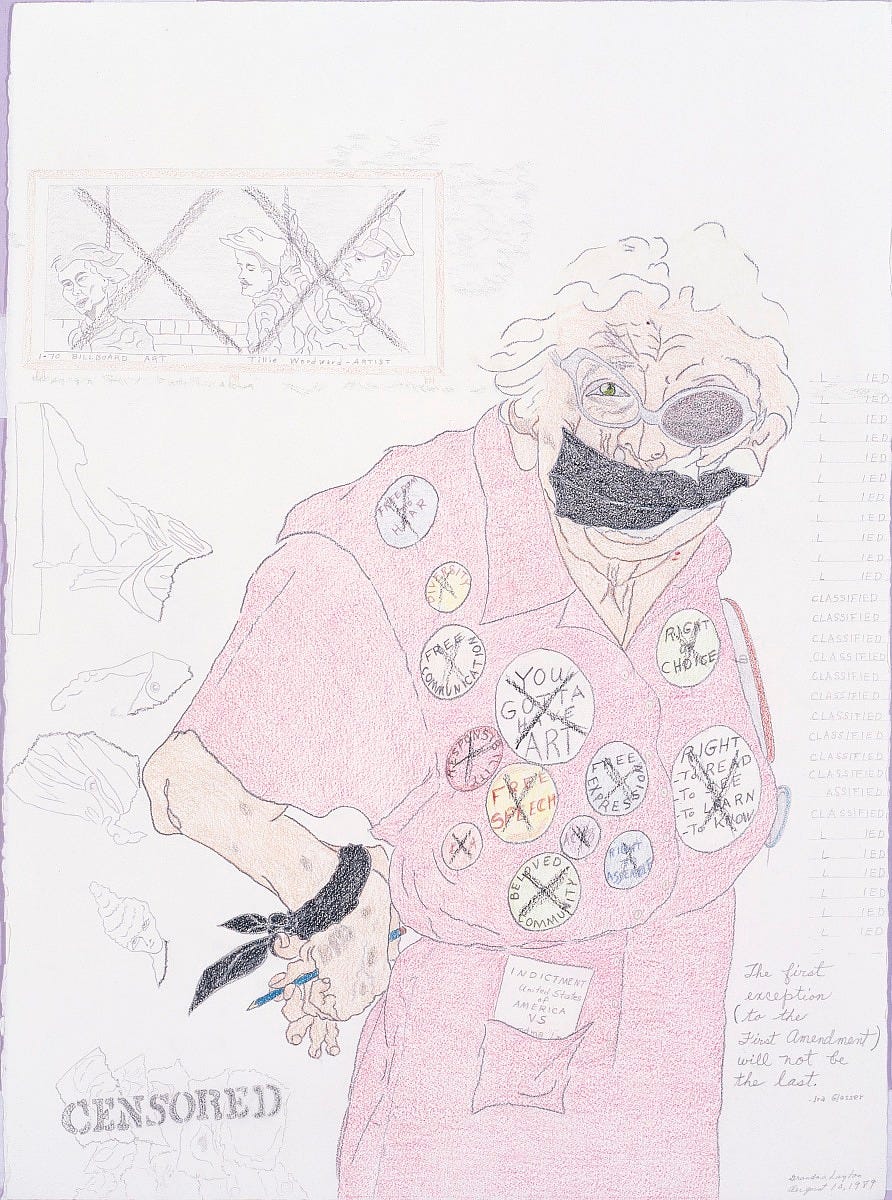
Layton comes from a family of writers and journalist and was herself managing editor of her hometown newspaper, The Wellsville Globe. The editorial content of her drawings reveals the influence of her journalism background. Following a divorce she raised five children, which perhaps explains her empathy for those who find themselves in situations beyond their control. She also suffered from bouts of depression for much of her life, which caused her to identify with those tormented by the pressures of modern society. Her work dispels the myths and misconceptions of old age. She examines personally and unexpectedly painful subject matter that rejects the stereotypical image of a grandmother. These drawings reveal the expectations of the wide-eyed child, the young girl filled with vitality, the wife and lover, the nurturing parent, and a strong-willed and opinionated social activist. Elizabeth Layton was struggling with bi-polar illness and profound depression when she began contour drawing, and art became more than therapy for this Wellsville, Kansas, Native - it saved her life. Her drawings and writings have enriched the lives of countless others and have been exhibited at the Smithsonian’s National Museum of American Art, and in more than 200 art museums and centers throughout the U.S.
This chance encounter with Layton’s art and story has stayed with me all these years as a sort of companion, as art and artists sometimes become.
I was thinking of Elizabeth Layton again recently after a rough several weeks. In addition to (in conjunction with) a couple hard family medical situations that are ongoing, I have had a few weeks of feeling like the machine of my body— this whole psyche-soma thing— just isn’t working properly. There’s a confluence of issues at play, including aging, hypothyroidism, stress, and the attendant weight gain. My body is pulling in weird ways, and I’ve had weeks of migraines, lower back pain, hip and leg pain, sleeplessness … Years ago, I pulled my S-I joint (an old grading injury), and it’s been acting up since I tried to go back to lifting weights last year. This after gaining an additional 15 pounds between the last presidential election and inauguration. And now it’s been too hot to take walks. (Am I blaming my pain on climate change and Republicans? Partly, yes.)
Anyway, since finishing my MSW semester last week, I’ve had big ideas about writing! keeping a daily illustrated journal! purging all clutter from my house! But mostly I’ve been laying low and trying to take it easy. The other day, though, my mood and pain were manageable enough that I really wanted to do something creative. I wrote down part of what I’d been thinking that morning— those kinds of thoughts that come to me and make me think, “I’ll write that down,” even if just for my own amusement.
I ended up making some illustrations to go with it. These are all supposed to me be, but I was doing a sort of modified blind contour drawing (à la Elizabeth Layton) and just letting each face looked how it looked. Again, to amuse myself. There’s some more language I was going to put with the third image, but here’s how far I got:
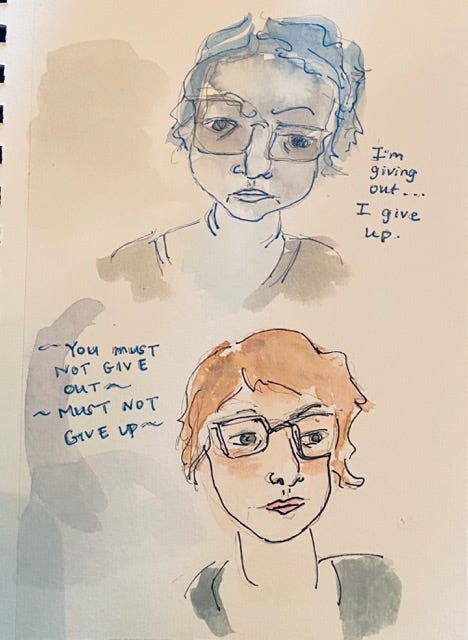
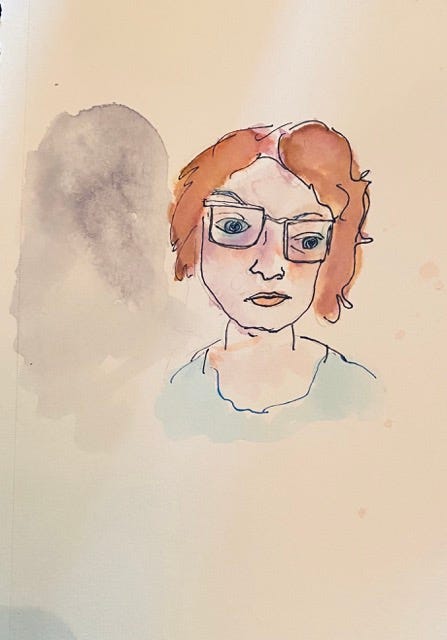
This is also based on this other voice that comes to me sometimes, whether it’s a wise inner Self or a benevolent Spirit, I’m not sure. But I like to lightly take note of it when it occurs.
I share this because it gave me that feeling of, “Haha. This is weird. I love it.” It’s a feeling I really value and to me it’s part of what I hope to convey when I teach workshops— let yourself notice yourself and be amused. Sink into your weird. Make note of it. That’s the seed— and the healing potential— of a creative life.
Thanks for reading this! If you’re interested in my workshops but can’t make this weekend’s, I’m also teaching Framing Experience: Flash Nonfiction for Self-Discovery through writers.com starting August 18th.
And watch musewriting.com for new offerings next week, including another round of Thirty Days of Flash Memoir, starting in late September!

No posts
Comments
Nothing yet. Say the first thing.
Sign in to join the conversation.