
One thing that wasn’t clear to me when I first started was the difference between commercial work and editorial. Because it’s not just about the photos appearing in a magazine that makes them editorial. Magazines contain both editorial and commercial images. It all comes down to the purpose of the images.
Take for example these two different photos. What do you notice?
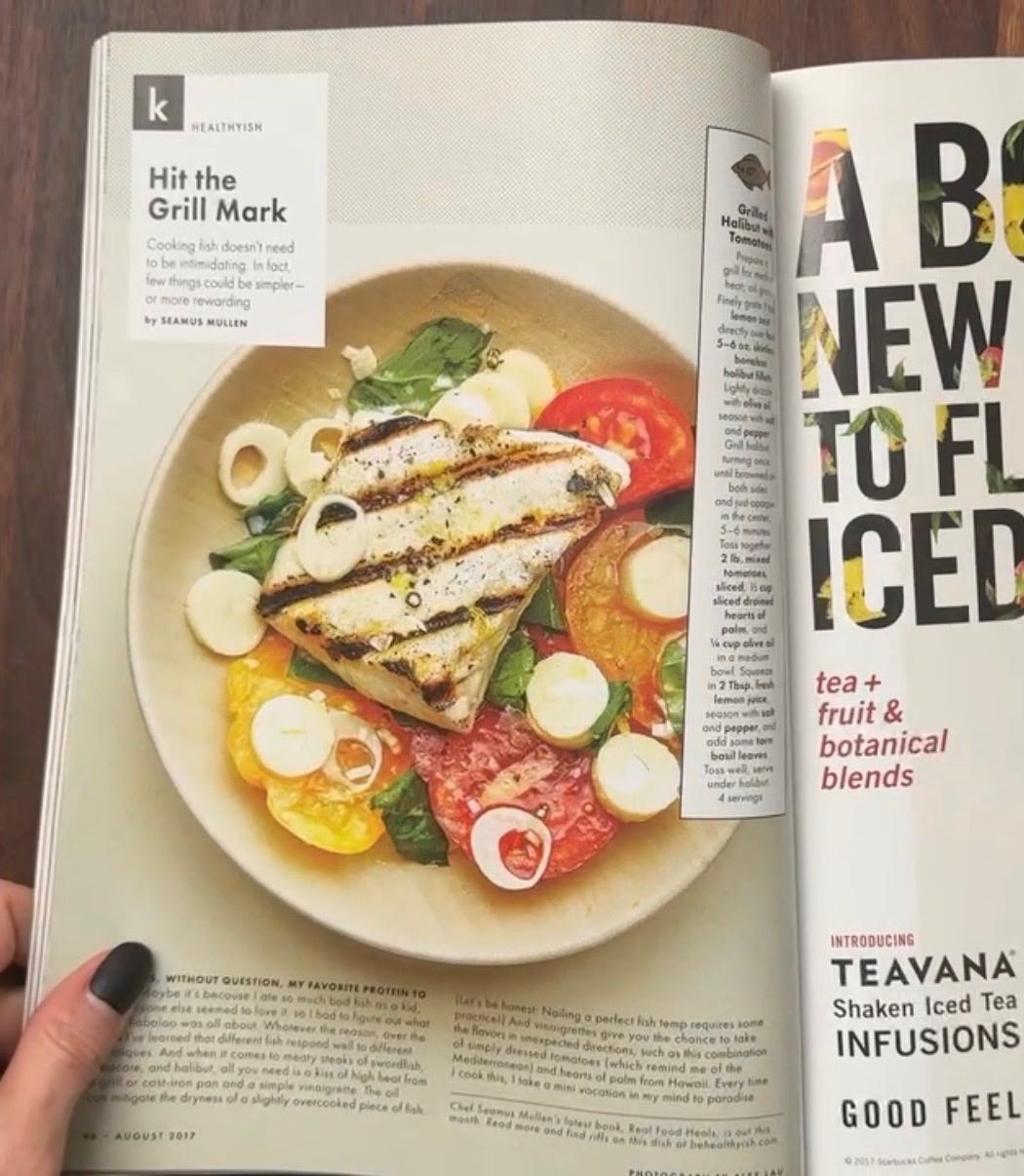
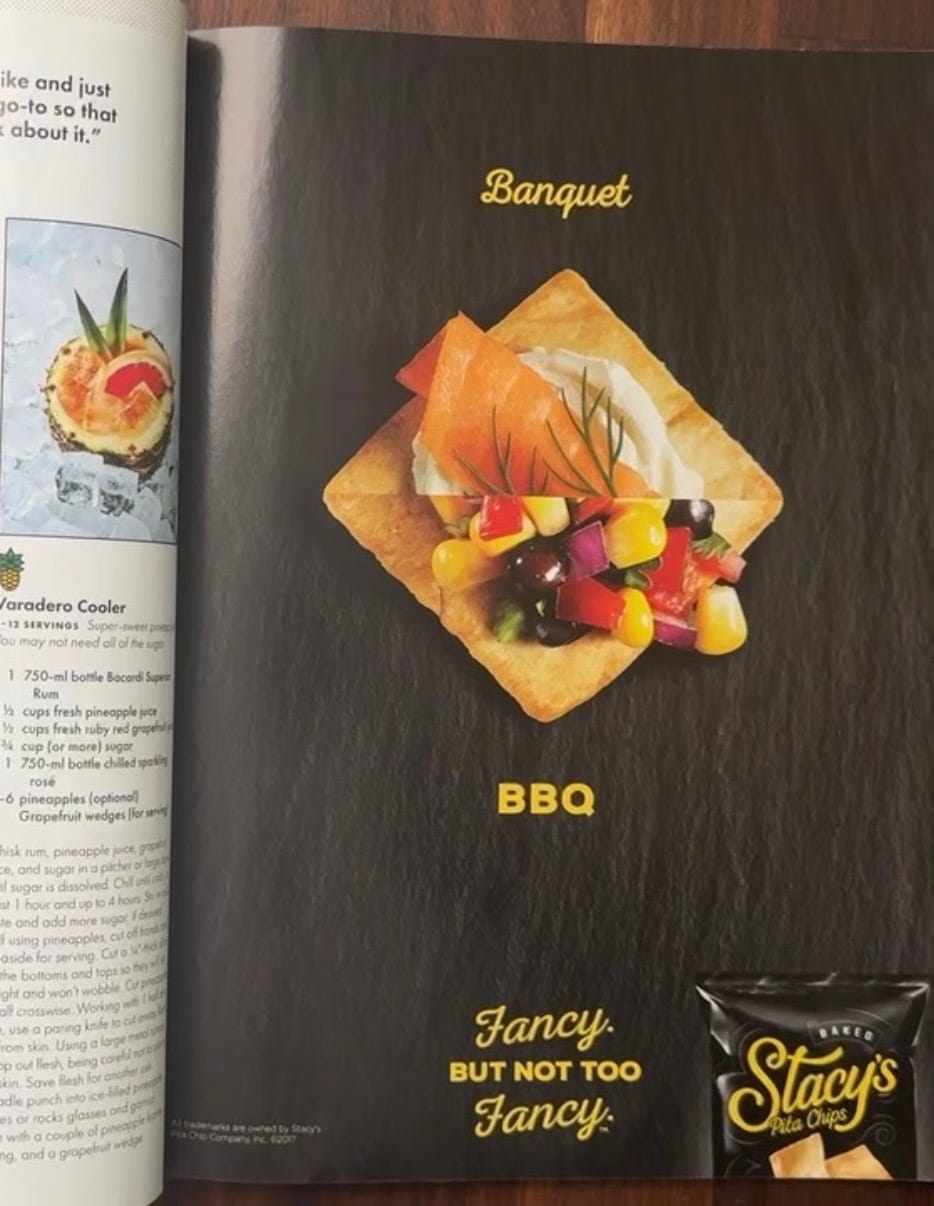
They’re both food photos in a magazine. But the first one is illustrating a fish recipe. The second is an advertisement for pita chips.
The advertisement is commercial. The illustration is editorial.
When weighing if a photo is commercial or editorial, I ask the question: are the photos intended to persuade and sell OR inform and entertain?
Let’s walk through a few common scenarios to bring it home, because the lines can get blurry.
Imagine a local food and lifestyle magazine wants you to capture images of a new restaurant opening for an upcoming article about the chef of the restaurant.
Is that editorial or commercial?
Editorial.

Why? Because the magazine is telling a story about another business. It’s informing their readers about a new place to dine out. Certainly there’s a good chance the article will drive business to the new restaurant, but the magazine isn’t promoting their own products with this article. Their primary motivation is to inform and entertain.
This points to another tell-tale sign that something is editorial. Look at the revenue model of the business publishing the image. Are they making money from consumers directly buying a product or service? Or are they making money from other businesses who pay to advertise on their platform? Magazines make the majority of their money selling ads, not the products on their pages, so that’s editorial.
You get contacted by a food blogger who creates recipe content on their website and social media. They want to outsource the photography of their recipes to you.
Is that job commercial or editorial?
That’s editorial if they’re not directly selling anything. Typically, the purpose of the recipe is to help readers make the dish at home. And just like the magazine, they make the majority of their revenue from other companies advertising on their site or through ad networks who coordinate ad placements on their site.

But what if that blogger has a post that’s sponsored by an olive oil brand and you photograph that? It’s still considered editorial when the blogger uses it because they’re not promoting their own goods and services for the reader to buy. They’re making their money on the ad revenue.
But what if the brand then wants to use the photos from the blog post to share on their social media? That’s commercial because they’re sharing it to sell more olive oil. That’s a situation where you charge a commercial usage license to the brand based on how they want to use the image.
A meat subscription company has a blog on their website where they share recipes that include their products. They want you to capture recipe images for their blog.
Is that work editorial or commercial?

Commercial. Because even though the recipes might be informative, the primary interest the brand has in creating blog content is to sell more of their products.
So again, it all comes back to: is the purpose of the image to entertain and inform, or to persuade and sell?
With that distinction made, keep in mind that editorial more often tells a story. That sometimes means the images can be more creative. Not always, but if the purpose of the images is to entertain and inform, there’s generally a motivated story to go with them.
For example, a holiday spread in Southern Living will be decked out, possibly placed in a cozy home environment. Versus a commercial ad for a tub of hummus on a graphic background meant to grab attention and sell.
And so depending on the publication, you might be working with a photo editor, a food editor, or an art director. They might have a very specific creative vision and a clear sense of how this shoot fits into the context of their other stories and the overall look of the issue. For that, your job is to clearly understand that vision and help bring it to life.
However, I did some editorial work for a non-profit recently that had a very small staff and gave me very little direction, so a lot of the creative perspective fell to me.
When an editorial opportunity comes your way, be sure to ask about who you’ll be working with, get a sense of what they’re bringing, and clarify their expectations for you. Playing the role of art director and photographer adds to the workload of the shoot and might have bearing on your interest in taking the gig.
Speaking of workload, let’s talk money.
On a basic level, editorial and commercial work aren’t so vastly different when it comes to the way I come up with pricing.
I always start from the same place: the cost of my time to fulfill the scope of the project, the expenses required to produce the work, and licensing for the client to use the work.
But where things are different in editorial is in how willing I am to price at or below my bottom line if the client’s budget is limited. In general, editorial budgets will be smaller in comparison to commercial budgets.
However, (CAVEAT!) just because something is editorial does not mean they have a small budget. I've done editorial work for bloggers and publications that paid the same as commercial work. I don’t want you to automatically present lower numbers because you’re talking to a magazine.
But it helps to have a solid understanding going into an editorial opportunity of the full value it offers to you. Because there will be jobs that come your way that have value beyond financial compensation, and might be worth doing for less.
For example, a magazine might come to you and say they’re working on a restaurants feature for their summer issue and they have a $500 budget for nine photographs taken at three local restaurants. If you do the math, $500 would be well below what you’d normally charge (I hope!) considering that visiting three restaurants in a day would take at least half a day if not more for shooting and travel time, plus editing on top of that.
So, how do you decide if it’s worth it to do this job for less?
Take a piece of paper and draw a line down the middle. On one side write Costs. On the other side write Gains.
What are the opportunity costs of this shoot? At the very least, eight hours of your time. That’s not insignificant. How could you invest those eight hours differently to yield a greater return? How could you make more money in the long term with that time? You could spend it marketing, networking, or building your portfolio.
The $500 isn’t nothing, so we can count that as a gain. But it’s definitely not equal to the value of eight hours of your time.
What other gains are there? That’s relative to you.
Let’s imagine you’ve been running your business less than a year and you’re still building up your client list. So far you’ve only done one photoshoot in restaurants but you’d love to do more. This shoot would build your confidence for restaurant shooting and help you log some more time doing work in that environment.
You also don’t have any tear sheets from magazines in your portfolio and you’d love to add some, so this would be a great opportunity for portfolio building.
And because the feature is on restaurant owners, you’d get to meet and photograph three restaurant owners you didn’t know previously who could then turn into future clients. That’s a better-quality way to access them compared to a cold pitch, because the magazine is introducing you to them and because they’re being featured, they’ll be excited when you arrive for the photoshoot. This shoot will definitely expand your network.
Granted, it’s not a guarantee of future work. Sometimes these things pan out into something bigger, sometimes they don’t. But networking with potential future clients rarely hurts.
Weighing the costs and the gains, there are some compelling reasons to take this opportunity if you’re in this specific situation. Counting up the value of making new connections, building your confidence, and adding to your portfolio, those are in essence marketing activities that are valuable to you at this stage in your business. So if you have the time in your schedule to spare eight hours and you’re excited about the job, take it!
But you also have to base the value of this on your own definitions of what’s valuable, not on what someone else tells you the value is. Because at some point someone will ask you to do something for low pay or for free and say, “it’s going to be great exposure!” Very, very, very rarely does the promise of exposure actually pay.
Cookbooks are a unique form of editorial work with their own timelines, deliverables, and client structures. We’ll dig deeper in a future article, maybe even a series?
The short note here is that cookbook projects are longer-form, bigger commitments compared to magazine assignments, and should be weighed thoughtfully. The same Costs and Gains framework applies, but the scale is different. A cookbook can take months of your time, which means the gain side has to be substantial to justify the commitment.
Perhaps you’re already aware, print magazine budgets continue to shrink across the industry, which means fewer assignments and lower rates at many traditional publications. However, online publication rates are wildly variable. Some online publications pay competitively where others pay almost nothing and pitch “exposure” as part of the deal. Again, try to be honest about the costs and gains for you personally in these situations.
There’s also been a proliferation of brand-owned editorial publications, where a CPG (Consumer Packaged Goods) company publishes a recipe-driven “magazine” either on their site or even on newsstands.
These blur the line between editorial and commercial work. Technically the work might look like editorial content, but the publisher is a brand, which means the work is commercial. It’s worth being clear about this before you accept the rate, because brand-owned publications sometimes pitch editorial-style rates for what’s actually commercial work.
Editorial work is rarely the highest-paying work in your career, but it can be a feather in your cap and a portfolio builder. A byline in a respected publication signals to other clients that you operate at a certain level. Many photographers take editorial assignments at lower rates specifically because the credit opens doors to better-paying commercial work later.
And so it can help to reframe editorial from “low-paying obligation” into “strategic investment”, but only when it actually is a strategic investment. The point of running the Costs and Gains exercise is to be honest with yourself about which it is.
Next up in the series: CPG brands. Consumer packaged goods. The companies that make products people buy, use, and replace regularly. This is where many long-term working food photographers focus their billable time because of the financial upsides. ‘Till then!
No posts
Comments
Nothing yet. Say the first thing.
Sign in to join the conversation.