
My relationship with religion has unfolded across most of my life. I was raised Catholic, converted to evangelical Christianity in college, studied theology in seminary, and entered the ministry. I eventually became a pastor in one of the largest churches in North America. Christianity was more than a set of beliefs I held. It provided the interpretive structure through which I understood reality, morality, identity, purpose, and the meaning of my own life.
Leaving that world began a journey that has now spanned more than thirty years. Throughout that time, I have worked closely with people living through religious trauma, the collapse of inherited belief, the recovery of self-trust, and the difficult work of building a life after certainty. This work began long before “deconstruction” became a familiar cultural term. Over the years, it developed into my work in non-religious spirituality and, more recently, the establishment of existential health as a field concerned with the human relationship to meaning, identity, mortality, belonging, freedom, and self-authorship.
My understanding of religion has changed considerably along the way. I once regarded religion primarily as a system of supernatural beliefs, doctrines, institutions, and prescribed practices. I now understand that what we call religious grows from something more foundational in human architecture. Human beings seek orientation, construct meaning, create rituals, form communities, encounter mystery, face mortality, and organize their lives around what they consider sacred. Religion did not create these dimensions of existence. It gathered them into particular symbolic, institutional, and metaphysical forms.
For this reason, I am not categorically opposed to organized religion or religious practice. Religious communities can offer belonging, ethical formation, ritual, continuity, beauty, and meaningful ways of facing the conditions of human life. They can also centralize authority, sanctify harmful beliefs, suppress agency, and demand forms of self-betrayal in the name of faithfulness. The decisive issue is what a religion does with the human realities entrusted to it and what happens to people under its authority.
The following essay should be read within that larger context. My criticism of religion arises from sustained engagement rather than reflexive hostility. I remain interested in what religion reveals about the human search for meaning and transcendence, even as I challenge its claims to exclusive truth and unquestioned moral authority. Religion deserves neither automatic reverence nor automatic dismissal. It must answer for the forms of life it creates, the uses of power it legitimizes, and what it ultimately does to human beings.
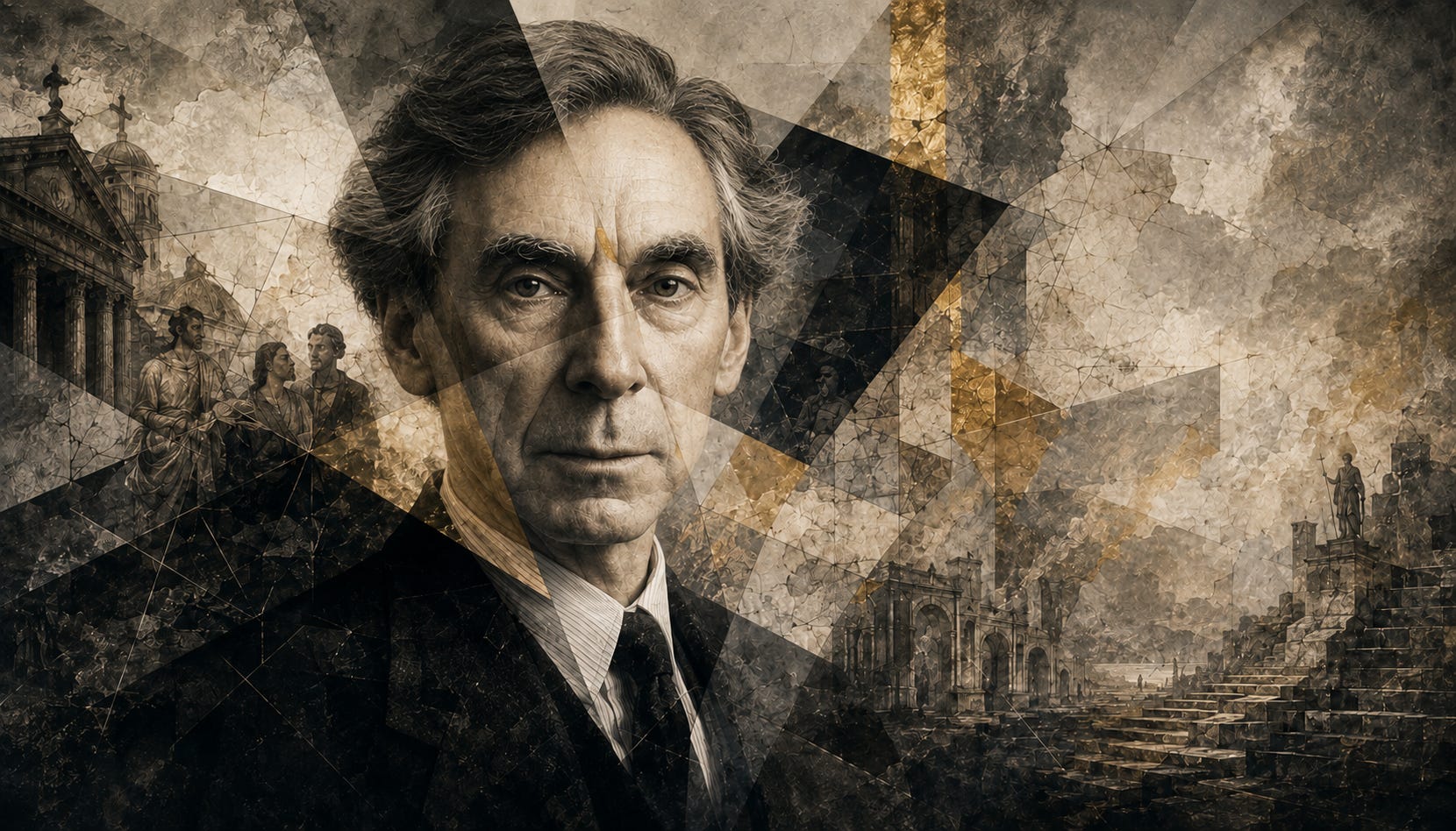
Bertrand Russell (1872–1970) was a British philosopher, mathematician, logician, and public intellectual whose work helped shape modern analytic philosophy. Awarded the Nobel Prize in Literature in 1950, he wrote widely on knowledge, language, morality, politics, war, and human freedom. Russell was also a prominent critic of organized religion whose essays, including “Why I Am Not a Christian,” challenged Christianity’s claims to truth and moral authority.
Bertrand Russell entered my life as more than a philosopher whose arguments I found persuasive. He gave language to suspicions I had already begun to feel but had not yet learned to trust. After years inside Christianity, including theological education and ministry, I understood the internal logic of the faith. I knew how its claims were constructed, how its moral authority was defended, and how effectively it could explain away the evidence against itself. What I had not fully grasped was that Christianity’s moral credibility could be evaluated independently of Christianity’s account of its own divine origins.
Russell helped me see that a religion’s truth claims and its human consequences belong to different categories of judgment. A religious system may possess intellectual coherence, ancient texts, elaborate doctrines, moving rituals, and millions of devoted adherents. None of these establishes that the system is morally trustworthy. The moral question begins elsewhere. We have to examine what happens to human beings when its beliefs become institutions, its doctrines become laws, its leaders acquire power, and its account of reality becomes the authorized framework through which everyone must interpret their lives.
That shift changes the terms of the conversation. Religious traditions have long been permitted to serve as their own witnesses. Christianity claims divine authority and then uses that claimed authority to authenticate its moral teachings. It describes itself as the guardian of goodness, interprets resistance as rebellion against God, and treats obedience as evidence of virtue. The structure is self-sealing. The institution establishes the standard, judges itself by that standard, and declares its authority vindicated.
Russell broke open that enclosure. He insisted that religion answer to the world beyond its own explanations. Once that demand is made, a more difficult history comes into view.
In “Why I Am Not a Christian,” Russell confronts the familiar assertion that Christian belief is necessary for morality:
“That is the idea, that we should all be wicked if we did not hold to the Christian religion. It seems to me that the people who have held to it have been for the most part extremely wicked. You find this curious fact, that the more intense has been the religion of any period and the more profound has been the dogmatic belief, the greater has been the cruelty and the worse has been the state of affairs.”
Russell proceeds with characteristic severity, invoking the Inquisition, torture, witch executions, slavery, war, and the long resistance of organized churches to humane reform. His historical claims are sweeping, at points more polemical than precise. Christianity has never been a single moral actor, and Christians have participated in abolition, civil rights, peacemaking, prison reform, healthcare, education, and countless forms of human care. Any responsible account must include these realities.
The counterexamples do not dissolve Russell’s charge. They make it more exacting. Christian faith has inspired both liberation and domination, courageous resistance and institutional cruelty. The same Bible has been carried by the enslaver and the abolitionist, the segregationist and the civil rights marcher, the colonizer and the liberation theologian.
This moral variability raises a problem more serious than the simple accusation that religion makes people wicked. If the same revelation can authorize opposing moral worlds, revelation alone cannot settle which interpretation deserves our allegiance.
Religious communities often resolve this contradiction by dividing their history into true and false expressions of faith. The loving Christian represents authentic Christianity; the persecutor misunderstood it. The abolitionist followed Jesus; the slaveholder distorted scripture. Such distinctions can be theologically defensible, but they also protect the tradition from sustained moral scrutiny. Every humane outcome becomes evidence for the religion, while every atrocity is attributed to human failure. Christianity receives credit for its saints without accepting full responsibility for the systems its doctrines helped legitimate.
I call this sacred insulation: the capacity of a religious system to protect its moral identity from the consequences produced under its authority. Sacred insulation allows an institution to remain good in its own account regardless of the suffering woven through its history. Cruelty becomes an aberration, even when it recurs across centuries. Harm is blamed on defective believers, cultural contamination, or insufficient fidelity. The sacred framework itself remains untouched.
No human institution should possess that exemption. A political ideology would not be judged solely by its founding ideals while every destructive outcome was dismissed as a misuse. A medical system could not preserve its credibility by celebrating successful treatments and declaring its recurring injuries unrelated to its governing assumptions. Religious institutions deserve the same seriousness. Their ideals belong in the assessment, along with their structures of authority, patterns of formation, treatment of dissent, and effects upon vulnerable people.
Christianity has frequently grounded its moral authority in the character of God. If God is perfectly good, and Christian teaching reveals God’s will, obedience to that teaching becomes the proper foundation of morality. Within this framework, human judgment remains limited and unreliable. Divine command carries an authority that experience cannot overrule.
The difficulty emerges when obedience produces recognizable harm. A doctrine fractures a person’s relationship with their body, sexuality, mind, or deepest experience. Churches protect their reputations by silencing victims. Parents estrange themselves from a child because religious fidelity has been made more sacred than relationship. Entire communities oppose the dignity of others while interpreting their opposition as obedience to God.
At that point, believers are often told that divine goodness exceeds human comprehension. What appears cruel from a human perspective may belong to a higher moral order. The teaching must be trusted even when its consequences seem devastating. This move preserves theological consistency at the cost of moral perception. People learn to doubt their compassion whenever compassion conflicts with doctrine.
The result is a form of moral estrangement. Moral sensitivity remains, though trust in it has eroded. Someone feels the suffering in front of them and then consults an inherited system to determine whether that suffering deserves a response. Cruelty is recognized, yet naming it feels like rebellion. One’s own humanity becomes an unreliable witness in the presence of authorized belief.
Russell’s critique exposes the danger of confusing moral claims with moral performance. A tradition may speak beautifully about love, justice, mercy, and human worth while forming institutions that repeatedly violate those values. Moral language can even conceal the violation by renaming it. Rejection becomes faithfulness. Domination becomes spiritual leadership. Shame becomes conviction. The suppression of inquiry becomes trust. The abandonment of oneself becomes surrender to God.
A religion’s moral performance can be evaluated only when human consequences are allowed to count as evidence. Allowing those consequences to matter does not reduce morality to immediate comfort or personal preference. Loving action can be difficult, boundaries can be painful, and ethical responsibility may demand sacrifice. Human flourishing is more complex than the avoidance of discomfort.
Still, any system claiming moral authority must explain the patterns of fear, coercion, exclusion, self-division, and institutional protection it produces. Declaring those consequences spiritually necessary does not resolve the problem.
The central issue is answerability. Who has the right to question the system? What evidence can count against it? Which human experiences are permitted to challenge its conclusions? A moral framework becomes dangerous when it recognizes no authority beyond itself and offers no meaningful path by which those it harms can call it to account.
Russell’s criticism reaches beneath specific doctrines to a deeper moral architecture. Traditional Christianity has often equated goodness with submission to divine authority. Human beings are creatures, God is sovereign, and virtue consists in bringing the self into conformity with God’s will. The moral life begins with obedience.
Submission has an understandable appeal. Human beings are capable of self-deception, aggression, greed, and rationalization. No mature moral vision can treat personal desire as infallible. Religious traditions preserve hard-won wisdom, place individual life within a larger horizon, and remind us that we are accountable to realities beyond immediate appetite. The critique of submission should not collapse into the fantasy that each person can become morally sufficient unto themselves.
Even so, submission carries its own dangers, especially when the human interpreters of divine will become institutionally powerful. God does not issue church policies, write doctrinal statements, conduct disciplinary hearings, or decide which experiences count as legitimate. Human beings perform these tasks while claiming authorization from God. Submission to divine authority becomes inseparable from submission to those who define what divine authority requires.
This creates an authority transfer that is easily concealed. The believer experiences themselves as obeying God, while the actual content of obedience is supplied by a pastor, text, tradition, family, or community. Human authority acquires sacred force without having to acknowledge itself as human. Resistance can then be treated as spiritual failure rather than a legitimate response to interpretation, power, or harm.
A morality of submission forms a particular kind of self. It rewards compliance, distrusts inner conflict, and treats certainty as a sign of faithfulness. Moral discernment is gradually replaced by moral permission. People learn to ask whether an action is allowed, whether a belief is orthodox, whether a relationship has been approved, and whether their lives conform to the prescribed pattern. The capacity to evaluate, choose, revise, and take responsibility remains developmentally underused.
People formed by submission can possess considerable courage and intelligence, often exercising enormous discipline within the world they have been given. The deeper problem concerns agency. When goodness has been defined as obedience, self-authorship feels morally dangerous. Leaving the system can make freedom feel like guilt, uncertainty like failure, and independent judgment like an invitation to corruption. The authority structure survives internally even after its doctrines lose credibility.
Russell understood that a renewed religious life would require a different moral center. He called it “a morality of initiative.”
Russell writes:
“The first and greatest change that is required is to establish a morality of initiative, not a morality of submission, a morality of hope rather than fear, of things to be done rather than of things to be left undone.”
This is among the most generative formulations in his writing on religion. A morality of submission is organized around permission and prohibition. Its central achievement is negative sinlessness, the successful avoidance of forbidden acts. Russell imagines a moral life measured by what a person helps bring into existence.
The distinction reaches beyond the difference between passivity and action. Initiative requires a different relationship with uncertainty. Obedience offers a predetermined path. Initiative confronts circumstances for which no rule is sufficient. It asks us to perceive what is happening, recognize what the moment requires, and act without the guarantee that an authority will certify the decision in advance.
Such moral agency is demanding. Rules can spare us from direct encounter with complexity. They reduce the burden of judgment and protect us from responsibility for ambiguous outcomes. Initiative removes that shelter. The person must remain answerable for what they create, including the consequences they failed to anticipate. Freedom becomes a practice of responsible participation rather than release from all constraint.
Russell’s morality of initiative also changes the direction of moral attention. Sin-centered systems direct attention inward toward purity, guilt, temptation, and personal standing before God. Initiative turns the person toward the world. What suffering can be reduced? What possibility can be cultivated? What forms of relationship, community, justice, and beauty do our circumstances invite us to create?
This shift does not make the moral life easier. Negative sinlessness can be maintained within a narrow field of concern. Someone may obey every rule recognized by their community while remaining indifferent to structural suffering, relational harm, or the consequences of the institution they support. Initiative expands the field. Goodness involves responsiveness to a world whose needs cannot be contained within a fixed moral inventory.
The distinction also reveals why religious morality can remain rigid while presenting itself as principled. A prohibition survives by repeating itself. Initiative must stay in contact with reality. As circumstances change and previously excluded voices become audible, moral understanding must deepen. Conviction need not be surrendered whenever culture shifts, though it must remain open to the possibility that inherited beliefs were formed without adequate attention to those who bore their consequences.
A morality capable of progress must remain corrigible. It must be able to learn from suffering, revise its judgments, and acknowledge when obedience has served injustice. Without corrigibility, conviction hardens into moral closure.
Russell continues:
“It is not the whole duty of man to slip through the world so as to escape the wrath of God. The world is our world, and it rests with us to make it a heaven or a hell.”
These sentences transfer the center of moral gravity from another world to this one. They reject a religious imagination in which earthly life functions primarily as a test of loyalty, a temporary stage before eternity, or a fallen realm awaiting divine rescue. Russell places responsibility for the human world into human hands.
This transfer has profound existential consequences. Divine sovereignty can provide meaning, reassurance, and restraint. It can also become an alibi. Suffering is assigned to providence. Injustice is deferred to final judgment. Ecological destruction is minimized because the present world is temporary. Political responsibility weakens under the expectation that history will be resolved through supernatural intervention.
A this-worldly spirituality removes that alibi. No guarantee remains that justice will triumph beyond history or that the damage we cause will be repaired elsewhere. The absence of cosmic rescue intensifies our obligation to one another. A finite life becomes more precious when it is no longer treated as preparation for the life that counts most.
Russell’s confidence in human power, however, requires its own scrutiny. The twentieth century supplied abundant evidence that human initiative can produce domination as readily as liberation. Scientific brilliance, political imagination, and technological creativity do not carry moral wisdom within themselves. Humanity can make the world more habitable and devise more efficient means of destroying it. Agency alone is morally indeterminate.
A viable morality of initiative therefore needs more than confidence in human capacity. It requires reality contact: the willingness to encounter the world beyond our preferred explanations and allow its consequences to revise us. It requires relational accountability, since other people can perceive harms our own perspective conceals. It also requires historical memory, because societies repeatedly disguise old forms of domination in the language of innovation and progress.
Human responsibility must be joined to human humility. We inherit a world we did not create, depend upon systems we cannot fully comprehend, and affect lives we will never see. Self-authorship takes place within these conditions. It does not make us sovereign individuals. It asks us to participate consciously in a web of life that precedes us, exceeds us, and will continue after us.
Russell did not simply imagine a world emptied of religion. In Chapter VII, “Religion and the Churches,” of his 1916 book Why Men Fight, he considered what religion would have to become if it hoped to regain the confidence of free-minded people:
“The religious life that we must seek will not be one of occasional solemnity and superstitious prohibitions, it will not be sad or ascetic, it will concern itself little with rules of conduct. It will be inspired by a vision of what human life may be, and will be happy with the joy of creation, living in a large free world of initiative and hope.”
The word “religion” is doing unfamiliar work here. Russell strips away supernatural threat, dogmatic submission, ascetic suspicion, moral surveillance, and institutional control. What remains is a vision of human possibility expressed through affection, creativity, responsibility, and joy.
Some will conclude that this remainder is no longer religion. The objection deserves serious consideration. If religion loses God, revelation, worship, sacred authority, and binding doctrine, the term may become so elastic that it names any deeply held orientation toward life. Humanism, ethics, art, and communal aspiration already provide language for much of what Russell describes.
Yet religion has never consisted solely of beliefs about supernatural beings. It has also organized the human relationship to ultimacy: how we face mortality, interpret suffering, experience belonging, relate to mystery, and locate our lives within a larger whole. Institutional religion claimed an interpretive monopoly over these dimensions of existence. Its decline does not cause the underlying questions to disappear.
Many people leave religion only to discover that the human needs religion once organized remain. They still grieve, wonder, seek belonging, confront death, experience awe, and struggle to know what deserves their devotion. Deconstruction can expose the inadequacy of inherited answers while leaving the questions fully alive. The end of religious certainty becomes the beginning of existential exposure.
This is the territory of non-religious spirituality. It does not attempt to recreate religion without God or preserve religious forms out of nostalgia. It begins with the recognition that spirituality names dimensions of human experience that no institution owns. Awe does not belong to theology. Ritual does not belong to the church. Contemplation does not require metaphysical certainty. The experience of depth, interdependence, transcendence, and reverence remains available within a naturalistic understanding of life.
Russell’s reconstructed religion points toward this territory, even if he did not fully map it. He understood that human beings need more than the negation of superstition. Critique can release the mind from false authority, while a livable world requires sources of orientation, practices of attention, forms of belonging, and visions of what human life may become.
The deepest issue running through both of Russell’s passages is authority. Who determines what counts as good? Where does moral knowledge come from? How should human beings act when inherited doctrine conflicts with lived experience?
Leaving religion is often described as a change in belief, though the more consequential transition involves the recovery of authorship. Years spent locating truth outside oneself can leave the capacities for discernment and self-trust underdeveloped. Those emerging from such systems must learn to make judgments without the promise of certainty, trust their perceptions while remaining open to correction, and assume responsibility for choices that no sacred authority will make on their behalf.
This movement can be described as the transition from outsourced authority to grounded self-authorship. Outsourced authority places final interpretive power beyond the person. Grounded self-authorship recognizes that every authority is encountered, interpreted, and enacted through human consciousness. Even submission is a human choice, though religious systems often conceal that fact.
Self-authorship does not grant the individual sovereignty over reality. We are formed through relationships, language, culture, history, embodiment, and conditions we did not choose. Our interpretations require continual testing against evidence, consequences, and the perspectives of others. Authorship names our inescapable participation in making meaning and choosing how we will live.
Religious systems can suppress this capacity by presenting their interpretations as reality itself. When the framework collapses, people often feel as though reality has collapsed with it. Some seek another totalizing system, surrender to a charismatic teacher, or retreat into cynicism. The loss extends beyond belief. They have not yet developed the existential capacity to live without outsourced certainty.
Russell’s morality of initiative depends upon that capacity. Initiative requires human beings who can tolerate ambiguity, remain present to complexity, and act without absolute guarantees. It requires a self capable of holding freedom without fleeing into another structure of submission. Here Russell’s critique of religion converges with the work of existential health.
Existential health concerns our capacity to navigate the fundamental conditions of being human: meaning, identity, mortality, belonging, freedom, limitation, and uncertainty. These conditions form the terrain of human life rather than problems awaiting permanent resolution.
A moral system can support existential health by strengthening agency, reality contact, relational responsibility, and the capacity to live with uncertainty. It can also undermine it by teaching people to distrust themselves, fear their humanity, suppress unresolved questions, and surrender interpretive authority to an institution.
This offers another way to evaluate religion. Alongside its doctrines and declared values, we can examine the existential capacities it develops. Does it help people face mortality honestly, or use the afterlife to avoid death? Does it cultivate belonging, or make belonging conditional upon conformity? Does it strengthen discernment, or train people to confuse obedience with wisdom? Does it deepen responsibility for the world, or offer a metaphysical escape from it?
No simple verdict follows from these questions. Traditions contain multiple currents, and communities embody them differently. A ritual may deepen one person’s capacity for reality while helping another avoid it. A doctrine may provide stabilizing meaning in one context and become an instrument of control in another. Existential evaluation remains close to lived consequences without assuming that every consequence can be measured by a single standard.
Complexity, however, cannot become another form of sacred insulation. When patterns of harm persist across communities and generations, they require structural explanation. Shame surrounding the body, terror of eternal punishment, the suppression of women, hostility toward LGBTQIA+ people, protection of abusive leaders, and the erosion of self-trust are often connected to doctrines, authority structures, and formative practices that deserve direct examination.
A religious or spiritual life worthy of human beings would increase our capacity to encounter reality without abandoning ourselves. It would deepen belonging without demanding conformity, invite moral seriousness without relying upon fear, and orient us toward the world without pretending that human power is limitless. Its value would become visible in the quality of participation it makes possible.
Russell gives us a compelling moral direction: initiative over submission, hope over fear, creation over prohibition, and human responsibility over divine rescue. Yet no philosopher can complete the work of reconstruction for those who come after religion. Each generation inherits that task under different conditions.
Our generation faces forms of authority Russell could only partially anticipate. Digital systems shape attention, desire, identity, and belonging with a reach once reserved for religious institutions. Political movements borrow the emotional architecture of faith while dispensing with its language. Wellness cultures turn personal optimization into a moral duty. Artificial intelligence increasingly mediates knowledge and may become another place where people outsource judgment. The decline of organized religion has multiplied the authorities competing to receive our submission.
Russell’s critique must therefore be extended beyond churches. Any system can acquire sacred insulation when it presents its framework as unquestionable, interprets dissent as moral failure, and separates its ideals from its consequences. Secular ideologies are equally capable of dogmatism. Human beings can absolutize political identity, scientific reductionism, markets, nations, therapeutic language, or personal autonomy. The religious impulse survives wherever contingent human constructions are treated as final.
Shared life still requires institutions, traditions, expertise, and authority. The urgent work is to develop forms of authority that remain humanly answerable. Such authority discloses its assumptions, accepts correction, distributes power, and treats the experiences of those affected by its decisions as morally relevant evidence.
A spirituality of initiative would operate in the same way. It would offer practices without demanding surrender, wisdom without claiming monopoly, and community without making belonging conditional upon agreement. It would help people inhabit the questions of existence while preserving their responsibility to author their own lives.
Russell mattered to me because he challenged Christianity at the point where its defenses were strongest. Christianity claimed to possess the foundation of morality. Russell brought history into the courtroom and asked the religion to answer for what had been done under its authority.
His accusation was severe, and its historical framing requires qualification. Its central demand remains unavoidable. No religion should be permitted to judge humanity while exempting itself from human judgment. No doctrine should be called loving while the suffering it produces is declared irrelevant. No institution should claim moral authority without becoming accountable for its moral performance.
Russell also refused to leave us with negation. Beyond the religion of fear, prohibition, submission, and deferred salvation, he imagined a religious life animated by hope and creative responsibility. His vision did not ask human beings to escape the world. It called them into deeper participation in it.
My own journey has led me to name that possibility non-religious spirituality and to situate it within the broader work of existential health. It begins after the collapse of religious monopoly, when no institution can claim exclusive ownership of meaning, morality, mystery, or the sacred. It asks human beings to recover their authority without imagining themselves self-sufficient, to create meaning without falsifying reality, and to accept responsibility without assuming control over everything that exceeds them.
The sacred, if the word is to remain useful, cannot be whatever an institution protects from examination. It must refer to what calls forth our deepest responsibility: the dignity of persons, the web of life, the reality of suffering, the possibility of love, and the unfinished world we share. Such a spirituality would be judged by the humanity it makes possible.
Religion has spent centuries asking whether human beings are worthy of God. Russell turned the inquiry around. Our time must continue the work by asking whether our gods, doctrines, institutions, and spiritualities are worthy of human beings.
The questions raised in this essay belong to a larger body of my work on religion, deconstruction, non-religious spirituality, and existential health. The following pieces explore what becomes possible when inherited religious authority gives way and the work of reconstructing a life begins.
The End of Religion Is Not the End: Rethinking God, Theology, and Religion After Religion
An exploration of what remains after institutional religion loses its authority, and how God, theology, spirituality, and the sacred might be reconsidered beyond inherited religious frameworks.
What Comes After Religion? Essays on Losing Your Religion, Reclaiming Your Authority, and Learning to Inhabit Your Life
A collection of essays for those navigating life beyond religion, centered on recovering self-trust, confronting uncertainty, and building a life without surrendering authority to another totalizing system.
What Comes After Deconstruction? Existential Health and the Work of Building a Life Beyond Religion
An introduction to existential health as the work of reconstruction after deconstruction, addressing the capacities needed to navigate meaning, identity, belonging, mortality, and self-authorship when inherited answers no longer hold.
If this essay speaks to questions you are navigating, consider becoming a paid subscriber ($50 annually). Your support makes it possible for me to continue developing the field of existential health, writing substantial public essays, and creating resources for those building lives beyond inherited religious certainty.
Paid subscribers also receive complimentary membership in the Center for Non-Religious Spirituality, including access to our workshops, discussion circles, community gatherings, support groups, and growing body of resources. Your subscription supports the work and brings you into a community taking the deeper questions of being human seriously.
Comments
Nothing yet. Say the first thing.
Sign in to join the conversation.