
The future author of Paradise Lost, John Milton, married a woman almost half his age. He was 34 and Mary Powell was 17. Within weeks, she left him and returned to her family.
Their marriage had a lot of problems, least of which being the age gap. Most pressing: Milton supported the parliament in the widening civil conflict, while her family supported the king.1
But divorce as we know it wasn’t an option in seventeenth-century England. Milton wondered: Why couldn’t he dissolve a marriage that failed to provide companionship?
In 1643, he published the first of four tracts on divorce, The Doctrine and Discipline of Divorce. He argued that divorce on the grounds of spiritual incompatibility—rather than just adultery—should be legal.2
Marriage, Milton believed, should be
…the apt and cheerfull conversation of man with woman, to comfort and refresh him against the evill of solitary life.3
Ultimately, Mary returned, and Milton never got divorced. But he still believed that divorce and remarriage should be options.
Part of what made Milton’s arguments so powerful was that he had been compiling a list of resources, including quotations and stories about marriage and divorce, well before his own nuptials.4
From the time he was in school, Milton collected all his evidence under themes in his commonplace book, which he divided among three general topics: ethics, economics, and politics. Then, he further divided each topic as he added quotations and notes. Here, Milton used the term “economics” in its older sense of household management. Thus, many of the entries indexed under economics reference family and marriage. For example, this is a page of notes on marriage.
Matrimonium. Vide de Divortio.
(Marriage, see Divorce)
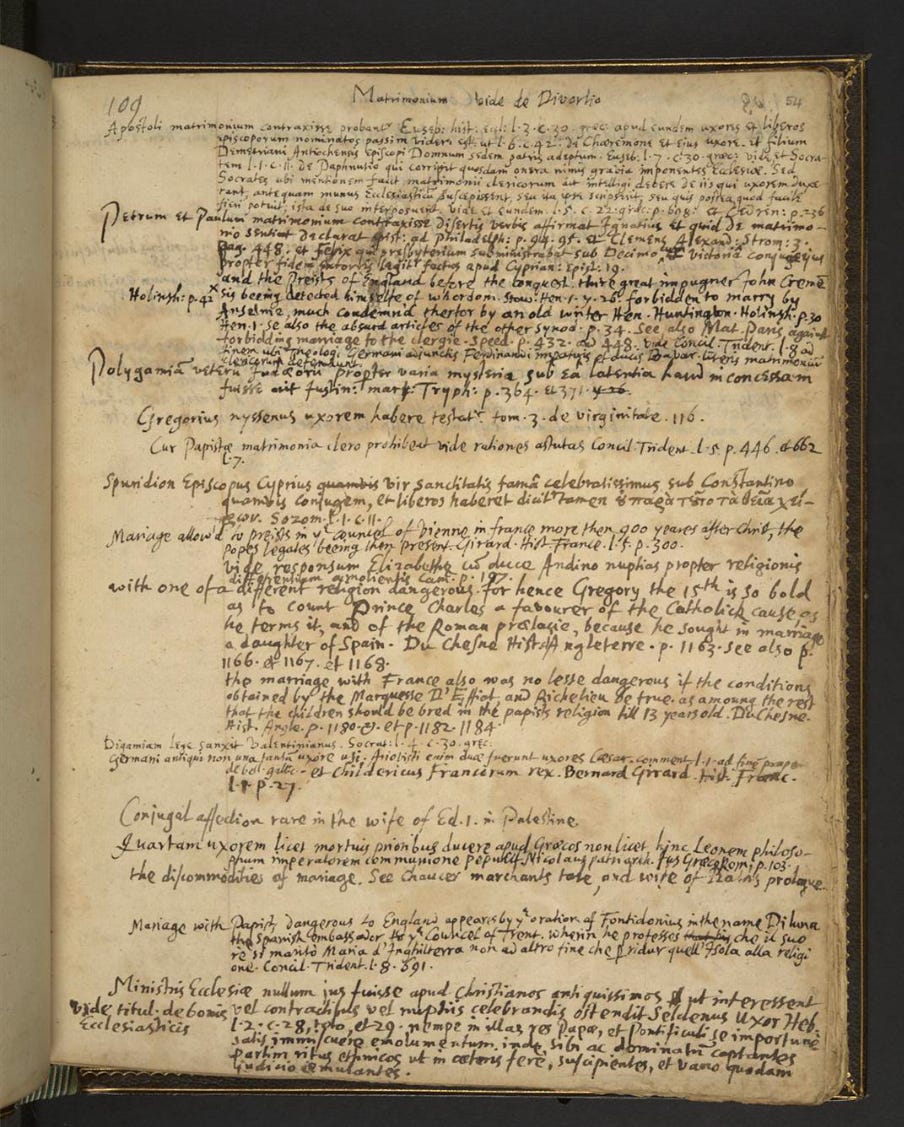
Milton spent quite a few lines describing historical figures who took two wives and reminded himself to turn to Chaucer’s Canterbury Tales for the disadvantages of marriage (particularly “The Merchant’s Tale” and the “Wife of Bath’s Prologue”).
Here is a page devoted entirely to divorce.
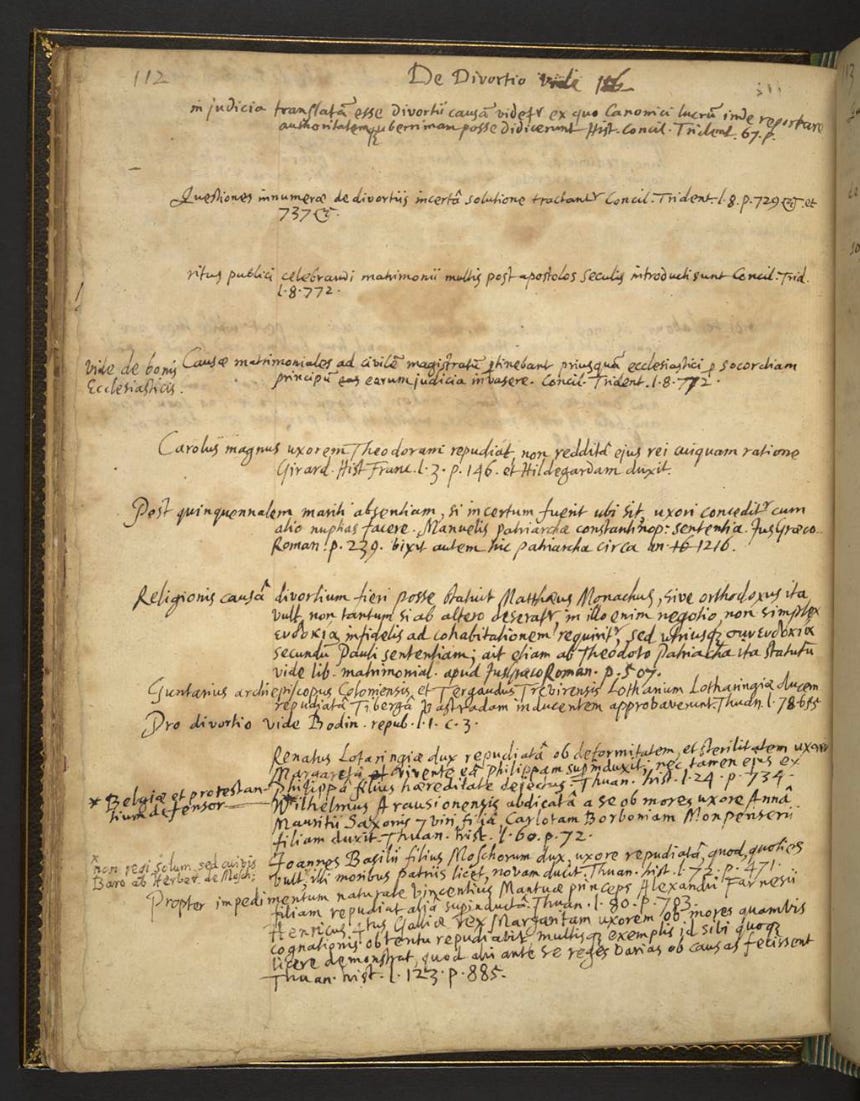
With his commonplace book, Milton built a foundation of knowledge he could return to for his various projects. When Milton set out to write polemical works like those arguing for divorce, he had a wealth of history and quotations to draw on.
While Milton began with three broad categories: politics, economics, and ethics, he filled each of them with sub-topics that mirrored his own particular interests.
Could Milton have known, while collecting material on marriage and divorce, how personally useful it would become? I don’t know, but I imagine he was grateful to his former self for having amassed so much evidence. That’s one of the more magical aspects of note-taking: We don’t always know what will be useful. Perhaps there is something perfectly suited to this moment waiting for you in your older notes.
Noted is fueled by you. Your ❤️s and comments inspire me. As always, I would love to know your thoughts.
Yours in note-taking,

Milton would write three more tracts on divorce.
Milton, John. Complete Prose Works of John Milton. Vol. 2, 1643–1648, edited by Ernest Sirluck, Yale University Press, 1959, p. 235.
Quoted in Dobranski, Stephen B. “Milton’s Social Life.” The Cambridge Companion to Milton, edited by Dennis Richard Danielson, Cambridge University Press, 1999, p. 11.
See Dobranski, “Milton’s Social Life,” p. 11:
While we may be tempted to interpret Milton’s ensuing pamphlets defending divorce as merely personal, an entry in his Commonplace Book indicates that he had begun thinking about the institution of divorce prior to his own marriage.
Comments
Nothing yet. Say the first thing.
Sign in to join the conversation.