
If you ran into Ludwig van Beethoven (1770-1827) in Vienna, where he spent most of his adult life, you might have found him scribbling in a little notebook. He often worked out musical ideas in these sketchbooks, capturing inspiration as it came to him.
But by 1818, he was carrying small pocket notebooks for an entirely different purpose. He could no longer hear what his friends were saying.

In 1801, he confided to friends that he was having trouble hearing. From 1812-1816 he tried using ear trumpets. But by 1818, his deafness had progressed to such an extent that he could only come up with a single solution: A small blank notebook.
When he could no longer hear his friends, he had them write their part of a conversation in what have become known as the “conversation books”—some seem to have been lost when they fell off a moving wagon, but a hefty 139 of them survive.
As Jan Swafford writes in his biography, the Conversation Notebooks give us an unparalleled view into the composer’s daily life:
…from then on, history could eavesdrop on much of Beethoven’s daily discourse.1
More accurately, Swafford admits, we can eavesdrop on what others were saying to him because Beethoven usually spoke his responses rather than writing them down.2
These notebooks are filled with his friends’ bawdy jokes (about sharing wives) and business dealings. Sometimes, Beethoven wrote out shopping lists, addresses, or book recommendations.
But the most powerful notations in these books surround Beethoven’s nephew, Karl. In November of 1815, Beethoven’s brother died, leaving his son’s guardianship contested. Believing Karl’s mother to be unfit, Beethoven engaged in a prolonged legal battle for custody.
Throughout these notebooks, a drama around Karl plays out. Beethoven’s friend Joseph Karl Bernard warns him that he’ll be embroiled in legal battles:
As long as you are the guardian and Karl stays here, you will have to battle not only all the cares that you have had up to now…3
There’s a funny exchange early on, when the young Karl tells his uncle, via the conversation books:
I don’t know where the lice are coming from. Anyway it’s healthy to have lice.4
Soon Karl turned to more mature subjects. He asked his uncle about custody and who he would live with. And then Karl wants to join the army—something Beethoven refused to allow until 1826, after Karl attempted suicide.
Beethoven’s conversation notebooks end a few weeks before his own death, with conversations about getting new bedsheets.
Like most of Beethoven’s biographers, I wanted a bit more insight into the composer than the conversation notebooks actually deliver. But I suppose that’s a lesson itself: even geniuses have to negotiate the minutiae of life.
Even geniuses worry about bedsheets.
Noted is fueled by you. Your ❤️s and comments inspire me. As always, I would love to know your thoughts.
Yours in note-taking,

P.S.
Want more composers? Check out these posts from Noted’s archives:
Leonard Bernstein's West Side Story Notes
·
January 8, 2024

In the last year of his life, Leonard Bernstein (1918-1990) traveled to Berlin as the wall came down. To honor German reunification, Bernstein led an orchestra of musicians from East and West Germany through Beethoven’s Ninth Symphony.
Mozart's Music Notes
·
July 3, 2023
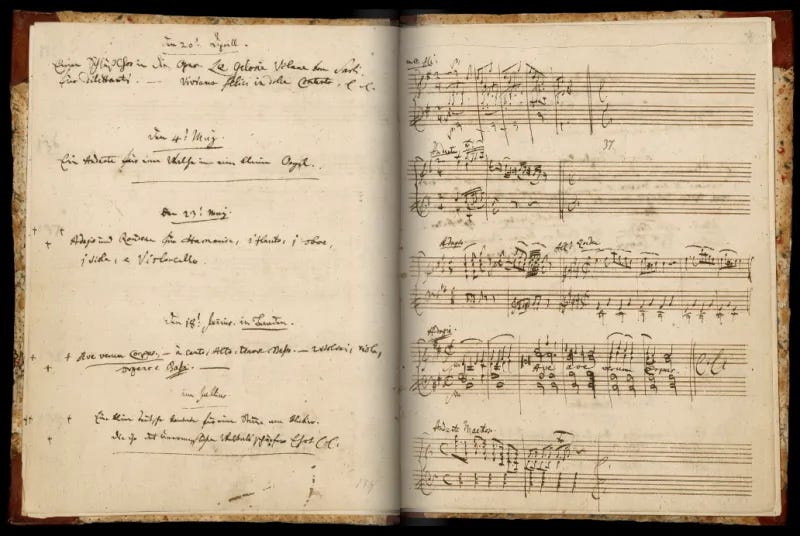
Mozart actually had a sister. And she was tremendously talented. As children, Wolfgang and Nannerl’s careers were intertwined. Their father taught them together. They toured Europe playing together. But soon Nannerl disappeared from the spotlight. Leopold, their father, determined that his son was the golden ticket.
Swafford, 2014. Beethoven: Anguish and Triumph : A Biography. Houghton Mifflin Harcourt, p. 698.
See Theodore Albrecht, “Time, Distance, Weather, Daily Routine, and Wordplay as Factors in Interpreting Beethoven’s Conversation Books,” Beethoven Journal 28, No. 2 (Winter, 2013), pp. 64–75.
Beethoven, Ludwig van. Beethoven’s Conversation Books. Volume 1, Nos. 1 to 8 (February 1818 to March 1820). With Theodore Albrecht, The Boydell Press, 2018, p.3.
Cited in Swafford, p. 701.
Comments
Nothing yet. Say the first thing.
Sign in to join the conversation.