
Passive AI use slowly erodes your judgment without you noticing
A study found 58% of participants felt “AI did most of the thinking”
The variable isn’t the tool, it’s the posture you take with it
Pushing back on AI builds confidence; accepting it passively flattens it
The fix: write your thinking down before you open the tool
Hey folks,
Last week I sat down to write an important proposal for a client. I had the rough shape in my head including the work we had already done together, the work they had asked for, what we were already capable of providing and what we were developing. This was standard business owner / co-founder / product manager work. The kind I’ve done a thousand times.
I asked Claude to help me organize the various components including our current course offerings and upcoming ones. It came back with an approach I hadn’t considered. Tighter, more elegant, easier to defend with a clear thread from the past into the future of the relationship with this client. I read it twice and started rewriting my pitch around it.
Then I paused.
I sat down, 90 minutes earlier, to write this proposal with a clear point of view. I left it with what seemed like the AI’s point of view. The disorienting part wasn’t that the AI was better or worse. It was that I couldn’t precisely tell you where the seam was. Which of those decisions was mine? Which had I quietly ceded?
Seems I’m not alone.
A study published April 16 in Technology, Mind, and Behavior gives this exact phenomenon a name and a number. Sarah Baldeo, a PhD researcher at Middlesex University, ran 1,923 adults through ten simulated work tasks including planning with incomplete information, interpreting ambiguous data, and defending strategic decisions. The work AI is supposedly best at. Around 58% of them walked away feeling that “AI did most of the thinking”. Those participants reported less confidence in their own independent reasoning, less ownership of the ideas they’d produced and a trade-off they hadn’t meant to make: speed at the expense of depth.
The part of the study that struck was this. It wasn’t the use of AI that did this. It was passive acceptance. The participants who actively modified, challenged, or rejected AI suggestions reported higher confidence and a stronger sense of authorship than people who weren’t using AI at all.
This was triply fascinating to me as a writer, product manager, and business owner.
Used passively, AI made people feel like the ideas weren’t theirs. But when pushed on, argued with, ignored when wrong etc, the same AI made people more confident in their own thinking. The variable wasn’t the tool. The variable was the posture the person took with it.
I have been writing about judgment as the new scarce resource for most of this year. The Karpathy talk on “agentic engineering” reframed the engineering job as supervising work instead of doing it. The Klarna and IKEA stories made the case that AI exposes what your strategy actually is. The piece on customer development argued that AI didn’t speed up discovery. It made the discovery work the only work left.
All of that assumes the harder skills like judgment, instinct, the practitioner’s “no, that’s not what they actually mean” would be there waiting on the other side of AI doing the typing. The Baldeo study suggests that this harder skill is a muscle. And the more you accept what the AI hands you without pushing back, the less you strengthen that muscle, ironically creating work output that is less trusted.
Baldeo’s word for what happens to people who don’t push back is “intellectual leveling.” She means it descriptively. Over time, heavy passive users start to linguistically sound like the AI. As their opinions get less sharp and their points of view flatten, the room increasingly loses a voice it used to have.
Before I open any AI tool on a piece of practitioner work, be it a customer plan, a strategy document, a hard email, a roadmap conversation, I write down the rough shape of my answer first. It starts off as three or four bullets and will almost always morph into a sentence or 3 (or 4 tbh). It doesn’t have to be good. It often isn’t but it has to exist as the starting point for this work.
Then I bring in the AI.
When the AI comes back with a recommendation, I do not edit my notes. I compare my initial instinct with the AI’s output. Where did we agree? Where did we differ? Where was the AI obviously wrong and I almost moved with it anyway? That comparison is the signal I have that my judgment is still a thing I own and not a thing I borrowed.
The notes provide an honest snapshot in time of what I was thinking before the tools began to shape an answer for me. The effort to compare my original thoughts with what’s currently on the screen is now a big part of the work.
Baldeo’s research suggests a second discipline I’m starting to take seriously. She suggests taking a few days a week off the tools entirely. This is not intended as a productivity hack but rather as a recalibration. If you can’t tell where your thinking ends and the AI begins, the only way to find out is to spend a day or two writing, thinking or defending an idea without one. If it feels harder than it used to, that’s the data point. That muscle is starting to atrophy.
The popular framing of this study will be “AI is making us less confident” but the practical application here is more urgent.
AI is not the thing eroding your judgment. Passive acceptance of AI is the thing eroding your judgment. The participants in Baldeo’s study who pushed back on the tool outperformed the ones who never opened it. The skill that AI commoditized faster than any other isn’t analysis. It isn’t speed. It’s the willingness to disagree with the assistant.
If you’ve spent the last year getting fluent with AI tools, that fluency is real and it’s worth something. But it’s not the asset. The asset is the part of you that knows when to ignore what the tool just said. Protect it the same way you protect your time on a calendar: deliberately, with a system, before something else fills the slot.
There’s still time to join our Rethinking Product Metrics for AI Products webinar tomorrow with Ben Yoskovitz. Details are here.
Even if you can’t attend live, sign up anyway. We’ll send a recap afterward.
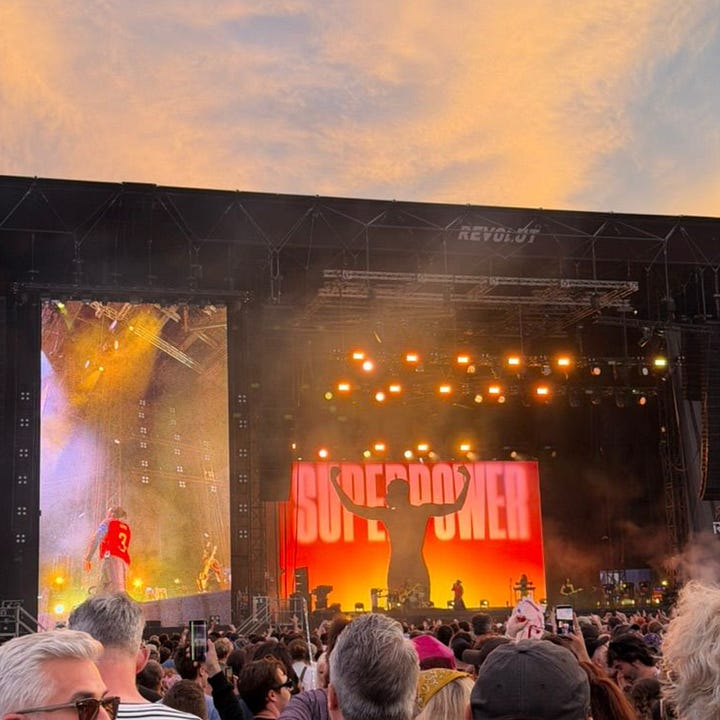
I attended Primavera Sound 2026, a multi-day music festival in Barcelona, Spain. I’ve been coming here for 12 years now. It’s an annual ritual and this year was no different. The crew of friends I go with all arrived this year (biggest crew we’ve ever had) and we spent 4 days staying up super late, laughing, dancing, singing and generally just having the best time. While the music is definitely important, seeing these guys who I don’t see very often was the real win for the week/end.
That said, highlights for me were The Cure, Gorillaz, Lil Simz and The XX reunion show was just incredible. Some pics below:


What's the outcome? By Josh Seiden. Yeah, that Josh Seiden. I know it's a bit self-serving but I genuinely enjoy Josh's essays on AI, design and sourdough bread. I think you will too.
The Strokes. They're awesome. I'm a huge fan. I have tickets to see them this fall. And they have a new record coming out.
Star City. This is technically a spin-off of Apple TV's For All Mankind but if you haven't watched that, you can jump right in here. Two episodes came out right away and it is brilliant. Dark, mysterious and occasionally violent, it's a look at the alternate timeline of the Soviets landing on the moon first from the Soviet perspective. I'm all in already.
Two workshops coming up, both with our Certified Training Partners:
with Simon Flossmann | 💬 German
June 22nd, 2026
📍 Live Online
Register here
with Federico Zuppa | 💬 Spanish
June 24, July 1 & 8, 2026
📍Live online (Zoom)
Register here
Interested in working together? Please reach out.
In case you need it, here's a description of what I do.
Comments
Nothing yet. Say the first thing.
Sign in to join the conversation.