
I’m back from a season of travel and at the start of a new semester, that familiar moment when life once again fills with tasks, deadlines, and responsibilities. As always, returning to work has drawn me back into reading and research. I’ve been catching up on my favorite Substacks, exploring a few new ones, revisiting my educational technology subscriptions, and reading articles from Word on Fire. One of those articles stirred something important in me and prompted this reflection.
An essay by Sebastian Barros titled “When Machines Take the Work, What Happens to the Soul?” raises a question that feels increasingly urgent in an age of artificial intelligence. What becomes of the human person if work disappears?
It is a question worth slowing down for, especially as tech leaders confidently suggest that work itself may soon be obsolete.
Barros makes a crucial observation. Work existed before the Fall and remains necessary. In the Christian tradition, work is not a punishment. It is part of humanity’s original vocation. Work forms us. It disciplines us. It gives shape to our days and meaning to our effort. In the words of Barros,
“Work is not only a task. It is a path of virtue. It calls the person out of self-interest and into service. It teaches that life has direction and that effort can be redeemed. Genesis presents work as the first invitation into stewardship.”
I have felt this firsthand as a classroom teacher with 8 weeks off each summer. As much as I enjoyed it, summers off often unraveled my sense of rhythm. Without a reason to wake at a given hour, even my prayer life slipped out of alignment. Leisure without structure does not automatically lead to flourishing. At times, it leads to drift.
Barros argues that artificial intelligence now threatens work at a deeper level than previous technologies. This is not only about robots replacing factory labor. AI is increasingly capable of taking on cognitive tasks such as analysis, interpretation, and decision-making. These are jobs that depend on the presence of mind rather than physical strength. If such work disappears, Barros warns, society may feel pressure to invent jobs simply to keep humans occupied.
Long before artificial intelligence entered the public imagination, Saint John Paul II anticipated this crisis. In his 1981 encyclical Laborem Exercens, he insisted that work is not primarily about output or efficiency. Work is about the human person.
He wrote, “The primary basis of the value of work is not the kind of work being done, but the fact that the one who is doing it is a person.”
John Paul II distinguishes between the objective dimension of work, which includes tools, technology, productivity, and results, and the subjective dimension of work, which is the worker who is formed through the act of working. Technology, including AI, belongs entirely to the objective dimension. The human person is always the subject. When work is treated as a technical problem to be optimized or eliminated, the person is diminished. A society without work is not liberated. It becomes unmoored.
Elon Musk has repeatedly suggested that AI and robotics will replace all jobs, making work optional.
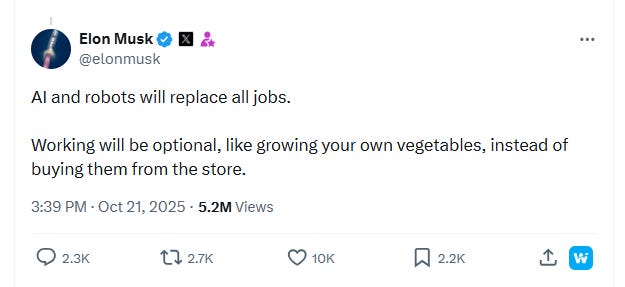
Humans, he argues, will receive income while machines handle everything else. To him, this represents paradise. From a Christian perspective, and from a human one, it does not.
A life without the necessity of contribution is not a life of dignity or of happiness. Purpose cannot be replaced by consumption. Leisure only makes sense when it follows labor. Otherwise, it collapses into boredom and restlessness.
Here, I agree with Barros. Humans need work.
At the same time, it would be dishonest and uncharitable to speak about the future of work without acknowledging the real suffering already unfolding. People are losing jobs now. Families are being destabilized. Careers built over decades are being abruptly interrupted. Technological change, even when it eventually leads to new forms of work, is never painless, and it is rarely just. The transition takes time, and during that time, real people bear real costs.
To name this suffering matters. It is not a failure of imagination or resilience to grieve the loss of meaningful work. In Catholic social teaching, work is tied not only to dignity but to provision, stability, and belonging. When work disappears suddenly, the wound is not only economic. It is personal, social, and often spiritual.
Any serious conversation about AI and automation must therefore include responsibility for those displaced. Efficiency cannot be the highest good. Progress that ignores human cost is not progress at all. If technology is to serve the human person, then society must be willing to accompany those who are harmed in the transition, rather than dismissing their losses as a temporary inconvenience.
Where I disagree with both Barros and Musk is the assumption that AI can replace what actually matters most.
The problem is not that AI will eliminate meaningful work. The problem is that we have misidentified what meaningful work truly is.
We treat desk-bound, screen-heavy jobs as high value while undervaluing the work that sustains society at its most vulnerable points. We funnel our brightest students into so-called STEM careers even as we face critical shortages in teaching, nursing, and social work.
Humans were not designed to sit at desks all day. The physical and psychological consequences are now undeniable. Sedentary life has been called the new smoking because of the number of people it harms and kills. If AI takes over digital bureaucracy, data analysis, and endless screen-based tasks, that may be a gift rather than a loss. If robots take over repetitive warehouse labor and factory work, that too can free human energy for work that better fits who we are.
The highest value work I see every day is not happening behind a screen. It is happening in classrooms. I sit behind a screen because I value classroom work and want teachers to have the tools they need to teach well. If compensation reflected value, teachers would be paid on par with administrators, since they are both necessary. Imagine what education could look like if our best students became teachers, if class sizes were smaller, or if two teachers were present in every classroom. Teachers would have the time and presence to notice what too often goes unseen, including trauma, neglect, and warning signs. Nearly every story of extreme violence reveals the same pattern: A child was invisible for too long.
I volunteer with foster youth, where social workers routinely manage seventy or more children each. This is not a failure of compassion. It is a failure of scale. No one can provide meaningful care at that ratio. Children fall through the cracks not because no one cares, but because there are not enough humans present.
Healthcare tells the same story. We have too few nurses and too few general practitioners, and we have created an over-specialized system that fragments care. I see multiple specialists every few months because no single doctor has the time or support to see the whole picture. What if instead of so many specialists, we had many more general practitioners, supported by AI tools that assist with diagnostics and research? Doctors could then focus on listening, judgment, and care. AI should amplify doctors, not replace them.
Drawing on thinkers like Josh Brake, the goal of technology should not be novelty or efficiency alone. It should be redemptive reasoning. We should be creating what humans need, not merely what they want.
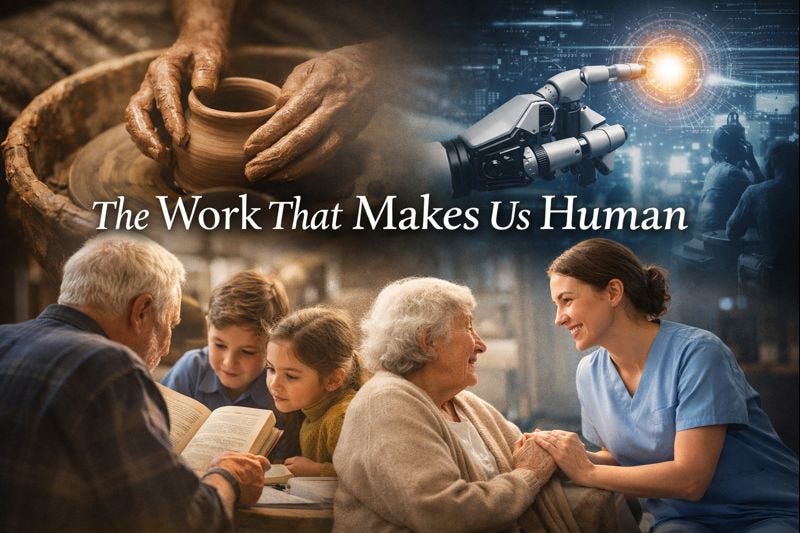
AI can help eliminate dehumanizing labor, reduce unnecessary bureaucracy, and potentially lower the cost of living. One can imagine a DMV office that is both pleasant and efficient. Human energy can then be redirected toward work that requires presence, such as teaching, healing, visiting the lonely, and caring for children.
This is not artificial work. It is profoundly human work.
High-value work happens face-to-face. Classrooms, hospitals, homes, and care systems are where value is created, not measured, but lived. AI cannot notice a child’s silence. It cannot sit with grief. It cannot recognize despair in a posture or a pause.
Presence is irreplaceable.
John Paul II warned that when work is reduced to a technical or economic problem, the human person is diminished. Technology must serve the person, never the other way around. AI does not have to make society less human. Used wisely, it could make society more human than we have allowed ourselves to be in generations. The future should not be one with fewer humans needed. It should be one in which humans are finally free to do the work only humans can do.
Thanks for reading The AI Theologian! This post is public so feel free to share it.
John Paul II. Laborem Exercens (1981). Vatican encyclical on the dignity of human work and the distinction between the subjective and objective dimensions of labor.
Sebastian Barros. “When Machines Take the Work, What Happens to the Soul?” in The World on Fire. Reflection on AI, work, and human meaning.
Second Vatican Council. Gaudium et Spes (1965). Pastoral Constitution on the Church in the Modern World, especially sections on human dignity, work, and social life.
Josh Brake (2025). Be Redemptive. The Absent-Minded Professor. https://substack.com/@joshbrake/p-184514119
No posts
Comments
Nothing yet. Say the first thing.
Sign in to join the conversation.