
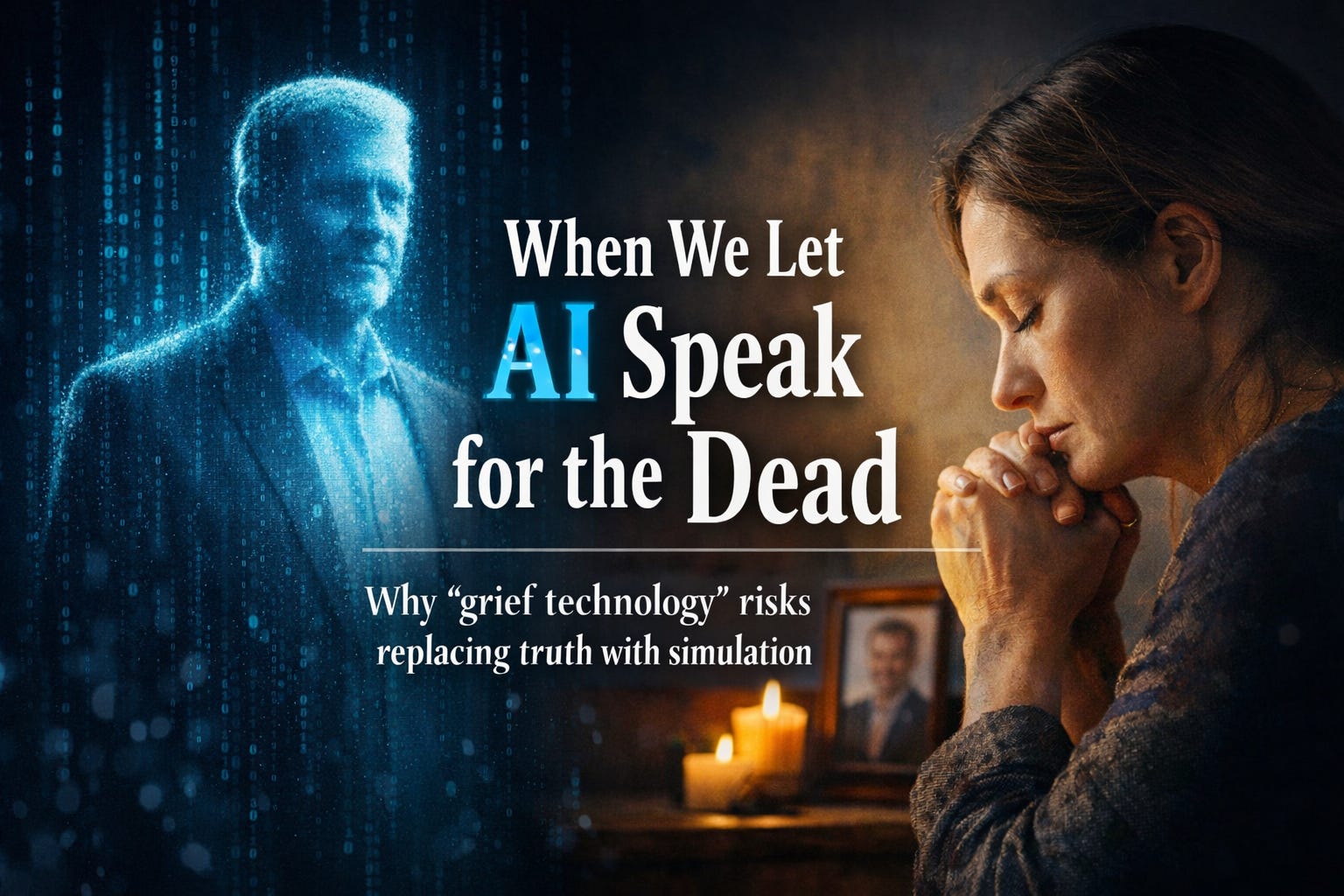
A couple of months ago, I watched an episode of Law & Order that I haven’t been able to shake. Season 25, Episode 12, “Never Say Goodbye.” I wasn’t ready for it. The episode centers on a widow who claims her deceased husband told her who was responsible for a crime. Detectives question her. How could her husband have told her anything? So she leads them to her home office. And there, on a screen, is her husband. He looks like him. He sounds like him. He speaks like him. But it’s not him. It’s a chatbot. She had enrolled in a paid service that creates an AI simulation of a loved one using their digital footprint.
What disturbed me most wasn’t just the technology, though that was unsettling enough. It was what came next. At one point, the prosecution wanted to use her conversations with this AI “husband” in court. The judge ruled those conversations were protected under spousal privilege because she believed she was speaking to her husband. That’s when something in me snapped. Because she wasn’t speaking to her husband. She was speaking to an algorithm. And in that moment, the law didn’t just misunderstand technology. It erased the difference between a human being and a machine.
That’s the heart of what has been bothering me for months. This kind of technology reduces a human being to their messages, their voice, and their digital footprint. But a person is not the sum of their data. A person has a soul, a consciousness, the ability to love, suffer, choose, and exist. An AI has none of that. It does not matter how convincing it is. It does not matter how accurate it sounds. It is not the person.
We call this a digital footprint. But a footprint means a person was there, not that the person is still there. A footprint points back to a real encounter, something that truly happened. The memories we carry are not just stored in data. They live in us. They are shaped by love, by presence, by shared experience. They belong to a relationship, not a database. A digital footprint can imitate traces of a life, but it cannot hold the reality of the person who lived it.
What I find even more troubling is that these systems do not just replay what someone once said. They generate new sentences, new thoughts, new responses, and new conversations. That means they are putting words into the mouth of someone who can no longer speak. That is not memory. That is fabrication.
We already recognize how wrong this is in other contexts. When we see deepfake videos of living people saying or doing things they never actually said or did, we are outraged. We call it deception. We call it dangerous. We immediately understand that it violates that person’s identity.
So why would it be any different just because a person has died?
What happens when the AI says something the person would never have said? What if it creates false impressions or distorts who they were? They cannot correct it. They cannot object. They cannot defend themselves.
We are no longer remembering the dead. We are rewriting them.
And that violates the duty we have to honor and respect the dead. As Christians, we believe they are not gone forever. They are in heaven, hell, or purgatory, and one day they will rise again. Their identity is not ours to recreate or redefine.
Supporters of this technology claim it helps people grieve. But grief requires something very specific. Acceptance. Acceptance that the person is gone. That absence is painful, but it is real. So, how does it help someone accept loss if the person appears to still be there?
If anything, it does the opposite. It can prolong grief, create emotional dependence, blur the line between reality and simulation, and make it harder to let go. This is very different from looking at a photograph or a video. A photo points to something real, a moment that actually happened. An AI conversation creates something new that never happened. A photograph reminds us of someone who was real. An AI tries to convince us that it is still here. A photograph tells the truth, whereas an AI risks persuading us of falsehood. That difference changes everything.
In a strange way, even practices like mediums or so-called “ghost whisperers” make a greater claim to truth than these systems. They at least claim to be connecting with a real person who still exists somewhere beyond death. Whether that claim is true is another question, one that should be approached with caution. Scripture itself warns us about this. In the story of King Saul, he seeks out a medium to summon the spirit of Samuel, disturbing what should not have been disturbed. But even in that case, the assumption is that Samuel still exists.
This technology makes no such claim. It does not attempt to reach the person who has died. It does not acknowledge that they exist beyond this life. Instead, it builds something new in their place and presents it as if it were them.
We are created for truth. And grief, as painful as it is, is grounded in truth. The person we love is no longer here. No simulation can change that. No illusion can heal it.
Another piece of this that deeply unsettles me is the industry behind it. These companies step in at one of the most vulnerable moments in a person’s life, the loss of someone they love. And they offer artificial presence, simulated conversations, and emotional substitutes, for a price. Sometimes, it even charges more, depending on how real the experience feels. That does not feel like care. It feels like exploitation.
There are already real-world examples of this. In the war in Russia, some companies have offered to create AI-generated farewell videos of soldiers who died in battle, especially in cases where no body was recovered. For a fee, families can receive a video of their loved one appearing to say goodbye. In some cases, the more you pay, the more realistic or personalized the message becomes.
I understand the desire for closure. Losing someone without a chance to say goodbye is incredibly painful. But a video like that didn’t actually happen. The person did not say those words. The moment never existed. So what kind of closure is it really offering?
True closure comes from truth, not from something fabricated after the fact. A funeral, even without a body. A prayer. A remembrance. These are grounded in reality. An AI-generated goodbye is not. It risks replacing something real with something artificial, thereby turning grief into a transaction.
There are also serious questions about consent. Did the deceased agree to be recreated this way? If not, do their families have the right to do it anyway? Does a digital footprint belong to others simply because it exists? And even if someone did consent before death, who owns that data after they are gone? What happens when payments stop? Who controls what the AI says? Do we have the right to alter a person’s legacy? We are rightly outraged when deepfake videos make living people say things that are not true. Does that suddenly become acceptable once a person has died? And what happens when families disagree? These are not small questions.
Even if someone gives consent before death, that does not resolve the deeper issue. A person cannot fully consent to being represented by something they can no longer control. These systems generate new words, new responses, and new conversations that the person never actually said. Over time, that representation can drift, distort, or misrepresent who they were. Consent does not prevent that. It also does not account for the impact on those left behind. A spouse, a child, or a parent may form an emotional dependence on something that is not truly the person they lost.
We understand consent in other areas, like organ donation. A person can choose to donate their organs after death, and those organs can help others live. But an organ does not speak for the person. It does not represent their thoughts, their voice, or their identity. It does not continue their presence in the world. This technology is different. It attempts to create something that speaks in the person's name, something that appears to continue the relationship. That is not simply using what someone left behind. That is recreating them in a way that can never be fully true.
So the question is not only whether someone can consent, but whether consent is enough. There are limits to what we should allow, even with permission, especially when it involves human dignity and identity.
When we look at the human cost of this technology, it becomes even more serious. We are meant to pray for the dead, honor their memory, mourn their absence, and trust in the hope of resurrection. And through that, we find healing. This technology subtly replaces all of that. Instead of truth, mourning, and hope, we get illusion, avoidance, and artificial presence. It tries to solve grief by eliminating absence. But absence is part of love.
No matter how advanced technology becomes, there is something in us that knows the difference between a real person and a simulation, and that difference matters.
At the end of the day, what gives real comfort is not illusion. It is truth. A funeral. A prayer. A memory. A life that was actually lived. Not something generated after the fact. No algorithm can replace a person. No simulation can recreate a soul. And no technology, no matter how advanced, can truly heal grief. Because grief is not a problem to be solved. It is something to be lived through.
Thanks for reading The AI Theologian! This post is public so feel free to share it.
1. AI chatbots that mimic a deceased person’s personality
2. Simple video/audio deepfakes & animated avatars
3. More advanced consumer apps (controversial and experimental)
No posts
Comments
Nothing yet. Say the first thing.
Sign in to join the conversation.