
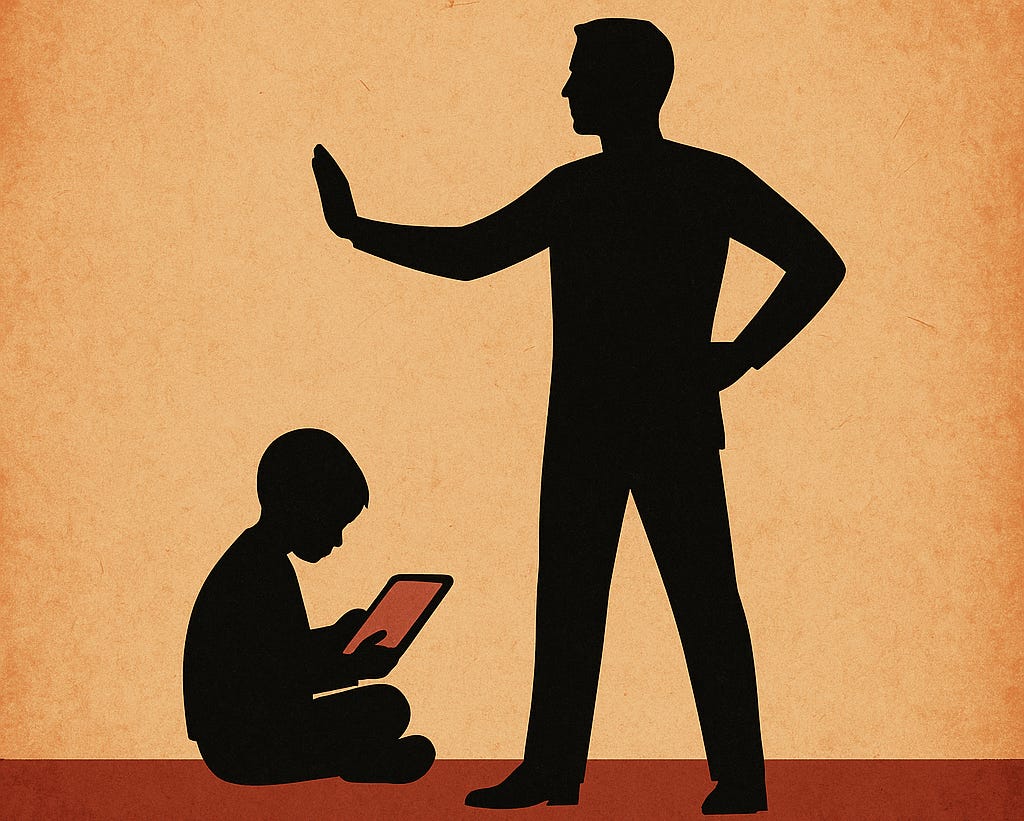
Lately, I’ve been thinking a great deal about younger children and technology. I’ve written plenty about high schoolers: the teenagers already knee-deep in screens, battling distractions, navigating AI. But what about little children? What about the ones whose minds are still soft clay? I gave a presentation at a parish recently on this topic, aimed chiefly at parents, and then something Pope Leo said this week pushed me further: we must protect children’s creativity and thinking from premature exposure to AI.
“We must pause and reflect with particular care upon the freedom and inner life of our children and young people, and the possible impact of technology on their intellectual and neurological development. The new generations must be helped, not hindered, on their path to maturity and responsibility.” - Pope Leo XIV
This only deepened what I already believe. And it’s not complicated, really, just radically countercultural. As far back as 1995, my professor said, “Carmen contra mundi”. Today, the world tells us that the earlier children use technology, the better prepared they’ll be. But that is the world speaking, not wisdom, not science, and not the Church. Contra mundi is not comfortable, and it rarely wins applause. But children deserve parents and educators who will choose their well-being over societal convenience.
Let me start plainly:
Children under 12 should not have their own screens. And they certainly should not be interacting with AI alone. I can already hear the objections brewing, so let me explain why.
The Damage We Didn’t Predict — Because We Didn’t Look First
One of the great mistakes of modern education is that we introduce technology first and research its impact later. No control groups, no consent forms, no measuring outcomes, until later. Always backwards. And once we get around to studying it, the damage is already done. Imagine if medical research worked this way. How many bodies would it leave behind?
It is now a fact that excessive screen exposure affects children’s brains, their social development, their ability to regulate emotion, even their posture and eye contact. You don’t need a PhD to see this. Just sit in a restaurant. How many times do you see a young family at dinner, the parents talking and the child silently hunched over a tablet, swiping away the very conversations that should be forming their mind and heart? Screens have become the new pacifiers, disfiguring minds.
The Elementary Classroom We Should Have
If I were designing an elementary classroom, it would look shockingly old-school to most people. No one-to-one devices. Not even a classroom set. Instead, children would go to a computer lab once or twice a week, just like we all used to. There, they would learn basic digital literacy, such as typing, using Word, staying safe online, and maybe editing a simple video or image. That’s plenty. They don’t need a laptop on their desk to learn long division or how to read.
The teacher, however, should have technology. A good smart board (the real ones, not the cheap imitation projectors) or one of the newer Samsung interactive boards. A computer. A sound system. And the display should be large enough for every child to see clearly (the room-to-screen ratio matters). But the children themselves? They can simply look up. They do not need a glowing rectangle inches from their noses.
And handwriting — yes, handwriting — becomes even more essential at this age. A new study just came out confirming what common sense already knew: handwriting helps children recognize letters and read more effectively than typing. Nothing can replace that. Not yet, and not ever. Even with high school kids, I insist on 2-in-1 laptops with a stylus so they can handwrite notes on a flat surface, which not only improves retention but also removes the very physical laptop screen, which helps with attention.
The Line We Must Draw With AI
Now comes the hard part.
Children under 12 should never interact with an AI on their own. Full stop.
An adult must always be present, not just to keep them safe but to model what healthy AI use looks like. Otherwise, we risk something far deeper than misinformation: we risk damaging the child’s sense of their own capability.
I was horrified listening to a radio ad for “Miko,” an AI toy marketed to parents as a way for children to “learn facts” and “become smart.” No. Absolutely not. A child chatting with a robot, believing every answer, forming habits of dependence before their mind is formed? That is not learning. That is programming. There is too much danger here, not only in what the AI might say, but in what the child might stop doing as a result: wondering, discovering, struggling, imagining, and asking a real human being. Even with devices like Alexa Plus, which I actually praised the other day for household tasks, you must turn on child safety settings. Don’t give children access to tools that can easily replace curiosity with convenience.
So How Should Adults Use AI With Kids?
The proper use of AI with young children is simple: The adult uses it. The child watches.
If a teacher is doing a lesson on frogs, she might use an AI tool to generate a diagram or create a coloring page featuring a frog in the school’s garden. She could print it and let the children color while she explains.
If a parent is reading a story at home and the child wants “another story about the elf and our town,” the parent can ask an AI, but the parent controls the interaction. The child is not left to explore the machine alone; they can learn to use it as a tool.
Homework is another area. If your child doesn’t understand fractions (and let’s be honest, many adults don’t remember fractions either), go ahead and call an AI in for help. But let the AI teach, not do. Children must learn to think, solve, and make mistakes. If we hand them shortcuts too early, we rob them of the very things that make learning beautiful. Children need to learn that they can do hard things, that the struggle and the friction can lead to growth.
Virtue cannot be built on easy answers.
What Parents Must Reclaim
I know this is hard. When you choose to parent contra mundi, you will look strange to the culture around you. Technology is everywhere, AI is constantly expanding and showing up uninvited, and pretty soon it will be in our refrigerators and toothbrushes! And children love it. But parents must reclaim their own authority here. Please do not give your child an iPad at a restaurant to keep them quiet. Let them be bored. Boredom is not a crisis; it is the seedbed of creativity. It is in boredom that children begin to imagine, invent games, and build worlds in their minds.
When I see children outside chalking on the sidewalk, riding scooters, making up rules for some game that adults will never understand — oh, my heart could burst ( I went up and thanked one of the moms the other day, couldn’t help it) Those kids will be leaders someday precisely because they learned how to play, negotiate rules, trust one another, and solve problems without a machine stepping in. Unstructured play is where humanity is formed. But if you give them an AI toy that entertains them 100 hours a day, when will they ever learn to sit, to think, to wonder?
If we want children to survive the world of AI, we must surround them with trusted human relationships, starting early: playdates, neighbors, cousins, priests, and teachers. Adults who love them and they can go to with their questions. A child should not be turning to an AI for answers before they turn to you.
If we want teenagers who are capable of wisdom, discernment, and virtue, we cannot suddenly expect it at 14. We must cultivate it from the very beginning.
In the End, This Is About Hope
This is what frightened me most about the Pope’s recent warning: that children exposed too early may lose hope in their own abilities. They will believe the machine is always smarter, always faster, always right. And that is a tragedy. We cannot do this to them.
Children need their childhood with screens pushed back, AI firmly in its place, and adults leaning in. If we truly care about their creativity, their imagination, their souls, then we must safeguard them from becoming dependent on machines before they even know who they are.
And so yes, perhaps we must all be contra mundi, not out of defiance, but out of love.
Thanks for reading The AI Theologian! This post is public so feel free to share it.
No posts
Comments
Nothing yet. Say the first thing.
Sign in to join the conversation.