
There’s so much talk about efficiency, both for and against it. Some people think that spending more time on a task means giving more of yourself, and there’s truth to that, since time is our greatest asset. But lately I’ve been thinking about the kind of efficiency that actually amplifies the human part of our work rather than erasing it.
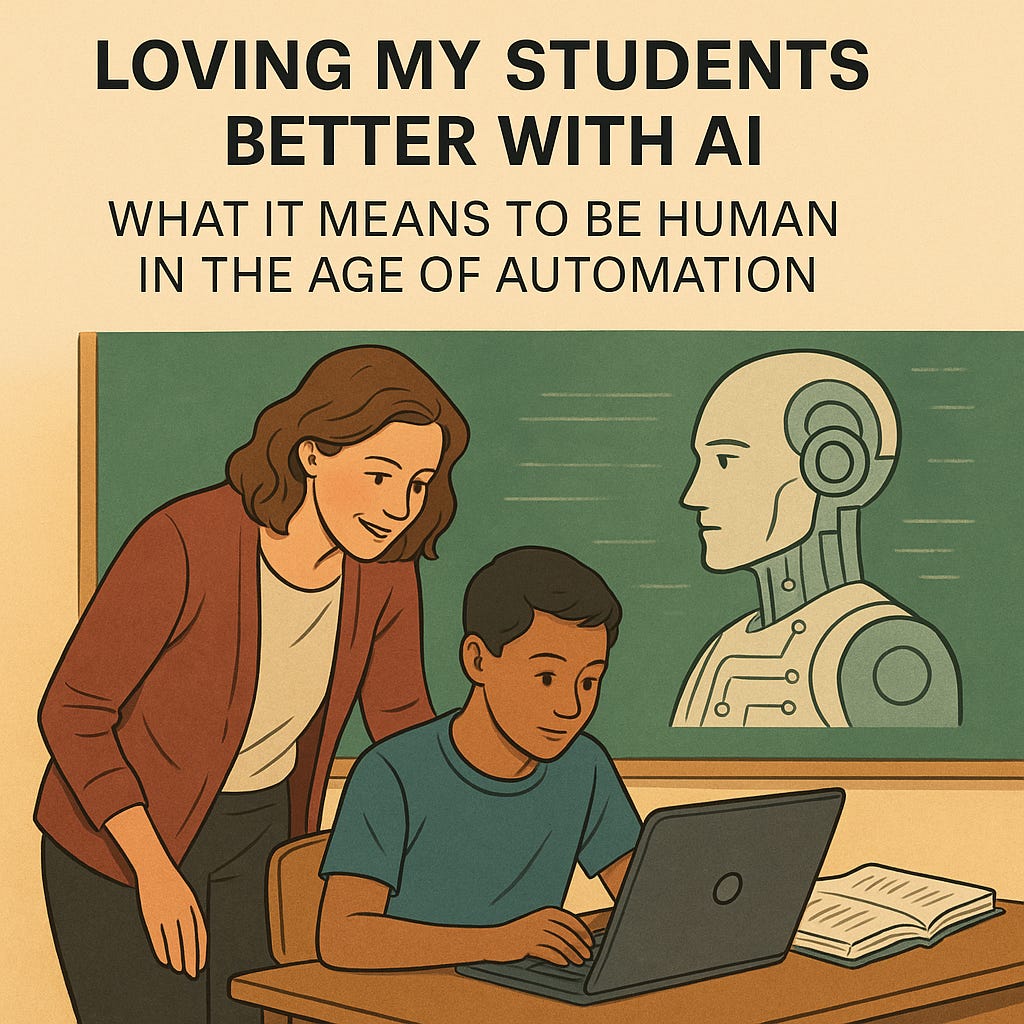
I’ve been experimenting with AI tools in my teaching, and it’s been a revelation. I wouldn’t want English teachers to use AI to grade essays, because writing is deeply personal; it lets you see into another person. But for math, chemistry, or in my case, coding assignments, it’s a different story.
Recently, I started using Comet, an agentic AI browser, to help me grade Java code. At first, I hesitated, since there’s always that sacrifice of privacy when using any AI assistant, but once I did, I was amazed.
Comet wasn’t just faster than I am; in many ways, it was better. It noticed things in my students’ code that I didn’t. When a student’s logic seemed completely wrong, I’d often ask myself, What were you thinking, kid? But the AI could see what they were trying to do and point out their mistake within context. The feedback it produced helped me understand my students better and, ultimately, helped them grow.
Using AI made me love my students better.
Saint John of the Cross said, “At the evening of life, we will be judged on love.” When I used AI to provide my students with more precise and thoughtful feedback, I wasn’t ignoring them or letting a machine replace me. I was partnering with a tool that made my care for them more effective.
Of course, these agentic AIs still need our help. The first thing I asked Comet to do was create a relatively simple flyer, and it confidently told me to see what it had made in Canva. It was terrible.
I then tried Canva AI, Gamma AI, and ChatGPT, but none of them could match website names with the correct QR codes or make something visually appealing. They can write and code with precision and even create beautiful images, but they struggle to combine those elements into something truly beautiful.
That’s what fascinates me. AI can master words and logic, but it doesn’t understand aesthetics or emotion. It can debug a student’s loop but can’t tell when a document feels inviting. It doesn’t know beauty, and maybe that’s exactly what keeps the human heart at the center.
Another surprise came from a familiar voice in my home: Alexa. She’s managed my house and calendars for years, but when Amazon’s large language model update rolled out, she became helpful in a whole new way.
Now Alexa understands natural requests like “Turn on all the kitchen lights” or “Water the plants” instead of “Alexa, ask Rachio to water zone one.”
Recently, I came home from physical therapy with a printed list of appointments—the kind I’d usually have to enter into my calendar one by one. This time, I took a picture of the list and asked Alexa to add them all to my calendar. So simple. So fast. So efficient.
Even my husband, once skeptical about AI, has come around. Now, Alexa has become a kind of third partner in our conversations, joining in with facts, movie trivia, or quick directions. She’s not just efficient; she brings both convenience and connection.
AI isn’t replacing us. It’s reminding us what connection feels like.
This is the question that looms over everything. I recently attended a conference in New York about AI, where experts from Amazon, Microsoft, and other major companies discussed this very topic. One speaker put it perfectly:
“We still need senior engineers, and to get them, we must hire and train junior ones. AI may be able to perform entry-level coding more efficiently, but humans continue to grow, learn, and lead. We can’t skip that process.”
That struck me deeply. Humans are still needed in the loop. AI can accelerate tasks, but it can’t replace presence, discernment, or love. It needs us, not as operators, but as partners.
A book I’ve been reading said people will pay more for the human experience, and I believe it. Sure, McDonald’s can get away with touchscreen ordering, but no one goes to a fine restaurant hoping for a robot waiter.
Even when I travel, my Lyft driver’s conversation—his stories, his restaurant tips—adds something no robo-taxi ever could. We’re built for connection. It’s what we crave, even in the smallest exchanges.
So yes, AI may take some jobs, as every new technology does. But it will also create new ones, especially those that depend on being human. The relationships, empathy, and understanding that define us aren’t replaceable. They’re what make our work, and our world, worth doing.
AI won’t take away our humanity unless we hand it over.
Whether we’re grading code, managing calendars, or asking Alexa for movie trivia, the goal isn’t just efficiency. It’s relationship.
“We’ll be judged not on what we built, but on how we loved.”
Thanks for reading The AI Theologian! This post is public so feel free to share it.
No posts
Comments
Nothing yet. Say the first thing.
Sign in to join the conversation.