
Part One took place on the Indian subcontinent. For Part Two we’re moving to Kenya in Africa. (And just in case you’ve joined recently: This is a two-part series about the projects of some people who vigorously embrace the more-than-human world. You can read Part One, about the Greater Adjutant, here.)
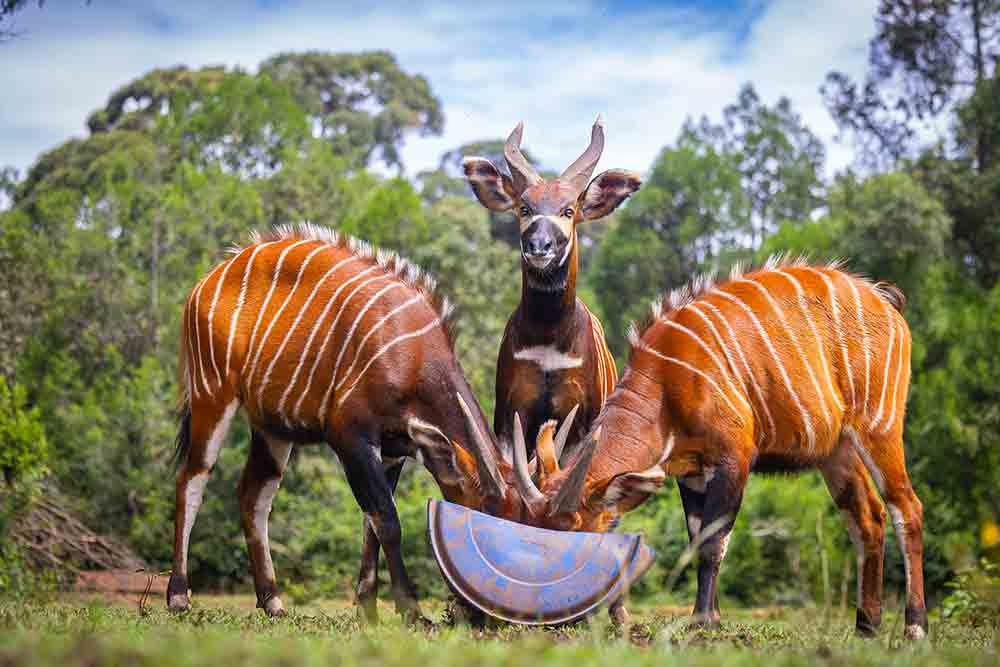
This week’s report of a significant rescue mission involves the elusive Mountain Bongo, the world’s largest and most endangered antelope with no more than about 100 individuals remaining in the wild. They live in Central Africa, in dense tropical forests. I couldn’t establish how many of these animals originally lived in Kenya’s high-mountain forests, except that they were once widespread and lived also in Uganda (where they’re extinct now). Their numbers rapidly decreased in the 20th century due to trophy hunting, poaching, habitat loss because of illegal logging, and domestic grazing. Many mountain bongos died during a regional outbreak of Rinderpest (a.k.a cattle plague), a viral disease affecting cloven-hooved animals, both domestic and wild. It has since been eradicated, but was one of the deadliest known animal illnesses. While other bongo subspecies such as the western or lowland bongo are listed as Near Threatened because the population is steadily declining (from 28,000 in 1999; they’ve been exposed to hunting and trapping, habitat destruction, and human settlement), the IUCN (International Union for Conservation of Nature)’s Red List declared the eastern or mountain bongo to be Critically Endangered at their last assessment in 2016.
They’re so beautiful with their reddish-brown coats and white stripes, wouldn’t you agree? The stripes break up the outline of the animals and are a useful camouflage, hiding their presence. Both males and females have horns that twist once, those of the males are longer and more massive. They’re heavy! According to Wikipedia, males weigh between 485–893 lb, and females 331–518 lb. Because they’re mostly nocturnal (active during the night, sleeping during the day) and also very shy, relatively little is known about them. During the 20th century quite a number were caught and shipped to various zoos in Europe and the United States. It’s assumed that many died during capture and transportation, but at present, more mountain bongos live in captivity than in the wild, in Europe as well as in the United States.
In 2004, the Mount Kenya Wildlife Conservancy, together with the Kenya Wildlife Service, established a breeding and rewilding program in Kenya, with the goal to increase the numbers of mountain bongos in Kenya to 750 individuals by 2050. The program has three main components: first, it protects the animals’ existing habitat in Mount Kenya and other native ranges. Second, breeding programs maintain genetic diversity in captive populations. And third, reintroduction programs will establish new wild populations. Because the few remaining wild animals are spread over several different areas, genetic diversity loss is an additional danger they face. That’s why repatriation from American and European zoos was part of the plan to make sure the mountain bongos wouldn’t go extinct. Actually, I learned that this was one reason why some had been allowed to be exported in the first place:
“The Conservancy’s pioneering work dates back to 1964 when the Government of Kenya, concerned about the declining numbers of Mountain Bongos in Mount Kenya and Aberdares, permitted Don Hunt, then Director of Mount Kenya Game Ranch and founder of the Conservancy, to export Mountain Bongos to American zoos as a safeguard for the species. This move ensured that if the situation in the wild worsened, the Mountain Bongos would not become extinct and could be reintroduced later when the conditions became right. Based on this proposal, the Government permitted him to export 36 Mountain Bongos to the USA. These Mountain Bongos bred successfully and became the founder population of the animals in the zoos in the United States. When the Mount Kenya Wildlife Conservancy was established in 2004, 18 Mountain Bongos were repatriated from the USA to kick off the Mountain Bongo Breeding and Rewilding Programme.”1
The 18 repatriated mountain bongos (four males and 14 females, from zoos in Florida, Texas, and other US states) couldn’t just be released into the forest. They had to learn to find food by themselves, how to escape from predators, and they needed help with building a strong immunity against diseases in the wild. If I understand correctly, they were held in a zoo-like environment, where they could safely adjust to life in Kenya.
In 2020, the Mount Kenya Wildlife Conservancy collaborated with a number of other organizations and established the Mawingu Mountain Bongo Sanctuary, an 800 acre indigenous forest area on the slopes of Mount Kenya. And in 2022 five bongos, direct descendants of the original 18, were released into the first-ever Mountain Bongo sanctuary in Africa and the world. This environment, a pristine natural forest, provides a more extensive area to continue rewilding the mountain bongo in preparation for survival in the wild.
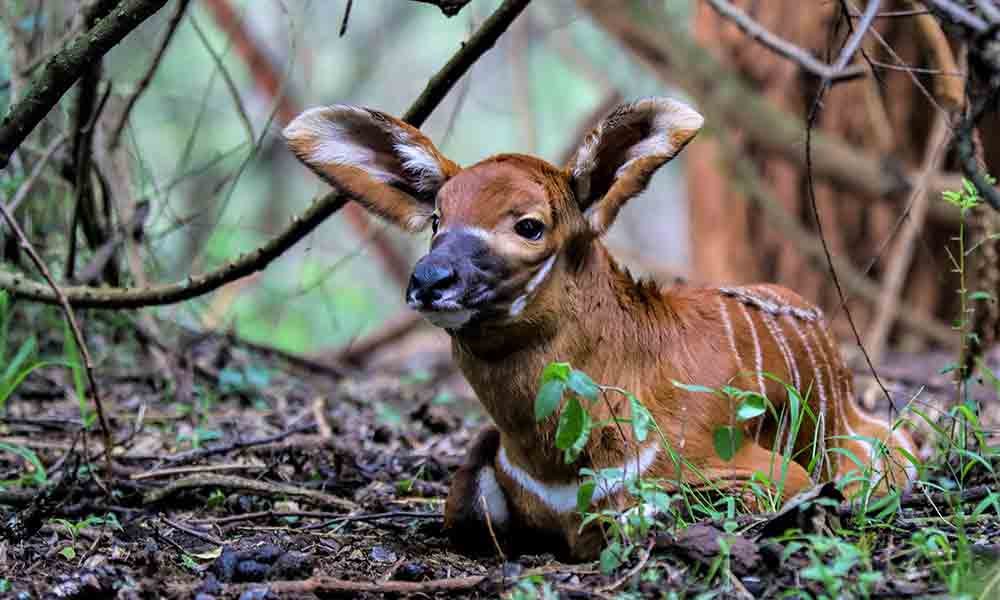
From a 2022 press release:
“Breeding and rewilding of the Mountain Bongo will continue to be done concurrently, thus creating a stream of candidates to support reinforcement of wild Mountain Bongo populations and reintroduction into the historical ranges.
The sanctuary has opened with 5 Mountain Bongos already primed for that environment. Every subsequent year, an additional 10 Mountain Bongos will be translocated into the sanctuary in groups of 5 every six months. Individual Mountain Bongos to join the sanctuary will be selected offspring from the breeding herds and allowed to roam and mate randomly in the sanctuary.”
In 2025, the Rare Species Conservatory Foundation donated 17 mountain bongos who were repatriated from a zoo in Loxahatchee, Florida. 12 females and five males were prepared for the trip: they were vaccinated for pathogens and against tick-borne diseases. They were segregated and had to be moved daily to a different corral to minimize stress. Then they were crated and sedated for the 30-hour-long journey. A wildlife veterinarian and several animal care experts accompanied the bongos. After arriving at the Jomo Kenyatta International Airport in Nairobi, the Kenya Wildlife Service transported the animals 155 miles by road to the Sanctuary where they were finally released!
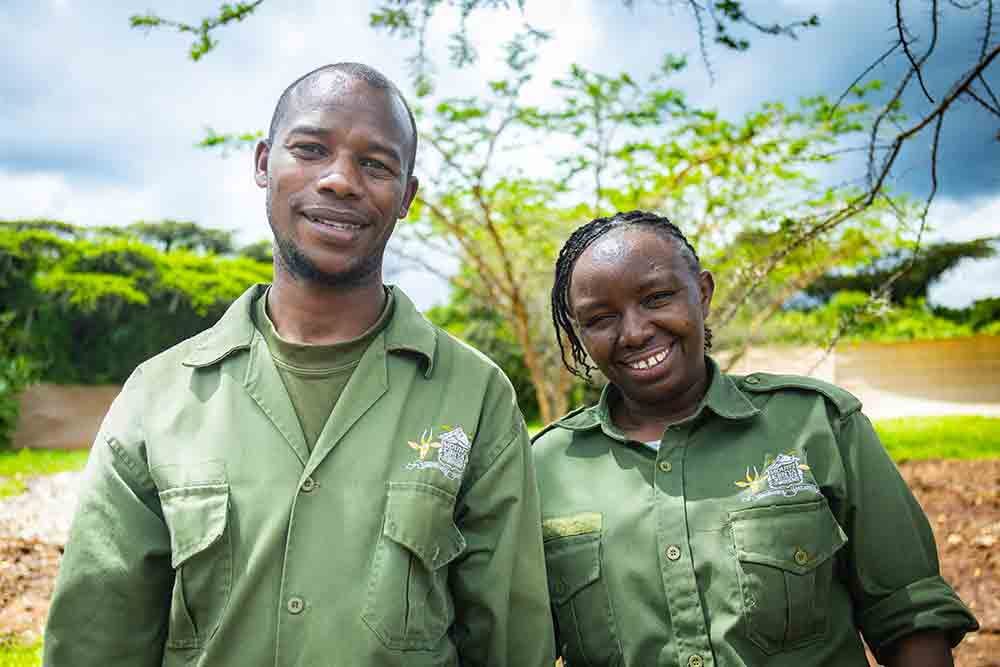
And finally, in April of 2026, another four male mountain bongos travelled from the Czech Republic (actually, from zoos in Prague, Frankfurt and Berlin in Germany, and Givskud in Denmark) to Kenya. Ngenoh Erick Kibet, a wildlife officer at the Mount Kenya Wildlife Conservancy, and Christine Gichohi, an animal keeper at the conservancy, flew to Czechia to be close to and spend time with the animals. Once they all arrived at the sanctuary, Kibet and Gichohi cared for the new animals, making sure they settle in, get their favorite foods, and are comfortable in their new environment.
There are too many people and organisations involved to name them all. But the enthusiasm and dedication that fires this project, saving the mountain bongos from extinction, and which includes Kenya government officials as well as animal advocates from lots of international agencies, is somehow contagious and gives hope.
Comments
Nothing yet. Say the first thing.
Sign in to join the conversation.