
If you’re reminded of something like “super-human”, this is absolutely NOT what I mean. Just the opposite, in fact. I’m talking about those who embrace the more-than-human world, and who actively, with great ingenuity, and lots of courage work for those creatures who have been driven close to extinction by the human world. Today I want to write about two examplary humans, involving an endangered species that would have almost disappeared from the face of the Earth, because of loss of habitat, hunting, and other human-caused infringements.

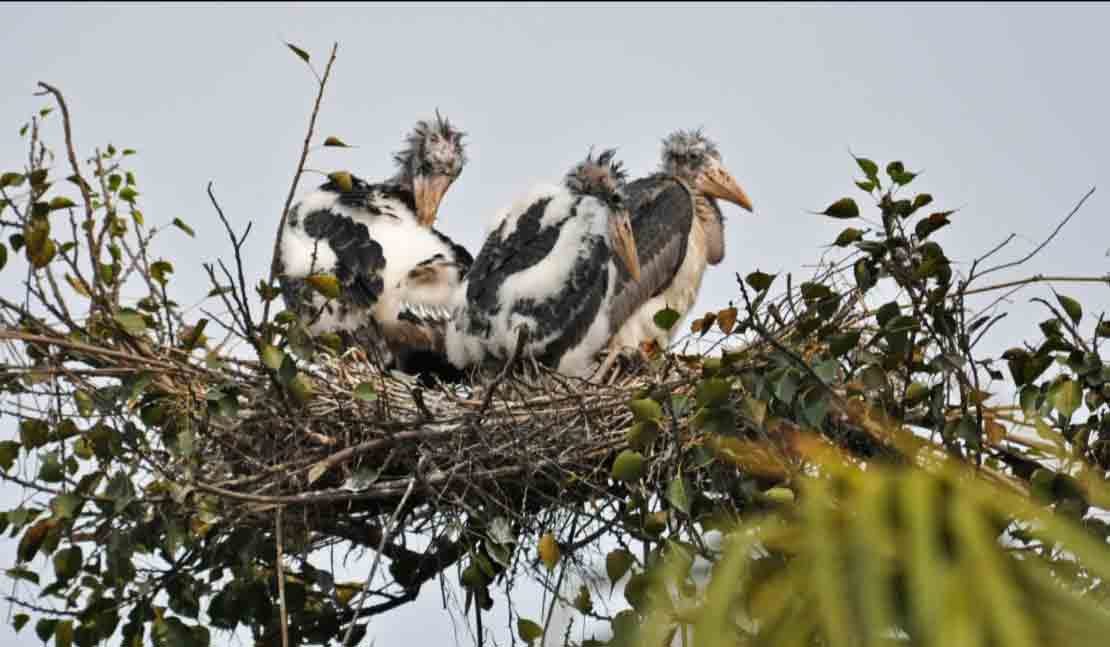
The creature they’re rescuing is decidedly odd. I must confess, that alone makes it endearing to me, but there’s much more. This is the story of the Greater Adjutant (Leptoptilos dubius), a member of the stork family who was close to extinction not so long ago. This tall bird is definitely not pretty; at least, not at first sight. It does grow on you, from what I’ve learned, thanks to some special people’s special efforts.
These birds are huge: they stand almost 5 feet tall, and their wingspan is more than 8 feet. Until the beginning of the 20th century vast numbers of adjutant storks lived in India, Pakistan, Burma, and other countries in Southeast Asia. In Calcutta (Kolkata) particularly, they could be seen on top of every house during the rainy season. Over the next hundred years there was a massive decline in the stork population which was depleted in the whole region, until there were only about 500 - 600 birds left by the early 2000s.

There are several reasons for the rapid shrinking of the greater adjutants population. Lack of food is one: they feed on fishes, aquatic snakes, frogs, and other wetland creatures, but human overfishing and draining of the wetlands which are then turned into crop fields depleted the birds’ food sources. Also, they like to put their big nests close together on the same tree, and in India a big tree can be something like a savings account: if the owner owes some money, the tree will be cut down, the nests fall to the ground, and all the babies die.
One thing I couldn’t figure out: as the illustration above from Calcutta shows, the large birds must have been widely tolerated. But when I read about their decline and the rescue efforts initiated by mainly two individuals, the storks were despised by villagers, hunted and killed because of their unsavory habits. For one thing, they smell bad: being scavengers, they bring dead carcasses up to their nests or in the trees and then drop stinking poop on the ground. In Assam, they spend a lot of time in landfills and garbage dumps where they forage for food, because the wetlands disappeared. Villagers thought of them as harbingers of bad omen by the beginning of the 21st century, and their numbers were dwindling fast.
In 2007, Purnima Devi Barman was a PhD student studying zoology and wildlife biology at Gauhati University in Assam ( a state in northeast India, tucked between Bhutan, Bangladesh, Tibet, and Burma, and one of the few places where the greater adjutants were seen sometimes). Her dissertation focused on these birds, and she wanted to find out why there were so few of them left. One day she received a report: a villager had cut down a big tree on his property which had housed nine nests, each filled with a number of young fledgelings. When she arrived, the villagers gave her a hard time because of her concern about the baby birds; they made fun of her and complained about the dirt and stink the birds left behind. Purnima had grown up loving and caring for all living beings, so she was convinced that she had to help these poor creatures. But instead of lecturing or admonishing the villagers, she listened to their complaints and showed up with a broom to clean the temples.

Slowly she gained the trust of the locals, especially the women: many of them were mothers, and Purnima appealed to their love for their children and encouraged them to extend this love to include the helpless nestlings. With tireless energy and lots of innovative ideas, she managed to weave the formerly despised birds into the identity of the community, so that the stork has become a symbol for their way of life. Purnima’s many local initiatives include cooking competitions, prayer songs, school programs, and community dances. She created the “Hargila Army” (from a Sanskrit word which means “bone swallower”) which has over 20,000 members, including 400 local Assamese volunteers. Her and her coworkers’ efforts have impressive results: the number of greater adjutants in Assam’s villages have more than doubled, from barely 400 birds to as many as 1,200; from only 28 nests in 2007 to over 200 in 2019.

There is another area in India where the greater adjutant is making a comeback: near Bhagalpur in the Indian state of Bihar, bordering Uttar Pradesh to the west and West Bengal to the east. When birding enthusiast and member of the Indian Birds Conservation Network, Arvind Mishra, heard in 2007 that a few adjutants had been sighted in the floodplains of the Ganges – a birding spot unknown at the time – he rushed to visit the nesting areas. Just like in Assam, the villagers disliked the birds: they made a grunting noise which scared the children, they said, and they objected to the smelly bird droppings. Arvind was even suspected to be a police spy and bird smuggler!

When the Indian Forest Department helped Arvind to establish a rescue and rehabilitation center in Bhagalpur, and scientists and environmentalists became regular visitors, the villages in the area benefitted: electricity was installed and methods of transportation were greatly improved. Medical facilities and doctors became available. Arvind made sure that the locals understood that the fame of the village, its global importance, and the innovations they enjoyed were all due to the greater adjutants, locally known as “garudas”. He also educated the people. Unlike in Assam where the birds are forced to frequent landfills, the Ganges floodplains provide plenty of food: they feed on snakes and rodents, protecting the village crops from pests. Nowadays, the community is proud of their association with the endangered birds, especially since their efforts have good results: from 78 birds in 2007 to about 600 in the Bihar region. The villagers who originally regarded the storks as nothing more than a nuisance, gladly participate with Arvind to save more birds. They’re not out of danger yet: shrinking wetlands, climate change, and plastic that looks like food all threaten the birds’ survival. But they don’t seem to give up easily, and they found some formidable guardians!
My next post will describe another remarkable conservation effort, undertaken by some wildlife officers in Kenya: the repatriation of four mountain bongos, critically endangered antelopes with less than 100 remaining in the wild.
Comments
Nothing yet. Say the first thing.
Sign in to join the conversation.