
A problem a character can walk away from is a story an audience can walk away from.
It’s one of my favorite adages among writers, and though it sounds simple, I can’t tell you how many scripts I’ve read over the years that seem to forget this. Script after script, whether a pilot or feature, comedy, horror, or drama, present their characters in situations that can easily be solved, yet they continue to plod along, unhappy and stuck in the situation, when a solution is staring them in the face.
It’s tempting to fall into that listless feeling of settling because that’s something we tend to do in real life. And to be clear, that feeling can definitely be relatable. The trick is to get us to feel empathy for the character, rather than annoying an audience into not caring about them – then turning off the TV.
Personally, I feel this is why a lot of recent shows about obscenely wealthy people completely miss the mark with relatability: the focus is on the problem, rather than their feelings about the problem. When Renata, Laura Dern’s character in Big Little Lies, found out her husband had mismanaged and lost all of their money – we’re talking about tens (or hundreds?) of millions here – it could have been about the sense of betrayal and how much she had loved and trusted him. Instead, she wallowed in self-pity over how she longer had all her nice things and her poor little girl had lost her chance at a future – even though Renata herself still had a seven figure job that would surely put her daughter through any top-rated university in the world. This plot line also kept stealing the focus from the characters in the show who had real problems involving domestic violence, sexual assault, and murder.
I didn’t care that Carrie Bradshaw bought a ten-million-dollar penthouse in downtown Manhattan and immediately hated it on And Just Like That. I didn’t care that Sierra, a minor character on The Affair, was struggling as a new mom in her Hollywood Hills mansion when she clearly could have hired an army of nannies.
This extends to plenty of stories about characters who may or may not be rich; the point is, when there’s a solution to be found, it’s annoying to see a character plainly ignore it.
Recently, I’ve been watching a sitcom I hadn’t gotten around to when it was popular, 2 Broke Girls. It’s a silly comedy about two twenty-something waitresses who work the night shift in a run-down diner in Williamsburg and put all of their spare energy into starting a cupcake shop. It’s a simple premise, but the show does a fantastic job of keeping them broke and working in that sad little diner. The show could easily have just stayed with them over the years, shrugged and said, “oh, it’s the economy, they can’t get better jobs because…they just can’t.”
Instead, they let the characters continue to make the best decision they can for their business, which always happen to keep them at the diner.
Here are a few ways to avoid the trap of keeping characters stuck in situations for no reason – and how this silly sitcom provides some great examples of how to execute it while staying true to the story.
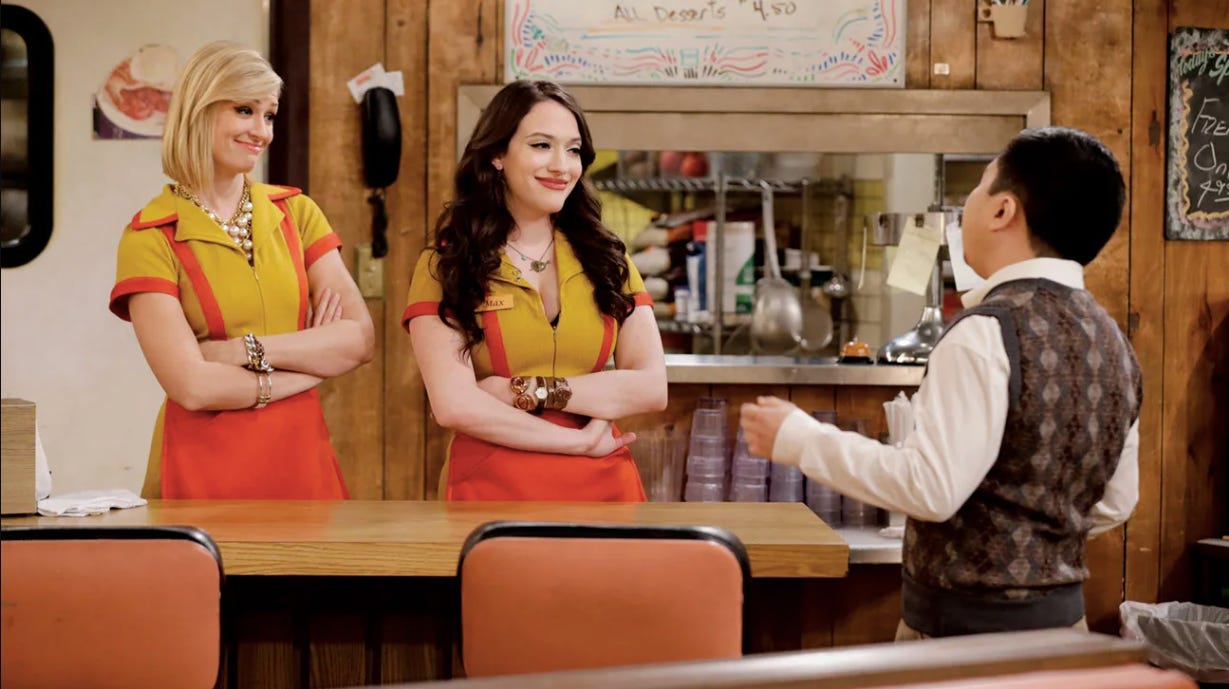
Avoid the Victim Mentality
Max is a high school drop-out who had a tough upbringing. Caroline was a wealthy Manhattan socialite who lost everything when her father was arrested for running a Madoff-style Ponzi scheme. Lots of bad things happened to these characters in the past, but we never see this kind of thing on camera. We meet them in the pilot when these facts of life have become their backstory and move forward with them from there. Obstacles consistently come out of nowhere to challenge them in the show, of course, but those obstacles always feel like a natural ebb and flow to the plot, with actions dictating consequences and creative problem solving executed to deal with the issue of the week. If bad things just kept happening to Max and Caroline over and over again, keeping them stuck in the diner simply because life is too hard and there’s no point to trying, the audience would get bored pretty quickly – and for a comedy, that wouldn’t be very funny.
Make the “Whys” Crystal Clear
Caroline graduated at the top of her class at Wharton Business School, so an obvious question would be: why doesn’t she quit the diner and go get a job using her degree? There’s always an answer. At first, everyone in her old life has stopped talking to her because of what her father did, so she just needs something – anything – to get her back on her feet. Then, she wants to open the cupcake shop with Max – her dream business venture. The owner of the diner lets them sell cupcakes to the customers, so that’s a start. Then, they open a real store! But it doesn’t make much money, so they still need to work at night. Then, the store closes, but the owner lets them set up a cupcake window at the back of the building and work from there.
Why do all of this? Because this is Caroline’s dream (and Max’s, too). She wants her own business and she wants to run it with her best friend. The diner may not be an ideal job with its terrible hours and worse pay; in fact, it may even be the thing that’s keeping them broke – and keeping them broke is the engine of the show. But it’s the only constant they have in working toward their goal, which makes it a less-than-ideal situation they can’t walk away from.
If the Block is Emotional, Make That the Heart of the Story
To circle back to the point of how being stuck in a bad situation can in fact be relatable, it is true that all of us have emotional blocks that keep us there, even when a solution is available to us. When exploring a situation with an emotional block like this, the best course of action is to lean into it, making the emotional arc the focus, rather than the external problem.
2 Broke Girls addresses this when bringing up Max’s terrible childhood and does so in a way that showcases humor as Max’s primary coping mechanism. She frequently says “no” to opportunities in her work or her love life simply because she doesn’t believe good things are possible for her. But the show manages to avoid keeping her stuck in there. After her sarcastic jokes and attempts to avoid taking a risk or making a move that will bring her out of her comfort zone, she works through it, and we get to see Max be brave.

The White Lotus does a great job of this, as well. Though it’s another show that features the problems of the ultra-rich, the most recent season introduces us to a wealthy couple vacationing in Thailand with their three mostly grown kids, two in college and one in his twenties. Shortly after arriving, the father, played by Jason Isaacs, learns that shady business dealings he’s been involved in for years have finally ruined him, and after Thailand, federal prison is the most likely destination for him. The show could have wallowed in all they’re about to lose like we saw with Renata in Big Little Lies, but instead, the father’s arc has almost nothing to do with the money itself; rather, he spends the whole season taking a good, hard look at the life and family he has created that cares about almost nothing in the world other than money. His oldest son believes there’s only one point to being on this Earth, “to get what you want in life.” His wife delivers a now-viral monologue about how she’d rather die than be poor because she “isn’t meant to live an uncomfortable life.” It’s a reckoning for him of how he has let them down by making an impermanent resource the center of their lives and entire personalities.
Personally, I wouldn’t care about how they’re going to pay their kids’ college tuitions; chances are, they have a lot of rich friends and relatives, favors that can be called in, and scholarships that can be found. But I do care about how this man can turn this group of selfish assholes into a family that can get through their worst nightmare, as long as they stick together.
A character’s problems and obstacles can be tricky to write, but the more we see characters work through problems rather than be stuck with them, the more an audience will care how they find their way out of the mess.
No posts
Comments
Nothing yet. Say the first thing.
Sign in to join the conversation.