
Last semester, I took a classed titled Monsters in the Bible and Beyond, where I got to learn all about Biblical monsters and their influence on modern media. Giants, vampires, succubae, creatures from one lagoon or another, etc. – all of them are relevant to our modern perceptions of the cultural “other,” and for a horror fan/writer like myself, studying the long history and a deeper context for the psychology of monsters was an awesome experience.
A seminal work on the study of monsters is Jeffrey Jerome Cohen’s Monster Theory, which presents seven theses on Monster Culture. A perfect case study in the application of all seven is Pan’s Labyrinth, made by the master of the monster movie, Mr. Guillermo Del Toro.
Del Toro’s work on this topic in particular is very famous, and his position on monsters is pretty clear: he is a fan. Humans being the real monsters is a recurring theme in his work. A Vanity Fair reporter recently asked Del Toro what scares him, and he replied, “Politics, hatred, division. People with nice suits and horrible souls.”
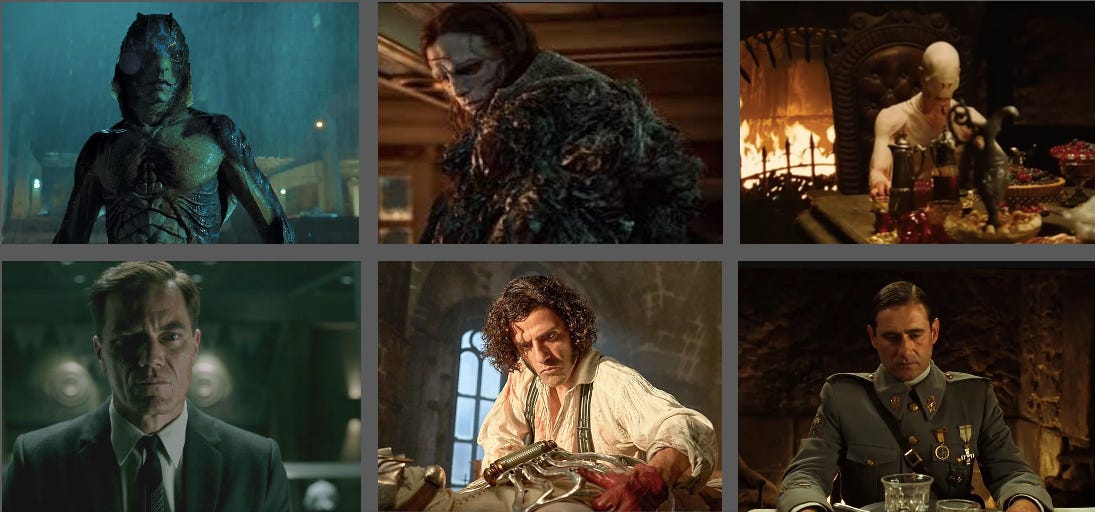
The word “Monster” is derived from the Latin Monstrum = “that which reveals” or “that which warns.” Monsters are the perfect visual representation of our most base-level fears, such as predators or natural elements we can’t control, as well are the fears our culture projects onto us. It’s why cultures create narratives around other, unfamiliar cultures that so often refer to abject behavior: cannibalism, incest, any other scary behavior that we want to define as inhuman.
Freud’s theory of the Uncanny informs Monster Theory. Freud builds upon the concept of the unheimlich and Ernst Jentsch’s definition of the uncanny meaning “unfamiliarity and intellectual uncertainty” to include something that doesn’t only inspire fear, but can also inspire wonder. It’s a fusion of both the unfamiliar and “the old-established in the mind, which has become alien through repression.” The Uncanny thrives in childhood, as we see in the film.
The Movie
What I love about Pan’s Labyrinth specifically is that it gives us this insight through the eyes of a child, which gives us a solid foundation of monster theory: the question of what we seek to learn from monsters is deeply rooted in our subconscious and sense of imagination.
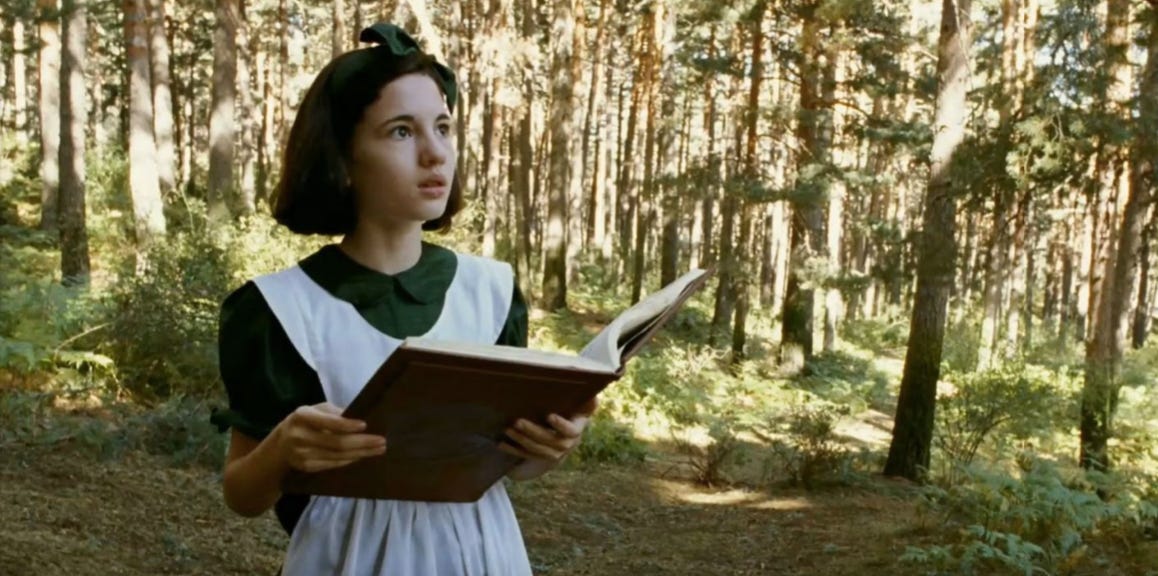
The story is set in Spain in 1944, during WW2 and after the civil war which ran from 1936- 1939, in which General Franco prevailed in a takeover of the government and imposing of a fascist regime. Along with her pregnant mother, Ofelia is on her way to move in with her new stepfather, who is a Captain in Franco’s army. This experience is extremely uncanny to Ofelia: she’s in her home country, but it’s very different from the one she was born into. She’s with her mother as well as this scary, violent stranger. She has this beautiful, blossoming imagination, but is now in an environment that strictly weaponizes the silencing of children’s voices.
In1944, Franco was at the height of his power, and the new government was attempting to stabilize the country. This included an abusive approach to educating children. Children’s homes were established for war orphans and children of poor families – forcibly removed, in those cases.
The number one expectation of children in these homes was silence, and the punishment for speaking could include being made to exercise outside on the asphalt in the middle of the night or lashings with a belt, and were applied to all children, not just the one who spoke without having been spoken to.
This is the worldview in which Ofelia is living, and it is from this perspective that we can really understand how narratives about other creatures reflect what we fear among our own.
Monster Theory
We start with the point of view of a mantis watching Ofelia on her journey to the house as she reads from her book of fairy tales. Mantises feel familiar, but they become Uncanny when they transform themselves into fairies to become the magical guides that bring Ofelia into a new world. That transformation is significant when looking at Cohen’s fifth thesis, The Monster Polices the Borders of the Possible. A familiar creature turning into a mythical one is what allows us to open the gates to another world.
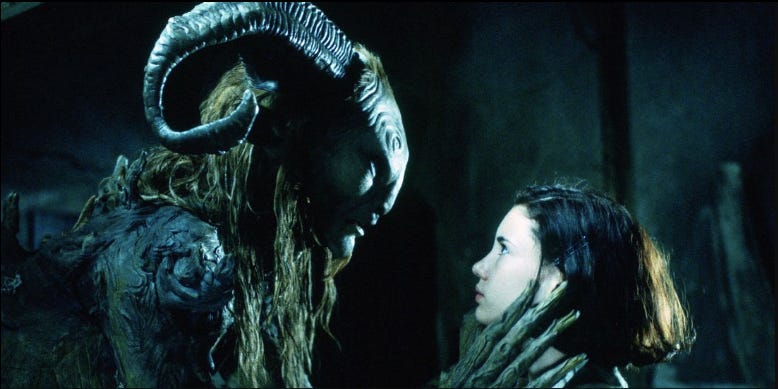
Ofelia then goes into a fantasy world, where we met Pan. He’s a faun, a fusion – according to Noel Carroll’s Nightmare and the Horror Film – of different characteristics of animals and humans. Pan reflects Cohen’s fourth thesis of Monster Culture, Monsters Dwell at the Gates of Difference. Pan tells Ofelia she is a princess of another world. She’s been missing for a while, but he can guide her back to the realm in which she belongs. He tells her, “Your real father had us open portals to allow your return” - a direct reference to children being taken from their parents and placed in boarding schools. Ofelia explains to him that her real father was a “traitor,” a.k.a. a resistance fighter against Franco. But here, Pan offers her a different perspective and inspires her to believe in what she didn’t think was possible.
In that way, he also reflects Cohen’s sixth theory: Fear of the Monster is Really a Kind of Desire. Ofelia is already uncomfortable in her new home, even if she doesn’t feel like she’s in real danger (yet). She knows the war has happened, that her father has died, and that her stepfather is terrifying. Now, she sees that she might not have to settle for living with that particular narrative. As Cohen writes, “The monster threatens to destroy not just individual members of a society, but the very cultural apparatus through which individuality is constituted and allowed.” In many cases with horror stories, such cultural repression is the real enemy, and the monster represents a desire to break down the rules by which we live.
Pan gives her tasks to perform to make it back to her world, and as she does so, the real- world narrative begins to shift to see the Captain flexing his power and ultimately losing it. Pan showing up and setting the fantastical story in motion is what cracks the foundation of silence and fear on which the current political climate relies.
Task #1: Ofelia must retrieve a magic key from the inside of a giant frog. The frog monster brings us again to Noel Carroll’s explanation of how visual monsters are created. The two main camps for monsters are fusion and fission. We’ve seen fusion with Pan, but in this case the monster is defined by a third option, magnification. Frogs aren’t necessarily scary, but one that can wrap its tongue around your entire arm probably is.
Ofelia succeeds, but her quest took priority over an important dinner with the Captain, which she misses, so she’s in deep trouble. The fear that this quest elicits is about the captain’s wrath, not the giant frog.
Before task #2, Ofelia becomes worried about her pregnant mother who has fallen ill, and Pan gives her a moving, infant-like mandrake root to keep under the bed, which seems to help. This is another reference to the Uncanny; in his writing, Freud specifically singles out a child’s belief that a doll can move when not being watched as an example of how unfamiliarity can inspire wonder as often as it can inspire fear.
Task #2: Pan gives Ofelia a magic piece of chalk and instructs her to draw a door that will bring her to the home of The Pale Man, the most famous and the most frightening of the monsters in the movie.
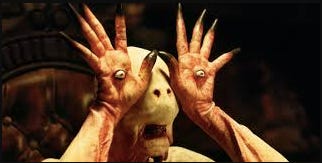
He’s surrounded by paintings of him eating children, so the threat here is explicitly clear. Del Toro has said in interviews that this character is a representation of the Catholic church and its elaborate secrecy machine that has weaponized silence and protected child predators. This is Cohen’s first thesis: The Monster’s Body is a Cultural body. In this case, the collective cultural body it represents in terms of monstrous behavior is that of the Church.
Ofelia’s third and final task: she needs to bring her new baby brother to Pan. When she does, he reveals that the baby’s blood is necessary to open the gates to the other world. Ofelia refuses, even if it means giving up on the fantastical world and risking death at the hands of the Captain, who is actively chasing her at this moment since she has run away with the baby.
Throughout Ofelia’s journey, things have begun to fall apart for the Captain. In the “real world” we see the plot unfold in which moles for the Resistance work against him and ultimately kill him. This is Cohen’s third thesis: The Monster is a Harbinger of Category Crisis. The whole point of weaponizing silence in a strict regime like this is to keep social boundaries as rigid as possible. Ofelia’s journey reflects the cracks that are showing in those boundaries by this time.
The story ends in tragedy when the Captain catches up with Ofelia and kills her – but he’s been followed by this team of Resistance fighters. In his last moment, the weaponization of silence is turned back upon him: he will never be spoken of and have no legacy.
The Takeaway
So, what can be gained from the study of monsters? The study of monsters is ultimately a warning against becoming what we claim to fear the most. There is no difference between the Captain and the Pale Man to Ofelia. In fact, the captain is even scarier because Ofelia has no magical chalk that will help her escape him.
The ending also shows us Cohen’s second thesis, The Monster Always Escapes, since it is the human characters who die while the fantastical ones live on, having inspired not just Ofelia but us, the audience, to believe in the possibilities for a better world.
And, Cohen’s seventh thesis in Monster Culture ultimately proves to be true to Ofelia: Monsters Stand at the Threshold of Becoming. By living among the monsters in a fantastical world, Ofelia has challenged the order of an authoritarian regime. Her blood, instead, opens the gates and secures her place among the mythical beings no both of her parents in a fantastical version of Heaven.
Ultimately, Ofelia embodies Cohen’s description of “bringing not just a fuller knowledge of our place in history and the history of knowing our place, but bearing self-knowledge, human knowledge – and a discourse all the more sacred as it arises from the Outside.”
No posts
Comments
Nothing yet. Say the first thing.
Sign in to join the conversation.