
Warning: Mild Plot Spoilers Ahead
When cultural misogyny becomes too much to bear, an anti-heroine emerges. She is defined by the paradox of her monstrous existence: pushed into it by an abusive patriarchal system, then blamed for it. When she confronts the culture that created her, words fail to bring justice to her situation. Instead, she will scream.
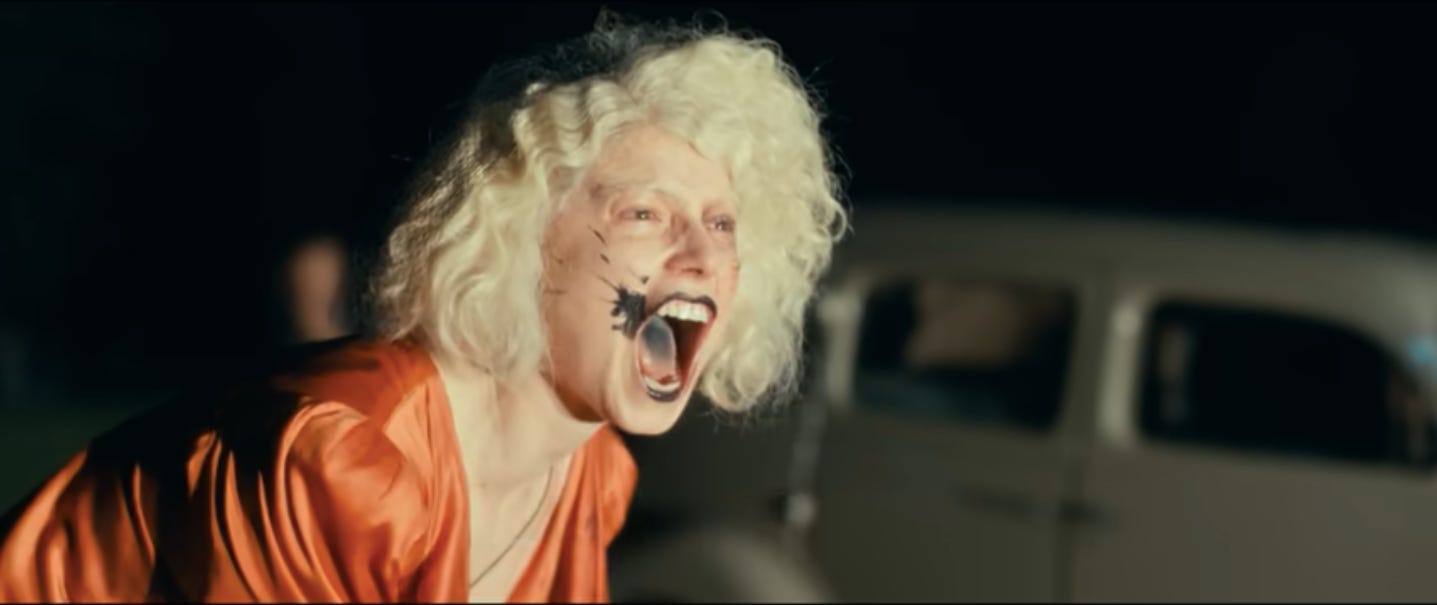
Maggie Gyllenhaal’s newest film, The Bride!, could not be arriving at a better time. As the iconic character from Universal’s 1935 sequel The Bride of Frankenstein screamed and burned down the tortured doctor’s cursed operation rather than live as a monster’s captive (and as a monster herself), Jessie Buckley’s brilliant portrayal magnifies the famous scream to give a voice to the collective feminine rage that has been boiling within women worldwide for thousands of years.
Our story begins with Ida, a woman in 1930s Chicago murdered by a gangster to ensure her silence on many other such executions; other women have been killed for the same reason, and all of them had their tongues cut out as punishment for speaking out against him. Meanwhile, Frankenstein’s monster (portrayed by Christian Bale and simply called Frank in this version) has existed in the abject of society for over a hundred years and enlists the help of Dr. Euphronius (Annette Benning) to create a companion for him to assuage the crushing loneliness.
After her resurrection, Frank and the Bride bring us with them on a Bonnie & Clyde-inspired crime spree with a feminist lens. After they aggressively fight back against an attempted gang-rape, killing the attackers in the process, the pair spend the rest of the movie on the run, not with the intention of hurting anyone, but refusing to back down to anyone who tries to hurt them. In the process, they inspire women all over the country to do the same. It’s an epic journey of rebellion not unlike those we have seen before in classic mythology dating as far back as the Hebrew Bible.
On the surface, the Bride seems like a reference to Eve, the biblical figure created as a companion to the first man in the story of Genesis. The loneliness of Frankenstein’s monster is indeed the catalyst for this act of resurrection, but the Bride bears a striking resemblance to a different mythological figure: Lilith, the first woman created by God as the wife of Adam in the Garden of Eden. In her story in the Babylonian Talmud, Lilith refuses a submissive sexual position with Adam, insisting that the two have been created as equals, and flees Eden under threat of execution. There is one mention of Lilith in the Hebrew Bible, in Isaiah 34:12-14, which reads: “Wildcats shall meet with hyenas, goat-demons shall call to each other; there too Lilith shall repose, and find a place to rest.” Her animalistic scream is a defining feature of what classifies Lilith as a monster, one doomed to live in the abject space of a woman who has broken the social contract of repressed sexuality and motherhood. The sound of a scream is loud and scary as opposed to soft and nurturing; she is the anti-mother. She is chaos incarnate.
It is little surprise that a female character occasionally emerges as the representative for all frustrated women whose voices have been stolen from them. Banshees in Irish folklore scream to warn of imminent death; sirens in Greek mythology sing beautiful songs to lure men to their demise; harpies in Greco-Roman mythology are shrieking hybrids of women and birds who bring about divine punishment.
In patriarchal societies, the subjugation of women begins with and depends upon the repression of voice. The first Mesopotamian written law code, c. 2350 B.C.E., contained the directive: “if a woman speaks out against her man, her mouth shall be crushed with a hot brick.” Mythical characters from Philomena to the Little Mermaid have their tongues severed as a price for autonomy; the Bible itself forbids women from speaking in church or positions of authority.
Women know this history extremely well.
The Bride! is structured by an unusual framing device: a narration of sorts, not of the plot but of the visceral emotions driving it forward, by none other than Mary Shelley, author of the novel Frankenstein: Or, a Modern Prometheus, also played by Buckley. Shelley’s anger at the patriarchal world radiates through the sharpness of her writing: it is men who defined her primary role in life to be that of a mother, men who were hijacking modern science and medicine in service of creating life as an experiment in Godlike behavior, and men who withheld the truth of women as the source of life and creation. The tragedies that ensue – including murder, wrongful execution, blackmail, and suicide – are the consequences of his arrogance; he has given himself the godlike powers of creation, and all of society suffers as a result.
In the film, Shelley tells us immediately that she wasn’t done yet; she had more to say. A lot more, as it turns out. The first time we see Ida, even before her murder, Ida becomes possessed by Shelley’s voice. Shelley continues to make interjections throughout the film, mirroring Ida’s angry outbursts on behalf of the women who can’t say such things themselves. In a particularly powerful scene, Ida seems to read the minds of abusive men in a crowded room, confessing their (mostly sexually) violent sins in public. “I speak for the dead!” she yells. And she does.
Such exposure is never framed as revenge, only as accountability. Revenge looks like something much more monstrous. For example, after being pulled over and assaulted by a police officer, Frank shoots him in her defense, then Ida takes the opportunity to bite his tongue out. It’s a satisfying moment, to be sure; but Ida hates that it happened. “I’m repulsive,” she says of the incident. Revenge might be justified, sure, but such violence is, inarguably, repulsive and terrible.
Gyllenhaal chose to set the story in a glamorous vision of the 1930s, a pivotal decade for American women, for politics, for Hollywood, and for the existence of this beloved character. The film is filled with references to Hollywood’s golden age: Ida and her nemesis, Lupino, clearly reference Ida Lupino, the prolific actress, writer, and director, and other character names reference Myrna Loy and Greta Garbo. There’s even a musical number that allows Ida and Frank to soak up the spotlight and lead a room full of dancers in a powerful expulsion of repressed energy. It’s a nod to the movies that have defined not just a particular era of American history, but Hollywood itself.
By this point, the film industry had become an economic powerhouse, and the horror genre was especially popular. Universal Pictures launched a media franchise of mythical monsters, including Frankenstein (1931), as well as Dracula (1931), The Mummy (1932), The Invisible Man (1933), and many others, all of which were adapted from preexisting literature.
It was the first sequel in the famous grouping, The Bride of Frankenstein (1935), that brought a new addition to the monsters, played by actress Elsa Lancaster: a woman created by men, for men, without her input or consent, one who has no name and becomes known for her deep, primal scream. (It is worth noting here that the technology of sound in movies was new at the time. How appropriate that, much like harpies, sirens, and banshees, a female monster will scream as soon as she can be heard.)
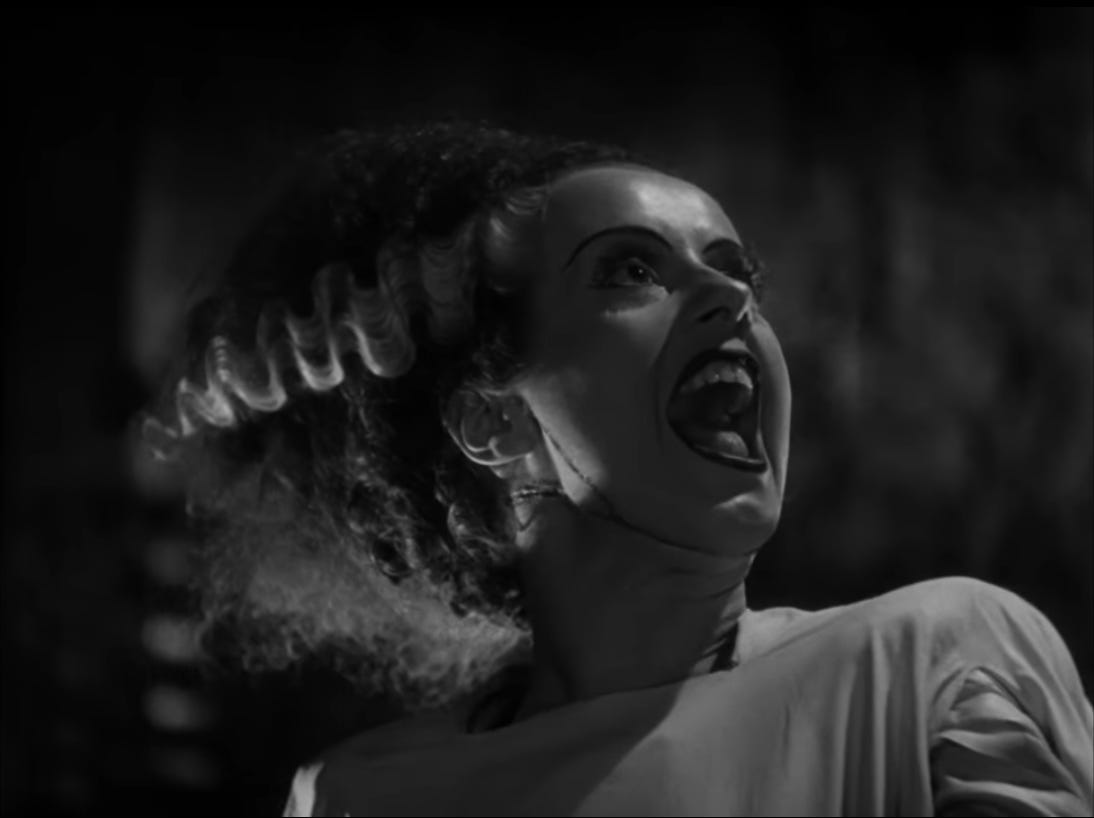
Considering that the 1930s was also a time which saw a rise in Christian Nationalism and a fierce backlash to the rights of women gained in the 1920s, the Bride’s first appearance on the silver screen feels like a reminder that a Lilith-type figure is always there, just outside of the rigid structure of the patriarchy.
The Bride as we know her does not exist in Shelley’s novel, but the monster created by Dr. Frankenstein does demand a wife. The doctor, tormented by the horror of what he has done, cannot bring himself to complete the task. The film, then, reimagines what may have happened had he acquiesced: the Bride, waking up and realizing the unnatural situation and the possessiveness Frankenstein’s creature feels toward her, instantly rejects him, screaming when he attempts to touch her. It is a reaction to such possessiveness that women in patriarchal societies know all too well – and one that loudly echoes Lilith’s rejection of her subservient role to Adam.
Ida does not reject Frank, although she does reject his marriage proposal. Seeing them both on the run from the law and refusing to comply with unjust punishments for rebelling against the status quo may serve as the plot’s engine, but there’s a real heart underneath it all: their bond as two monsters, outlaws, and rebels nurtures a true love between them.
Still, a rejection of marriage – and the implied submission that comes along with it – is something modern women can relate to. Lilith was the one who gave us this example, and the Bride is here to remind us of this option: we may be shunned, blamed, or pushed to the abject of society for it, but we can still choose our independence.
She doesn’t want to be the Bride of Frankenstein. Or Ida. Or defined by any other name given to her by a man.
Mary’s narration calls it out bluntly: “Grandfather’s name: Wollstonecraft. Father’s name: Godwin. Husband’s name: Shelley.” Given the impact of the feminist writings of her mother, Mary Wollstonecraft, we often refer to Wollstonecraft as her mother’s name. But it wasn’t, was it? Not really. No surname truly belongs to a woman, no matter how intelligent or accomplished she may be.
Gyllenhaal teased this in the movie’s trailer last year. “What’s my name?” the Bride asks us. “I don’t remember.” As Lancaster’s character was never given one, it seemed like revealing it would be an act of reclamation in this new version of the story. Instead, choosing no name at all and simply being known as “The Bride” is what serves as a modern act of rebellion.
One of the film’s trailers uses the song “Everybody Scream” by Florence and the Machine. Buckley’s brave performance does it for all of us. The banshees, sirens, harpies, and Lilith herself would be proud. I know I am.
No posts
Comments
Nothing yet. Say the first thing.
Sign in to join the conversation.