
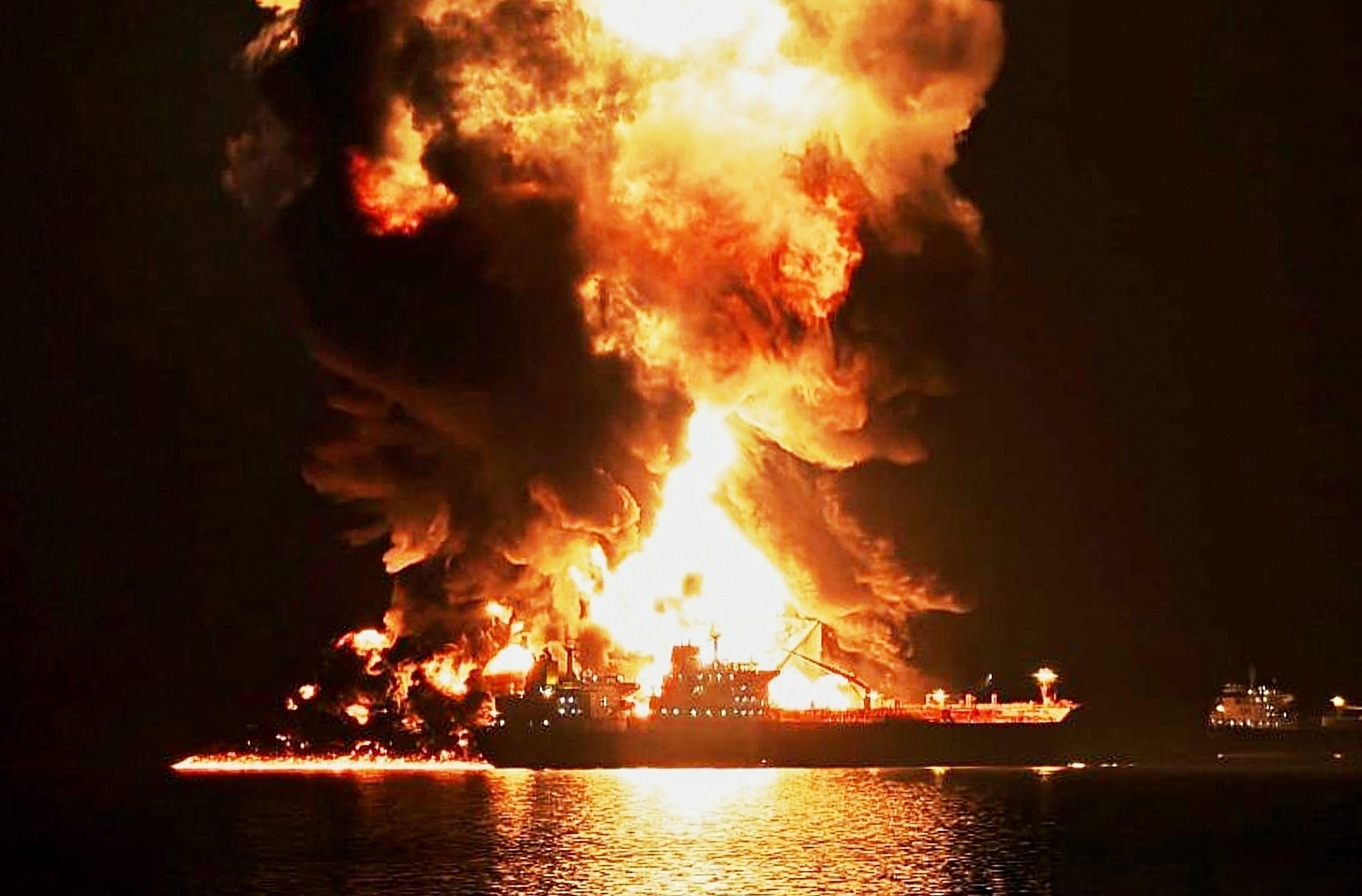
The collapse of the U.S.-Iran MOU places the GCC states in an increasingly precarious strategic position as Iranian missiles and drones again strike Gulf territory. The GCC states are highly exposed to the consequences of the conflict yet possess only limited influence over its conduct or ultimate outcome. They have been largely sidelined from both the MoU negotiations and the broader U.S.-Iran nuclear dialogue, despite being among the actors most directly affected by their collapse. Meanwhile, the potential reactivation of Iranian-backed proxy networks (particularly the Houthis) raises the prospect of a two-front war, threatening both Gulf territory and maritime trade while increasing the likelihood of their renewed military involvement in Yemen.
As the prospect of a prolonged U.S.-Israeli-Iranian war becomes more likely, the Gulf faces three broad strategic pathways. At the heart of each lies a question of Gulf agency.
Option 1: Absorb the Attacks and Lean into Restraint
Under the first scenario, Gulf states avoid direct military escalation and instead continue to absorb periodic attacks, disruptions, and threats against their territory and critical infrastructure. While this may be the least escalatory option in the short term, it risks locking the GCC into a frozen conflict that has diminishing strategic returns. Over time, the balance of costs would increasingly shift against Gulf interests. Persistent insecurity would raise insurance premiums and transportation costs, deter foreign investment, complicate economic diversification efforts, and weaken the Gulf’s reputation as a stable economic hub. Even attacks that inflict limited physical damage could have disproportionate economic consequences by increasing the perceived risk in the region.
The political costs are likely to accumulate. Prolonged restraint could gradually diminish Gulf influence as regional and international actors come to view the GCC as economically indispensable but strategically vulnerable. This shapes investor trust in the region and has a cascading economic effect over the long term. A strategy of strategic restraint could also be interpreted as strategic impotence or a sign of consent to a new order, encouraging further Iranian coercion rather than restoring deterrence. The result, taken to its logical conclusion, would be a gradual erosion of credibility, autonomy, and long-term economic competitiveness.
Perhaps most importantly, this outcome risks normalizing Iranian coercive leverage over the Gulf. Even without achieving outright military dominance, Tehran could acquire a de facto veto over aspects of Gulf security and foreign policy simply through the persistent threat of missile, drone, or proxy attacks. In effect, Iran would not need to defeat the Gulf militarily. It would only need to convince Gulf leaders that the economic and political costs of resisting its coercive pressure outweigh those of accommodation. Such a dynamic would represent a significant shift in the regional balance of power, allowing Iran to exercise influence disproportionate to its conventional military or economic strength.
Option 2: Conduct Limited Strikes as a Form of Defensive Deterrence
The second pathway would be one or more of the Gulf states joining the war against Iran and its proxies. In this scenario, one or more Gulf states conduct limited offensive operations against Iranian missile, drone, naval, or command-and-control platforms used to launch attacks against Gulf territory. The objective would be to restore deterrence by demonstrating that attacks on the Gulf carry direct and unacceptable costs. In this scenario, offensive military action would aim to re-establish the credibility of Gulf deterrence.
This is the most dangerous pathway. A unilateral GCC strike would almost certainly provoke Iranian retaliation, but with a significant escalation against civilian population centers, energy infrastructure, ports, airports, desalination facilities, financial centers, and other critical infrastructure. Tehran could also seek to widen the conflict horizontally by targeting Gulf states that provided logistical, intelligence, or basing support, regardless of whether they directly participated in the initial operation. Such a strategy would increase the costs of regional cooperation while attempting to fracture Gulf unity, which has already begun to fracture the past few months.
Military retaliation would also expose the limits of collective Gulf security. Although the GCC presents itself as a regional bloc, its members do not necessarily share identical threat perceptions, escalation thresholds, or tolerance for economic disruption. A military response initiated by one state could therefore impose security and economic consequences on all, even in the absence of collective political consensus. Rather than strengthening Gulf cohesion, retaliation could deepen divisions between states favoring coercive deterrence and those seeking continued accommodation or de-escalation with Tehran.
The reliability of U.S. security guarantees is also a major constraint. Gulf leaders cannot assume that Washington would provide unlimited military protection following a GCC-initiated escalation, particularly if the United States is simultaneously seeking to reduce its own direct involvement in the conflict. From the Gulf perspective, the greatest danger is joining a war that the U.S. ultimately chooses to exit, leaving GCC states in direct confrontation with Iran across the Persian Gulf without a credible external guarantor. The consequences would be tremendous. Gulf states would bear the immediate military, economic, and political costs of escalation while the U.S. looks for the exit door. An offensive retaliation could therefore leave the GCC more fragmented and deeply entangled in the war with Iran.
This scenario becomes more plausible if the conflict expands with the Houthis' opening of a Yemeni front. A renewed campaign against commercial shipping through the Red Sea and the Bab al-Mandab, combined with continued Iranian attacks against Gulf territory, would create the prospect of a two-front conflict. Gulf states would simultaneously face direct threats to their territory and critical infrastructure while also confronting disruptions to the only maritime alternative to the Strait of Hormuz in the broader region.
As the economic and political costs of continued restraint accumulate, Gulf leaders may conclude that deterrence cannot be restored through continued restraint alone. If attacks become normalized and the security of both the Persian Gulf and the Red Sea deteriorates, limited offensive operations may increasingly be viewed as necessary to re-establish credible deterrence and protect vital national interests. This could rapidly evolve into a broader regional confrontation, drawing the Gulf into a war with uncertain prospects for external military support.
Option 3: A Negotiated Settlement or Regional Non-Aggression Arrangement
I previously argued in the Gulf International Forum that a GCC-Iran non-aggression pact could provide one pathway out of the strategic targeting trap in which the Gulf states increasingly find themselves. This would not necessarily end the broader conflict between Iran and the United States or Israel. It would, however, aim to insulate the Gulf from that confrontation by establishing mutual commitments not to target each other’s territory, civilian infrastructure, commercial shipping, or energy facilities.
This pathway offers the greatest potential (of the bad options on the table) to preserve Gulf economic interests and strategic autonomy. A limited non-aggression arrangement could also establish crisis communication channels, understandings regarding proxy activity, and mechanisms to investigate or contain incidents before they escalate into wider conflict. More fundamentally, it would allow Gulf states to pursue a strategy of regional insulation rather than regional alignment, reducing the likelihood that they become the principal battleground for a conflict driven by external actors.
Yet this is also the scenario over which Gulf states exercise the least control. Its success depends not only on Iran’s willingness and ability to restrain its own military and proxy networks, but also on the United States and Israel refraining from actions that make regional compartmentalization impossible. Gulf governments could negotiate a bilateral or multilateral deal with Tehran, but they cannot ensure that the wider conflict will respect those political boundaries.
There is also a fundamental credibility challenge. Any non-aggression arrangement shares the same weaknesses as the MoU and would need to survive periods of intense escalation while providing meaningful consequences for violations. Without robust verification mechanisms, reliable channels of communication, and reciprocal commitments to restraint, such an agreement risks becoming little more than a temporary political declaration that collapses at the first major crisis.
The political conditions necessary for a durable non-aggression pact are absent. Renewed Iranian attacks against Gulf territory are unlikely to compel GCC states toward accommodation or suing for peace, just as continued U.S. and Israeli military pressure reduces Tehran’s incentives to offer meaningful security guarantees. The option, however, should not be dismissed as strategically irrelevant and should remain on the table. Both Iran and the Gulf may eventually conclude that some form of regional security arrangement is preferable to an indefinite cycle of coercion and retaliation. A non-aggression framework may be politically unattainable at the moment, but it could be one of the few long-term pathways out of the conflict.
The underlying strategic dilemma
The central dilemma at stake in each scenario is Gulf agency. Preserving agency and optionality will likely lead the region’s leaders to pursue all three pathways at once. Gulf states may initially absorb attacks while strengthening their defensive and retaliatory capabilities, while continuing to pursue diplomatic engagement with Tehran. In practice, this means showing near-term restraint to avoid unnecessary escalation, building credible hard military capabilities to restore deterrence if required, and maintaining diplomatic channels with Iran and the U.S. to insulate the Gulf from a broader regional conflict.
Continued restraint will not reduce the immediate risk of escalation but may normalize the Gulf’s vulnerability to coercion. Limited military retaliation, if used, may restore deterrence but risks making the GCC states active belligerents in a conflict whose trajectory it cannot control. Diplomacy offers the most sustainable long-term outcome, but its success depends heavily on decisions made in Tehran, Washington, and Jerusalem, not in Gulf capitals. In all three scenarios, Gulf agency remains severely restrained.
The challenge facing GCC leaders is preserving the ability to choose between restraint, retaliation, and accommodation independently of external pressure or coercion. The Gulf's overriding strategic objective should be to avoid becoming either the principal battleground or the principal bargaining chip in a conflict driven by actors over whom it has little control. Preserving that strategic optionality requires maintaining diplomatic channels with Iran, strengthening collective defense and credible deterrence, protecting critical maritime and energy infrastructure, and making clear to external partners that Gulf territory cannot be treated as an expendable platform for pursuing strategic objectives that the GCC neither defined nor fully shares.
No posts
Comments
Nothing yet. Say the first thing.
Sign in to join the conversation.