
I recently had the pleasure of joining Dr. Andreea Vanacker on The One Million Years of Joy Show, a podcast dedicated to exploring what it means to live with greater joy, purpose, and holistic wellbeing. As an author, entrepreneur, speaker, brain tumor survivor, and self-described “brain science lover,” Andreea has made it her mission to spread more joy in the world by engaging in thoughtful conversations with leaders, researchers, and changemakers about the practices that help us—and our organizations—flourish.
What I appreciate about Andreea’s approach is that she doesn’t treat joy as something separate from leadership or business. Instead, she asks how purpose, compassion, and human connection can become integral to the way we lead our lives and our organizations.
During our conversation, she asked me a question that is one I often come back to:
“What if the way we spend and invest could become a way to heal the world?”
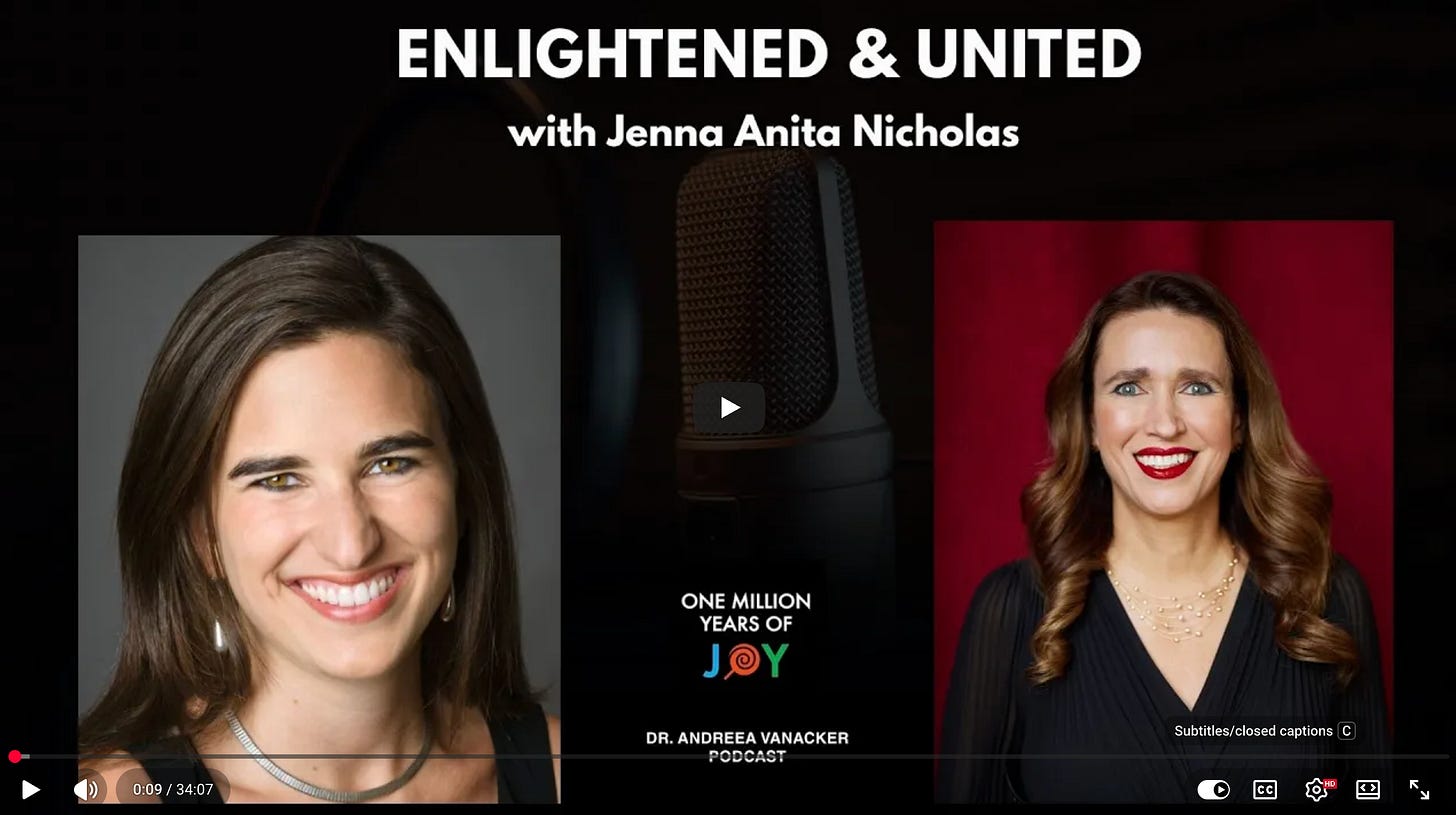
It’s a beautiful question because it invites us to think differently about business. Not simply as a mechanism for generating returns, but as a daily opportunity to contribute to healing.
When we hear the phrase healing the world, it can sound overwhelming—as if it belongs only to governments, philanthropists, or global movements. But I don’t think healing begins there. I think it begins in the smallest interactions we have every day.
It begins with how we lead a meeting.
How we make an investment.
How we design a product.
How we treat the person sitting across from us.
One of the ideas I return to often in The Enlightened Bottom Line is viewing humanity as a single body. If one part of the body suffers, the whole body is affected. Likewise, when one community is excluded, one ecosystem is damaged, or one generation is overlooked, the consequences ripple far beyond what we can immediately see.
That way of seeing changes how we make decisions.
I shared in the interview the example of Devoted Health, a company that last raised funding at a $13 billion valuation. Before many patient interactions, caregivers are encouraged to pause, close their eyes, and imagine the person they are about to meet is a beloved member of their own family. It is such a simple practice, yet it transforms the quality of care because it changes the posture of the person offering it.
I often wonder what would happen if more organizations adopted exercises like this.
What if customer service wasn’t just about efficiency, but about dignity?
What if leadership wasn’t simply about execution, but about empathy?
What if investing became an expression of stewardship rather than ownership?
Throughout the conversation we explored another theme that has become increasingly important to me: work as a form of worship. Regardless of our individual faith traditions—or whether we identify with one at all—I believe there is something powerful about approaching our work with reverence. It reminds us that our careers are not separate from our values. They are one of the primary places where those values become visible.
That doesn’t mean every day is easy.
It means every day offers another opportunity to align what we believe with what we do.
One practical question leaders often ask me is, “How do we actually build this into an organization?”
The answer isn’t only a mission statement hanging on the wall.
It’s creating practices that reinforce your values every single day.
In the interview I shared examples like Esusu, an incredible fintech company I had an opportunity to invest in which recently reached a $1.2 billion valuation. Their internal credo serves as a guide for decision-making, ensuring that compassion and purpose aren’t abstract ideas but practical standards for how the company operates. I also spoke about organizations that use cultural manifestos and regular check-ins to ensure people don’t lose sight of what they’re truly optimizing for.
Culture isn’t created during annual retreats.
It’s created in repeated moments.
The conversations we have.
The behaviors we reward.
The questions we ask.
One of the biggest challenges in business today is that we’re often measuring the wrong things.
During our discussion I reflected on Robert F. Kennedy’s famous observation that GDP measures everything except what makes life worthwhile. I also shared lessons from studying happiness in Bhutan (while at Stanford Graduate School of Business), where success is viewed through a broader lens than economic output alone.
Those experiences continue to influence how I think about investing.
Financial performance matters.
But so does trust.
Belonging.
Human flourishing.
Long-term stewardship.
That’s why I continue returning to the Indigenous principle of seven-generation thinking—considering both the legacy we’ve inherited from the seven generations before us and the impact our decisions will have on the seven generations yet to come. That longer horizon changes the kinds of questions we ask and the decisions we’re willing to make today.
As the conversation came to a close, I was asked what challenge I would leave with listeners.
My answer was simple.
What trace are you leaving?
There’s a passage from the Baháʼí writings that has become a touchstone in my own life. It reminds us that every decision we make—as an employee or employer, producer or consumer, borrower or lender—leaves a trace. The invitation is to ensure that our actions reflect our highest ideals.
I have that question written on a Post-it note on my refrigerator.
Not because I always have the answer.
But because remembering to ask it changes how I move through the day.
Perhaps that’s where healing begins.
Not with one extraordinary act.
But with thousands of ordinary choices made with greater intention.
Look forward to hearing your thoughts,
Jenna
Please fill out the form below if you want to participate in a cohort focused on the Enlightened Bottom Line.
You can see my upcoming events below:
Jenna is the President of LightPost Capital, an investment and acquisition firm. She is an active angel investor and has invested in over 3 unicorns. She is also the CEO of Impact Experience.
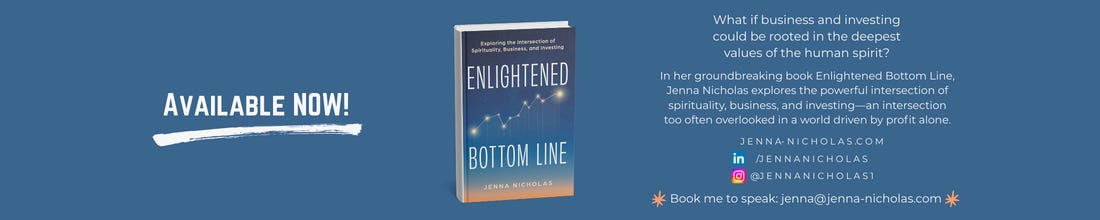
In her groundbreaking book, Enlightened Bottom Line, Jenna Nicholas explores the powerful intersection of spirituality, business, and investing—an intersection too often overlooked in a world driven by profit alone. Drawing on moving stories of entrepreneurs, investors, and leaders who are living out this integration, along with cutting-edge research, Nicholas reveals how spiritual wisdom can guide ethical choices in finance and business.
Please consider supporting my work on Substack. As a paid subscriber you will receive a free book, access to the archive and other perks.
No posts
Comments
Nothing yet. Say the first thing.
Sign in to join the conversation.