
One of the greatest joys of writing The Enlightened Bottom Line has been the opportunity to learn from people who have spent decades living at the intersection of purpose and practice. I had the privilege of sitting down with Constance Broz, whose life beautifully demonstrates what it means to align values with action.
Constance’s journey is an extraordinary one. Born in France, she came to the United States to study international agriculture at Cornell University, where her studies exposed her to questions of social justice and, as she likes to joke, introduced her to her future husband. After graduation, she worked in Haiti with Catholic Relief Services, partnering with religious and community leaders on small-scale agricultural development. Those experiences shaped her understanding that meaningful change happens when we invest in people, relationships, and communities—not simply projects.
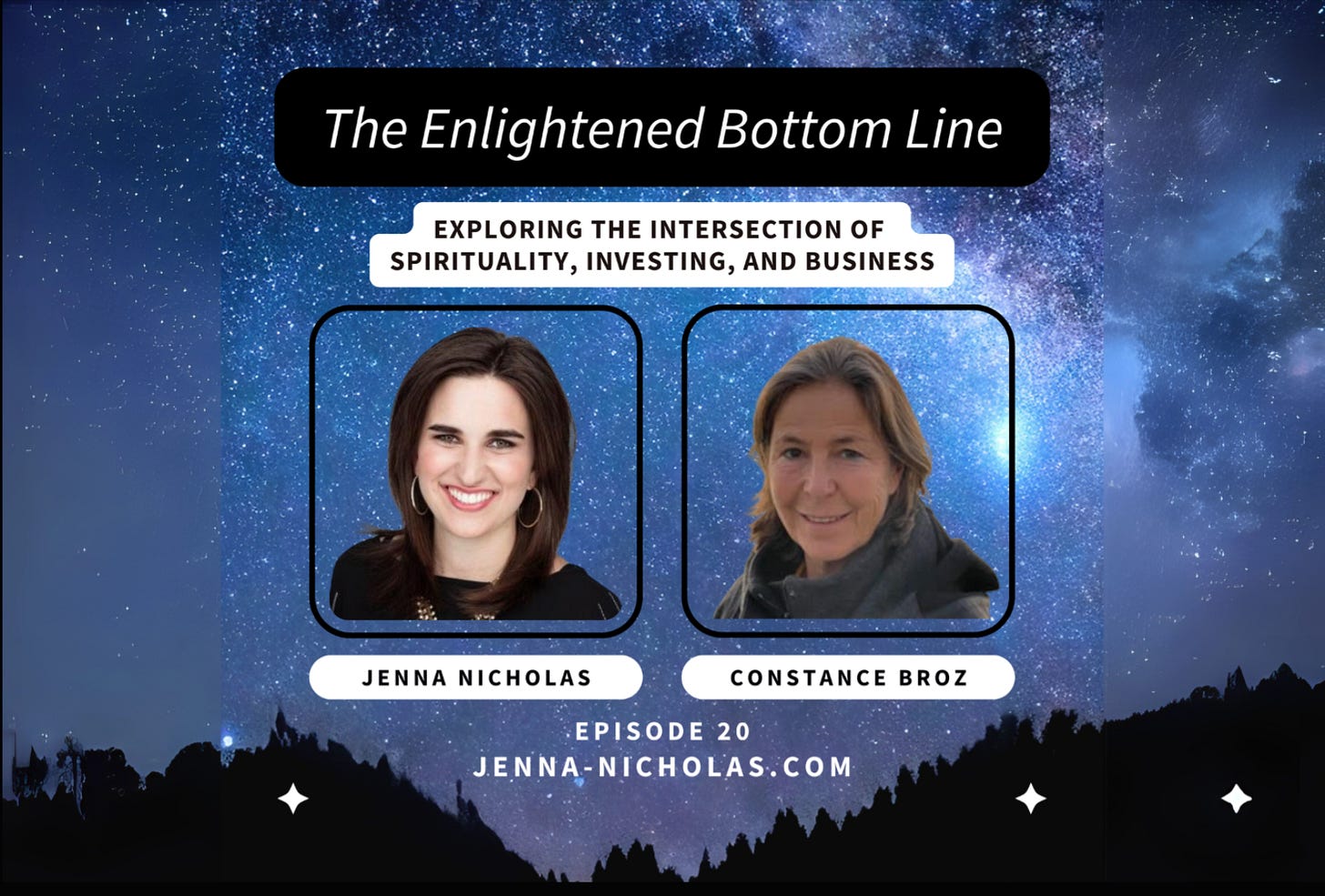
She and her husband, Thomas, later founded Live Earth Farm, an organic farm in California, dedicated not only to producing healthy food but also to educating future generations about stewardship and sustainability. Over time, the same principles that guided her work on the land naturally informed the stewardship of her family’s wealth. Constance became an early leader in values-driven investing. Constance discussed her participation in Impact Experience as deepening her understanding of how history, race, and systemic inequities continue to shape financial systems—and how investors can respond with greater awareness and intention.
What struck me most during our conversation was the way she sees the world.
Early in our discussion, Constance shared an image that has stayed with me. Drawing from both African and Christian traditions, she described the intersection of spirituality and finance as the place where a river meets the ocean—a place where fresh water and salt water come together. It is constantly moving, constantly changing, and because of that dynamic relationship, it becomes one of the most fertile ecosystems in nature.
I found that metaphor beautiful because it reframes what we often think of as competing forces.
Business and purpose.
Profit and values.
Practicality and spirituality.
Perhaps they aren’t meant to compete at all.
Perhaps they are meant to nourish one another.
Throughout the conversation, Constance reminded me that finance isn’t simply about numbers on a spreadsheet. Behind every investment is a founder with a vision, a team with hopes and fears, customers whose lives may be changed, and communities that will experience the ripple effects of those decisions. When we forget the people behind the numbers, we lose sight of what investing is ultimately for.
That observation resonates deeply with my own experience.
Some of the most successful investors I’ve met possess extraordinary analytical abilities. But what distinguishes them isn’t simply their financial acumen. It’s their curiosity.
They ask different questions.
Not just, Will this company grow?
But, Who are these founders becoming?
What kind of world are they helping to create?
What values will shape the decisions they make when no one is watching?
Constance also spoke about the importance of exposing ourselves to ideas outside our usual circles. She encouraged intentionally seeking out conferences, retreats, and communities that challenge our assumptions—not to abandon what we believe, but to expand our understanding.
I think that’s where transformation really happens.
Learning isn’t measured by how many books we read or podcasts we listen to.
It’s measured by what changes because of them.
One of my favorite moments came when Constance reflected on farming. For more than thirty years, she and her husband have cultivated an organic farm, and she described how that experience completely reshaped the way she thinks about capital.
Capital, she said, is remarkably similar to land.
Both require stewardship.
Both require patience.
Both demand long-term thinking.
When you care for soil, you’re not only thinking about today’s harvest. You’re asking what kind of land you’ll leave for future generations. She believes capital deserves the same mindset. We’re not simply trying to maximize short-term returns. We’re cultivating something that should remain healthy, resilient, and life-giving long after we’re gone.
As our conversation drew to a close, Constance offered an image that beautifully captured everything we had discussed.
She simply held up her hands.
She said, “Don’t separate the right hand from the left hand.”
Don’t separate your values from your investments.
Don’t separate your work from your purpose.
Don’t separate who you are from how you lead.
Instead, allow every part of yourself to work together. She suggested that perhaps coherence isn’t actually harder than compartmentalization—we’ve simply become accustomed to believing that it is. And maybe the real reward isn’t only better decisions, but the deep satisfaction that comes from living and working as one integrated whole.
I couldn’t agree more.
Look forward to hearing your thoughts,
Jenna
Please fill out the form below if you want to participate in a cohort focused on the Enlightened Bottom Line.
You can see my upcoming events below:
Jenna is the President of LightPost Capital, an investment and acquisition firm. She is an active angel investor and has invested in over 3 unicorns. She is also the CEO of Impact Experience.
In her groundbreaking book, Enlightened Bottom Line, Jenna Nicholas explores the powerful intersection of spirituality, business, and investing—an intersection too often overlooked in a world driven by profit alone. Drawing on moving stories of entrepreneurs, investors, and leaders who are living out this integration, along with cutting-edge research, Nicholas reveals how spiritual wisdom can guide ethical choices in finance and business.
Please consider supporting my work on Substack. As a paid subscriber you will receive a free book, access to the archive and other perks.
No posts
Comments
Nothing yet. Say the first thing.
Sign in to join the conversation.