
One of the questions I’ve been exploring throughout The Enlightened Bottom Line is deceptively simple:
What happens when we stop separating who we are from how we work?
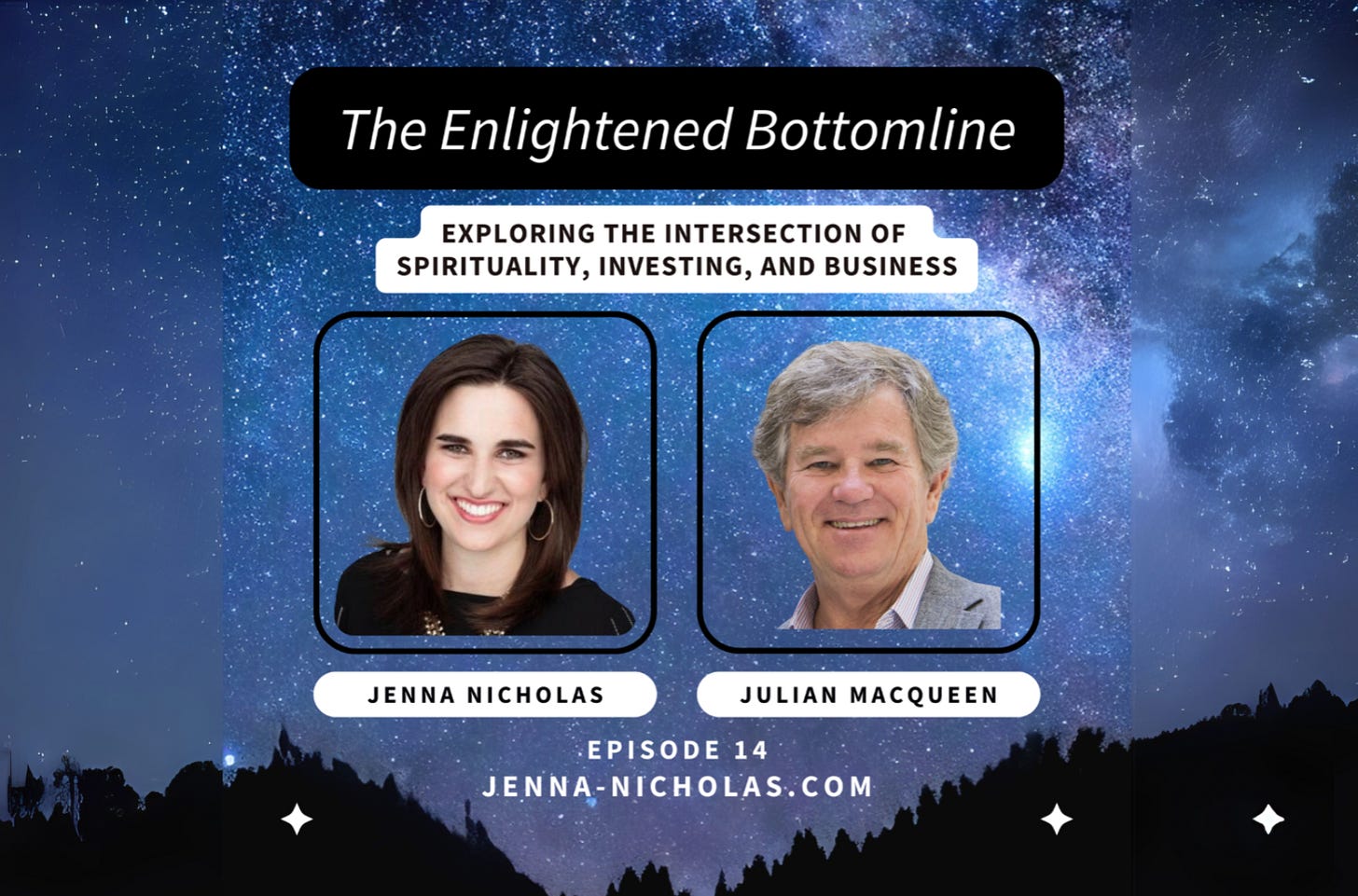
I had the opportunity to sit down with entrepreneur Julian MacQueen, co-founder of Innisfree Hotels, (with wife Kim MacQueen) whose approach to leadership has been shaped by more than forty years of intentionally integrating his spiritual values into the culture of his company. As we spoke, I was struck not by a particular management technique or business strategy, but by a philosophy that feels increasingly relevant in today’s workplace.
Julian MacQueen told me that for much of his life he wrestled with a question many of us quietly carry: How do I bring my deepest beliefs into the place where I spend most of my waking hours? Rather than leaving those values outside the office door, he made the decision to build an organization where people were encouraged to show up as their whole selves.
That idea resonated deeply with me.
For generations we’ve been taught to compartmentalize. There is our personal life. Our professional life. Our spiritual life. Our family life.
But what if that fragmentation is part of the problem?
Some of the healthiest leaders I’ve met don’t seem to switch identities depending on the room they’re in. Whether they’re speaking with investors, employees, customers, or family members, there is a remarkable consistency in how they show up. They lead from the same values regardless of the audience.
That consistency creates trust.
One practice Julian described particularly caught my attention. Early in building his company, his team developed what they call the Cooperative Mode—a simple framework for helping people communicate honestly, recognize unhealthy patterns, and resolve conflict before it grows into something larger. The goal wasn’t to eliminate disagreement. It was to create cleaner, healthier relationships.
As I listened, I couldn’t help but think about investing.
Every founder I’ve backed, every leadership team I’ve worked with, eventually encounters conflict. The differentiator isn’t whether difficult conversations arise. It’s whether an organization has developed the emotional capacity to navigate them with honesty, humility, and care.
One concept Julian shared has stayed with me ever since our conversation.
He calls them “paranoid fantasies.”
We’ve all experienced them. A colleague walks past without saying hello. An email goes unanswered. Someone cancels a meeting.
Within moments, our minds begin writing stories. Did I do something wrong? Are they upset with me? Is there a problem I don’t know about?
Most of the time, those stories have very little to do with reality.
Julian’s team has developed a simple practice. They ask one another, “Can I check out a paranoid fantasy?” It creates permission to replace assumptions with curiosity before misunderstandings become resentment. I found that idea incredibly freeing.
How much energy do we spend reacting to stories we’ve invented rather than conversations we’ve actually had?
Imagine how many relationships—inside companies and outside of them—could be strengthened if we became more curious than certain.
There was another aspect of Julian’s philosophy that I found refreshing.
He believes work should include joy.
Not because work is always easy, but because joy creates the conditions for creativity, trust, and resilience. He laughed while telling me that one of the very first principles his company adopted was simply, “Have fun.”
I think that’s an important reminder. Purpose doesn’t require heaviness.
Some of the most impactful leaders I’ve met laugh easily. They create space for play, curiosity, and human connection even while tackling incredibly complex problems.
Joy isn’t a distraction from meaningful work. Sometimes it’s what makes meaningful work sustainable. Perhaps my favorite moment came when Julian described his understanding of service.
He said something that perfectly captured the spirit of The Enlightened Bottom Line: “Work is worship.” For him, the hospitality business isn’t simply about checking guests into hotels or making beds. It’s about creating environments where people can gather, rest, connect, and experience belonging. When viewed through that lens, every role becomes an opportunity to serve something larger than ourselves.
That conversation reminded me that purpose isn’t found only in extraordinary careers.
It’s found in ordinary moments approached with extraordinary intention.
Whether we are investing capital, leading teams, building companies, or serving customers, we always have a choice about how we show up.
Perhaps bringing our whole selves to work isn’t about becoming someone new.
Perhaps it’s about having the courage to stop pretending we’re someone else.
Look forward to hearing your thoughts,
Jenna
Please fill out the form below if you want to participate in a cohort focused on the Enlightened Bottom Line.
You can see my upcoming events below:
Jenna is the President of LightPost Capital, an investment and acquisition firm. She is an active angel investor and has invested in over 3 unicorns. She is also the CEO of Impact Experience.
In her groundbreaking book, Enlightened Bottom Line, Jenna Nicholas explores the powerful intersection of spirituality, business, and investing—an intersection too often overlooked in a world driven by profit alone. Drawing on moving stories of entrepreneurs, investors, and leaders who are living out this integration, along with cutting-edge research, Nicholas reveals how spiritual wisdom can guide ethical choices in finance and business.
Please consider supporting my work on Substack. As a paid subscriber you will receive a free book, access to the archive and other perks.
No posts
Comments
Nothing yet. Say the first thing.
Sign in to join the conversation.