
For decades, corruption in Latin America was treated as a pathology.
A president took bribes. A minister steered contracts. A political party operated a kickback scheme. Journalists exposed the scandal, prosecutors launched investigations, and international organizations issued reports. Corruption represented a deviation from how the state was supposed to work.
That understanding increasingly feels outdated.
Across Latin America and the Caribbean, corruption no longer functions primarily as a collection of illegal transactions. In many places, it has become a governing mechanism. It helps determine who receives protection, who obtains contracts, which laws get enforced, which institutions remain independent, and which political actors survive.
The most important corruption story in the region today is not about individual wrongdoing.
It is about the emergence of corruption as political infrastructure.
Few countries illustrate this transformation more clearly than Guatemala.
For years, Guatemala’s anti-corruption struggle centered on personalities. Reformers focused on prosecutors, judges, presidents, and business elites. The assumption was straightforward: remove corrupt individuals and institutions could recover.
Recent developments suggest the challenge runs much deeper.
President Bernardo Arévalo came to office promising institutional renewal after years in which anti-corruption prosecutors, judges, journalists, and civil society actors faced intimidation, exile, and prosecution. His administration has spent much of its political capital attempting to restore the credibility of state institutions that many Guatemalans no longer trust. The replacement of Attorney General Consuelo Porras in May marked an important turning point after years of accusations that the Public Ministry had become a vehicle for protecting entrenched interests and obstructing reform efforts.
Yet the central question remains unresolved.
Can a state recover simply by replacing officials, or has corruption become embedded in the way institutions operate? A corrupt official can be removed. A corrupt governing system is much harder to dismantle.
Guatemala increasingly appears to be confronting the second problem.
A different version of a similar story takes hold in Peru.
Most discussions of Peru focus on political instability. The country has cycled through presidents, impeachment battles, investigations, and constitutional confrontations at a remarkable pace. Eight presidents have held office during the past decade. Corruption scandals and public distrust continue to dominate political life.
The current presidential election reflects that deeper crisis. The race remains extraordinarily close, with contested ballots likely to delay a final outcome for weeks.
Most observers view this instability as evidence of institutional weakness.
But another interpretation deserves consideration.
What if instability itself has become part of the governing arrangement?
Political systems typically fail when they cannot produce authority. Peru increasingly produces something different: deeply fragmented authority. Congress constrains presidents. Presidents challenge Congress. Prosecutors investigate political leaders. Political leaders attack prosecutors. No institution possesses enough legitimacy to govern, but nearly every institution retains enough power to obstruct.
This creates an environment where informal bargaining becomes more important than formal governance.
The most revealing example could be Peru’s informal mining sector. Successive governments have repeatedly extended temporary regulatory arrangements intended to formalize small-scale mining. Instead, those arrangements have evolved into a politically powerful system that no major political coalition appears willing to dismantle. What began as an exception increasingly resembles a permanent governing compromise.
The result is not state absence.
It is governance through accommodation.
Want to see how corruption and security can become inseparable? Look at Ecuador today.
The country continues to face severe violence driven by organized crime. In response, President Daniel Noboa has pursued increasingly aggressive security measures. Yet human rights organizations and democracy observers argue that many of these measures have raised concerns about institutional independence, constitutional safeguards, and accountability.
This creates a dilemma that extends far beyond Ecuador.
As criminal organizations gain influence, governments demand stronger powers to combat them. But stronger powers often weaken the very institutions responsible for ensuring accountability.
The irony is striking.
The greater the threat posed by criminal infiltration, the greater the temptation to weaken institutional constraints. Yet weakening those constraints can create new opportunities for political capture, abuse, and corruption.
What emerges is not a linear problem but a self-reinforcing cycle.
Figure 1. The Corruption-Security Feedback Loop
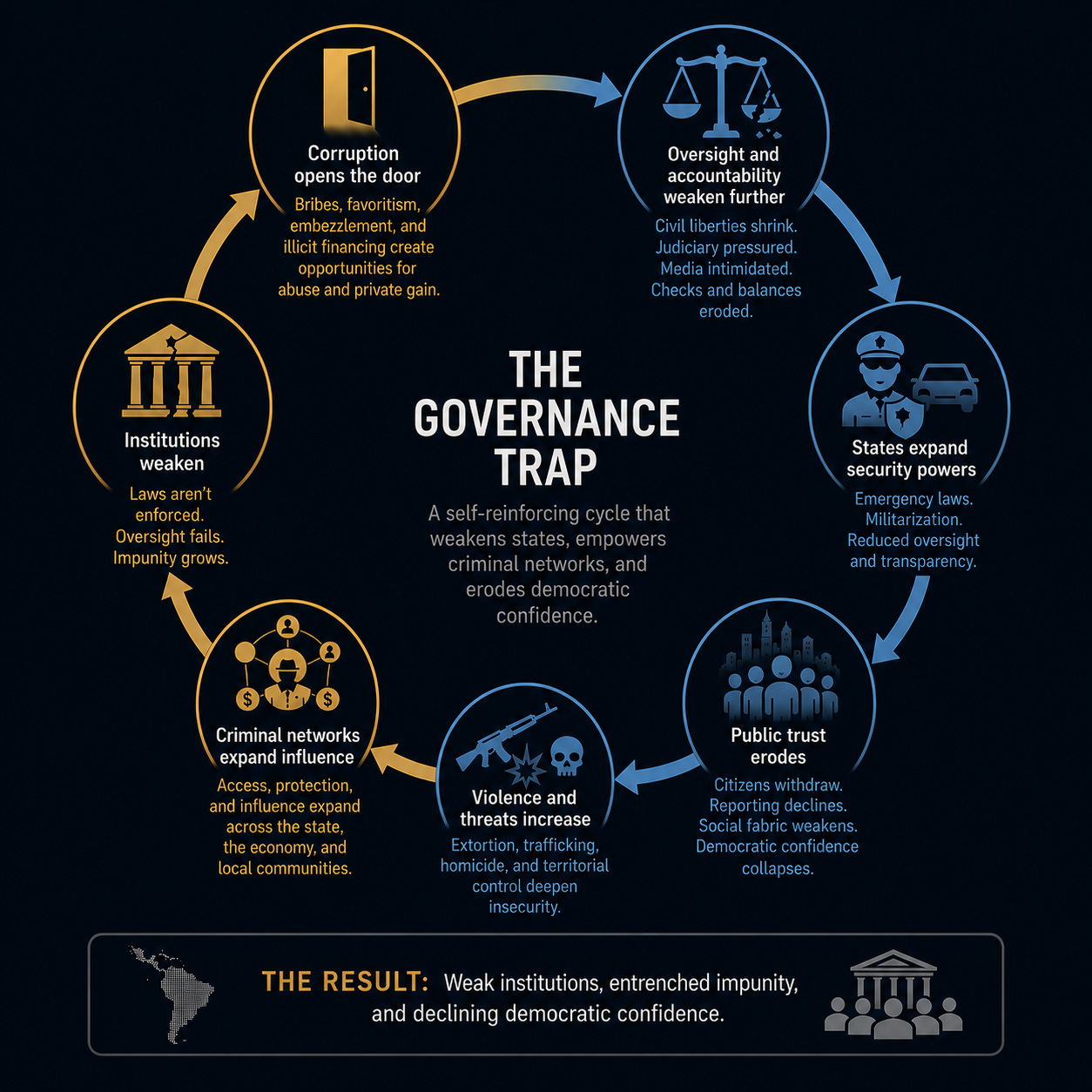
In this sense, corruption and insecurity increasingly reinforce one another. Criminal actors exploit weak institutions. Governments respond by concentrating power. Concentrated power creates new opportunities for abuse. Public trust declines further.
The cycle repeats.
This dynamic increasingly appears across Latin America. It helps explain why governments can simultaneously expand security powers while public trust in institutions continues to decline. The problem is no longer simply corruption or insecurity. The two increasingly reinforce one another.
The region’s corruption debate remains stuck in a framework developed during the anti-corruption wave of the 2000s and 2010s. That framework focused on exposure: Find the money. Reveal the scheme. Name the officials.
Those efforts produced important victories. They also generated a misleading assumption: that corruption primarily operates through individual misconduct.
Today’s reality looks different.
In many parts of Latin America, corruption has evolved into a system of political coordination.
It helps manage relationships between elites, business interests, criminal organizations, security actors, local power brokers, and state institutions. It determines who receives access, protection, information, contracts, permits, and enforcement.
Viewed this way, corruption resembles governance more than theft.
That does not make it legitimate. It makes it resilient. And resilience is precisely what many reformers have struggled to explain.
Why do corruption networks survive repeated scandals?
Why do anti-corruption victories often produce only temporary change?
Why do new administrations frequently confront the same problems that undermined their predecessors?
One answer is because they are not confronting isolated acts of corruption.
They are confronting alternative systems of governance.
This distinction has major implications for policymakers, investors, and analysts.
If corruption functions primarily as criminal behavior, enforcement remains the answer. If corruption functions as governance, enforcement alone will never be sufficient.
The challenge becomes institutional reconstruction.
That requires understanding how authority actually operates rather than how constitutions claim it operates. It requires identifying the networks that distribute power beneath formal institutions. And it requires recognizing that corruption often persists not because states are absent, but because political actors continue to find it useful.
The future corruption debate in Latin America will not center on bribery.
It will center on governance.
That may be uncomfortable for policymakers who prefer clear distinctions between state and non-state actors, legality and illegality, order and disorder.
Yet the region increasingly demonstrates that those categories overlap more than they separate.
The question is no longer whether corruption weakens governance.
In many places, the more important question is whether corruption has become one of the ways governance actually occurs.
No posts
Comments
Nothing yet. Say the first thing.
Sign in to join the conversation.