
The death of Héctor Rusthenford Guerrero Flores—better known as “Niño Guerrero,” the leader of Tren de Aragua—may prove more significant than the death of a single criminal leader.
If reports are accurate, U.S. forces carried out a strike in Venezuela with the cooperation of Venezuelan authorities, killing the man who transformed a prison gang into one of the most notorious criminal organizations in the Western Hemisphere. The operation itself generated headlines. What it reveals about the future of security policy in the Americas deserves even more attention.
For years, governments treated transnational criminal organizations and terrorist groups as fundamentally different threats. Criminal groups pursued profit. Terrorist organizations pursued political objectives. States built separate legal authorities, institutions, and strategies to confront each one.
That contrast is beginning to erode.
The rise of Tren de Aragua, and the U.S. response to it, shows how quickly the old categories are breaking down.
Tren de Aragua did not emerge from an ideological movement. It did not publish manifestos or articulate a revolutionary vision. The organization grew out of Venezuela’s Tocorón prison system and expanded during the country’s prolonged economic and political collapse. It spread across migration routes, criminal markets, and weakly governed spaces throughout South America, building operations that included extortion, human trafficking, migrant smuggling, drug trafficking, and illegal mining.
For most of its existence, governments viewed the group through the lens of organized crime.
That began to change in 2024, when the U.S. Treasury Department designated Tren de Aragua as a significant transnational criminal organization. The move enabled sanctions, asset freezes, and financial restrictions, but it still placed the group within the traditional framework used to combat organized crime.
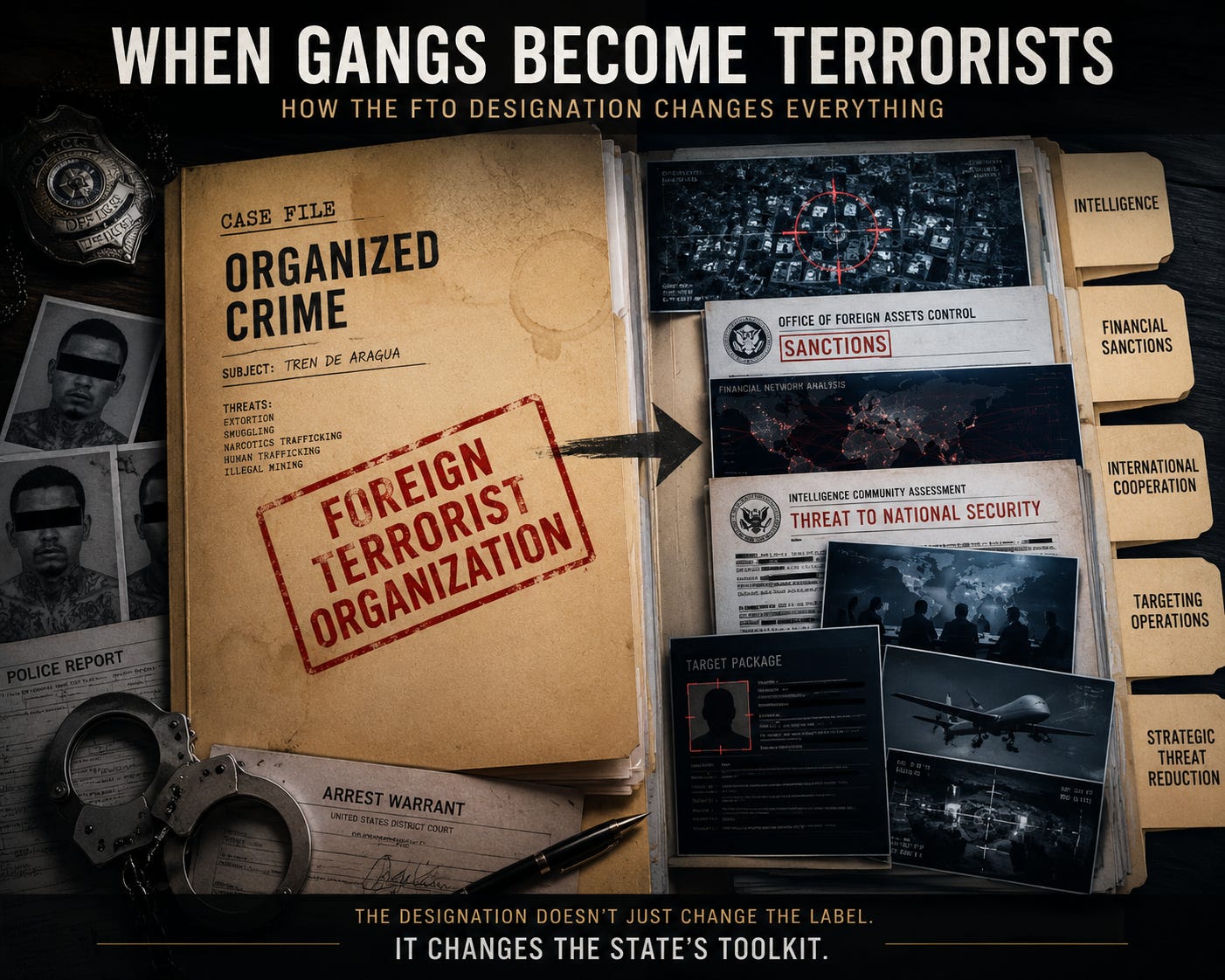
A year later, the Trump administration took a far more consequential step. The State Department designated Tren de Aragua as a Foreign Terrorist Organization. The designation placed the group into the same legal architecture used against terrorist organizations and created new authorities for sanctions, prosecutions, intelligence collection, immigration enforcement, and international cooperation.
Many observers treated the designation as a political statement.
It was not.
The strike against Guerrero demonstrates that Washington increasingly views the designation as an operational framework.
This matters because Foreign Terrorist Organization designations do more than change labels. They change assumptions. They alter how policymakers think about threats, what tools they believe they can use, and what actions become politically and legally conceivable.
For decades, policymakers generally sought to arrest criminal leaders. Increasingly, they appear willing to target them.
The killing of Guerrero suggests that the boundary separating law enforcement from counterterrorism is becoming much thinner than it once was. Whether one supports this shift or opposes it, it represents a significant development in hemispheric security policy.
The larger test case may not be Venezuela at all. It may be Mexico.
Tren de Aragua operates across borders and threatens regional stability, but it remains modest in scale compared to the major Mexican cartels. If the strike against Niño Guerrero signals a willingness to apply counterterrorism logic to criminal organizations, the implications for Mexico become impossible to ignore.
For years, debates over cartel designations focused on legal definitions. Could a cartel qualify as a terrorist organization? Did the label fit? Those questions remain important, but the Tren de Aragua case suggests a different question may matter more: What happens after the designation?
Once governments define a threat as terrorism, they rarely limit themselves to symbolic measures. They expand intelligence collection, financial pressure, international cooperation, and operational authorities. The designation begins to shape policy itself.
That dynamic creates an uncomfortable reality for both Washington and Mexico City. The more cartel violence becomes framed as a national security challenge rather than a criminal justice problem, the more difficult it becomes to maintain the traditional boundary between counterterrorism and counternarcotics policy.
For decades, the United States and Mexico have built their security cooperation around a framework that treats cartels as criminal organizations, however powerful and violent they may be. The emerging terrorism framework points in a different direction. It encourages policymakers to think less about prosecution and more about disruption, less about policing and more about strategic threat reduction. Whether that shift ultimately proves effective remains an open question. What is already clear is that it carries profound implications for sovereignty, bilateral relations, and the future of security cooperation in North America.
Yet the Tren de Aragua case reveals another paradox.
One of the central debates surrounding the group has involved its relationship with the Venezuelan state. Some U.S. officials have argued that Tren de Aragua benefited from ties to elements of the Maduro regime. Others have questioned the extent of those connections. Public reporting has noted that a U.S. intelligence assessment challenged claims that the gang operated directly as an instrument of the Venezuelan government.
Now comes the irony.
The same organization that many policymakers described as a state-enabled threat appears to have become the target of a joint operation involving U.S. and Venezuelan authorities.
That contradiction highlights a reality that often gets lost in public debates over terrorism and organized crime. States often do not choose between principle and pragmatism. They frequently pursue both at the same time.
Governments may condemn another state’s behavior while simultaneously cooperating against a shared threat. They may describe a criminal group as intertwined with a regime while relying on elements of that same state’s security apparatus to dismantle it. International politics rarely offers the neat distinctions that policy frameworks often assume.
The broader question extends well beyond Venezuela.
Tren de Aragua is unlikely to be the last criminal organization to receive a terrorist designation. The United States has already applied similar designations to several Mexican cartels and other transnational criminal groups. The logic behind those decisions reflects a growing belief that criminal organizations can generate national security effects that resemble those traditionally associated with terrorism.
That belief carries profound implications.
If governments increasingly define criminal organizations as terrorist entities, they will likely expand the use of counterterrorism tools against criminal networks. Intelligence services will play larger roles. Military capabilities may become more relevant. International cooperation could deepen. Financial sanctions will almost certainly expand.
At the same time, policymakers must confront an uncomfortable question.
Does every violent criminal organization fit within a terrorism framework?
Tren de Aragua undoubtedly presents a serious threat. Its members have committed horrific acts across multiple countries. Yet its origins remain rooted in criminal enterprise rather than political ideology. The organization seeks money, territory, and influence. It does not seek to overthrow governments or impose a coherent political vision.
That difference may seem academic. It is not.
The more governments blur the line between crime and terrorism, the more they risk adopting tools designed for one problem while confronting another. Sometimes those tools will prove effective. Sometimes they may create new challenges.
Guerrero’s death therefore represents more than the removal of a dangerous criminal leader. It offers a glimpse into a new security doctrine taking shape across the Americas.
For years, the region treated organized crime as a law-enforcement challenge. Today, governments increasingly frame certain criminal organizations as national security threats. Tomorrow, they may treat them as terrorist adversaries subject to the full spectrum of state power.
If that trajectory continues, the most consequential debates may occur not in Venezuela, but in Mexico, where questions of cartel violence, state sovereignty, and U.S. security interests intersect more directly than anywhere else in the hemisphere.
The debate over Foreign Terrorist Organization designations has often focused on symbolism. The strike in Venezuela suggests something far more important.
The designations are no longer merely changing how governments describe criminal organizations.
They are changing how governments fight them.
No posts
Comments
Nothing yet. Say the first thing.
Sign in to join the conversation.