
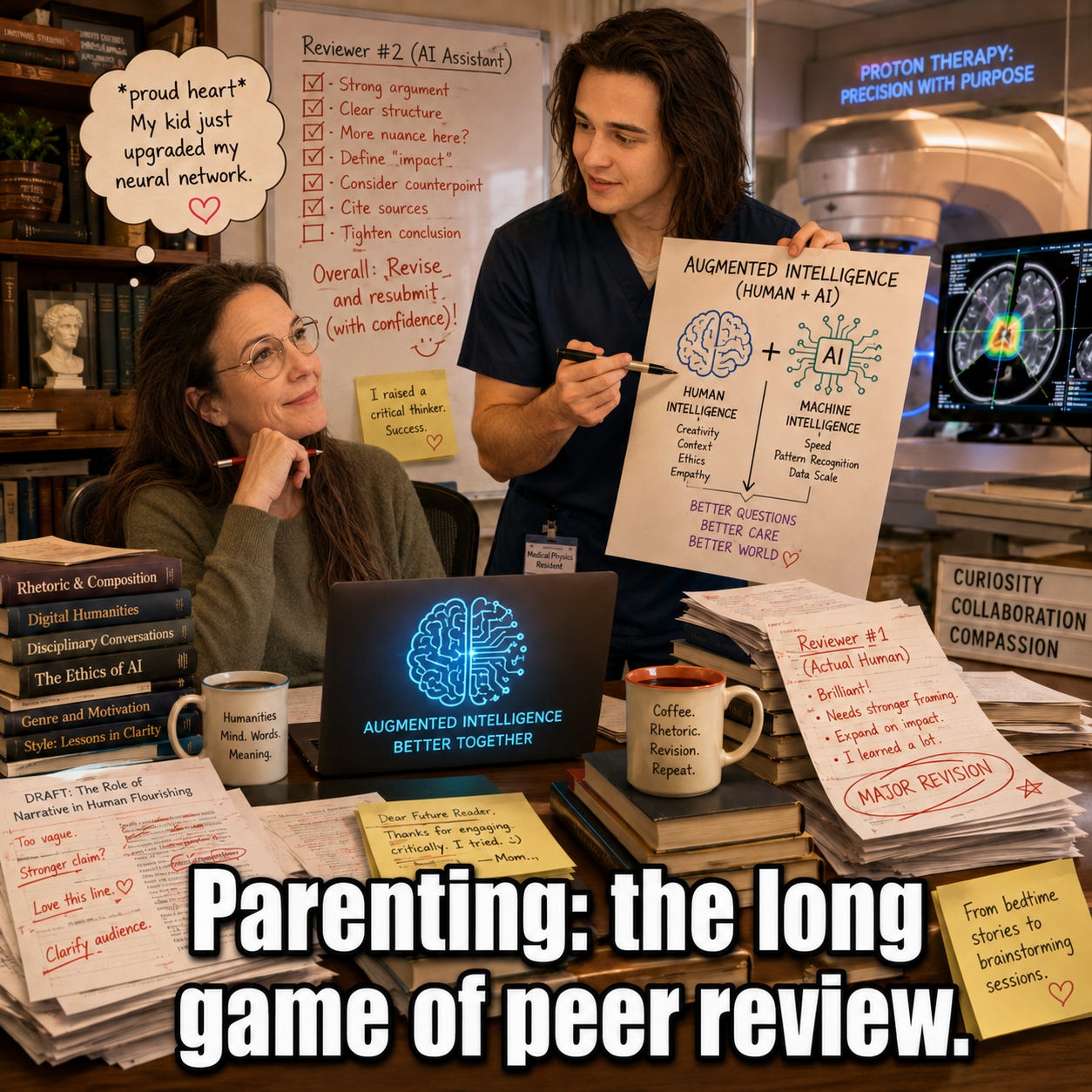
I keep returning to the language problem that many of us in the Humanities have wrestled with since 2022.
We say “artificial intelligence,” and immediately the room changes. The phrase carries a lot of heft: replacement, automation, imitation, threat, hype, cheating, job loss, machine authorship, robot overlords, and all the usual liberal arts FOMO anxieties. Some of those concerns are real. Some are inflated.
But for humanities researchers, especially those of us studying writing, rhetoric, language, composing practices, and human meaning-making, “artificial intelligence” may not always be the most precise term for the work we are trying to do.
I am increasingly interested in the term augmented intelligence, a term that grows from a longer history of human-computer collaboration, a history I plan to unpack more fully in a future post.
I first learned that medicine was making this language shift from my son, Duncan, who is in his second year of medical physics residency at Emory. There is something wonderfully humbling about having your own child explain a disciplinary language shift to you! Duncan was Georgia Tech’s youngest PhD in medical physics, completing the degree at 24. I will pause here for the appropriate amount of maternal pride, which is to say: all of it.
An aside: Duncan’s dissertation research helped me understand why medicine’s shift toward “augmented intelligence” is linguistic clarity. His work used computational modeling to help human experts plan proton therapy more precisely for cancers where anatomy, motion, and uncertainty shape treatment decisions.
In proton therapy, precision is both the promise and the challenge. Proton beams can target tumors with remarkable specificity, but that precision also makes treatment sensitive to small changes in a patient’s anatomy. Organs move. Bodies shift between treatment sessions. Tumors and surrounding tissues can change. Duncan’s research used Gaussian Process models and Water Equivalent Thickness mapping to help account for those patient-specific changes. In plain terms, his work helped model how proton beams move through changing human bodies so researchers and clinicians can better evaluate treatment possibilities. He used machine learning and AI to assist, but not to subsume expert judgement, evaluation, or thinking.
I think this is where the phrase “augmented intelligence” becomes useful for humanities research. Stay with me…
In Duncan’s example, AI and machine learning don’t replace the physician, physicist, or researcher. They are helping experts evaluate more possibilities, model uncertainty, improve planning efficiency, and make better-informed decisions. The human is responsible for interpretation, judgment, care, and patient-focused treatment.
The American Medical Association recently made this conceptual move part of its “official” professional language. Its House of Delegates uses “augmented intelligence” as a way to describe artificial intelligence through its assistive role, emphasizing AI designed to enhance human intelligence rather than replace it. That language offers an important model for the humanities because it keeps professional judgment, ethical responsibility, and human expertise at the center.
The timing of the AMA’s shift is especially useful. In 2023, the organization conducted a comprehensive study of more than 1,000 physicians’ sentiments about AI in healthcare. It repeated that study in late 2024 and again in 2026. By 2026, more than 80% of physicians reported using AI in their professional work, double the rate reported in 2023. At the same time, about 40% of physicians reported feeling both excited and concerned about AI’s role in healthcare.
That combination is instructive: increased adoption, continued concern, and a professional vocabulary that keeps human expertise visible.
In October 2025, the AMA also launched its Center for Digital Health and AI, explicitly positioning physicians at the center of shaping, guiding, and implementing AI tools. The AMA acted on language while adoption was accelerating and while concerns about privacy, transparency, governance, liability, physician training, and professional judgment remained active.
Humanities researchers should pay attention.
Medicine and the humanities are very different fields, of course. Doctors diagnose, treat, and care for patients. Humanists interpret, compose, teach, critique, archive, contextualize, and make meaning. But both fields share one essential concern: the work can’t be reduced to output alone. A diagnosis is never just a data point. A piece of writing is never just a string of sentences. A historical archive is never just a searchable database. A student’s draft is never just a product to be optimized. Each is part of a human situation shaped by context, judgment, expertise, ethics, and care.
That’s why the AMA’s language is useful beyond medicine. “Augmented intelligence” does more than soften the phrase “artificial intelligence.” It changes the frame. And, it’s what a professional field should do when a powerful technology enters its work: study adoption, name concerns, define principles, build governance, and insist that human expertise remains central.
Humanities researchers can do the same. For humanities AI research, I would define augmented intelligence this way:
Augmented intelligence describes human-directed AI use that expands a writer’s, teacher’s, researcher’s, or reader’s capacity for inquiry, interpretation, composing, and revision while preserving human judgment and accountability.
This definition keeps the research object in view: the relationship between system, user, context, task, and consequence. And, that relationship is where I think we as humanities researchers live.
If physicians can say AI should support clinical judgment rather than replace the physician, humanities researchers can say AI should support rhetorical judgment rather than replace the writer.
That is a touchstone for practicing humanities research and teaching. More to come. Thanks for reading - Jeanne
No posts
Comments
Nothing yet. Say the first thing.
Sign in to join the conversation.