
The dominant story about college students and generative AI has been remarkably flat: students are using generative AI (genAI) to cheat, professors are scrambling to stop them, and writing instruction is standing at the edge of a cliff. That story is tidy, but it’s a bit incomplete.
In my research with both undergraduate and graduate university writers, I have been asking a different question that has deep historical roots in the field of writing studies: What happens when we stop treating AI-assisted writing as a finished product and start watching the process unfold?
A completed essay can tell us only so much. It can’t show us the student who prompts an AI tool, reads the output, frowns, rejects the phrasing, asks for a different structure, copies one sentence, deletes two more, checks a claim, revises the prompt, and then says, in effect:
“No, that is not what I meant.”
Writing with genAI is not always good writing; it’s not always ethical writing. It’s not always thoughtful writing. But it’s also not automatically the intellectual vanishing act that some early responses imagined.
My recent think-aloud protocol (TAPs) research suggests something more complicated: many students are not simply handing authorship to the machine. They are negotiating with it.
In earlier (2023-2024) work with James Blakely, John C. Havard, and Laura Palmer for Composing with AI, we surveyed first-year writers about generative AI and the future of writing. Even in Fall 2023, when many institutions were still trying to decide whether AI belonged in the classroom at all, students were already thinking in shades of gray. Ninety percent of respondents had heard of GPT or similar tools. Twenty-eight percent reported using generative AI in some academic writing situations. When asked whether generative AI was the future of writing, 28% said yes, 29% said no, and 43% said maybe. When asked whether AI use in academic spaces was cheating, 58% answered “sometimes.”
That “sometimes” has stayed with me for the past three and a half years. Sometimes is not evasion. Sometimes is a theory of context.
Students were already distinguishing between brainstorming and copying, feedback and substitution, polishing and plagiarism. They were asking the question so many AI use policies still struggle to answer: What kind of genAI use supports writing, and what kind replaces it?
That early survey work gave us student perceptions. But perceptions are retrospective. Students tell us what they think they do, what they remember doing, what they are willing to admit doing, and what they believe their instructors want to hear. To be fair, I need to say that I use survey data too. But… it’s a self-report method to use alongside behavioral observations.
So my research team turned to think-aloud protocols, or TAPs.
In TAPs, participants verbalize their thoughts while completing a task. We pair that spoken stream with screen recordings so we can study writing as it happens. The method is beautifully nosy in the best scholarly sense. It lets us see the composing process in motion: the pause, the prompt, the doubt, the revision, the moment a student decides an AI output is useful, irrelevant, inaccurate, too generic, or simply not theirs.
In a book chapter based on our exploratory pilot cohort of 20 first-year writers, my coauthors and I found that students used AI across recursive composing processes: prompting, evaluating, revising, adapting, and sometimes rejecting AI-generated suggestions. The published chapter reports that students used AI most often for planning and revision rather than drafting alone, treating outputs as provisional rather than authoritative.
That distinction is crucial. If the only question is “Did genAI touch this text?” then everything becomes suspicious. If the question is “What did the writer do with genAI?” then we can begin to teach.
In the pilot TAP data I presented at Oxford back in April for EAET, the pattern was not “AI writes, student submits.” At the participant level, 72.2% had at least one planning episode, 72.2% had at least one revising episode, and 88.9% used AI across two or more process stages. At the episode level, half of coded episodes were planning, 31.2% were revising, 14.6% were drafting, and 4.2% were editing.
An episode was defined as: a bounded segment of a writing session in which the writer is pursuing one recognizable goal or activity before shifting to a new goal, activity, tool use, or outcome.
This is not a picture of students just outsourcing prose. It’s a picture of AI entering the writing process unevenly, awkwardly, and often recursively.
One especially important pattern in our coding was “revise without draft.” For example, 55.6% of participants showed revise-without-draft behavior, suggesting that AI was often being used to reshape existing ideas rather than simply generate a first text from nothing.
The cheating panic tends to imagine genAI use as a single transaction: prompt in, essay out. But writing with genAI often looks more like a loop. Students ask for structure. They compare outputs against their intentions. They notice when the tool sounds wrong. They object to claims that are too vague. They push back against wording that feels unlike them.
In our pilot study, we noted that students’ recursive friction appears in comments like: “Wait, this isn’t what I meant.” “Let me try that again.” “That’s closer… but not quite.”
That “not quite” is where evaluative behaviors live and thrive.
One of the most interesting things TAPs reveal is that friction does not always stop the writing process; it can improve it. We’re defining friction as the wrestling with the iterative nature of putting thoughts into words, which also comes from Jane Rosenzeig.
When a student dislikes an AI output, that discomfort can become rhetorical judgment. The student has to ask: Why does this not work? Is it the tone? The evidence? The level of detail? The source? The voice? The audience fit? In other words, the AI output becomes a rhetorical object to evaluate, not an authority to obey.
In our analysis, we discovered that verification and ownership repeatedly appeared as central features of student decision-making. All students in the pilot adapted rather than copied AI uptake.
This doesn’t mean students always verified well. It doesn’t mean they always knew what counted as a reliable source. It doesn’t mean they never over-relied on the genAI tool itself. But it does mean the process is visible in their behaviors, can be learned, and can be taught.
And that’s where I want the conversation to go: away from “AI or no AI?” and toward “What kind of human judgment are students practicing when AI is present?”
Please know that I don’t dismiss academic-integrity concerns. In a recent Springer Nature paper coauthored with Saad Boulahnane, Loubna Haddi, and Abdelkader Sabil, we examined how students in Moroccan and U.S. university contexts perceive and rationalize genAI use in academic tasks. The study drew on survey data and thematic analysis from 187 students: 90 from Kennesaw State University and 97 from Hassan I University.
The findings showed contextual differences. KSU students more often framed genAI as an academic assistance tool, including as a “study buddy,” while Hassan I University students emphasized academic pressure and institutional ambiguity. Our chapter argues for context-specific academic integrity guidelines, AI ethics training, clearer institutional expectations, and further study of how students’ rationalizations evolve over time.
We concluded that students don’t make ethical decisions in a policy fog. When instructors say “do not use AI” in one course, “use it freely” in another, and nothing at all in a third, students learn to improvise. Sometimes that improvisation is thoughtful. Sometimes it’s convenient. Sometimes it’s risky. But ambiguity itself becomes part of a learning environment.
So, for me, it follows that academic integrity in the age of AI cannot rely only on surveillance. Our Composing with AI chapter argued that focusing primarily on policing, disciplining, and punishing students is a weak pedagogical response to a technology that will be widely used outside school.
This does not mean “anything goes.” It means students need explicit instruction in use, limits, disclosure, verification, and authorship. I discussed strategies for reasonable efforts with Dr. Tricia Bertram Gallant in her brilliant “Opposite of Cheating” podcast.
What research has told me is that students who use AI to brainstorm are not doing the same thing as students who submit an untouched AI-generated essay. A student who asks AI to explain a dense source is not doing the same thing as a student who invents citations. A student who uses AI to revise for clarity isn’t doing the same thing as a student who lets the tool replace their own argument.
Research tells me that we need policies and assignments that can tell the difference.
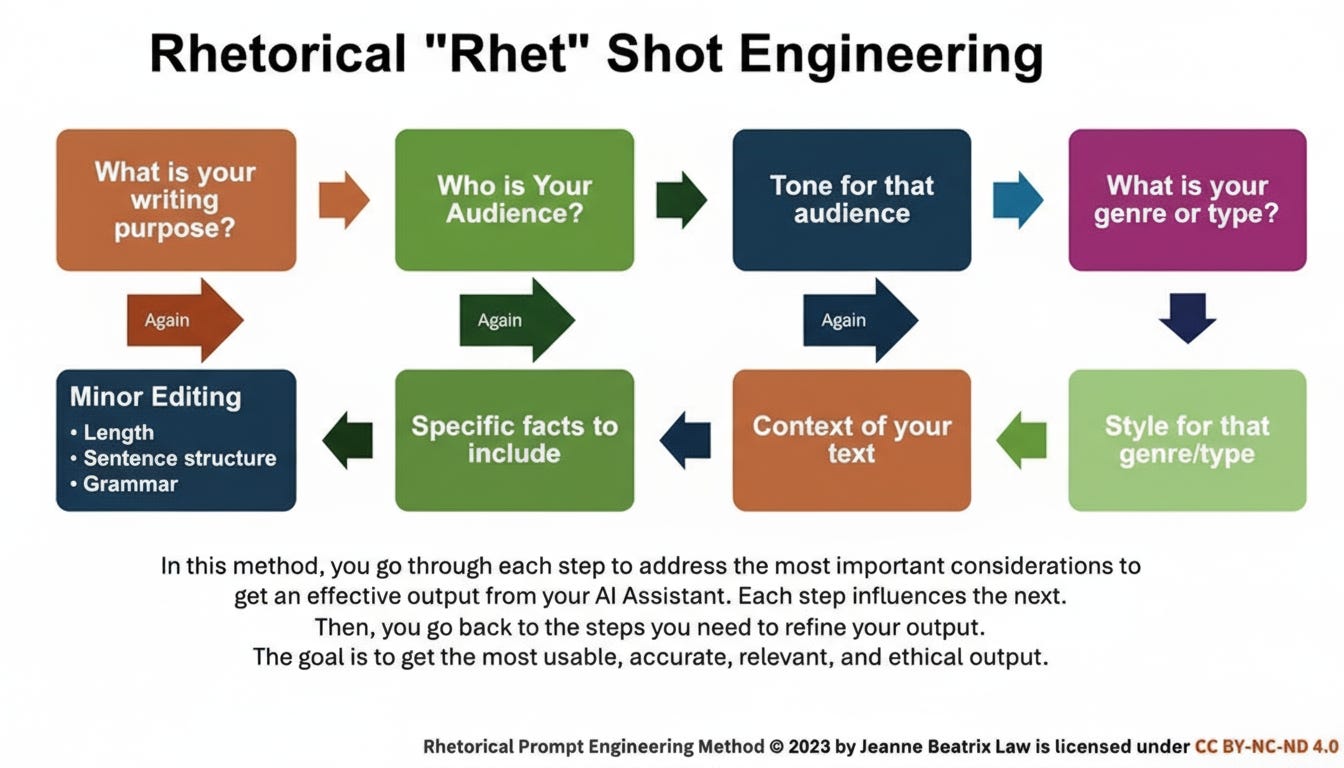
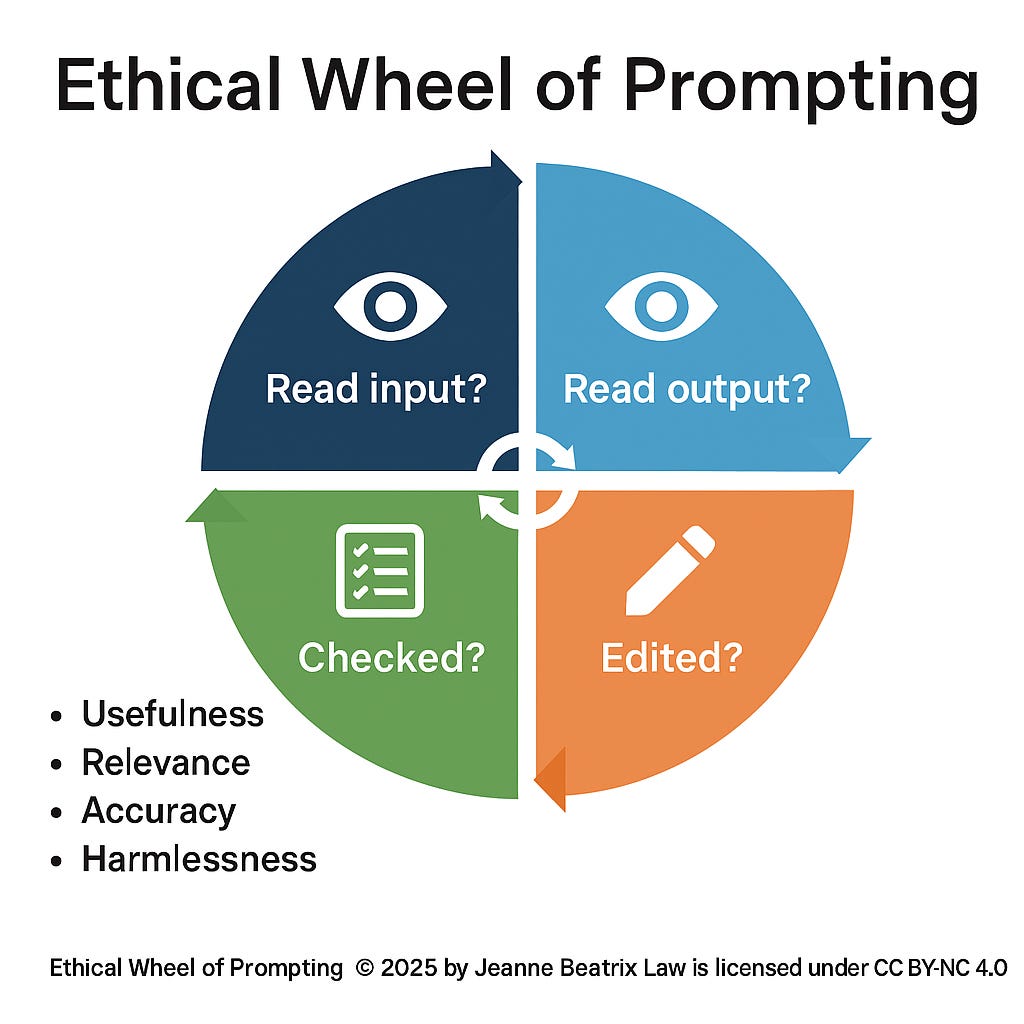
This is why I developed the Rhetorical Prompting Method (RPM)and the Ethical Wheel of Prompting (EWP).
RPM asks students to slow down before prompting by naming purpose, audience, tone, genre, style, context, facts, and revision goals explicitly in their prompts. The point is not to make prettier prompts or to speed up the writing process. The point is to externalize rhetorical thinking, which often slows down the process — at least at first.
The Ethical Wheel then asks students to evaluate AI output for usefulness, relevance, accuracy, and harmlessness before they accept, revise, reject, or share content.
I have published these frameworks in multiple public-facing teaching contexts because I see them as open pedagogical infrastructure, not proprietary classroom tricks. Both frameworks are licensed CC: BY ND and have been scaled for specific uses, which is the whole point of creating and testing frameworks, right?
In my WAC Clearinghouse article, “Before the Paragraph, After the Prompt,” students build a three-prompt portfolio, apply RPM to align purpose, audience, genre, and style, and then use EWP to audit AI exchanges for usefulness, relevance, accuracy, and harmlessness. The assignment asks students to visualize the path from prompt to AI output to human revision, emphasizing that the writer remains responsible for decisions at every stage.
That same principle shaped my Macmillan Bits on Bots work, where I introduced RPM and EWP as practical frameworks for human-driven AI collaboration in writing courses. The goal was never to make students dependent on AI. The goal was to help them become more explicit, reflective, and accountable about the choices they were already making when they used it.
I also made this argument in The Conversation: AI is not replacing student writing so much as reshaping it. The pedagogical question is not whether AI enters the writing process, but whether students know how to guide it, question it, revise against it, and maintain responsibility for the final work.
Together, RPM and EWP turn AI use into a visible writing process. They help students ask:
What am I trying to do? Who is this for? What did the AI give me? What is missing? What is wrong? What needs verification? What sounds unlike me? What should I keep, change, or reject?
Those are not technology questions only. They are writing questions. They’re also access questions. For neurodivergent writers, for example, our preliminary research (from Oxford presentation and forthcoming publication) showed that externalizing these steps can reduce cognitive load and make the writing process more sustainable. In my Cambridge presentation, I described AI not as a replacement for thinking, but as a tool that can help “hold the pieces together so that thinking can happen.”
If you want summaries of these two PowerPoints, with the understanding that the results are unpublished and preliminary, reach out to me at my KSU email: jlaw29@kennesaw.edu.
I’m still advocating for the phrase prompt engineering which is defined as writing effective instructions for a model so it consistently generates content that meets the user’s requirements. That sounds more technical than rhetorical, as if better AI writing depends on secret syntax, magic words, or whatever incantation makes the chatbot behave itself. But for writers, prompt engineering is fundamentally rhetorical, language work.
A prompt is a composed text, in the loose sense of the word. Obviously, a text can also be multimodal (video, image, sound, etc). Each prompt has an audience, even if that audience is a machine trained on human language. It has a purpose. It carries assumptions about genre, tone, style, evidence, context, constraints, and desired uptake.
In other words, prompt engineering for writing is not separate from rhetoric. It is rhetoric in a new interface.
This is not just my writing-professor bias showing its sensible side. OpenAI’s own documentation defines prompt engineering as “the process of writing effective instructions for a model” so that the model generates content that meets the user’s requirements. It also notes that models benefit from explicit instructions around how to accomplish tasks and that instructions can specify tone, goals, and examples. Translated into composition terms, that is purpose, context, genre, style, modeling, and audience expectation.
Scholars in digital rhetoric and computers and composition have made this connection explicit. Gupta and Shivers-McNair (2024) argue that studying ChatGPT prompt writing can promote critical AI literacies, and they define prompt writing as writing instructions for generative AI tools to elicit desired outputs. Their work treats prompt writing as a rhetorical activity rather than merely a technical trick.
That is the logic behind our Rhetorical Prompting Method (RPM), which, BTW, we have tested over the past three years with more than 12,000 student writers. A vague prompt such as “make this better” gives the model almost no rhetorical target. Better for what? For whom? In what genre? With what evidence? In whose voice? With what ethical limits?
A rhetorically engineered prompt is different:
Revise this 150-word grant summary for a mixed audience of faculty reviewers and workforce partners. Preserve my key claims. Reduce jargon. Keep an evidence-based, public-facing tone. Do not invent facts. Flag places where I need stronger evidence. Use only my attached document for truth.
Not better magic; better human-crafted writing.
This is also a sustainability argument. If prompting is vague, users often compensate by regenerating repeatedly until the output “feels” closer. Rhetorical prompting does not eliminate iteration—writing should still be recursive—but it can reduce wasteful iteration by helping writers ask more precise questions earlier.
So yes, prompt engineering matters. But for writing, it can’t be taught as hackery. It should be taught as rhetorical judgment: careful diction, clear context, audience awareness, genre knowledge, ethical constraint, and purposeful revision. The most sustainable prompt is often the one that knows what it is asking for.
Generative AI does not float above the material world. MIT News reports that generative AI carries environmental consequences, including increased electricity demand and water consumption. The computational infrastructure behind AI requires energy for training, deployment, and inference, and data centers require water for cooling. MIT also reports that researchers have estimated a ChatGPT query consumes about five times more electricity than a simple web search.
This does not mean students should never use AI. It means “use AI well”
must include “use AI with purpose.”
A sustainable genAI writing pedagogy can teach students not to regenerate endlessly because they are bored, vague, or unsure what they want. It can teach them to plan before prompting, prompt with rhetorical clarity, evaluate outputs carefully, and stop when the tool is no longer helping.
In other words, sustainable prompting is not separate from good writing pedagogy. It is good writing pedagogy. There’s a great calculator from the University of Maine that my students have really taken to, and another beta app that we built from it tied explicitly to RPM — both openly licensed to share :)
A student who knows their purpose will prompt less wastefully. A student who understands audience will need fewer generic rewrites. A student who evaluates usefulness, relevance, accuracy, and harmlessness will be less likely to accept fluent nonsense. A student who knows when not to use AI is practicing both ethical judgment and environmental restraint.
MIT’s follow-up reporting also points toward efficiency as part of reducing AI’s environmental burden, including smaller models, more efficient hardware, and smarter data-center operations. Those system-level changes are essential. But educators can also teach user-level restraint: choose the right tool, write the prompt carefully, verify before regenerating, and stop when the exchange stops serving the writing task.
The next phase of AI literacy should include the carbon shadow of the prompt.
We now have preliminary findings from an expanded TAPs dataset of approximately 100 students (stay tuned for publications). I am not ready to cite those findings formally yet, but I can say this: the larger dataset is making the story more interesting, not less.
Students are not a single category of “AI users.” They are planners, tinkerers, avoiders, over-reliers, skeptics, experimenters, revisers, shortcut-seekers, and careful editors—sometimes all in the same session.
That is why TAPs are important behavioral observation tools. They help us move from moral panic to process evidence.
If we only look at the final text, we may miss the student’s judgment. If we only ask whether AI was used, we may miss how it was used. If we only ban the tool, we may miss the chance to teach students how writing, authorship, access, and ethics are changing in front of us.
The goal is not AI abstinence, nor is it AI surrender.
It might be human-at-the-helm composing: rhetorical, ethical, neuroinclusive, documented, and sustainable.
Students are already writing with AI. The serious question is whether we will help them become better writers because of that reality—or leave them alone in the prompt box and call that integrity.
Thanks for reading - Jeanne
No posts
Comments
Nothing yet. Say the first thing.
Sign in to join the conversation.