
Readers unfamiliar with Fourth Wall Phantoms may wish to read my notes only after reading the book.
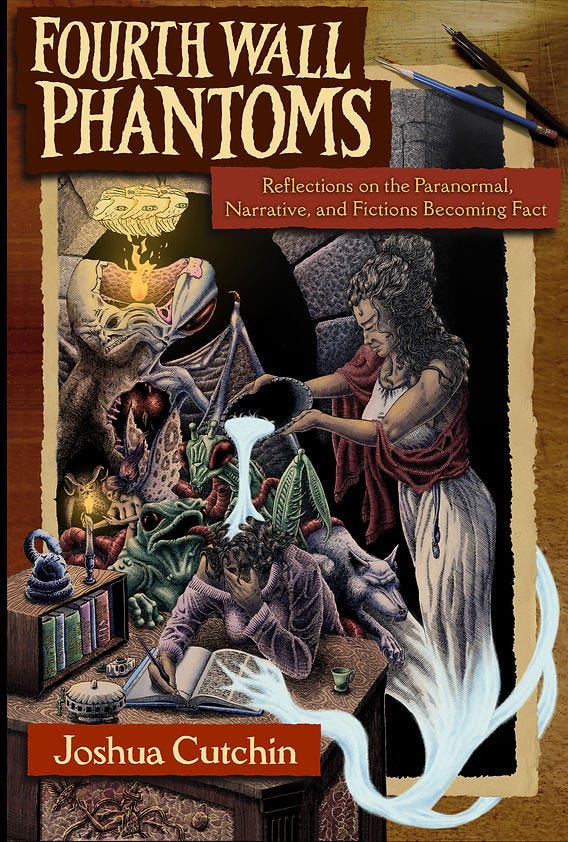
Fourth Wall Phantoms (2025) by Joshua Cutchin uses narratology as a framework to explore experiences of high strangeness and the paranormal.
Cutchin argues that UFOs, cryptids, and spirits are not merely objective or subjective events, but embodied narratives. He uses the Ouroboros as a central metaphor: a continuous feedback loop where human stories, media, and imagination bleed into reality, and reality in turn shapes those stories, creating a boundary where fiction becomes fact.
The traditional dramatic concept of the "fourth wall" ceases to be a secure barrier separating an audience from a performance, mutating instead into a highly porous, bi-directional door through which fictions can physically step into and address our lives.
To unpack this methodology, my analysis will first supply a chapter-by-chapter summary of Cutchin’s text, highlighting his specific focus on narratological mechanics, tulpas, screen memories, Proppian morphology, and metalepsis.
Armed with this critical toolkit, I will explore Lucy Clifford’s 1882 Victorian horror story, "The New Mother." By examining the physicalization of fictional bogeymen, we will chart precisely how the tale serves as an active script for a full-scale incursion of high strangeness.
Chapter Synopses
1. The Fourth Wall is a Door
Narratological Focus: The breaking of the "fourth wall"—the imaginary boundary between a performance and the audience.
The High Strangeness Connection: Cutchin introduces the core concept of "fictional incursions," where characters or tropes from fiction manifest in waking reality. He reviews accounts of individuals seeing entities like Donald Duck or comic book characters. Cutchin frames high strangeness as operating on "dream logic" that breaches the fourth wall of consensus reality, turning an artistic barrier into a literal doorway.
The Metaleptic Shatter: In narratology, metalepsis occurs when a character breaks the fourth wall to address the audience. Or when an author steps into their own creation. Cutchin posits that when humans experience high strangeness—such as a UFO or cryptid encounter—a literal "metaleptic shatter" occurs. The phenomenon forces the witness to realize they are not passive audience members looking at a separate, objective event; rather, the phenomenon "looks back" and draws the human directly into the unfolding cosmic script.
The Phenomenon as a Mirror: Cutchin argues that the phenomenon behaves like a manipulative director or projectionist. It reaches across the fourth wall into the audience's collective mind-store to pull out familiar imagery—whether it's sci-fi film tropes, folklore, or personal memories—and uses them as masks to interface with us.
Co-Authoring Reality: Because the fourth wall is a door, the exchange goes both ways. Human imagination, fear, media trends, and stories do not just stay contained within our minds; they feed back into the ether, "re-writing" the templates and forms that the phenomenon utilizes to breach our consensus reality. Humanity is simultaneously the audience, the actors, and the co-authors of the anomalous experience.
2. The Truth is Stranger
Narratological Focus: The externalization of the creative process and authorial inspiration.
The High Strangeness Connection: Cutchin documents numerous historical and modern accounts of writers (e.g., Charles Dickens, Alan Moore, Robert E. Howard) whose fictional characters materialized physically or autonomously dictated stories. This chapter illustrates the Ouroboros in action: intense human imagination "kindles" a narrative until it rebels against its creator and crosses over into physical space, interacting with the audience as an independent entity.
3. Mind Over Matter, Matter Over Mind
Narratological Focus: The metaphysical and philosophical underpinnings of narrative construction (Idealism, Panpsychism, and Retrocausality).
The High Strangeness Connection: Exploring how stories materialize, Cutchin contrasts the concepts of tulpas and egregores (thoughtforms) with Eric Wargo’s theory of retrocausality—where future experiences loop backward to inspire past creative works. Cutchin posits an ex nihilo (out of nothing) space at the center of the time-loop where the Ouroboros feeds on itself, allowing human consciousness and a living universe to co-create the physical landscape of the weird.
4. Lying Saucers
Narratological Focus: Science fiction as a modern mythology; the concept of "screen memories."
The High Strangeness Connection: Cutchin focuses on UFO encounters that mimic science fiction films and pop culture (e.g., “Star Wars” Ewoks, “Star Trek” Vulcan ears, or Michael Jackson stage personas appearing during abductions). He argues that the phenomenon utilizes our media catalog as a script. The Ouroboros loop is explicitly traced via the term "flying saucer" itself: a typo/misnomer in historical media loop-back to cause the phenomenon to physically adjust its shape to match media-bred media expectations.
5. Props to Propp
Narratological Focus: Structuralism and Vladimir Propp’s 31 functions of the folk "wondertale."
The High Strangeness Connection: Cutchin maps the standard alien abduction narrative directly onto Propp's structural blueprint for fairytales. He demonstrates that the traumatic, confusing steps of an abduction match the narrative beats of a protagonist being tested by an "adversary" and receiving a "magical agent." Cutchin aligns this with Peter Gilet's work to show that both fairytales and high strangeness encounters are driven by a singular, underlying initiatory archetype embedded in reality.
6. Beyond Us and Within Us
Narratological Focus: Cinematic techniques (multiperspectivity, setting, and character-effects).
The High Strangeness Connection: The phenomenon mimics the mechanics of a film director or projectionist. Just as a setting in horror literature mirrors a character's internal psyche, the landscapes of high strangeness—utilitarian UFO rooms or dark, isolated woods—exteriorize the subconscious states of the experiencer. The Ouroboros loop here shows humans acting simultaneously as the audience, the actors, and the co-authors of the anomaly.
7. Metalepsis Mundi
Narratological Focus: Metalepsis—the structural violation of narrative levels (e.g., an author stepping into their own book or a character attacking the reader).
The High Strangeness Connection: Cutchin frames the entire physical universe as a layered narrative. When a person encounters a cryptid or a UFO, a "metaleptic shatter" occurs. He applies Jeffrey Kripal’s "Super-Story" to show that by looking at the phenomenon, the human reader inadvertently invites the phenomenon to look back, drag them into the text, and permanently alter their life's plotline.
8. The pH of Disbelief
Narratological Focus: The suspension of disbelief and the corrosive role of absolute certainty.
The High Strangeness Connection: Cutchin discusses how the absurd, "bizarre theater" of paranormal events (like trickster behavior in crop circles or nonsensical statements from ufonauts) is deliberately designed to short-circuit human rationality. The Ouroboros loop requires a delicate "acidity" or balance of belief; absolute skepticism or absolute dogma kills the narrative loop. The phenomenon produces absurd fictions to stay safely in the liminal zone between fact and fiction.
9. Monstrum
Narratological Focus: The etymology of monsters as "demonstrations" or signs pointing to a deeper text.
The High Strangeness Connection: Shifting to cryptozoology, Cutchin argues that cryptids (Bigfoot, Mothman, lake monsters) are not hidden biological animals, but living narrative punctuation marks. They are physical manifestations of the untamed wilderness or psychological trauma, breaking the fourth wall to remind humanity of the wild, unmapped chapters of reality.
10. Made of Stories
Narratological Focus: The narrative architecture of memory and identity.
The High Strangeness Connection: Cutchin looks at the realm of spirits and ghosts. Rather than surviving consciousness or electromagnetic echoes, Cutchin argues that spirits are literally made of stories. They are independent narrative fragments that attach themselves to physical spaces or living people, using the Ouroboros loop to pull energy from our attention to keep their fading storylines alive.
11. Ghost Written
Narratological Focus: Pseudepigrapha, pastiche, and the evolution of folklore templates.
The High Strangeness Connection: Cutchin analyzes how the specific iconography of the paranormal changes across centuries. He shows how Victorian literary inventions of fairies and ghosts eventually rewrote older folk beliefs. The updated literary templates then leaked back into the collective unconscious, dictating how modern eyewitnesses physically see and experience encounters.
12. Folklore in Superposition
Narratological Focus: Quantum-like narrative superposition (the intersection of multiple genres).
The High Strangeness Connection: Cutchin explores cases that defy clean categorization—where a single event simultaneously looks like a UFO sighting, a fairy encounter, and a poltergeist haunting. He suggests that before an event is observed and written down into a human journal, it exists in a narrative superposition. The Ouroboros loop collapses this wave function based on whatever cultural genre the observer is most familiar with.
13. Ideas Have People
Narratological Focus: The concept of autonomy in memes, ideas, and archetypes.
The High Strangeness Connection: Reversing the materialist view that humans possess ideas, Cutchin argues that powerful narrative ideas and archetypes possess us. He presents accounts of everyday people who unwittingly begin to embody specific mythological figures or deities without prior knowledge of them. The archetype uses the human as an instrument to physically enact its story in our world.
14. Prometheus with a Paintbrush
Narratological Focus: The artist as a literal shaman and demiurge.
The High Strangeness Connection: Cutchin concludes the main text by positioning the human creative act as a deeply volatile, magical operation. When artists, filmmakers, and writers build cohesive worlds, they are stealing Promethean fire. They do not just reflect reality; they feed the Ouroboros. They write the code that the phenomenon uses to breach the fourth wall, meaning humanity bears a creative responsibility for what haunts its steps.
Case Study: Lucy Clifford's story "The New Mother”
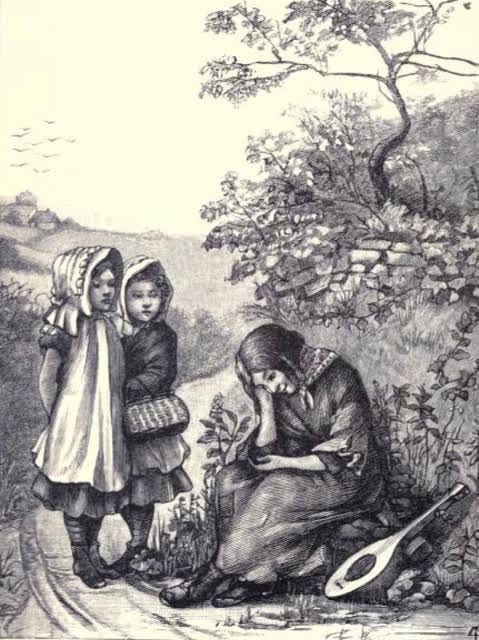
Lucy Clifford’s 1882 "The New Mother" is a chilling moral allegory that operates as a pristine example of the psychological and narrative mechanisms Joshua Cutchin explores in Fourth Wall Phantoms. By examining the trajectory of the two children, Blue-Eyes and Turkey, through Cutchin's advanced literary criticism toolkit, we can map how a seemingly rigid Victorian cautionary tale mutates into a terrifying display of high strangeness, narrative entities, and the breakdown of consensus reality.
1. The Fourth Wall as a Door & Fictional Incursions
In Cutchin’s framework, the "fourth wall" is not a static boundary between a text and its audience, but a porous door through which fictions can step into reality. Clifford’s story explicitly literalizes this concept through the threat of the New Mother.
Initially, the New Mother is introduced purely as a textual/linguistic construct—a horrific fable invented by the biological mother to enforce an interdiction ("if you are very naughty... I shall have to go away and send home a new mother, with glass eyes and wooden tail"). The children treat it as an impossibility, a fiction: "There is no mother with a wooden tail and glass eyes... they would be much too expensive to make."
However, the children's subsequent escalating acts of real naughtiness serve as a kindling threshold. They obsessively focus on the narrative rules laid out by a mysterious, wild village girl. By throwing water on the fire, breaking the clock, and smashing a looking-glass, they are not simply misbehaving; they are ritually enacting a script that shatters the fourth wall.
The climax of the story features a terrifying fictional incursion: the linguistic bogeyman materializes in the physical world. The children hear something heavy being dragged outside and look out the window to behold the flashing of two glass eyes beneath a black satin poke bonnet. The fictional nightmare has breached the fourth wall of their cottage, physically cracking and splintering the painted door with her wooden tail.
2. The Co-Creation Hypothesis & The "Mind Store"
Cutchin outlines the Co-Creation Hypothesis, suggesting that the high strangeness entities we encounter are tailored by a living universe using masks plucked from our own cultural "mind store."
In "The New Mother," the agent of this manifestation is the wild village girl with the peardrum. The peardrum itself acts as a physicalized symbol of the narrative process: it is a musical instrument with a box on the side containing a little peasant man and woman who only dance for truly naughty children. The girl refuses to show Blue Eyes and Turkey the dance because the children are inherently "good."
Driven by an absolute obsession to see this hidden narrative, the children inadvertently co-create their own doom. They draw upon the specific, horrifying imagery provided by their mother’s warning. When the environment warps around them—marked by the broken clock striking eleven and the discordant clanging of the peardrum—the universe reflects back their chosen script. They expected a monster with glass eyes and a wooden tail, and through their compliance with the narrative rules of the village girl, that is precisely the placeholder reality gives them.
3. The Structuralist Fairytale Template (Propp & Gilet)
Mapping Clifford's narrative onto Vladimir Propp’s 31 functions of the wondertale and Peter Gilet's streamlined model reveals a horrifying inversion of the classic initiatory archetype Cutchin describes:
Function I (Absentation): The story opens with a missing family member—the father is far away at sea. Later, the biological mother absents herself, taking the baby with her.
Function II & III (Interdiction & Violation): The mother delivers an explicit interdiction: "Don’t look at any strangers you meet, and be sure you do not talk with them." Blue-Eyes and Turkey immediately violate this by engaging with the wild girl with a peardrum by the stones.
The Villain / Adversary / Donor: In a bizarre metaleptic twist, the wild village girl acts simultaneously as the Donor (offering a magical agent/secret through the peardrum) and the Adversary. She tests the children, telling them it requires "a great deal of skill to be naughty well."
Function VIII (The Villain Causes Harm): Unlike traditional fairytales where the Hero overcomes the test, Blue-Eyes and Turkey fail the moral calculus. The harm caused is the permanent exile of their real mother and the arrival of the New Mother.
The Double & Failed Return: Gilet notes that characters can exhibit a "preoccupation with the normal world." The children clean the cottage, wash the floor, and rub the tins in a desperate attempt to return to consensus reality. But they have gone too far past the threshold. They are cast out into the forest forever, sleeping on dead leaves, looking back at a home that is permanently closed to them and occupied by an alien entity.
4. Philosophical Idealism and the Metaleptic Shatter
Cutchin utilizes Idealism—the philosophy that reality is fundamentally mental and continuous with our consciousness—to explain why the weird cannot be "scienced away." In "The New Mother," space and matter become entirely subordinate to the psychological and narrative state of the characters.
When the children fully commit to their "naughtiness," the environment reflects their inner moral decay. The fire is extinguished, the white boards are neglected, and the clock is broken. A metaleptic shatter occurs when the boundary between the mother's warning (the text) and the children's physical home breaks down.
The New Mother represents what Cutchin refers to as a meaning event or an acausal synchronicity elevated to a horrific peak. Her features are explicitly unnatural, inorganic, and robotic—glass eyes, a wooden tail—resembling the bizarre, clichéd, or "fake" presentation often reported by alien abductees or witnesses of high strangeness (such as the stiff, caricatured Men-in-Black or the mechanical, cartoonish flying saucers). She is a literal puppet of the story who has usurped the role of the director.
Conclusion: The Ouroboros of the Final Flash
The story closes on a haunting image that perfectly encapsulates Cutchin's concept of the eternal, living nature of text:
"Now and then, when the darkness has fallen and the night is still... a blinding flash comes through the window, and they know it is the light from the new mother's glass eyes..."
This blinding flash through the cottage window behaves exactly like the anomalous light phenomena at the heart of UFO and cryptid encounters. It is an engine of radical doubt.
The children are trapped in an ongoing, looping nightmare where they must watch their old home from the dark forest, haunted by a physicalized fiction they co-authored but can never dismantle. They wanted to see a story dance, and in the end, they became the captive, tormented characters imprisoned within it.
Conclusions
Fourth Wall Phantoms serves as an valuable toolkit for students, readers, and critics of horror fiction. By bridging the gap between theoretical narratology and the lived experiences of high strangeness, Cutchin strips horror of its clinical, materialist limitations and restores it to its true home: the realm of profound psychological and spiritual meaning. Rather than viewing genre tropes—such as screen memories, shape-shifting entities, and bizarre theatrical plots—as mere consumer contamination or trivial clichés, Cutchin forces us to recognize them as essential components of an underlying, universal structure. He elegantly demonstrates that our oldest legends, modern horror pulps, and contemporary cinematic nightmares are not just idle fabrications; they are the literal vocabulary of a living, co-creative reality.
Cutchin's Framework
At the heart of Cutchin's framework is an uncompromising refusal to let the "certainty fetish" of absolute skepticism or rigid dogma sanitize the weird. By treating both textual fiction and real-world encounters as part of an overlapping Ouroboros loop, his methodology offers a superior, more holistic way to track the evolution of horror. This lens proves that the hard lines we draw between an author's imagination and a witness's testimony are fundamentally illusory. When we analyze horror through this unified, Kripalian perspective, a story like Lucy Clifford's "The New Mother" ceases to be a Victorian warning and becomes an active, terrifying map of how human dread can kindle and physicalize an anomaly.
Cutchin’s framework leaves the reader with the deeply unsettling, yet thrilling realization that the boundary between fact and fiction is entirely porous—and that when we peer into the abyss of horror fiction, we are looking directly into a mirror of our own reality.
Cutchin's Skill
Cutchin’s unique skill lies in his autodidactic ability to weaponize dense, often impenetrable narratological concepts—such as metalepsis, multiperspectivity, and Proppian morphology—and transform them into concrete, highly scannable tools for exploring everyday strangeness. He steers clear of the reductionist "free-for-all" traps of simulation theory or the multiverse, instead choosing to work within parameters that protect the raw, emotional human element of the encounter. Walking this razor-sharp line with characteristic humility and agnosticism, Cutchin avoids coming off like a rigid lecturer, choosing instead to act as a grounded, insightful guide through the marginal dirt of the paranormal landscape. Ultimately, his brilliant study succeeds because it does not try to scientifically explain away the mystery. Instead, Cutchin teaches us how to feel its truth, providing an essential and enduring roadmap for anyone brave enough to ask the right question: why do horror stories continue to leak out of the darkness and into our lives?
Jay
20 July 2026
Comments
Nothing yet. Say the first thing.
Sign in to join the conversation.