
Readers unfamiliar with Helltracks and Dreamthorpe may wish to read my note only after reading the novels.
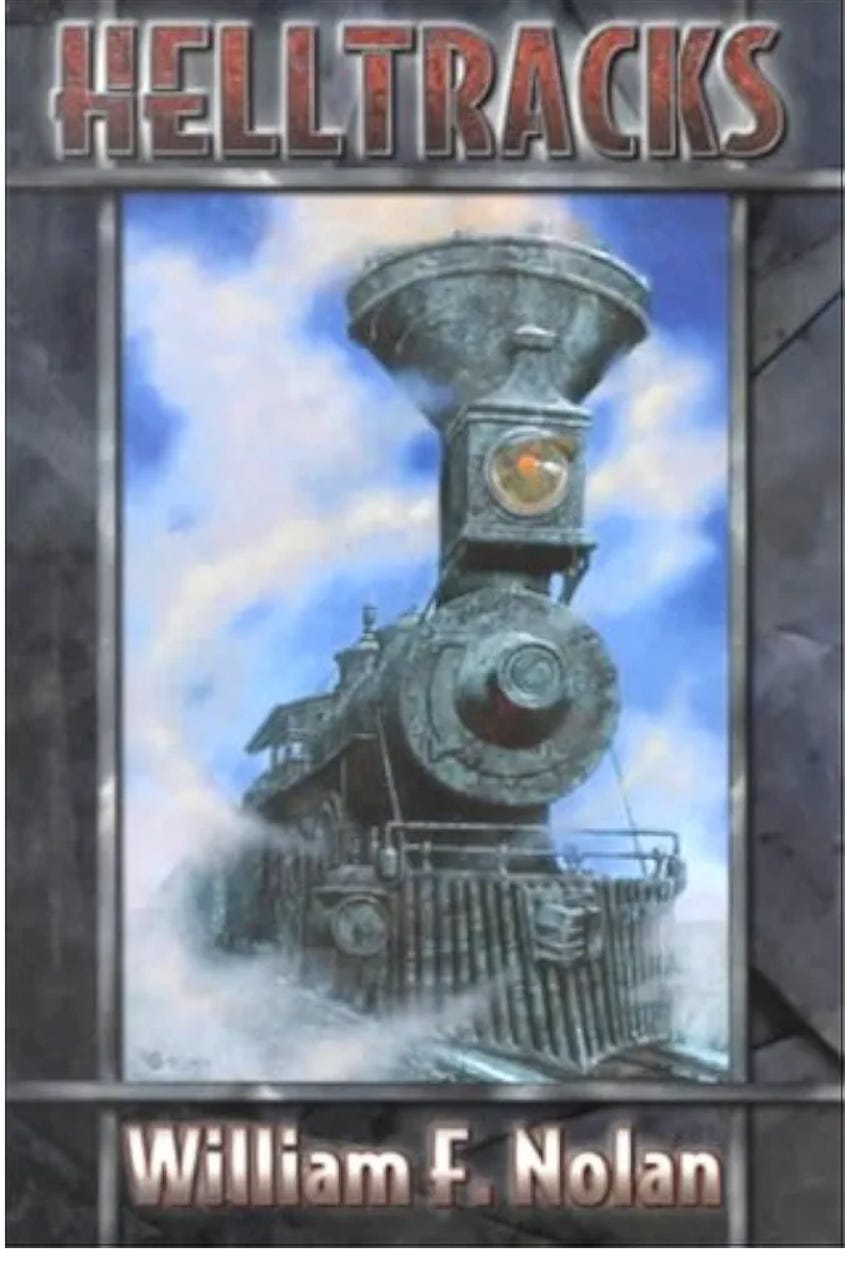
William F. Nolan’s Helltracks blends Western, crime, and supernatural horror elements against a uniquely unforgiving Montana landscape around the Little Belt Mountains.
Plot Summary
The novel follows two primary and converging narrative threads.
The Ventry Family and the Train: Following the death of his wife, aging sheep rancher Paul Ventry faces the departure of his daughter, Amy, who seeks a new life in the city. When Amy vanishes after boarding what she describes in a postcard as an "old black steamer," Ventry becomes obsessed with finding a train that authorities insist no longer exists. His search leads him into the mountains, where he discovers a terrifying truth: an ancient steam locomotive has achieved a sentient, organic life, hunting human prey to sustain its existence.
The Serial Killer: Alternating the Ventry family storyline is the journal of Edward Michael Timmons, a "positive thinking" serial killer known as the "Big Sky Strangler." Timmons traverses Montana's highways, recording his clinical, cold-blooded murders and his twisted justifications for them.
The novel culminates as Paul Ventry’s son, Josh, and Josh’s companion Cris Mitchell—a mining executive and explosives expert—confront the living train in a desperate bid for survival and vengeance.
Location and Atmosphere
Nolan utilizes the modern Montana landscape as a vivid and essential horror component. The setting shifts between vast open spaces of prairies to claustrophobic depths of the Little Belt Mountains.
Nolan’s atmosphere conveys localized mysticism, drawing on indigenous beliefs that certain sacred areas allow nature to reshape itself into organic life. This creates a "fierce, compact" mood characterized by isolation, grief, and an underlying dread of entities that shun the sun and travel only by night.
Structure and Comparison
Nolan notes in his afterword1 that he wrote the serial killer thread and the Ventry thread as separate units before braiding them together. This provides an off-kilter rhythmic counterpoint between the grounded psychological horror of a human predator and the grander, supernatural horror of the living train.
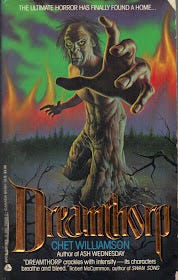
Helltracks’ theme of a small community or family unit facing evil in the wilderness draws comparisons to Chet Williamson’s 1989 novel Dreamthorpe. Williamson similarly explores how a setting's dark history and landscape can manifest as modern terror. Dreamthorpe is also structured in alternating chapters with a serial killer’s trek.
Changes from "Lonely Train A' Comin'" (1981)
Helltracks is an expansion of Nolan’s short story, originally titled "The Train." I first read it in the 80s as "Lonely Train A' Comin'" (1981).
Key changes include:
Subplot Addition: The character of Edward Timmons (the serial killer) was not in the original story; Nolan integrated him from another short piece, "The Cure," to provide the secondary narrative layer needed for a full-length novel.
Character Depth: In the short story, Paul Ventry is a stolid widower whose sister, Amy, dies after boarding the train. The novel expands the family dynamic significantly, adding Josh Ventry and Cris Mitchell, and changing Amy from Paul's sister to his daughter to heighten the emotional stakes.
Setting Realism: Nolan initially wrote the story without having visited Montana. After a 1981 research trip, he shifted the setting to include specific geographic locations like Ross Fork and Lewistown, posing supernatural elements in carefully realised surroundings.
Significance of the Dual Narratives
The decision to follow both a family battling a supernatural train and a serial killer writing his memoirs serves as a fast-paced study of "twin evils."
Human vs. Inhuman Evil: Timmons represents the "negative energy" of human depravity—a calculated, conscious choice to destroy life. The train represents an evolutionary, instinctual "spirit life"—an organism that has achieved life over a century, but has not achieved thought.
The Intersection of Trauma
By pushing both plot threads, Nolan explores how different tracks end in violent death. The Ventry family’s search for answers to a family member’s death—and the killer coming to grips with his insanity—both lead to the same wilderness: whether evil is human-made or supernaturally born, its impact on both the innocent and the culpable is equally devastating.
Hell tracks lead to Hell, but it is only a final destination for some.
Jay
6 May 2026
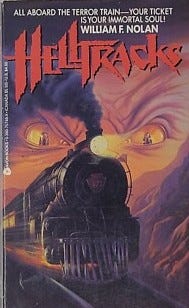
Nolan, W. F. (2000). Helltracks. Cemetery Dance Publications.
Comments
Nothing yet. Say the first thing.
Sign in to join the conversation.