
Hello everyone:
As always, please remember to scroll past the end of the essay to read some curated Anthropocene news.
Now on to this week’s writing:
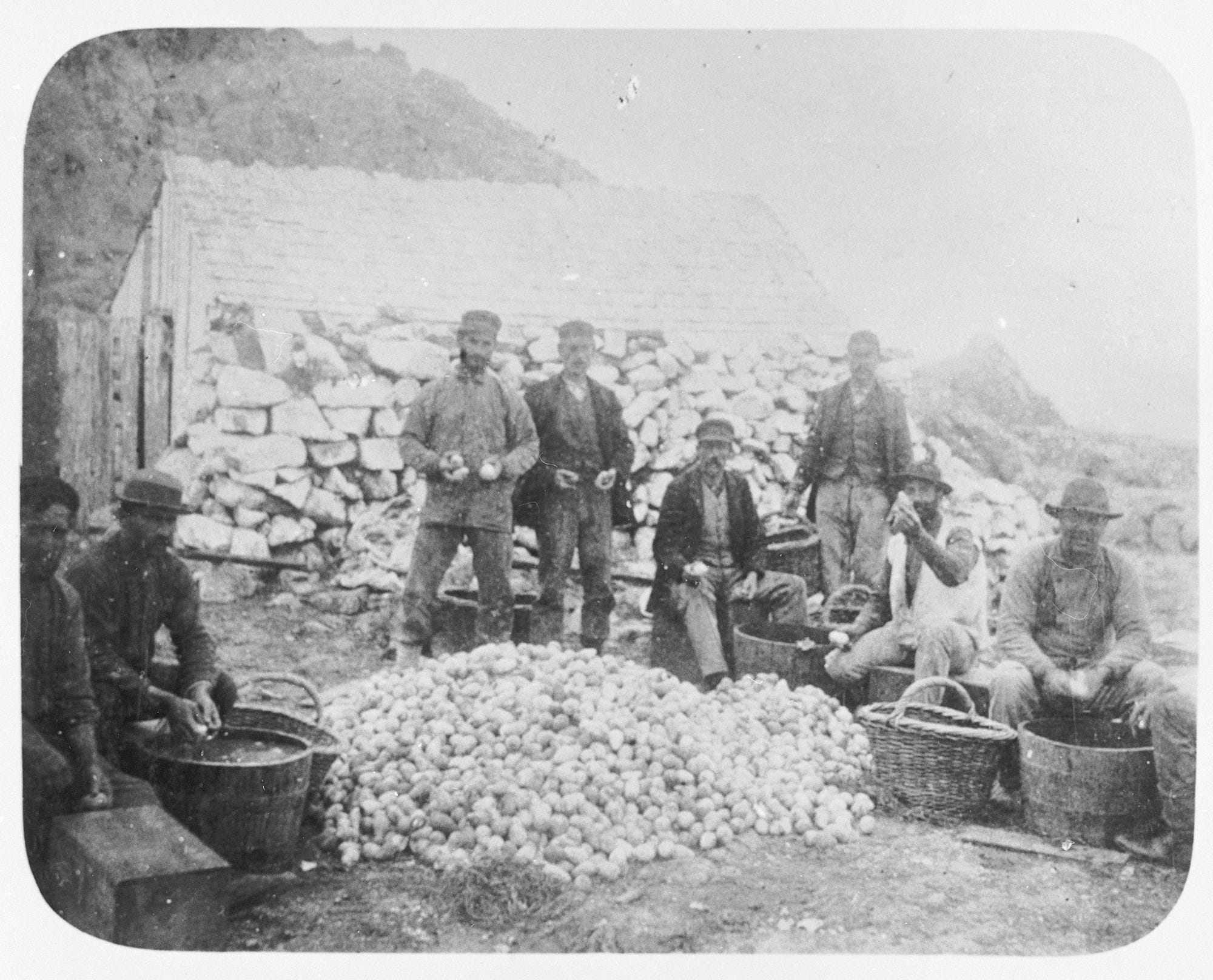
Here’s the image that’s haunted me this week: Children from a small fishing village brought out to an offshore island and paid to walk on gull nests and crush their eggs.
My grandmother Sally (my mother’s mother) was one of those children, here in midcoast Maine. She was born in 1910, so let’s say the island trips occurred circa 1920. Later in life - after World Wars and civil rights and space shuttles - she was still bothered by what she’d done.
My mother reminded me of the story recently, and the image of kids on a remote treeless isle stepping on gull eggs immediately felt to me like the kernel of a great novel of ecological grief and regret and unrequited dreams.
There’s a lot we don’t know. Was it fun for the kids, going out to the island to hunt for eggs, and breaking them with the joy of breaking ice on puddles? Or was it a sad and dystopian Easter egg hunt? (It probably depended on the kid.) What was it like for a child being dive-bombed and screamed at by a mob of frantic, angry gull parents? (Loud and chaotic, if not traumatic.) Were the kids barefoot, with the yolk squishing up through their toes? (Probably not, because the walking would have been too difficult.) How much were they paid, and what did those pennies mean to them?
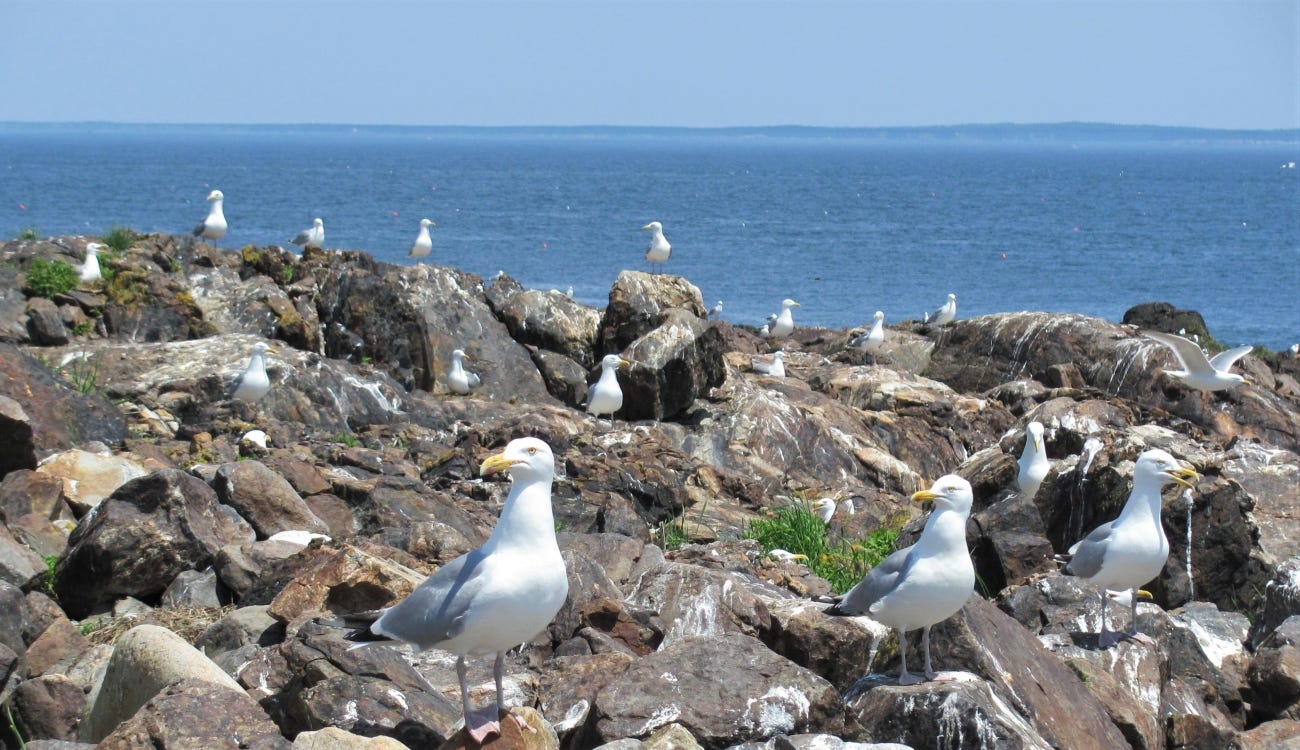
As for the Why of it, my mother remembers Sally emphasizing that the fishermen wanted fewer gulls around. This was back in a time of relative ecological abundance, when the draggers (local trawling boats) might come back to the harbor after a short trip so laden with fish that the stern was low in the water. Clouds of screaming gulls followed them in, hovering over and around the boats, feeding on the bycatch being tossed overboard and likely making a birdshit-spattered mess of men, fish, and deck. And these birds were, many fishermen believed, competing for the fish that these often impoverished fishing communities laid claim to.
But then I asked Steve Kress about it. Steve is perhaps the world’s foremost authority on seabird colony restoration and conservation. For the last half-century, he’s pioneered strategies for luring endangered seabird species to sites that will boost their population. He is best known for Project Puffin on Eastern Egg Rock, which is at the mouth of Muscongus Bay, just several miles from our house. Steve lives nearby, and I saw him the day after my mother brought up Sally’s story.
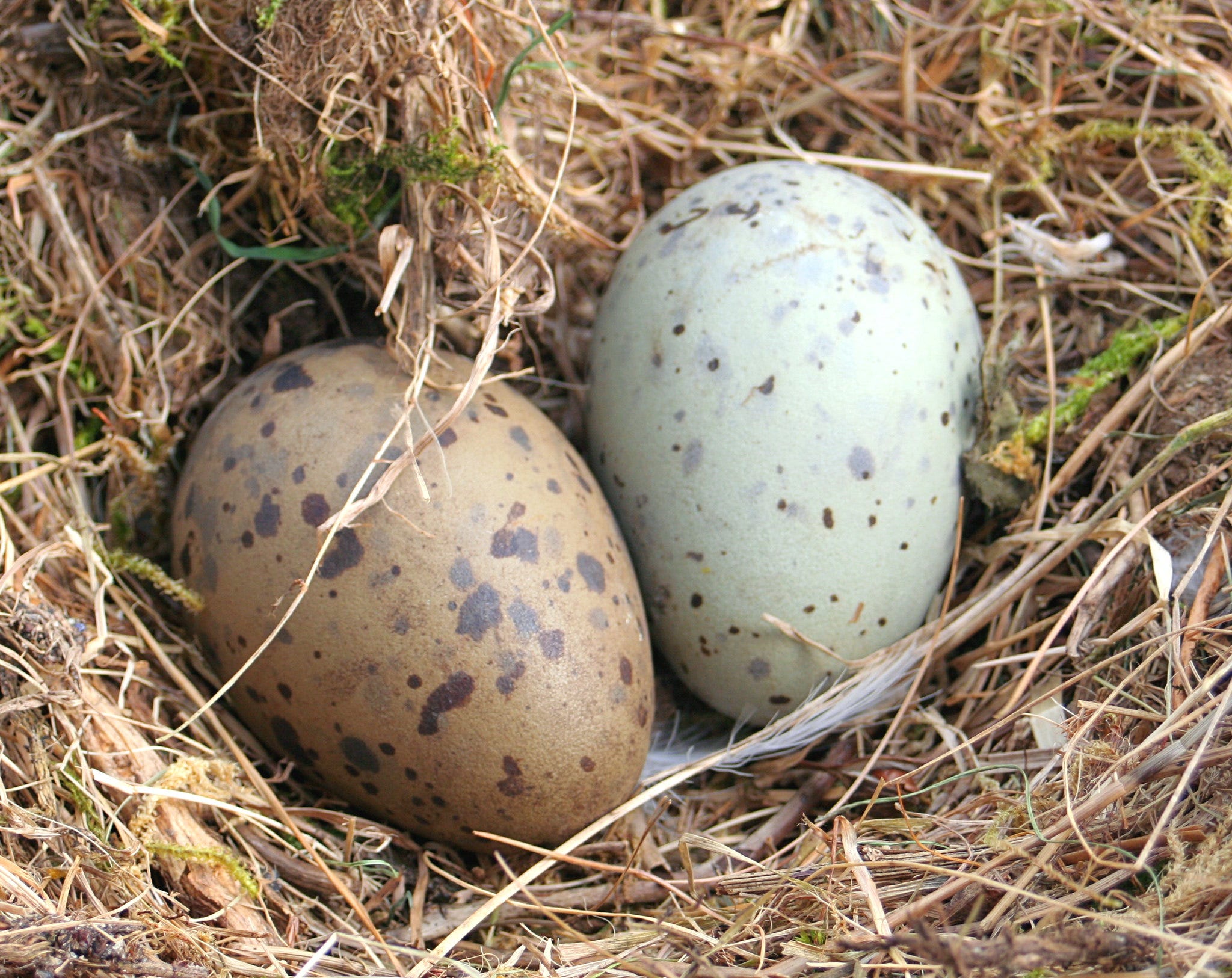
Steve was intrigued by the tale but not surprised. In the 19th and early 20th centuries, people on the coast of Maine, as elsewhere, were busy in their destruction of eggs and birds. But Steve didn’t think that the egg-breaking was about fishermen killing the competition. It was, he thought, about the community organizing their food supply. Seabird eggs were an important food source, but no one liked cracking open an egg and finding a partially developed chick in it. Crushing all the eggs prompted the birds to lay more, all at the same time, which meant the egg-gatherers had a much better idea of how long their next meal had been incubating.
Whatever the reason, the egg-smashing was part of a larger set of traditions and activities that had devastated many bird populations in North America, from egrets and gulls to eagles and hawks. Birds and eggs were eaten, and birds were taken for their feathers or simply shot for sport. (The extinction of the passenger pigeon, once a population of billions, is the most notable example.) As an aside, Steve noted that, here in Maine, cormorant chicks were sometimes taken from the nest and used as bait when fishing for cod by hand-line. (The cruelty is as notable as what it says about the size of the cod back then). The result of this unregulated culture of exploitation was the radical decline of birds across the continent.
At Eastern Egg Rock - named because it had always been a reliable place to harvest eggs - puffins had been eliminated by hunters by the 1880s. (There are two other Egg Rock islands in Muscongus Bay, and many more along the Maine coast.) By 1902, only one pair of puffins remained in all of Maine’s waters, at Matinicus Rock, and a warden was hired to protect them.
Part of what makes Sally’s story interesting is its timing. The Migratory Bird Treaty Act (MBTA) had been signed into law in 1918, around the same time she was crushing gull eggs. It’s difficult to overstate the importance of the MBTA in protecting North American birds in the intervening hundred-plus years. The treaty codified an agreement with Canada to work together on protecting the many bird species headed for extinction. In later decades, treaties with Mexico, Japan, and Russia broadened the scope and effectiveness of the MBTA. The Audubon Society, which advocated for the treaty back in 1918, believes it may have saved billions of birds in the years since.
The language of the Migratory Bird Treaty Act had to be as comprehensive as the threats to birds. Here’s how the U.S. Fish and Wildlife Service summarizes it:
The MBTA provides that it is unlawful to pursue, hunt, take, capture, kill, possess, sell, purchase, barter, import, export, or transport any migratory bird, or any part, nest, or egg or any such bird, unless authorized under a permit issued by the Secretary of the Interior. Some regulatory exceptions apply. Take is defined in regulations as: ‘pursue, hunt, shoot, wound, kill, trap, capture, or collect, or attempt to pursue, hunt, shoot, wound, kill, trap, capture, or collect.’
Despite the MBTA, saving birds in the 21st century is largely triage care. The hope of bringing back pre-Anthropocene avian abundance is still an unrequited dream and a story of ecological grief. Many North American bird species face existential threats, almost entirely because of human behavior and choices. Development and agriculture have filled in half our wetlands and flooded the great plains with pesticides, herbicides, fertilizers, and PFAS, eliminating or making toxic the habitats for more species than I want to count. Cats and windows and roads kill billions of songbirds every year.
It is a mark of how difficult things have become that many migratory birds, who have to navigate vast stretches of our civilizational minefields twice a year, are still considered species of “Low Concern.” I build and maintain nest box colonies for tree swallows, in part because their population dropped by an estimated 30% between 1966 and 2019. And yet, according to All About Birds, tree swallows only rate a 6 out of 20 on the Continental Concern Score.
Seabirds, meanwhile, have suffered a 70% decline in the last 75 years. In Alaska and Hawaii, the declines range from 55% to 95% over recent decades. The most recent State of the Birds report reminds us that “A heat wave in Alaskan waters from 2014 to 2016 starved 4 million Common Murres—the largest documented wildlife mortality event in the modern era.” There are so many pressures on seabird populations now, from avian flu to ocean plastics to nest-raiding invasive species to, especially, the chaos in ocean food webs caused by hotter seas and skies. Low-lying seabird colonies are being lost to both the old threat of development and the new threat of rising waters.
Here in the Gulf of Maine, seabird declines are matched by declines in the trawling fisheries caused by quickly warming waters and the excessive catch and bycatch of commercial fish species (cod, haddock, flounder, etc.) in previous decades. The industry has been literally decimated - reduced by 90% - from the early 1990s, when around 300 groundfishing boats worked coastal waters. Now there are about 30. Their trips out into the gulf are longer, the fish are smaller, and the nets are less full. The problem was never competition from the gulls.
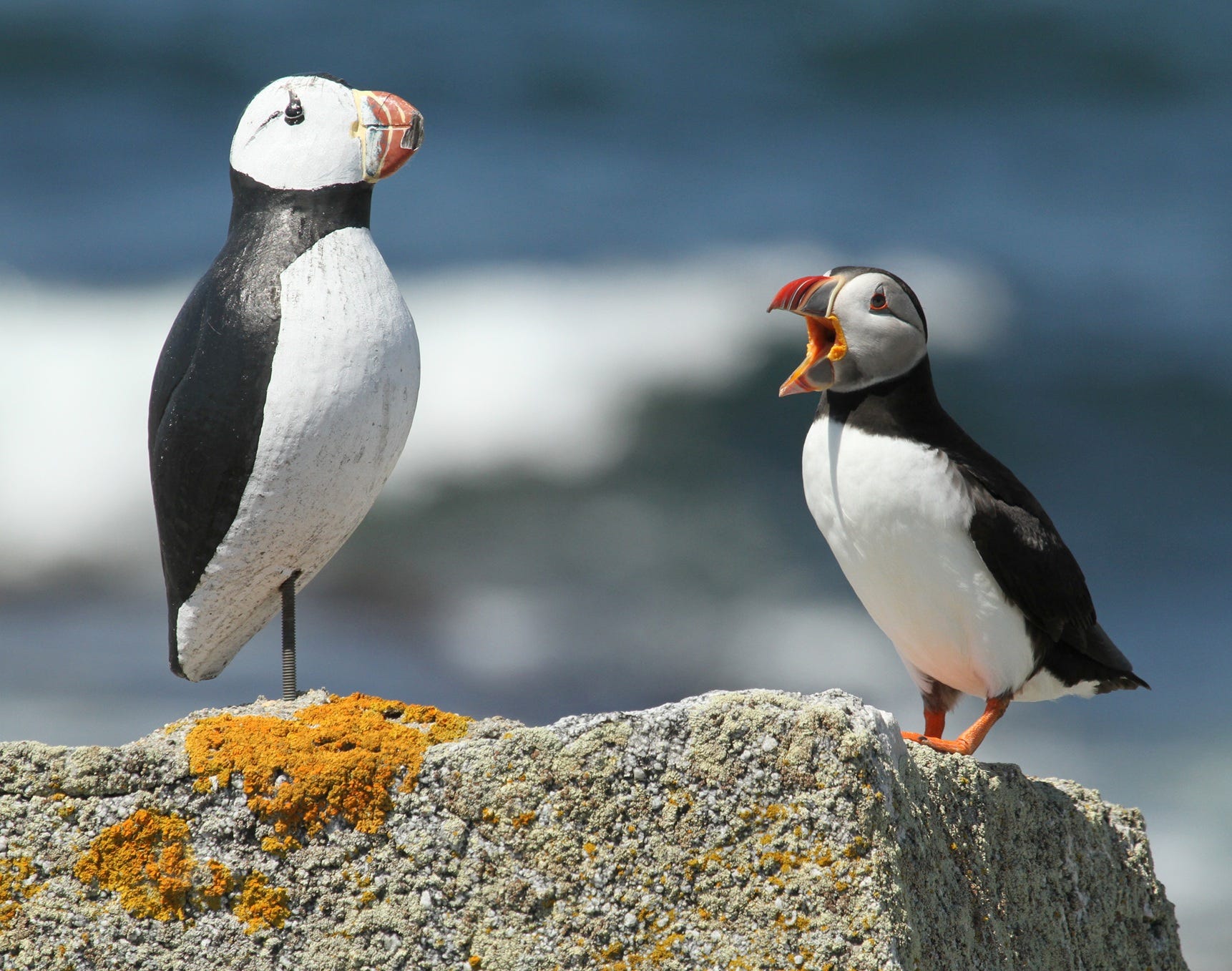
And yet there is real hope on some fronts. We’ve never done better work to protect and boost seabird populations than we’re doing now. That’s in large part thanks to the difficult, slow, methodical, empathetic, and innovative conservation work pioneered over decades by Steve Kress, the hundreds of people who’ve worked with and learned from him, and thousands of others around the world who are devoting their lives to the care of these astonishing and beautiful birds.
Project Puffin on Eastern Egg Rock was, as a recent Maine Monitor story put it, “the world’s first successful effort to return a seabird to an island where it had been eliminated by humans.” You can read the origin story of Kress’s “incredibly audacious idea” in a 2023 Audubon article marking its 50th anniversary. This year, the Monitor notes, Eastern Egg has recorded its highest number of active puffin nests (around 200) and its first-ever razorbill nest with young. A century after the Gulf of Maine was down to one pair of puffins, there are an estimated 1,400 pairs spread across several islands.
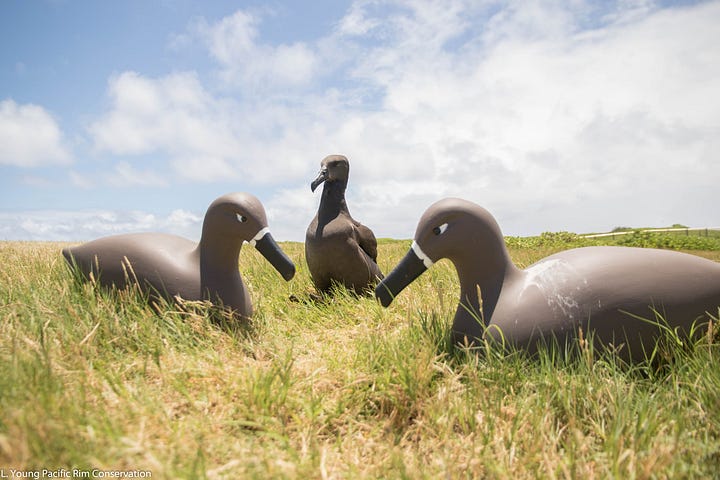
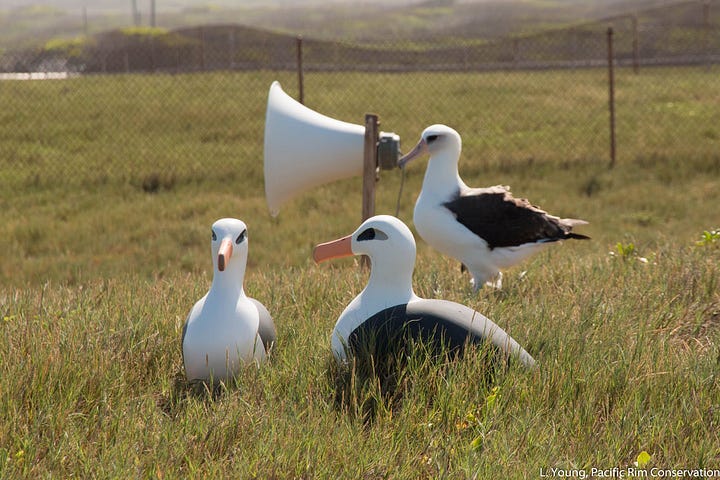
What they learned has been applied to many of the 500 seabird restoration projects around the globe, helping a third of all seabird species. Much of the magic lies in luring the birds in with decoys, audio recordings, new or artificial burrows, and other habitat modification. “Social attraction,” Kress has said, is “the greatest contribution that we’ve made to seabird conservation.” Ironically, he got the idea for using decoys to boost nesting numbers from a photo in National Geographic of Icelandic puffin hunters who had posted up dead puffins as a way to draw in more birds.
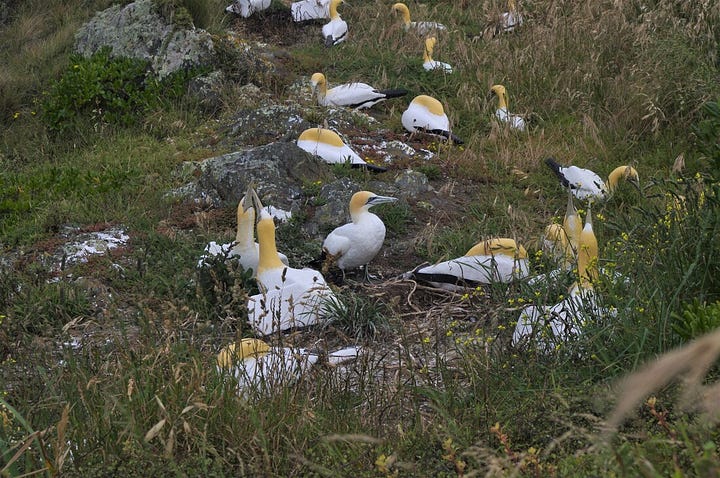
And as the lessons learned by Project Puffin have spread across the world, he says, “It’s a similar recipe every time: decoys, sound recordings, and habitat management.” This proved true for Galapagos petrels, for common murres in California, for crested terns in China, for short-tailed albatross in Japan, and for shearwaters in New Zealand, among many, many more.
Take a look at the Seabird Restoration Database and its many projects, and you’ll see the Project Puffin signature everywhere. Sometimes this is just about inviting seabirds back to places they used to nest (often after rats, cats, and other predators have been eliminated), but sometimes it’s about moving them to higher ground or within a fenced-off predator-free zone. One of Kress’s colleagues explains that in a rapidly changing environment, with all the threats to seabirds from introduced predators and rising seas, we have to create havens where none exist:
Sometimes, if you can’t protect birds where they are, the next best thing is to find a place you can protect them and attract them there.
And another colleague noted how important Kress’s work has been:
It’s rare that you feel like action by humans, in a positive way, really changes a geographic region. The work that Steve and all of the other folks who’ve worked on this project have done over the years—it really changed the world.
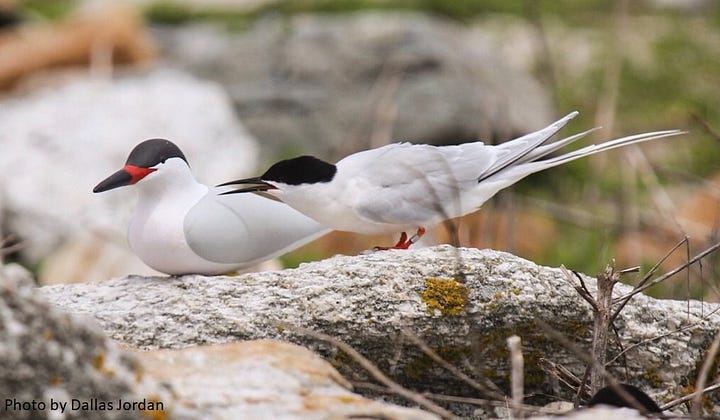
It’s remarkable, if not disorienting, to think about how much we’ve changed the world in just a couple centuries. Gazing back even just one century - a few generations, a single long-lived human life - takes us back to sailing ships instead of space shuttles, to a world shocked by the concept of a world war, to the young girl who would become my grandmother, and to the beginning of the end of ancient ecological abundance.
For us, and for the embryonic gulls in the eggs beneath Sally’s feet, it’s been a century of trauma and upheaval and accelerating transformation.
I wonder what it’s like to be an emerging consciousness inside an egg in a nest on a small island, immersed in the sound of the surf and cries of the birds, and illuminated by the fraction of sunlight passing through the porcelain perfection of your shell. I’m reminded of Charles Simic’s poem, “Stone”, which imagines the stone’s interior illuminated by a strange light, like
Text within this block will maintain its original spacing when published
a moon shining
From somewhere, as though behind a hill—
Just enough light to make out
The strange writings, the star charts
On the inner walls.
Which in turn reminds me of a fundamental human truth: We need stories to tell us how to live. We need the star charts and the writings.
We’re not born intelligent enough, like Atlantic puffins, to fly headlong into the sea in the middle of the night as soon as we fledge and then feed ourselves for a few years in the open ocean. We’re born without instructions. Thus we need stories, day after day for years, to guide us out of our infant helplessness, and we need stories to guide us through adulthood as well, stories that remind us of right vs. wrong and wise vs. foolish, stories like the Migratory Bird Treaty Act that keep us from turning eggs and feathers into extinctions and hats.
Poems, star charts and dictionaries; novels, family lore, and public policy; stump speeches, ads, and bibles; essays, nature guides, and video games; comedies, tragedies, and the gossip that brings both home. We are a chattering species of ape, and the chattering can take us so far away from ourselves and the reality of feather and flesh that we end up imagining we’re in a story about how high we can fly - to other planets, even! - while blindly fouling our own nest and crushing the eggs we know to contain the future of life.
We are in desperate need of a culture of stories that both ground us in reality and give our imagination wings. People like Steve Kress are helping to build that culture. They pay attention to the real world, and they provide instructions for us and our descendants in science journals and magazines and videos and classroom presentations, explaining how to care for the living world. In doing so, they explain too how to make a meaningful life and a better path for all of us.
I’d like to tell Sally that she and the other kids were never the problem, just as the gulls were not the problem. Communities living close to the land who harvest eggs, birds, and other wildlife in a thoughtful, sustainable way are not the problem. The problem is that we live in a system built to inflict ecological grief and unrequited dreams. The Anthropocene is a mess in which we’re all stepping on eggs while dreaming of avian abundance.
Let’s learn the lesson here, and get rid of the predators while moving our culture to higher ground.
Thanks for sticking with me.
From Amanda Royal, author of the Earth Hope newsletter, a new and remarkable project: an endless scroll of good-news conservation stories: Hope Scroll.earth. If you feel the need to scroll but would rather see headlines about India’s rebounding tiger population, a successful Irish pollinator-gardening program, wetland restoration in California, and much, much more, Hope Scroll is the place for you. Take a look.
From Avian Haven, a bird rehabilitation center here in Maine, another great inside look at what it takes to do the work of a rehabber: the always-difficult treatment decisions when the injured/sick bird arrives, the constant attention to detail (because mistakes can cost these wild birds their lives or their freedom), and the careful assessment of how and when to release the bird back to the wild. Here’s a relevant excerpt for this week’s topic:
Ask Athena which species are hardest to treat, and pelagic birds top her list — puffins, northern gannets, petrels, guillemots. These birds have very high metabolisms and are often already near collapse by the time they're found, sometimes requiring tube feeding every hour or two. They're also simply not built for proximity to people, and that exposure alone can bring on disease. "We try to get them in and out as fast as possible," she says, "because it's a lot of stress."
From High Country News, “In Inupiaq, when the weather talks, you listen,” a beautiful short personal essay about the Indigenous writer’s weather-forecasting grandfather and about living in western Alaska with what Sila, the weather, allows:
Papa was born with this understanding… I imagine he learned the signals from his dad, who learned them from his father and the generations before him who made Uņalaqłiq, the southernmost Inupiaq settlement, their homelands. What settlers changed to Unalakleet. He would stand at the beach, look out at the ocean, the current, the clouds and the color and movement of it all, and let Sila decide our days, our week ahead. If wind was coming, we couldn’t hunt ugruk. If Sila said “rain,” we waited to fish for humpies until a good stretch of clear skies arrived for days of hanging and drying. Sila told us, and continues to decide for us, our activities.
From Owl in America, an update on the Flamingo Revolution in Albania, which combines environmentalism with massive street protests against the government’s corruption. Here’s a quick summary:
The Flamingo Revolution is a movement of mainly Gen Z Albanians, eager to see their country ascend out of the mire of corruption it has faced since emerging from behind the Iron Curtain in the 1990s. They're using social media to rally people to the streets every day to call for the prime minister's resignation, repeal of the luxury-resort loophole, and term limits for ministers. They are also asking for new laws to limit the potential for foreign investors like Trump and Kushner to run roughshod over environmental protections and Albanians' wishes.
From Yale e360, the second-place film in their annual contest, “Here There Was Cerrado,” follows an environmental historian as she bicycles across what remains of Brazil’s massive savanna, the Cerrado. The most biodiverse savanna on Earth has now lost more than half of its habitat to cattle ranches and monocropped corn and soy, most of which will be exported as animal feed.
From Orion, “The Lost Vocabulary of Whaling,” a short illustrated list of Indigenous and colonial American terms related to the presence, hunting, and slaughtering of whales. “After 250 years of exploitation,” the article begins, “what remains is a graveyard of vocabulary and tools.”
From Anthropocene, “As the world warms, butterflies are relocating at an astonishing scale,” a report on a new study that finds that about 10% of the world’s butterflies are shifting their ranges. This is especially true in the tropics, where many insects were already living at the limit of their heat tolerance. Many butterfly species are expanding their range, and about a third have lost ground. In both cases, these are signals that shouldn’t be ignored:
“Butterflies are early warning indicators,” said Chowdhury. “If their ranges are shifting this dramatically, it signals profound changes across ecosystems.”
From Heated, “AI’s climate problem is worse than we thought,” news that all the concern about the explosive growth of (unnecessary, ridiculous, harmful) data centers being powered by a flood of new fossil fuel projects is “just the tip of the AI climate iceberg.” A new analysis of how AI is being used to accelerate and improve fossil fuel extraction techniques finds that the climate consequences could be 3.3 to 13.3 times worse than the emissions from powering data centers alone.
Comments
Nothing yet. Say the first thing.
Sign in to join the conversation.