
TL;DR: Feed your houseplant obsession while advancing plant biology and conservation research—up to 80% of a community plant biology lab’s $500k+ annual operating budget could feasibly come from micropropagating and selling houseplants.
We’re entering a new era of scientific advancement. Era may not be the right word. We’re entering an apocalypse. All aspects of the research process, from how we generate hypotheses to how we share and engage with discoveries, will be unrecognizable in five years. While I disagree with specific triggers driving this revolution—notably NIH- and NSF-targeted budget cuts—now is the time to scrap harmful practices (cough, for-profit scientific journals) and experiment with new models for doing research. Certain plants—fire followers—thrive after a blaze. The same will be true for those who choose to take advantage of this moment.
May all of us fire followers emerge from the ashes.
Adam Mastroianni is right. Funding science is badass. Our quality of life is fueled by technological advancement, and technology stands on the shoulders of scientific research. Government agencies and private markets typically foot the bill, and while they’re driven by different incentives, both implicitly select for research with a clear value proposition. Yet, plenty of research ideas aren’t explicitly connected to a hefty market, or lack the preliminary data needed to make it past an NIH study section. Ed Catmull, co-founder of Pixar said it best: “The politics of failure can impede our progress.” Where do the risky, outcast ideas live?
Some
boysfunders take a beautifulgirlideaAnd hide
herit away from the rest of the worldI wanna be the one to walk in the sun
Oh, girls, they wanna have fun(ding for scientific research)
Philanthropic funding has dared to sponsor the ideas that government agencies and venture capital won’t touch, leading to a new wave of research organizations like Arc Institute, Arcadia Science, Cultivarium, and Speculative Technologies. But we’ve only scratched the surface of alternative models for scientific research. Cooperatives, land trusts, blockchain-based organizations—all are structures we can leverage to make research more accessible and financially resilient. Within this vast sea of possibilities, I’m interested in a specific question: Can commercial revenue sustain a lab? My hypothesis is yes, based on a few assumptions:
Sell direct-to-consumer (D2C). Community labs are public-facing and there’s an inherent advantage to that. The mission to democratize science naturally attracts a broad audience. So, build with them. No more begging for a donation hoping the classic tax advantage pitch will empty their pockets. Instead, offer a product of value that in turn furthers the mission. Trust me, I get it. D2C sales is hard. From being on the leadership team that brought lululemon to the Paris market, to co-founding TUNE—a consumer-facing hardware company, I’ll be the first to tell you that the journey ain’t easy (and probably the last thing a researcher wants to do). But the consumer doesn’t care if you have a PhD, which journal you published your paper in, or if the total addressable market is a gazillion dollars. All that matters is whether you have a great product that satisfies a need or desire. If you ask me, this is peer review in its truest form.
There needs to be a deep synergy between the scope of the lab and the source(s) of revenue. They shouldn’t be completely unrelated endeavors, nor should they heavily rely on one another. The sweet spot is when the success of one strengthens the other. For example, a research discovery could lead to a new product offering or application, or the data generated from commercial sales could be useful for developing a research tool.
The revenue must be high-margin. In other words, the cost of the product or service should be ~50% of the revenue generated from selling it. Ideally it's less.
So, let’s revise our research question: Can synergistic, high-margin consumer revenue sustain a lab? Time to do an experiment. Cue micropropagation.
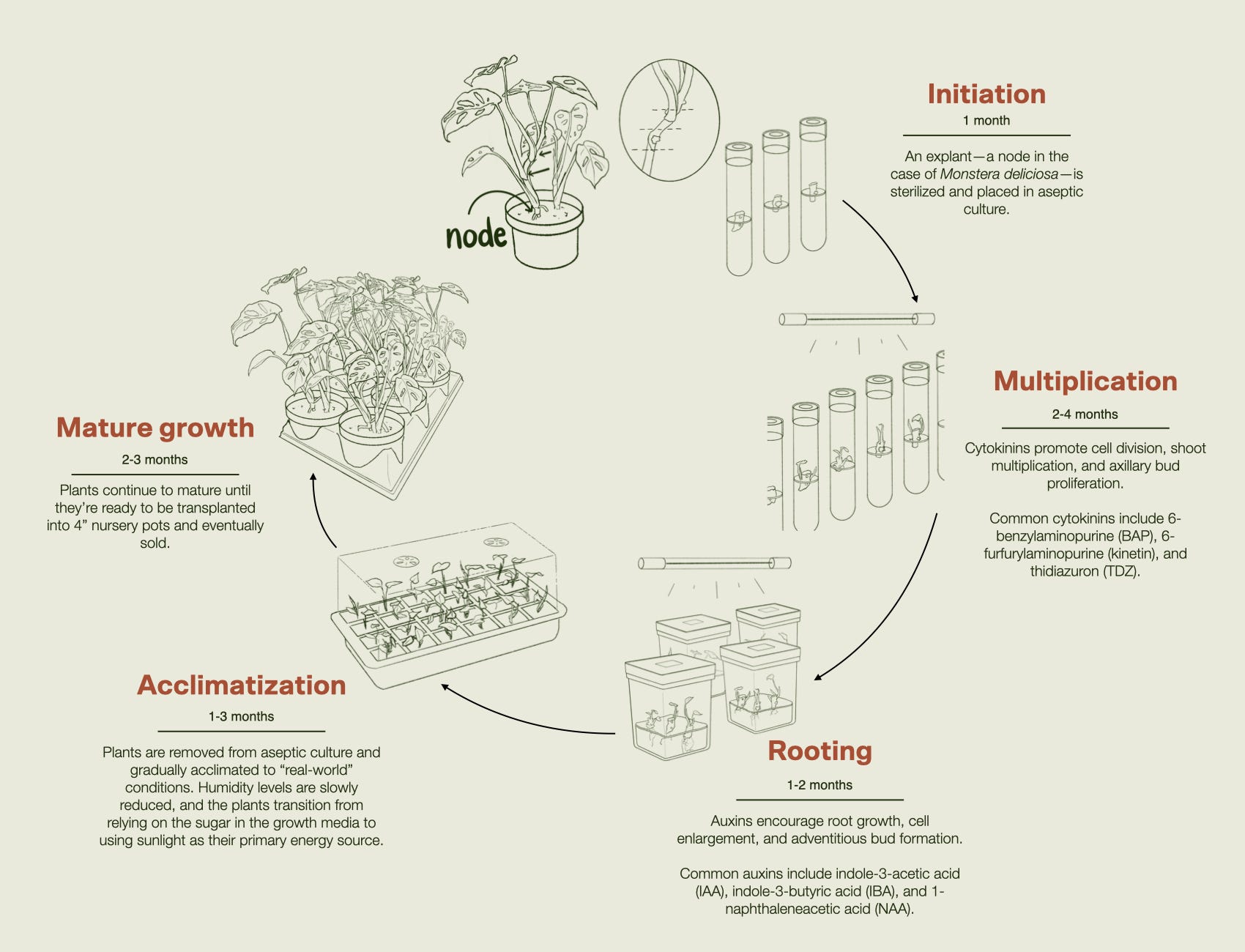
Contrary to humans, all plant cells are totipotent in theory. Totipotency simply means that, under the right conditions, single cells can regenerate an entire plant by means of organogenesis. You can then use pieces of the regenerated plant to make more regenerated plants, leaving you with an endless amount of genetic clones of your original plant. This is the foundation of micropropagation—a subset of plant tissue culture.
A piece of starting material, often referred to as an explant, is extracted from a “parent plant.” Explants can be a shoot tip, leaf, node, reproductive structure, or other plant parts. The explants are cleaned to remove other living organisms such as bacteria, insects, and fungi, and then grown in a sterile environment with controlled light, temperature, humidity, and nutrients. As the plant matures, the conditions are modified to fit its current growth stage. For example, cytokinins such as kinetin and 6-benzylaminopurine (BAP) are plant growth regulators (PGRs) often used during the multiplication stage. These PGRs are placed in micropropagation media to promote cell division, shoot multiplication, and axillary bud proliferation. However, their concentration is often reduced, if not omitted, during the in vitro rooting stage so that root initiation can occur, often driven by a different type of PGR—auxins.
The use of micropropagation has increased since the 1970s and it plays a vital role in plant conservation, disease elimination, and genetic engineering. Formerly endangered due to its low seed output, limited habitat, and low germination rate, the Cumberland sandwort (Arenaria cumberlandensis) now has a shot at survival thanks to micropropagation-based restoration. Fortunately, this fight against extinction isn’t unique to the Cumberland sandwort either. Micropropagation has been increasingly explored to save endangered species such as Handroanthus chrysanthus—overexploited for its timber.
Given its ability to produce a vast amount of plants using a relatively small footprint, micropropagation has become increasingly prevalent in the horticultural industry and among plant enthusiasts. In fact, the popularity of orchids is partly due to the mass micropropagation and distribution of rare hybrids. In the plant conservation world, “exceptional species” are those with seeds that can’t tolerate conventional storage methods. Oaks (Quercus spp.) are one such example. Their seeds—acorns—are unable to withstand being dried out and later cryopreserved (-130℃ to -196℃) or stored at -20℃. As a result, Oak conservationists rely on micropropagation. The same is true for plant synthetic biologists—scientists interested in introducing new genetic material into plant genomes with the hope of creating unique traits, whether meant for aesthetic or survival purposes. Once you have the infrastructure for micropropagation in place, the world is your oyster. You could say that plant tissue culture is the backbone of modern plant sciences and commercial horticulture. Do you feel the synergy…?
Given that the global indoor plants market is projected to reach $28.84B by 2031, and considering the broad applicability of plant tissue culture, micropropagating houseplants could be an effective way to both fund and advance plant biology research.
TL;DR: To cover 80% of its $500K+ operating budget, a community lab would need to sell at least 1,610 mature houseplants per month at a price point of $25 per plant. Below, I’ll break down the assumptions underlying this idea, but you can access a public version of the rough financial model here.
Let’s assume the annual operating budget of a community plant biology lab is $536,000 and the aspirational revenue distribution is:
80% from D2C plant sales and related products ($428,000),
7% from grant funding or corporate sponsorships ($37,000),
7% from classes and membership ($36,000), and
6% in individual donations ($35,000).
(I’ll release the financial model that justifies this annual operating budget in a future Sow n’ Grow essay.)
While plant parenthood-adjacent products could be another source of consumer revenue, I’m going to focus on D2C plant sales. We’ll also assume that the average revenue per plant is $25. Considering that in-demand rare houseplants will sell for 2-4 times this price, this feels like a reasonable average, but I plan to do a deeper analysis on this. Be sure to subscribe if you want to see the results.
With this assumption in mind, the lab needs to produce, sell and ship 1,610 mature plants to generate at least $428,000 in net revenue. Let’s walk through the math together.
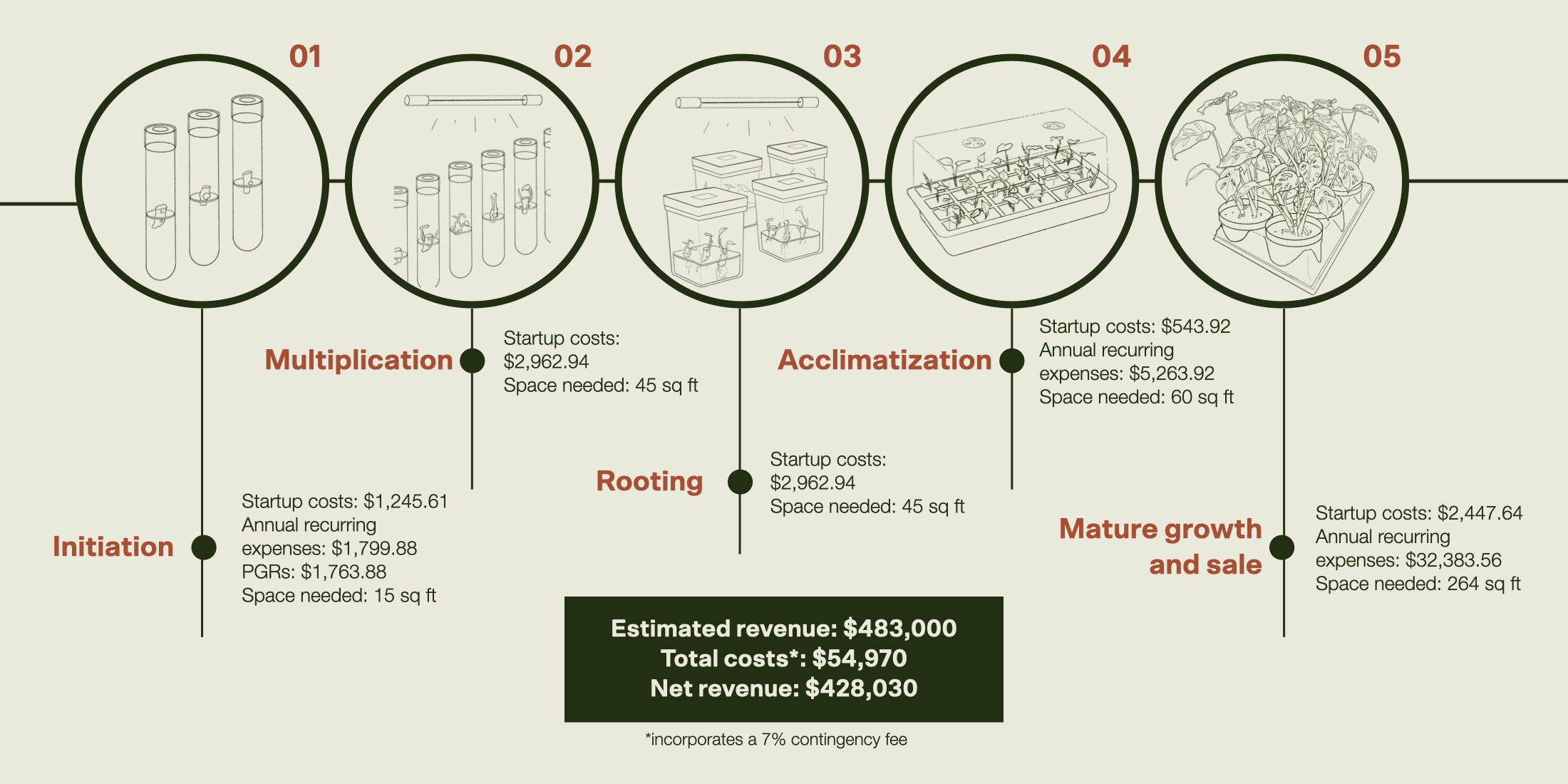
Each month the lab will need to store and maintain 1,610 plants growing in 4” nursery pots. In reality, a surplus of inventory is needed—this is dependent on plant growth rates—but for the sake of simplicity, we’ll stick with 1,610 plants. Each shelf of a 6-tier 30” x 14” growth rack holds 18 plants, meaning one rack can hold 90 plants. To accommodate 1,610 plants, 18 racks totaling $1,187.82 and 264 square feet are needed. An additional $1,259.82 must be added for grow lights, resulting in $2,447.64 in startup costs. As for recurring monthly costs, the lab will need 1,610 clear 4” nursery pots, potting soil, and shipping and packaging materials, totaling $2,698.63.
Note: These calculations are made under the assumption that the plants are to be grown indoors with grow lights during the mature growth and acclimatization stages, but a greenhouse is another viable option currently being explored.
To accommodate 1,610 plants in the acclimatization stage, the lab will need roughly 140 12-cell nursery trays, costing $265.86 per month. Nursery trays can be cleaned, disinfected and reused, but we’ll assume they need to be re-purchased monthly. Add $172.80 for soil, and the anticipated monthly costs total $438.66. As for startup costs, 6-tier racks are needed to store the nursery trays. With roughly 480 cells fitting on each rack, 4 growth racks and grow lights are needed, totaling $543.92 in startup costs. Plants in the acclimatization phase will also require an additional 60 square feet.
Although some micropropagation protocols can generate 15+ plants per culture, we’ll be conservative and assume that 5 plants can be acclimated per culture after completion of the rooting stage. For the sake of inventory management, as not all plants will successfully acclimate post-rooting, let’s increase this number by 20%, equaling 387 cultures (1,610 / 5 x 1.2).
Roughly 180 cultures can fit on a 6-tier growth rack, meaning that at least 3 racks with grow lights are needed for cultures in the rooting phase, totaling $407.94. Plants must also be stored in sterile culture vessels, adding $2,555.00 to the startup costs. (Vessels can be autoclaved and reused, but twice as many vessels must be purchased in case cultures need to undergo multiple rounds in the rooting stage.) Total startup costs for the in vitro rooting stage now equal $2,962.94, and an additional 45 square feet will be needed.
Returning to our assumption that each culture will generate 5 plants for acclimatization, the lab will need to accommodate 323 cultures in the multiplication stage. Because contamination will occur during the multiplication-to-rooting transfer process, let’s increase this number by 20%, equaling 387 cultures.
Like the in vitro rooting stage, 3 growth racks, grow lights, and 45 square feet will be needed, totaling $407.94. An additional 644 vented culture vessels are also needed, leading to a total startup cost of $2,962.94 for the multiplication stage.
To initiate the micropropagation process, explants must be cleaned and then placed in an aseptic environment to adjust to their new growth conditions. Rather than use square culture vessels for this process, vented test tubes will suffice, as initial growth will be slow.
Again, returning to our assumption that each culture will generate 5 plants for acclimatization, 320 initiation cultures will be needed. We’ll assume that 20% of initiated cultures will either be contaminated or won’t grow, so we’ll need to initiate 384 cultures each month. A 6-tier growth rack can accommodate 6 racks holding 21 test tubes on each shelf. Thus only a single rack is needed to store 384 initiation cultures. The combined startup cost of the rack, needed grow lights, and autoclavable, vented test tubes is $1,245.61, and additional 15 square feet of lab space is needed.
Note: Initiation is most time-consuming when trying to “onboard” a new species. If you already have sterile plants of a specific species in the multiplication stage, you can simply take an explant from those plants to start a new culture (“subculturing”) rather than go through the hassle of sterilizing and initiating a new explant. Growth will be much faster this way and contamination will be less of an issue.
Micropropagation protocols require anywhere from 0.5 mg to 7.5 mg per liter of plant growth regulators (PGRs). To be on the safe side, we’ll assume that 5.0 mg/L of most available PGRs are needed to make micropropagation media for the initiation, multiplication, and in vitro rooting stages. In the case of thidiazuron (TDZ), we’ll assume that 0.5 mg/L is needed, as this PGR is used less regularly. We’ll also assume that we’ll use each PGR three times per plant—once per stages 1-3. In reality, only 1-4 PGRs are needed for a plant’s specific media, 1.0-5.0 mg/L of each PGR is the concentration range found in most protocols, and micropropagation media will be made multiple times for each stage depending on each plant’s growth rate.
Given the quantity of media that can be generated from PGRs in powder form, we’ll add the PGR expense, totaling $1,763.88, to our startup costs, as they can last well over two years at this scale of production.
In all, the total startup cost to generate 1,610 plants per month equals $11,926.93. If we add a 7% contingency fee to both the startup and total monthly costs—$54,970.50—and subtract this from the $483,000 of aspirational gross revenue, we’re left with $428,029.50.
Let’s be clear, this is an extremely rudimentary model filled with omissions and additional assumptions that I didn’t mention, the most important of which is human capital. Micropropagation is only a viable revenue source if the cost of human capital required to produce and sell 1,610 plants demands 50% or less of the community lab teams’ time. My personal experience with micropropagation proves this to be true, but in 2025, I’ll closely monitor the total hours worked per stage in order to refine the model.
I’d also like to highlight some other considerations:
This financial model incorporates a 7% contingency fee into the startup and monthly costs to cover unforeseen expenses. Although this is a rather simple, well-defined business model with relatively low startup costs, it could be wise to incorporate a 15-30% contingency fee.
I’ve assumed that the average gross revenue per plant is $25, but a lab could charge a higher price if they closely follow (dare I say, set) houseplant trends and focus on rare plants.
Growing plants is arguably the easy part. A sales and marketing budget will be required to drive revenue at this scale, although this is compatible with the public-facing nature of community labs anyway. With that being said, a D2C model is only one of many that a micropropagation lab could explore. A lab could sell to local retail plant stores, wholesalers, “big box” garden centers, or even consider selling plant tissue culture plantlets to consumers who are willing to acclimate their own plants.
The startup and monthly costs are based on retail prices. These costs could be lowered significantly if purchased in bulk, negotiated with a supplier, or switched entirely. For example, if you switch from square, vented culture vessels to round, vented snap-lock containers, you could save $1,276 for every 500 vessels purchased ($3,460.03 in total savings at this scale).
There’s a wide range of quality when it comes to grow lights. I’ve included inexpensive Barrina T8 LED grow lights in this model, as the cultures mostly rely on sucrose for their energy source rather than intense light. However, as you scale, you’ll likely want to invest in higher quality grow lights, especially for the acclimatization and mature growth stages if plants are grown indoors. High-quality LED grow lights also have a lifespan of 50,000+ hours so they’ll last for at least 5 years using a 16/8h (light/dark) photoperiod before needing to be replaced. I plan on experimenting with different grow lights in 2025.
In this case, I’ve excluded the cost of rent and utilities, as this is incorporated into the lab’s overall operational expenses.
Payment processor fees, nursery license fees (required in California), and other micropropagation-specific fees have been omitted, but will be incorporated into future models as assumptions are revised.
Let’s face it, financial models are hypothetical. Real-world data will give the final say as to whether this is possible.
As I stated previously, the feasibility of this model is dependent on the assumption that the sale and production of 1,610 plants per month will only demand 50% or less of the community lab teams’ time. So throughout this year, I’m focusing on capturing real-world data as I perform my micropropagation experiments to refine these assumptions. Make sure to subscribe if you want to receive the monthly updates that document the process!
As always, your feedback is welcome. If you’ve noticed a blind spot in my thinking or have ideas, I encourage you to comment publicly on these essays or reach out to me at jasbneal@gmail.com.
Callie Chappell: Critical feedback
Leon Elcock: Critical feedback
Casey Lardner: Critical feedback
Rachel Pontious: Visualization
Elliot Roth: Critical feedback
Harper Wood: Editing
Cite as: Neal, J. (2025). Leveraging ‘plant parenthood’ to sustainably fund a community plant biology lab. Zenodo. https://doi.org/10.5281/zenodo.14986713
Comments
Nothing yet. Say the first thing.
Sign in to join the conversation.