
👋 Hi friends,
There’s a method to my micropropagation madness and I finally took the time to articulate it. Why am I so focused on plant tissue culture and tracking every step? Because I’m working toward a bigger vision—testing whether the commercial sale of micropropagated plants can fund a community plant biology lab.
If you haven’t seen my latest essay, “Leveraging ‘plant parenthood’ to sustainably fund a community plant biology lab,” please take a look! I’ve even included an interactive Excel model that maps out the relationship between the cost of goods sold (COGS) and potential revenue.
Poke holes, flag bottlenecks I’ve overlooked, suggest ideas—I want to hear it all. There’s already a great discussion happening in the comments, so jump in—the water’s warm! The lab is as much yours as it is mine. 🪴
Now, onto February’s update…
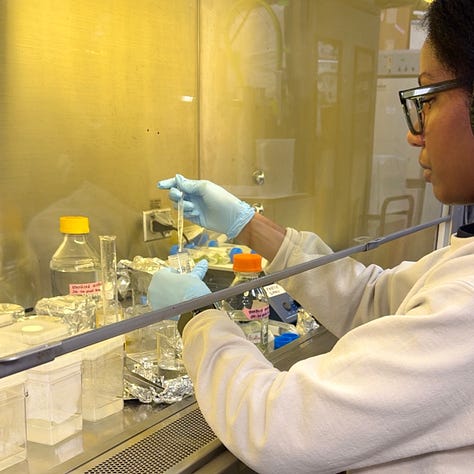
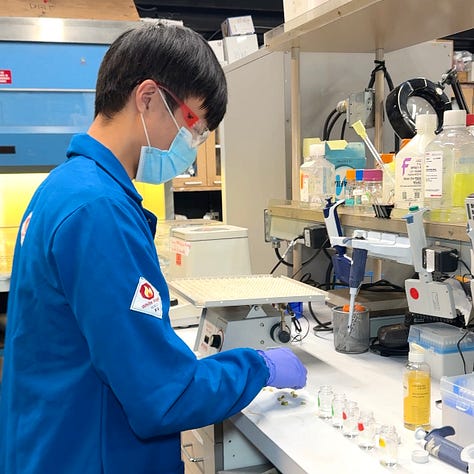
Burn: $405.90
Initiated cultures: 166
Contamination rate: 133/166, or 80.1%*
Time spent per culture: ~18 minutes (53.25 hours total for 166 new cultures and 11 subcultures)
*This may seem alarmingly high but there’s a reason for this, I’ll explain below!
Monstera explant sterilization tests: Before I begin to culture other rare Monstera species, I decided to take a step back and test different sterilization protocols.
To jog your memory, when we want to clone a new Monstera species using micropropagation, we need to cut a node or axillary bud from the plant of interest and then place it into micropropagation media. When sourcing rare Monsteras, we’ll likely have access to very small plants or cuttings, meaning we’ll only have a handful of nodes to work with. Thus, it’s important to hone in on a sterilization protocol that reduces contamination but doesn’t severely damage the plant tissue so that our chances of successful micropropagation are high.
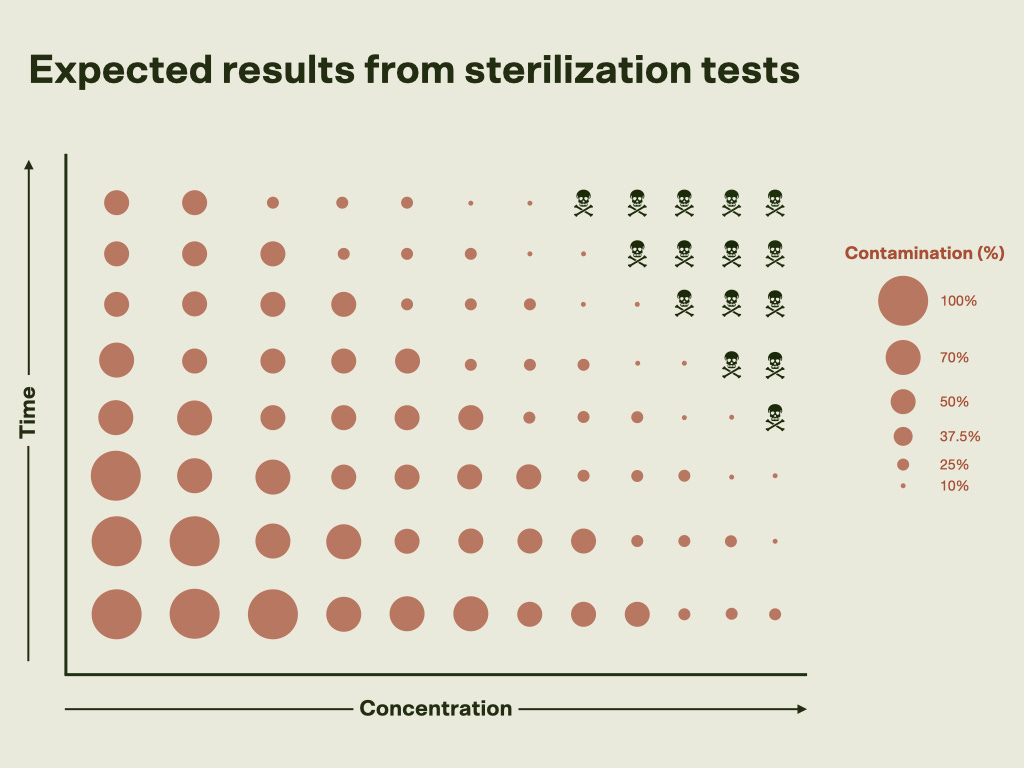
To do this, I tested two active ingredients—sodium hypochlorite (NaOCl) and sodium dichloroisocyanurate (NaDCC)—at varying concentrations and durations. As we increase the concentration of each active ingredient, we would expect to see a lower contamination rate. The same is true when we increase the amount of time the nodes are agitated in our sterilization solutions. Intuitively this makes sense, as stronger and longer sterilization treatments should kill more microbes. Yet, at some point, the concentration will be too high, or the time spent in the solution will be too long, and we’ll get sterilized nodes with severely damaged tissue. We threw the baby out with the bath water—we killed both the microbes on the plant and the plant itself.
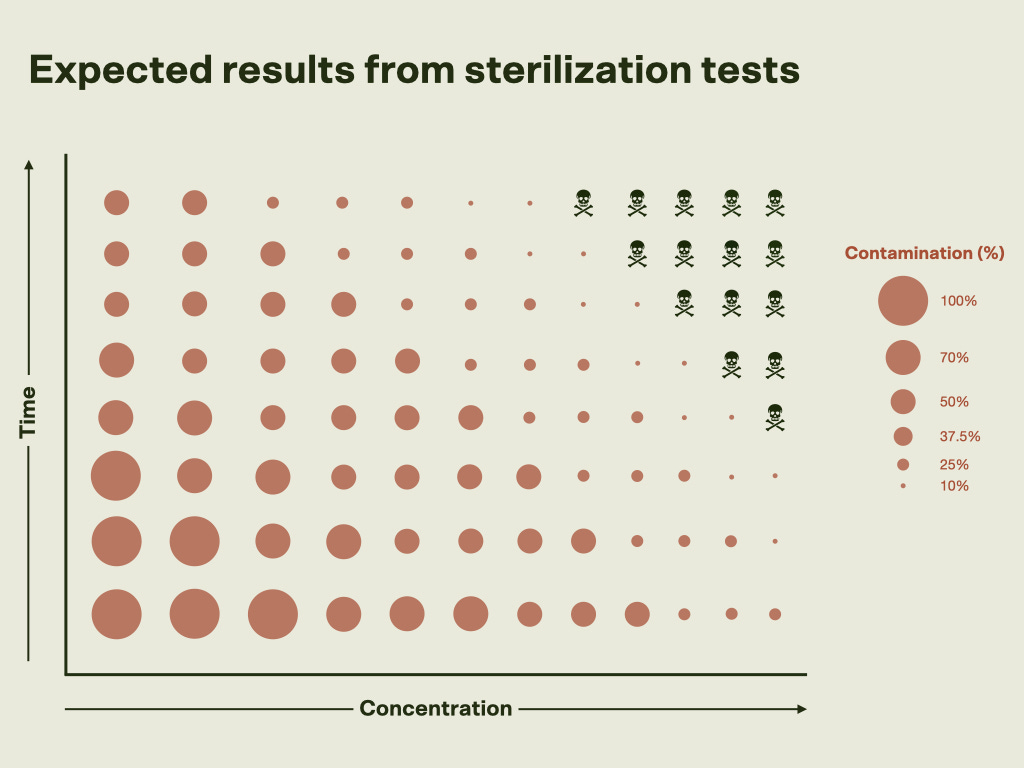
Figure 1: Expected results from sterilization tests. As time and concentration increases, we should see lower contamination rates. The goal is to find the condition that requires the lowest concentration for the shortest amount of time so that the explant sterilization process is quick, yet effective. This month’s high contamination rate is because the sterilization tests have started at the lower end of the concentration spectrum (the left side of Figure 1). March and April tests will focus on higher concentrations, and I expect to see a much lower contamination rate. 🤞
Center for Plant Conservation’s Applied Conservation Course: I began taking CPC’s Applied Conservation course for two reasons:
I believe community-led efforts can have a big impact on plant conservation and soil remediation and frankly, we don’t have much of a choice. UC Davis Botanical Conservatory may close its doors and let’s not forget how Annie’s Annuals—the beloved East Bay nursery known for its rare and heirloom plants—almost shut down last year. More on this soon.
I’ve been exploring the idea of a community-generated micropropagation dataset that machine learning models can leverage to predict ideal in vitro conditions for species that have yet to be micropropagated. The Cincinnati Zoo & Botanical Garden created a comparative in vitro database for this purpose but it has a few drawbacks: 1. The raw data doesn’t appear to be publicly available. 2. The dataset doesn’t include failed conditions. 3. More data is needed. 4. We need to re-think database and metadata schema so we can anticipate its usefulness for ML models. More to come on this too.
Re-writing and editing “Leveraging ‘plant parenthood’ to sustainably fund a community plant biology lab”
Complete NaOCl and NaDCC sterilization tests at higher concentrations. Since the upper bound concentrations are unknown, additional testing in early April may be needed.
Hands-on micropropagation workshop at Biocurious from 1:00-5:00 pm PST on Sunday 3/16 (Santa Clara, CA)
O’Shaughnessy fellowship application submission
Nothing this month, but stay tuned—a houseplant consumer survey is in the works. This will help me and other scientists better understand general houseplant trends and gauge interest in community-led conservation and remediation efforts!
Feel free to share this with any friends who might be interested. And if you received this email from someone else, you can subscribe directly to get the next one. 🌱
Comments
Nothing yet. Say the first thing.
Sign in to join the conversation.