
👋 Hi friends,
Many of you have asked for an update following my previous essay, A vision for a climate-focused community biology lab in Berkeley, California. To keep you in the loop, I’ll be sharing short, monthly recaps like this one. You can also expect to see a series of essays that elaborate on how I’m thinking about different funding models, the role of amateur science as AI research agents and robotics improve, and potential community-led research projects. Until then, these are my three most important takeaways from the past few months:
I’ve refined the lab’s initial scope so that there’s a focus on ornamentals. Because these plants tend to be less regulated than commodity crops, the introduction of new hybrids and varieties is often thanks to smaller businesses and amateur growers.
I’ve discovered that funding community labs presents a chicken vs. egg problem. Most grant/philanthropic funding requires existing physical and operational infrastructure, but you can’t set up any significant infrastructure in the absence of funding...
I’m not convinced that funding is the central problem, despite Point 2. (I’m now testing a grassroots funding model that relies on selling micropropagated houseplants.) Perhaps obviously, the success of a community lab is driven by its community, and this takes time to build and nurture. Originally I felt a rush to take advantage of vacant lab space available in the East Bay. I’ve realized I should slow down – for now, community building is more of a priority. Side note: I think the way research is pursued will drastically change within the next 5 years. I want to build a lab that keeps that in mind rather than recreate what’s familiar.
Burn: $384.88
Initiated plant micropropagation cultures: 40
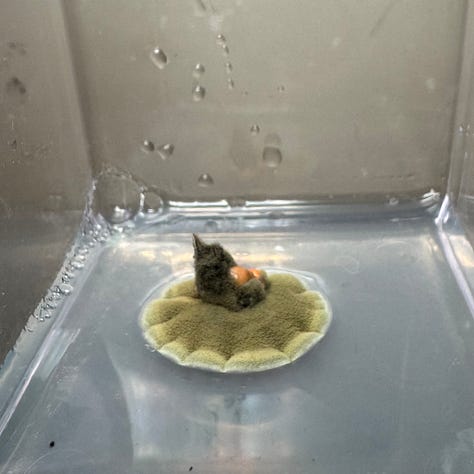
Contamination rate: 23/40, or 57.5%
Time spent per culture: ~25 minutes (19.75 hours total for 40 new cultures and 7 subcultures)
I prematurely focused on speed in an effort to decrease the time spent per culture, but this led to the worst contamination that I’ve seen yet. I also didn’t hit my target of initiating 80 cultures per month because I was on the East Coast for most of January. (I’m closely monitoring time spent per culture to test assumptions underlying a potential business model. I’ll dive deeper into this in an upcoming essay.)
I began testing the impact of higher cytokinin concentrations inspired by this M. deliciosa protocol. Cytokinins are plant growth regulators that promote shoot formation. Currently, I use 4.0 mg/L of 6-benzylaminopurine (BAP), but because Monstera plantlets grow slowly, I experimented with 5.0-7.0 mg/L of BAP. Unfortunately, due to the high contamination rate, I didn’t have enough cultures to analyze the effect. I’ll be repeating this experiment this month.
Dr. Shane Simonsen, an amateur breeder and founder of Zero Input Agriculture, and I collaborated on a research proposal to identify a simple liquid solution that could facilitate plant transformation via its application to the stigma before or after hand-pollination. However, I’m not convinced it's worth pursuing for a number of reasons:
Foreign DNA must bypass a lot of hurdles for this to work. Arguably the most important one is the resistance of degradation by nucleases released during pollination. The idea that pH or chemical treatments can improve DNA uptake is speculative and the proposal relies on existing compounds with mixed effectiveness. If stronger, novel nuclease inhibitors were considered, experimentation would be more worthwhile.
If successful, it may not be accessible to amateur breeders as originally intended. Resulting plants would likely fall under the GMO umbrella and be subject to regulatory challenges.
Regarding experimental design, transformation validation is lacking. After the initial conditions have been tested in vitro, a visible read-out of transformation success is necessary (e.g. expression of the RUBY pigment).
I only found evidence of small, single genes being integrated. I’m not sure if integrating larger, multi-gene vectors is unlikely, but I’d imagine so.
Like Agrobacterium-mediated transformation, DNA integration would be random, not targeted.
I’m not sure this method, if successful, is better than traditional breeding or other transformation methods. The biggest advantages are that it removes the need for plant tissue culture and it expands the genetic repertoire accessible to a plant because it isn’t dependent on species compatibility. But again, insertions would be random and if large or multi-gene inserts are prohibited, it’s essentially a different form of mutagenesis.
December 2024 had a few highlights worth noting:
Sean V—a local researcher—donated a 48” AirClean 600 PCR workstation, benchtop incubator, Opentrons-1 robot, benchtop autoclave/pressure cooker, and a bunch of consumables! (Shout out to Ben B. for helping us move everything into my home lab. 🙏)
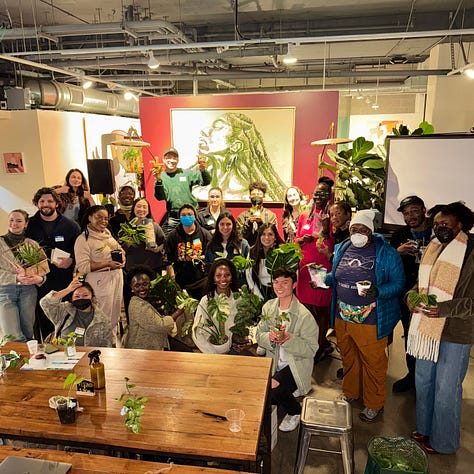
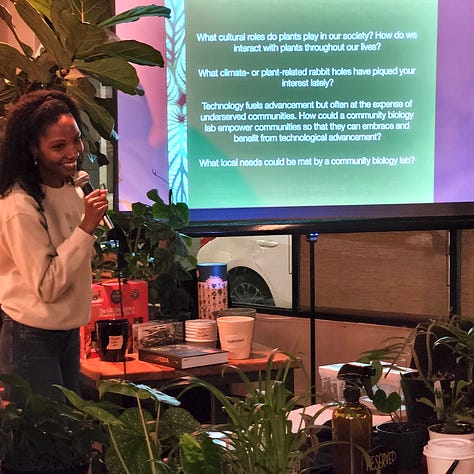
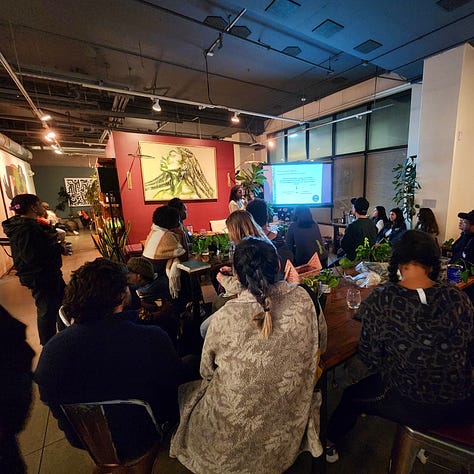
24 folks joined the Kinfolk plant swap on Tuesday 12/10. We had a group discussion about plant micropropagation and what community-led research could look like—it was a magical evening. ✨
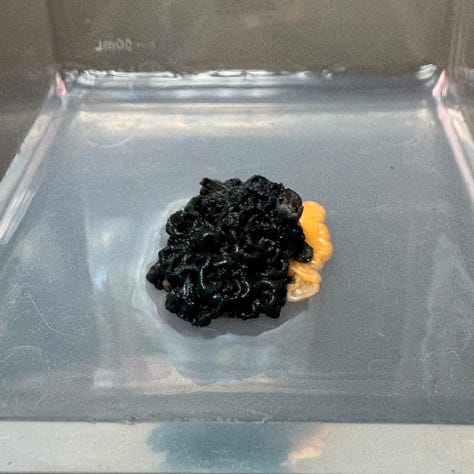
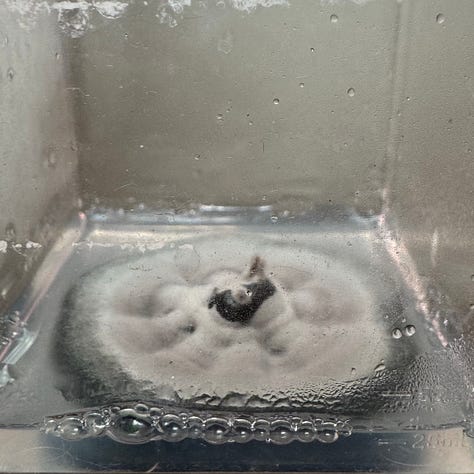
Refinement of the Monstera initiation and multiplication protocols is key. I have 10 different sterilization tests planned based on using sodium hypochlorite (NaOCl) and sodium dichloroisocyanurate (NaDCC) at various concentrations and durations. I also intend on testing whether removing plant growth regulators from the media after shoots have formed will enhance their growth. The goal is to consistently achieve a contamination rate that’s less than 10% and get rid of using a broad-spectrum biocide/plant preservation mixture (PPM) altogether. (Fortunately I currently use only 0.05% PPM in my tissue culture media so removing this shouldn’t be a problem.) Shout out to Sebastian Coccioba for giving me feedback on this!
To better evaluate the impact of different mother plants on growth and contamination, I’ll assign accession numbers to the mother plants moving forward (e.g. Source Plant #AA001 → Clone AA001-1, AA001-2 etc.). Thanks Rachel Helmich for mentioning this!
O’Shaughnessy fellowship application
I’m forming a small working group for people who want to use micropropagation to clone endangered plants. Let me know if you’re interested, I have 2/5 spots remaining.
Spring plant swap—stay tuned. We may have a special guest facilitate a discussion about using CRISPR for plants!
If you have plant tissue culture best practices you’d like to share, send ‘em my way! I’m also looking to get in touch with a scientist, preferably in the Bay Area, that’s familiar with protoplast fusion. If you know of someone, please reach out.
To build a lab with the future in mind, I’m also looking to chat with anyone working on or thinking about lab automation, especially how AI research agents interface with robots (e.g. companies like Trilobio). Introductions would be greatly appreciated.
Feedback on A proposal for a high-throughput approach to evaluate pollen tube-mediated transformation potential:
Do you agree or disagree with my comments above? Why or why not?
Are there other compounds that could serve as nuclease inhibitors, DNA-pollen tube binding promoters, or pollen permeability promoters? We’re especially interested in hearing about other broad-acting nuclease inhibitors to potentially test.
While feasible in theory, the DNA-pollen tube binding assay may not be the best way to test whether the addition of certain compounds promote DNA-pollen tube binding. For example, PicoGreen will not reveal the presence of bound ssDNA and centrifugation could remove loosely bound DNA. Further, qPCR will fail to detect the uptake of DNA by pollen, and bound fragments that may have been cut by nucleases and are “unrecognizable” to PCR primers would also remain undetected. Are there ways to refine this assay or determine DNA-pollen tube binding without a fluorescence microscope?
Feel free to share this with any friends who might be interested. And if you received this email from someone else, you can directly subscribe to get the next one. 🌱
Comments
Nothing yet. Say the first thing.
Sign in to join the conversation.