
👋 Hi friends,
Huge thank you to Bryné Hadnott for featuring my story and my pitch for a community plant biology lab in the KneeDeep Times. If reading’s not your jam (I’m looking at you, audiobook lovers), listen to the Democratizing Science episode of the Climate Biotech Podcast! Elliot Roth and I sat down with Dan Goodwin of the Homeworld Collective and chatted about the importance of play and failure, why current community lab funding models don’t work, and scientific rigor.
Many of y’all on both coasts have been asking me to host more plant tissue culture workshops—your wish is my command. 50% of the events’ revenue will go toward the community plant biology lab!
April 20th at Counter Culture Labs from 12:00-4:00 pm PST in Oakland, CA
June 7-8th at Genspace from 2:00-6:00 pm EST in Brooklyn, NY (RSVPs will open this month)
And lastly, the spring plant swap at Kinfolx is scheduled for Thursday 5/15 from 6-8 pm PST! Evan Groover, a plant synthetic biologist, and I will lead a short discussion about CRISPR and democratizing plant biology research. This hasn’t been publicly announced yet and spots are limited, so RSVP asap. We had a blast at the December swap—don’t miss this one. 🌱
Let’s jump in.
Monthly
Burn: $780.94
Initiated cultures: 73
Contamination percentage: 16/73, or 21.9%
Time spent per culture: ~12 minutes (17.75 hours total for 73 new cultures and 13 subcultures)*
*For those of you who are new here, I’m closely tracking the amount of time spent per culture to inform specific assumptions underlying the idea that houseplant micropropagation can fund a community plant biology lab.
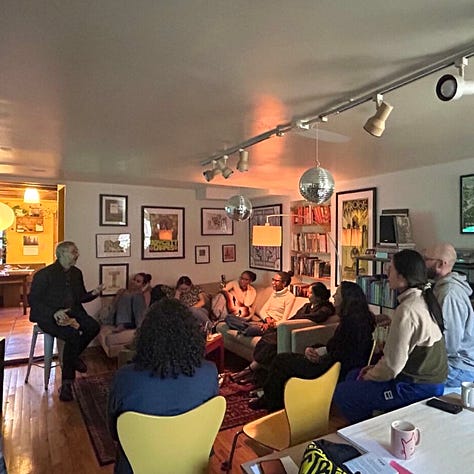
Anthony Neil Tan and I taught a sold-out micropropagation workshop at Biocurious on Sunday 3/16 in Santa Clara, CA.
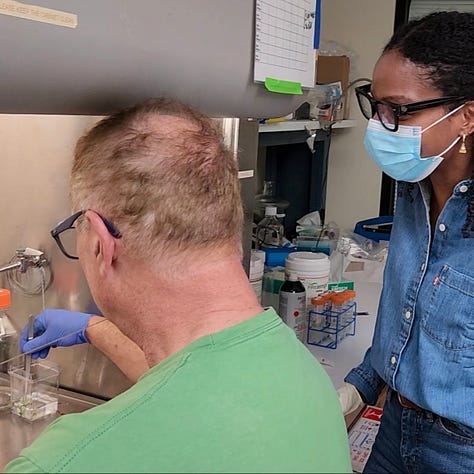
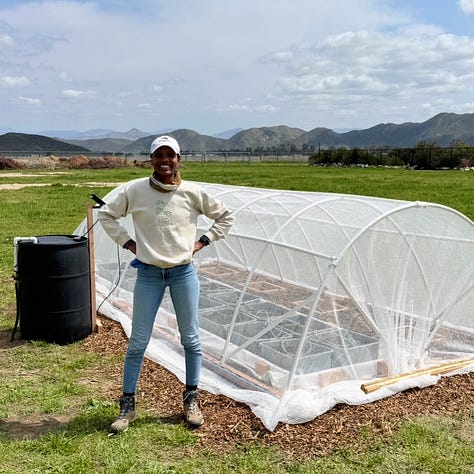
I officially submitted my application to the O’Shaughnessy fellowship! 🎉 If the stars align and I am awarded the fellowship, the money will mostly be for infrastructure (greenhouse build, lab equipment, etc). Speaking of infrastructure, shout out to MeliBio—specifically their CTO Aaron—for giving me some heavily discounted lab gear and consumables (and for gifting me some of their yummy bee-free honey)!
This month’s contamination rate dropped significantly compared to last month—21.9% versus 80.1%—likely due to my ongoing tests with higher concentrations of sterilizing agents and longer exposure times. Though I’m glad this has resulted in the lower contamination rate, I’ve noticed that tissue damage is occurring more frequently. This probably means the exposure times to the harsh chemicals are too long, so I’ll test shorter exposure times at higher concentrations in April.
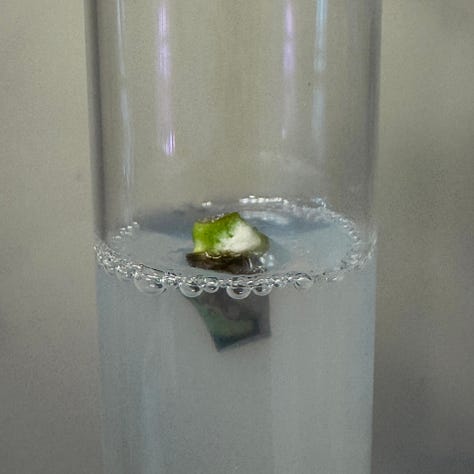
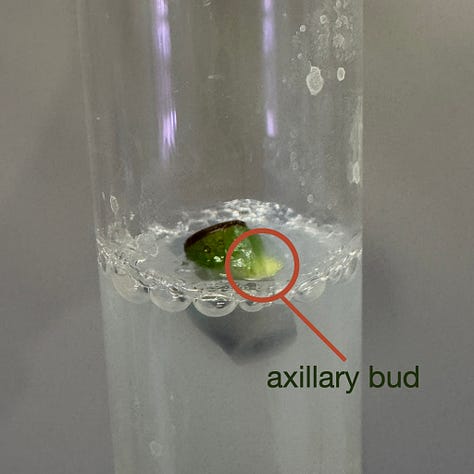
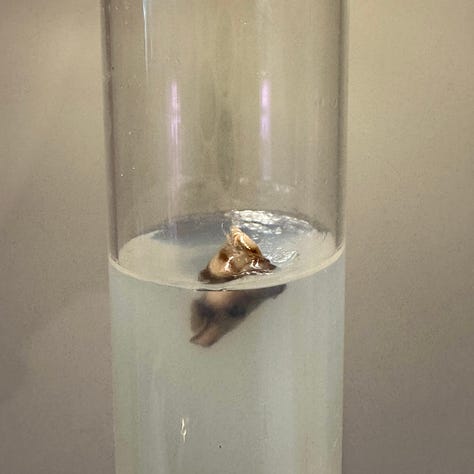
From left to right: A node contaminated by a fungus, a sterile node with a clearly developing axillary bud, and a browning node due to intense sterilization and oxidation Note: All of my sterilization tests involve exposing Monstera nodes to different sterilizing active ingredients at varying concentrations and durations to identify which is most likely to reduce contamination, while not damaging plant tissue. This is especially important when working with rare Monsteras where only a handful of nodes are available. Check out February’s lab update for more info!
I’m applying for two more residency/grant applications—the Astera residency and the Emergent Ventures grant. Completing both in April is a bit ambitious, but let’s shoot for the moon.
Since I was out of town for two weeks in March, I have a few more days of Monstera sterilization tests to do. My plan is to test higher sodium dichloroisocyanurate (NaDCC) concentrations at lower exposure times. I’ve also observed some browning, perhaps due to tissue oxidation. (When plant tissue is cut or damaged, it releases natural chemicals that help protect a plant from stress, pests, and diseases. These phenolic compounds react with oxygen and cause browning.) This is a well-known issue for ornamentals and woody plants, so I’ll add ascorbic acid (an antioxidant) into the media.
Now that the usefulness of an open-access plant tissue/cell culture dataset is abundantly clear, I want to begin mapping out the structure for a three session discussion on necessary database and metadata standards. Align to Innovate recently released their initial framework for how to describe and connect microbial growth data, which has given me a great starting point to do the same for plant tissue/cell culture.
I’m still taking the CPC Applied Conservation course. At some point I need to think about how to prioritize different vulnerable and exceptional plant species. Clare Loughran—the Curator and Conservation Officer at UC Berkeley Botanical Garden—provided some helpful direction here (cycads, conifers, and oaks), but I need to list all the factors to consider in addition to a plant’s NatureServe or International Union for the Conservation of Nature (IUCN) ranking. For example, while oaks are at risk, many organizations are already working on their conservation. Independent efforts might have a bigger impact focusing on less-supported taxa.
I’ll be attending Conserving Exceptional Plants: Cryobiotechnologies, Status, and Scale Symposium on April 8-10, 2025.
Like, share, and comment on my O’Shaughnessy fellowship video pitch on Instagram! If you’re interested in more regular content, follow Jas and Olive.
Connect me with more folks who have created large, open-access datasets—if they’ve worked with image data, even better. Reach out if someone comes to mind and I’ll send over a blurb you can use for an intro.
Feel free to share this with any friends who might be interested. And if you received this email from someone else, you can subscribe directly to get the next one. 🌵
Comments
Nothing yet. Say the first thing.
Sign in to join the conversation.