
Welcome to issue 214 of Japan Climate Curation! 📬 I’m Hiroyasu Ichikawa (ichi), curating Japan’s climate news weekly since 2022 for 550+ subscribers on this Substack & [3,220+ on LinkedIn].
🎧 This week’s audio versions are available:
Haven’t checked the Climate Curation yet? I’ve recently migrated it to Substack, which means it now follows the same format you’re reading here. Climate Curation curates 10 of the most important stories from global news media on climate change, climate tech, and the energy transition worldwide — and because it draws from a different pool of stories than Japan Climate Curation, the two are designed to complement rather than overlap. If you’d like a broader view of what’s happening globally alongside Japan’s developments, I’d be grateful if you’d take a look and consider subscribing to both. You can find it below.
Found this valuable? A quick like or share helps others stay informed. 🙂
Disclaimer: Generative AI tools (Claude, ChatGPT, Gemini Notebook) have been used for summary and translation assistance. 🙂
[🇯🇵📰👀Japan Climate News Headlines]
🌏 How the US-Iran War Has Redrawn Asia’s Energy Map [8/6 Nikkei Asia]
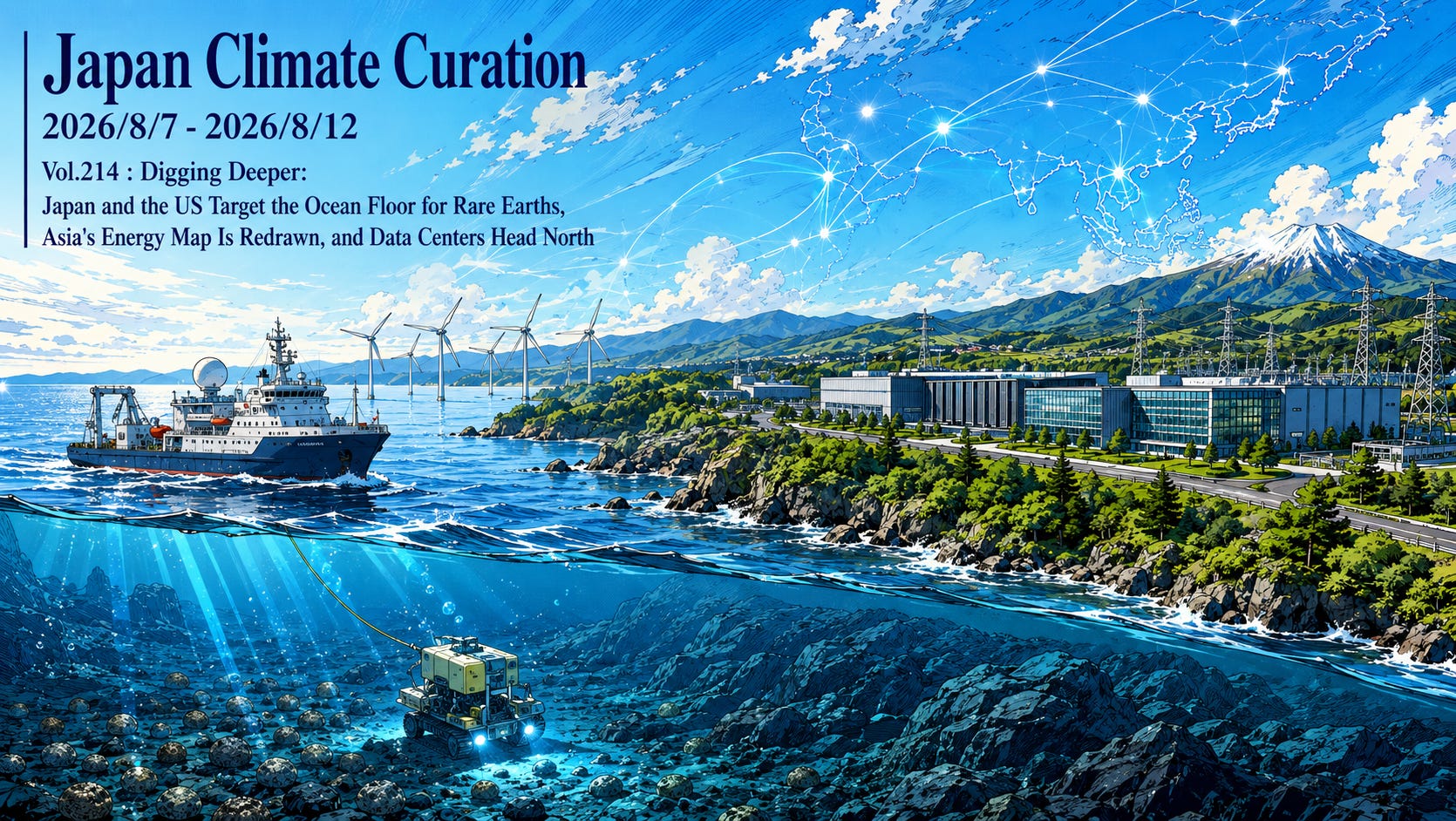
🧲 US and Japan Plan World’s Deepest Undersea Mine at Minamitorishima to Break China’s Rare Earth Grip [8/13 Bloomberg]
⚛️ Mitsubishi Heavy Wins Government Backing for Three Next-Generation Nuclear Reactor Projects [8/5 Reuters]
🏭 Kansai Electric and Kawasaki Heavy to Attempt Japan’s First Off-Site Transport of Captured CO2 [8/9 Nikkei Asia]
🌊 Sumitomo Corp Takes First-Ever Floating Offshore Wind Stake With 33% of UK’s Gwynt Glas Project [8/10 Nikkei]
🏢 UAE’s Mubadala Weighs Up to ¥1 Trillion for Japan’s 500MW Akita AI Data Center, Powered by Offshore Wind [8/11 Shulman Advisory]
🏘️ Residents’ Group Asks Japan to Reclassify Data Centers as Hazardous Facilities [8/7 NHK World]
🔆 PXP’s Tandem Solar Cell Combining Chalcopyrite and Perovskite Boosts Output 50%, Targets 2028 Mass Production [8/6 Nikkei GX]
🚙 BYD’s Racco Kei EV Tops 1,000 Orders in Two Weeks, Its Fastest Start in Japan [8/10 Nikkei]
🏗️ How Japan Reduced Deaths From a Major Quake [8/7 The New York Times]
【1】🌏 How the US-Iran War Has Redrawn Asia’s Energy Map [8/6 Nikkei Asia]
Five months into the war, Asia’s energy sourcing has shifted substantially, with the US and Russia emerging as main beneficiaries. Japan’s crude flows through Hormuz fell from over 90% to around 10%, offset by surging US imports; US LNG rose from 1% to over 15% of Japanese imports since February. Japan’s oil imports fell 11.4% and LNG 11.2%, cushioned by the world’s third-largest strategic reserves. China’s oil imports collapsed 40%, partly due to EV adoption — battery charging consumed 14.8 billion kWh in June, up 57.1% year-on-year. India’s Russian crude imports rose 156%.
💡 Insight:
Japan’s ability to cut Hormuz dependence from 90% to 10% in five months is the single most consequential energy security data point of 2026 — and it happened not through new infrastructure but through strategic reserves buying time while procurement was rerouted to the US.
China’s 40% oil import collapse, driven substantially by EV adoption and high-speed rail, is the clearest real-world evidence yet that electrification materially reduces geopolitical energy exposure — a conclusion with direct implications for Japan’s own EV lag.
【2】🧲 US and Japan Plan World’s Deepest Undersea Mine at Minamitorishima to Break China’s Rare Earth Grip [8/13 Bloomberg]
The US and Japan are advancing plans for the world’s deepest undersea mine at Minamitorishima, extracting rare earths from ~6,000 meters below the surface. Samples retrieved this year confirmed yttrium, gadolinium and dysprosium — heavy rare earths China dominates. A month-long full-scale mining test including refining is planned for February 2027, with a commercialization decision in 2028. Takaichi’s growth strategy allocates ~$5.7 billion by 2040 for deep sea resource development. Chinese survey ships have mapped up to Japan’s EEZ boundary, and a Chinese carrier entered the zone in June 2025. Extraction costs are estimated at three times China’s land-based production.
💡 Insight:
The Minamitorishima project has shifted from a resource development question to an alliance-security instrument — and its value to Washington may lie as much in the signal it sends Beijing as in the rare earths it eventually produces.
The economics remain brutal: extraction costs are estimated at roughly three times China’s land-based production, requiring billions over more than a decade, and Japanese officials privately concede no operations will begin during Trump’s presidency — making sustained US commitment the project’s largest non-technical risk.
【3】⚛️ Mitsubishi Heavy Wins Government Backing for Three Next-Generation Nuclear Reactor Projects [8/5 Reuters]
Mitsubishi Heavy Industries won government support under METI’s supplementary budget program for three next-generation reactor projects: safety technologies and standard design for advanced light water reactors, design and component technologies for SMRs, and supply chain strengthening. MHI is developing its SRZ-1200 advanced light water reactor for early commercial deployment in Japan, and leads government-backed development of test fast reactors and high-temperature gas reactors. The subsidies will accelerate a domestically designed SMR tailored to Japan’s seismic and tsunami conditions.
💡 Insight:
The explicit inclusion of supply chain strengthening as one of three funded pillars confirms that METI has recognized what last week’s coverage identified as the binding constraint: Japan cannot build reactors without first rebuilding the industrial base that has halved since 2010.
A domestically designed SMR tailored to Japan’s seismic and tsunami conditions is a strategically distinct product from the US and European SMR designs Japan is simultaneously financing abroad — and it may prove more exportable to other seismically active markets.
【4】🏭 Kansai Electric and Kawasaki Heavy to Attempt Japan’s First Off-Site Transport of Captured CO2 [8/9 Nikkei Asia]
Kansai Electric and Kawasaki Heavy will transport CO2 captured at the Maizuru coal-fired plant in Kyoto to Tomakomai, Hokkaido as early as this fiscal year — Japan’s first off-site transport of power plant CO2. Japan CCS, funded by 10 power companies, will handle transport by sea. If captured and stored underground, coal plant CO2 emissions could fall up to 90%. Tomakomai received government permission for trial drilling in September 2025, targeting commercialization in 2030. Japan CCS aims to build toward long-distance transport to Malaysia and Australia.
💡 Insight:
This is the first physical link in Japan’s CCS value chain — moving from capture demonstrations at individual plants to the transport infrastructure that makes storage economically viable at national scale.
The timing is a direct consequence of the Hormuz crisis: Japan lifted restrictions on inefficient coal plants in March, and coal use rose accordingly — making CCS the only credible route to reconcile increased coal generation with decarbonization commitments.
【5】🌊 Sumitomo Corp Takes First-Ever Floating Offshore Wind Stake With 33% of UK’s Gwynt Glas Project [8/10 Nikkei]
Sumitomo Corp acquired a 33.3% stake in the Gwynt Glas floating offshore wind project off the UK’s Celtic Sea coast — its first-ever floating wind investment. The 1.5GW project, with French and Irish state utilities each holding 33.3%, targets government permitting around 2028 and construction in the 2030s. The deal falls under Sumitomo’s July 2025 memorandum with the UK government to invest £7.5 billion (¥1.6 trillion) by 2035. Sumitomo is separately developing a fixed-bottom project off Saikai, Nagasaki.
💡 Insight:
Sumitomo’s first floating offshore wind investment coming via the UK — not Japan — validates the structural argument that Japan’s deep-ocean geography makes foreign floating wind expertise essential, and Japanese trading houses are now actively acquiring that expertise abroad rather than waiting for domestic capability to develop.
The timing — a major Japanese trading house committing to floating wind just as BP retreats from Japan’s own offshore wind sector — shows how differently Japan’s trading houses treat offshore wind at home versus abroad: struggling economics domestically, active capital deployment overseas.
【6】🏢 UAE’s Mubadala Weighs Up to ¥1 Trillion for Japan’s 500MW Akita AI Data Center, Powered by Offshore Wind [8/11 Shulman Advisory]
One of Japan’s largest AI data centers — up to 500MW capacity — is planned for Akita City, led by US startup BITGRIT and Japanese IT firm S2, with UAE sovereign wealth fund Mubadala considering an investment of several hundred billion yen to ¥1 trillion. Total development costs could reach ¥2 trillion, targeting early-2030s operation. Akita’s appeal lies in over 2GW of planned offshore wind across four zones. Separately, PowerX unveiled an integrated grid connection system, and SWCC partnered with Faraday Factory Japan to commercialize superconducting cables for data centers by FY2030.
💡 Insight:
The Akita project represents a structural shift in Japan’s data center geography — moving beyond the Tokyo/Osaka concentration that drives 8-to-10-year grid connection bottlenecks toward regions where renewable generation capacity precedes demand rather than lagging it.
Mubadala’s potential ¥1 trillion commitment, layered onto PowerX’s grid connection simplification and SWCC-FFJ’s superconducting cable roadmap, shows Japan’s data center ecosystem attacking its power bottleneck on three fronts simultaneously: capital, siting strategy, and transmission technology.
【7】🏘️ Residents’ Group Asks Japan to Reclassify Data Centers as Hazardous Facilities [8/7 NHK World]
A group including residents near planned data center sites has asked the Ministry of Land, Infrastructure, Transport and Tourism to review regulations, arguing that treating data centers as ordinary office buildings does not reflect their actual use. The group says data centers pose a fire risk and should be treated as “hazardous materials facilities” and classified as “special buildings” under the Building Standards Act. Group chair Teranishi Shunichi, Hitotsubashi University professor emeritus, noted some facilities are planned next to residential neighborhoods in the Tokyo area. A ministry official said it will study possible measures.
💡 Insight:
A regulatory reclassification of data centers as “special buildings” or hazardous facilities would materially change construction costs, siting options, and permitting timelines across Japan’s entire data center pipeline — a risk that current project economics have not priced.
That the ministry publicly acknowledged the need to address local concerns signals this is not a fringe complaint but an emerging policy question — and it strengthens the case for the geographic decentralization already visible in the Akita project.
【8】🔆 PXP’s Tandem Solar Cell Combining Chalcopyrite and Perovskite Boosts Output 50%, Targets 2028 Mass Production [8/6 Nikkei GX]
Startup PXP (Sagamihara) will begin mass production in 2028 of a tandem solar cell combining chalcopyrite and perovskite, raising conversion efficiency from 18% to 28% and output by 50%. A new Sagamihara factory launches in March 2027 with 25MW annual capacity, backed by ~¥1.5 billion from Tokyo Century and others. At under 1kg/m² — one-tenth the weight of silicon panels — installation runs 10x faster and costs roughly half. LCOE is projected at ¥20/kWh versus silicon’s ¥16. This would be a world-first commercialization, distinct from Chinese silicon-perovskite tandems. Gallium and indium remain heavily China-dependent.
💡 Insight:
PXP’s chalcopyrite-perovskite approach — distinct from the silicon-perovskite tandems Chinese manufacturers are pursuing — represents genuine technology differentiation in a market where Japan has largely ceded manufacturing scale to China.
The gallium and indium dependency on China undermines the energy security narrative — mirroring the dynamic playing out in rare earths, and illustrating why upstream material diversification must advance in parallel with downstream technology innovation.
【9】🚙 BYD’s Racco Kei EV Tops 1,000 Orders in Two Weeks, Its Fastest Start in Japan [8/10 Nikkei]
BYD Japan announced the Racco kei EV received 1,002 orders as of August 9 — two weeks after its July 28 launch — the fastest pace for any BYD model in Japan. The company targets 10,000 orders by end-2026. Notably, the top-tier “300 Premium” grade accounted for 80% of orders, versus 14% for the standard “300 Plus” and 6% for the entry “200.” By purchase type, 37.5% were additional vehicles, 35.7% replacements, and 26.8% first-time buyers.
💡 Insight:
The 80% share going to the top-tier grade is the most revealing data point — it suggests BYD is competing on product substance rather than price, despite facing a ¥400,000 subsidy disadvantage against domestic kei EVs.
That 37.5% of orders are additional vehicles rather than replacements confirms the multi-car rural household thesis behind BYD’s regional strategy — these sales are expanding the segment rather than cannibalizing existing kei purchases.
【10】🏗️ How Japan Reduced Deaths From a Major Quake [8/7 The New York Times]
The NYT reports last week’s major earthquake in Kumamoto destroyed or heavily damaged only a few hundred buildings, with a death toll of 38 one week on — compared with over 8,000 buildings toppled and 270+ deaths in the 2016 twin quakes. By 2024, roughly 90% of buildings in Kumamoto met national earthquake-resistance standards. Uto's rebuilt City Hall, built on shock-absorbing foundations, came through undamaged despite being less than five miles from the epicenter. Nishihara village's disaster drills held every two years enabled residents to rescue all nine trapped neighbors in 2016. Evacuation centers still lack air conditioning and bedding amid extreme heat.
💡 Insight:
Kumamoto’s decade of investment in earthquake-proofing buildings — reaching 90% compliance with national standards by 2024 — offers one of the clearest available demonstrations that sustained resilience spending saves lives on a large scale.
The remaining gap — evacuation centers without air conditioning or bedding during extreme heat — shows where Japan’s disaster preparedness still falls short, and it is exactly where rising temperatures make earthquakes more dangerous.
📬 That’s a wrap for this week! Thank you for reading.
Found this useful? A quick like, comment, or share on LinkedIn helps more people discover Japan’s climate developments. 🙏
📩 Stay connected:
🇯🇵 Japanese edition: [Climate Curation](LinkedIn / Substack link) — every Saturday
🐦 X (Japanese): @SocialCompany
🦋 Bluesky (English): socialcompany.bsky.social
💼 Work with me: Looking for research, consulting, or market insights on Japan’s climate/energy sector? Let’s talk. 📧 hiroyasu.ichikawa[@]socialcompany.org | ☕ Coffee chats welcome!
Comments
Nothing yet. Say the first thing.
Sign in to join the conversation.