
Welcome to issue 215 of Japan Climate Curation! 📬 I’m Hiroyasu Ichikawa (ichi), curating Japan’s climate news weekly since 2022 for 560+ subscribers on this Substack & [3,220+ on LinkedIn].
📣 One note before this week’s stories: Japan Climate Curation now has an optional supporter plan.
Nothing changes in what you receive. Every issue stays free, with no paywall — as it has been since 2022, and as it will remain.
What’s new is simply a way to support the work, for those who find it useful. If this newsletter saves you research time or informs how you think about Japan’s energy transition, you can now support it from $5/month. Reader support is what keeps this weekly curation independent and free for everyone. And 1% of all contributions goes to carbon removal through Stripe Climate.
Support Japan Climate Curation
🎧 This week’s audio versions are available:
Haven't checked Climate Curation yet? Now on Substack in the same format you're reading here, it curates 10 stories a week from global media on climate, climate tech, and the energy transition. It draws from a different pool of stories than this newsletter — the two complement rather than overlap.
Disclaimer: Generative AI tools (Claude, ChatGPT, Gemini Notebook) have been used for summary and translation assistance. 🙂
[🇯🇵📰👀Japan Climate News Headlines]
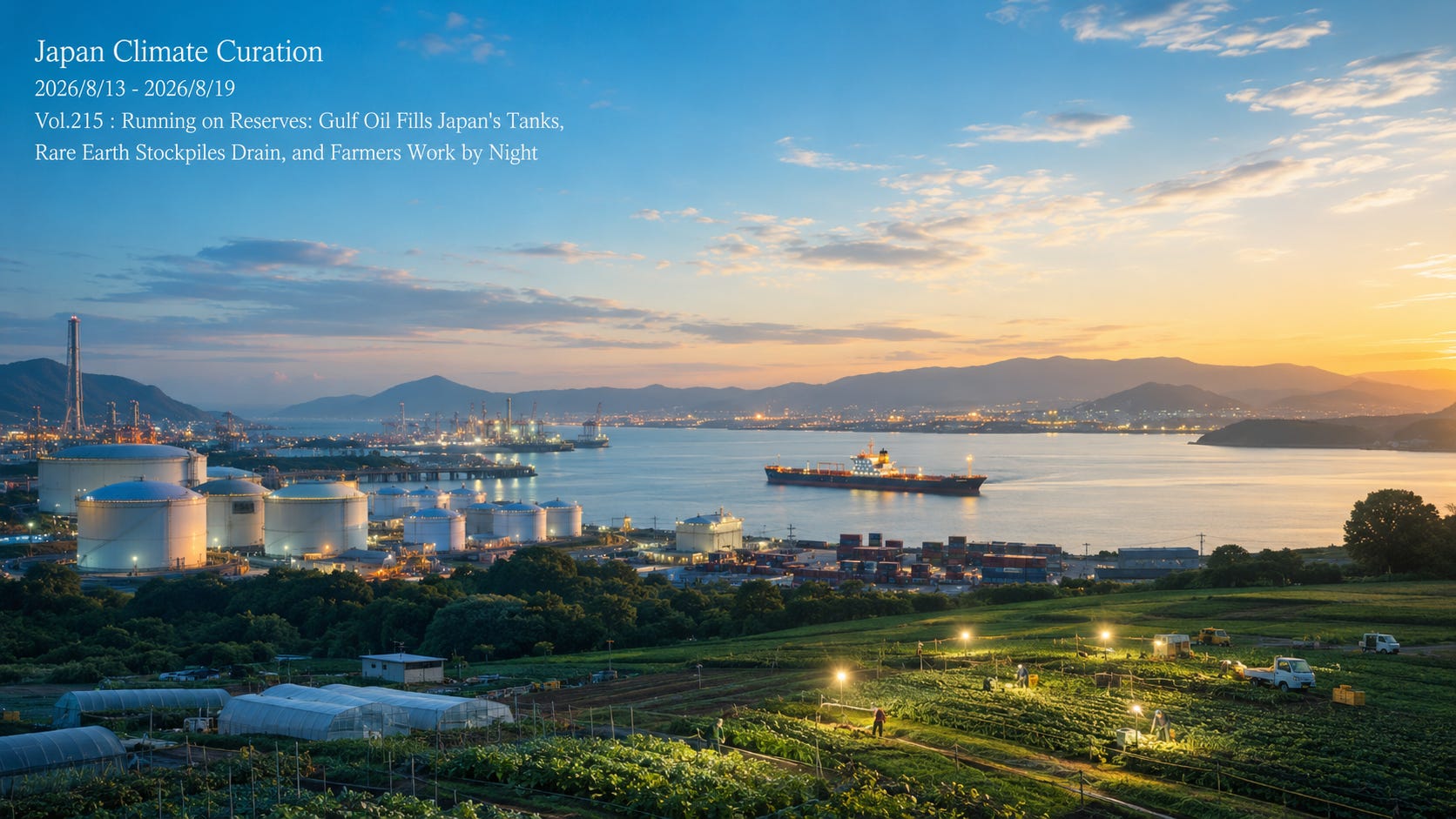
🛢️ Gulf Producers Push to Store Up to 10x More Oil in Japan as the Hormuz Crisis Drags On [8/18 The New York Times]
🧲 Japan’s Rare Earth Imports Collapse 80% as China’s Export Curbs Bite Into EV and Chip Supply Chains [8/15 Nikkei Asia]
🏦 Citi and JPMorgan Join Japan’s $4.6 Billion Financing for US Gas Plants, a First Under the $550 Billion Pact [8/15 Nikkei Asia]
💴 Takaichi’s ¥370 Trillion Industrial Policy Bet Faces Skepticism From Bond Markets and Economists [8/14 Nikkei Asia]
📈 Japan’s Power Futures Trading Nearly Triples as Utilities Hedge Against Fuel Price Swings [8/14 Bloomberg]
☢️ Worker Death at Tomari Plant Threatens to Delay Hokkaido’s Only Nuclear Restart [8/19 Bloomberg]
🔥 Japan’s Biomass Power Faces Scrutiny After 14 Fires and Explosions in Recent Years [8/17 Mongabay]
🏢 Itochu to Build 10 Data Centers Across Japan by 2030, Eyeing JR East Land and Power Access [8/20 Nikkei Asia]
🇦🇺 Chinese EVs Close In on Japan’s Australian Stronghold as BYD Nearly Matches Toyota’s Monthly Sales [8/15 Nikkei Asia]
🌾 Deadly Heat Pushes Japan’s Farmers to Work Through the Night [8/18 Reuters]
【1】🛢️ Gulf Producers Push to Store Up to 10x More Oil in Japan as the Hormuz Crisis Drags On [8/18 The New York Times]
Saudi Arabia and the UAE are urging Japan to expand crude stored in Japanese tanks by as much as 10 times the roughly 8 million barrels each currently holds, with similar talks underway in South Korea. Gulf producers seek storage beyond vulnerable maritime chokepoints, while Japan gains emergency supply buffers — though at the cost of tank capacity for domestic refiners and national reserves. Japan drew on these reserves, equal to about six days of demand, early in the conflict. Momentum built after economy minister Ryosei Akazawa visited the UAE and Saudi Arabia in May.
💡 Insight:
Japan’s declining domestic oil consumption has become a strategic asset — spare tank capacity is now a bargaining chip that buys preferential access to Gulf crude during emergencies, turning a symptom of economic contraction into energy security leverage.
The cost-sharing model could spread across Southeast Asia, where countries like the Philippines want national reserves but cannot afford the hundreds of millions of dollars required — making joint producer-government stockpiles one of the few constructive outcomes to emerge from this crisis.
Editor’s note: On August 19, Foreign Minister Motegi Toshimitsu told his Saudi counterpart in Riyadh that Japan will draw up a comprehensive cooperation plan for the energy sectors of Saudi Arabia and five other Gulf states, and will help boost regional oil reserves under its “POWERR Asia” initiative. Both ministers agreed on the importance of free and safe passage through the Strait of Hormuz at no additional cost (NHK World, August 20).
【2】🧲 Japan’s Rare Earth Imports Collapse 80% as China’s Export Curbs Bite Into EV and Chip Supply Chains [8/15 Nikkei Asia]
Japan’s imports of dysprosium-iron alloy fell 82% year-on-year to 13 tons in H1 2026, with zero imports in four separate months, while yttrium oxide imports dropped 74% to 204 tons — the lowest on record, below even the post-Senkaku trough of 235 tons in 2013. China accounts for roughly 70% of rare-earth mining and over 90% of magnet-grade production. Magnet maker Proterial has received no export licenses since November 2025, and companies are drawing down inventories to maintain deliveries to major customers.
💡 Insight:
Yttrium imports falling below the 2013 post-Senkaku trough means Japan is now in a worse position than during the crisis that triggered its original diversification strategy — 15 years of alternative sourcing efforts have not created the buffer they were meant to provide.
Japanese firms are currently absorbing the shortage through inventory drawdown, which means downstream disruption is a matter of timing rather than a possibility — the visible impact on chip equipment and EV motor production will arrive when those buffers are exhausted, not when the restrictions tighten further.
【3】🏦 Citi and JPMorgan Join Japan’s $4.6 Billion Financing for US Gas Plants, a First Under the $550 Billion Pact [8/15 Nikkei Asia]
Citigroup and JPMorgan Chase will join JBIC in providing $4.61 billion for gas-fired power projects in Pennsylvania and Texas — the first time American banks have participated under the $550 billion Japan-US investment framework. Japanese commercial banks had raised concerns about securing long-term dollar funding, prompting JBIC to turn to US lenders with abundant dollar reserves. Each contributes roughly a third, with NEXI guaranteeing the US banks’ exposure. SMRs remain excluded from this tranche because accident liability terms are unresolved.
💡 Insight:
Japanese commercial banks stepping back from long-term dollar funding due to concerns reveals a structural constraint on the $550 billion pledge that has little to do with politics — Japan’s banks cannot easily fund decade-long dollar exposures at the scale the framework requires.
SMRs being excluded from this tranche confirms that the nuclear liability impasse reported in July remains unresolved, meaning the gas projects are advancing while the nuclear component — the more strategically significant half — stays frozen.
【4】💴 Takaichi’s ¥370 Trillion Industrial Policy Bet Faces Skepticism From Bond Markets and Economists [8/14 Nikkei Asia]
Takaichi’s “big-boned policy” aims to mobilize over ¥370 trillion ($2.3 trillion) in public and private investment across 17 sectors and 62 technologies by FY2040, betting that AI-driven productivity gains can outpace debt, which is about 190% of GDP. The plan assumes potential growth rising to 1.8% from 0.4%, which would require total factor productivity growth to more than double. Long-term JGB yields surged to multi-decade highs after the draft’s release, and 70% of 50 economists surveyed by Nikkei and JCER doubt the debt ratio will fall sustainably.
💡 Insight:
The bond market has already priced its verdict — JGB yields hit multi-decade highs on the draft’s release, signaling that investors will not wait a decade to see whether productivity gains materialize before repricing Japanese sovereign risk.
Yaskawa’s director makes the sharpest critique of the policy design: subsidies flow to technology developers who would invest anyway, while the companies actually taking the risk — first adopters of automation in unproven applications — receive less support.
【5】📈 Japan’s Power Futures Trading Nearly Triples as Utilities Hedge Against Fuel Price Swings [8/14 Bloomberg]
Short-term power futures traded on the European Energy Exchange — which holds 97% of Japan’s power futures market — nearly tripled year-on-year to over 10,000 lots in July, a second consecutive monthly record. Day contracts hit all-time highs in both June and July. July futures volumes equaled nearly 44% of JEPX spot volumes, up 4 points from June. Participants now include international commodity traders and financial institutions trading spreads rather than physical exposure.
💡 Insight:
Futures volumes reaching 44% of spot trading marks a structural shift in how Japanese power risk is managed — the market is maturing from a physical delivery system into one where financial hedging is becoming standard practice.
The entry of international commodity traders and financial institutions that trade spreads rather than physical exposure means Japan’s power market is now attracting participants whose activity is driven by volatility itself, adding liquidity but also introducing a new source of price movement unrelated to supply and demand.
【6】☢️ Worker Death at Tomari Plant Threatens to Delay Hokkaido’s Only Nuclear Restart [8/19 Bloomberg]
A worker was killed after falling into a gravel silo used for seawall construction at unit 3 of the Tomari plant — the only nuclear facility on Hokkaido — Hokkaido Electric Power said. The utility had targeted a restart in mid-December 2027 and will now “reconsider the restart date after an investigation.” Tomari shut in May 2012 and won the local governor’s endorsement last November. BloombergNEF notes its restart would have a significant impact on power prices across Hokkaido.
💡 Insight:
Tomari’s restart carries outsized weight for Hokkaido’s power economics precisely as the island attracts semiconductor and data center investment — a delay compounds the grid constraints those projects already face.
The incident illustrates how Japan’s nuclear restart timeline is vulnerable not only to regulatory review and local consent but to construction-phase safety events, adding a category of schedule risk that investors modeling restart pipelines rarely account for.
【7】🔥 Japan’s Biomass Power Faces Scrutiny After 14 Fires and Explosions in Recent Years [8/17 Mongabay]
At least 14 fires, explosions and accidents have occurred at Japanese biomass plants in recent years. Japan is the world’s second-largest wood pellet consumer after the UK, with roughly 34 large plants generating 3.5GW. A 2024 explosion at JERA’s Taketoyo plant in Aichi — its third such incident — drew no fines or administrative penalties. Biomass is no longer eligible for feed-in tariffs, and no new plants are expected before 2030. Rising US and Canadian pellet prices are pushing buyers toward Vietnam and Indonesia.
💡 Insight:
Japan’s biomass sector illustrates what happens when a technology loses its subsidy support before achieving cost competitiveness — plants remain operating under fixed-price contracts as fuel costs rise, creating financial pressure that critics link directly to safety shortcuts.
The shift from North American to Southeast Asian pellet sourcing, driven by price, introduces fuel quality variability that industry critics identify as an accident risk — a supply chain consideration relevant to any utility or investor with biomass exposure in Japan.
【8】🏢 Itochu to Build 10 Data Centers Across Japan by 2030, Eyeing JR East Land and Power Access [8/20 Nikkei Asia]
Itochu will invest several hundred billion yen by 2030 to build around 10 data centers across Tokyo, Osaka and Kyushu, each with roughly 50MW capacity, leasing them to US tech giants before eventually selling them on. The trading house signed a real estate partnership with East Japan Railway in December, with a joint venture launching in October. JR East’s extensive landholdings and its own power generation could address the two biggest bottlenecks. Japan’s data center services market is projected to reach ¥5.65 trillion in 2030.
💡 Insight:
JR East’s combination of extensive landholdings and captive power generation makes railway operators an unexpectedly strategic partner class for Japanese data center development — solving both bottlenecks that have constrained the sector.
Itochu’s build-lease-sell model treats data centers as real estate rather than infrastructure to hold, a capital-efficient approach that contrasts with NTT Data’s long-term ownership strategy and reflects how differently Japanese trading houses and telecom operators view the same AI demand.
【9】🇦🇺 Chinese EVs Close In on Japan’s Australian Stronghold as BYD Nearly Matches Toyota’s Monthly Sales [8/15 Nikkei Asia]
EVs reached 21.7% of new car sales in Australia by July, roughly tripling since January, as Chinese makers push into a long-standing Japanese stronghold. BYD sold about 19,000 vehicles in June, narrowing its gap with Toyota — market leader for 23 years — to just 243 units for the month. Australian petrol prices rose about 30% from pre-war February levels. BYD’s Sealion 6 undercuts Toyota’s RAV4, and delivers in under four weeks versus six months. Australia imposes no tariffs on Chinese EVs.
💡 Insight:
Australia is the clearest test case for whether Japanese automakers can defend export markets without tariff protection — unlike the US and Europe, Canberra imposes no barriers on Chinese EVs, and Toyota’s 23-year lead has narrowed to 243 units in a single month.
Delivery speed has emerged as a competitive weapon alongside price: BYD buyers wait under four weeks, compared with six months for a RAV4, reflecting the same production-cycle advantage that Chinese manufacturers demonstrated in their home market.
【10】🌾 Deadly Heat Pushes Japan’s Farmers to Work Through the Night [8/18 Reuters]
Japanese farmers are rewriting the agrarian clock, shifting harvests to after dark as heatwaves make midday work dangerous. A record 59 agricultural workers died from extreme heat in 2024, more than double the 2021 toll. Around 70% of Japan’s farmers are 65 or older. Heat exposure cost the agricultural sector 926 million labor hours in 2024, according to Lancet Countdown; across all sectors, lost hours nearly doubled from the 1990s average, equal to roughly $46 billion in lost income, or about 1% of GDP. One poultry farmer now wakes 4,400 hens at 2:30 a.m. to feed before the heat suppresses their appetite.
💡 Insight:
The $46 billion in heat-related lost income — roughly 1% of GDP — reframes extreme heat from an environmental concern into a macroeconomic drag that compounds Japan’s existing productivity challenge, the very problem Takaichi’s ¥370 trillion strategy is meant to solve.
With 70% of Japanese farmers aged 65 or older, heat adaptation and demographic decline are converging on the same workforce — meaning food production faces a labor constraint that neither smart farming subsidies nor immigration policy can resolve quickly.
📬 That’s a wrap for this week. Thank you for reading.
Forwarded this issue? Japan Climate Curation lands in your inbox every Thursday — free, and always will be.
Found this useful? A quick like, a comment, or passing it along — on LinkedIn, X, Bluesky, or simply by email to a colleague — helps more people discover what's moving in Japan's energy transition. 🙏
And if this newsletter earns a place in your weekly reading, supporting it from $5/month or $50/year keeps it independent and free for everyone.
📩 Stay connected
🇯🇵 Japanese edition: Climate Curation — every Saturday on Substack and LinkedIn
🐦 X (Japanese): @SocialCompany
🦋 Bluesky(English): socialcompany.bsky.social
💼 Work with me
Research, consulting, or market insights on Japan’s climate and energy sector — let’s talk.
📧 hiroyasu.ichikawa[@]socialcompany.org | ☕ Coffee chats welcome
Comments
Nothing yet. Say the first thing.
Sign in to join the conversation.