
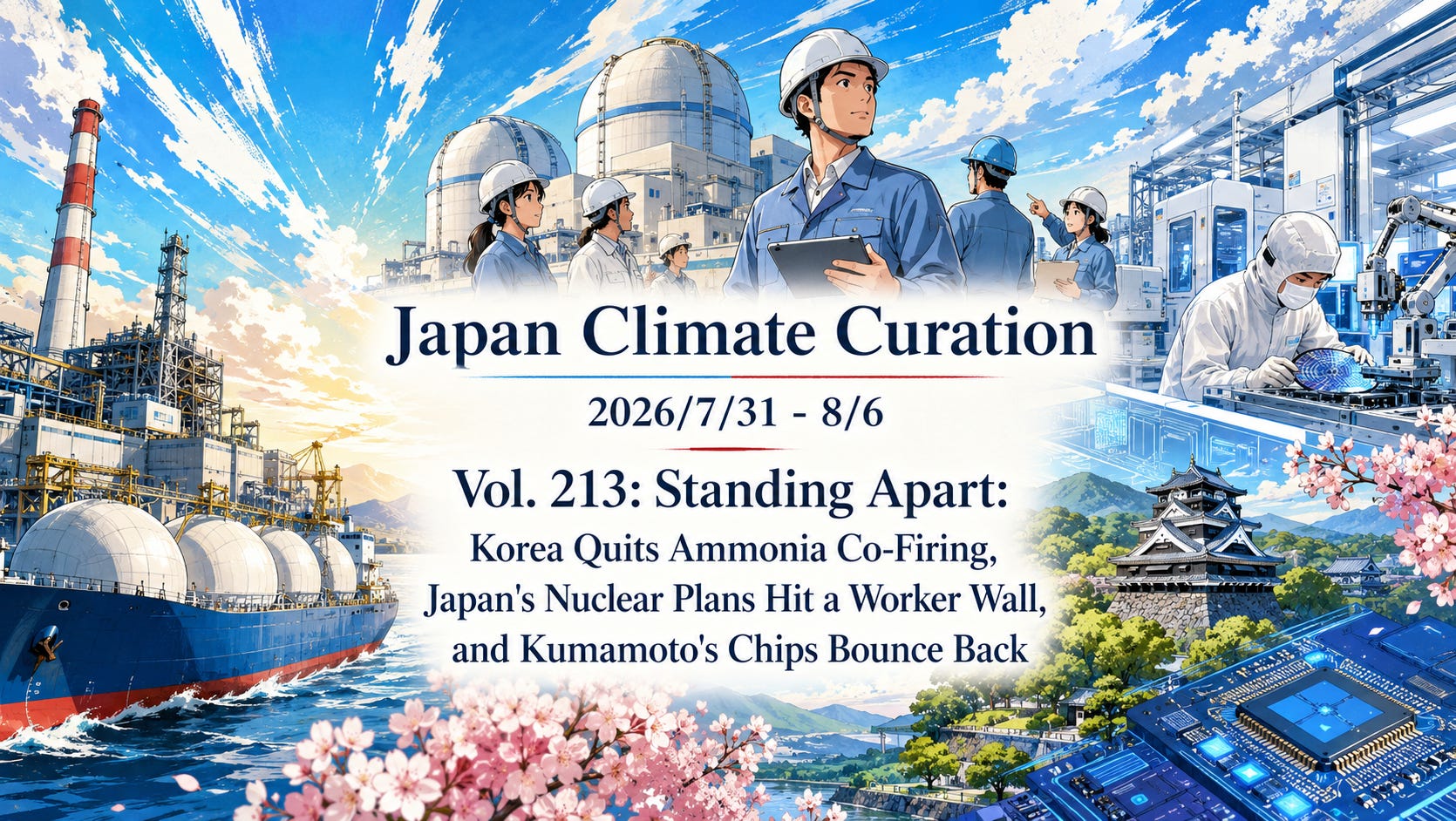
Welcome to issue 213 of Japan Climate Curation! 📬 I’m Hiroyasu Ichikawa (ichi), curating Japan’s climate news weekly since 2022 for 550+ subscribers on this Substack & [3,210+ on LinkedIn].
🎧 This week’s audio versions are available: English 🇺🇸 | Japanese 🇯🇵
Haven’t checked the Climate Curation yet? I’ve recently migrated it to Substack, which means it now follows the same format you’re reading here. Climate Curation curates 10 of the most important stories from global news media on climate change, climate tech, and the energy transition worldwide — and because it draws from a different pool of stories than Japan Climate Curation, the two are designed to complement rather than overlap. If you’d like a broader view of what’s happening globally alongside Japan’s developments, I’d be grateful if you’d take a look and consider subscribing to both. You can find it below.
Found this valuable? A quick like or share helps others stay informed. 🙂
Disclaimer: Generative AI tools (Claude, ChatGPT, Gemini Notebook) have been used for summary and translation assistance. 🙂
【1】🏭 Chip Plants Restart in Quake-Hit Kumamoto as 2016 Lessons Speed Recovery [8/5 The Japan Times]
Chip plants in Kumamoto are gradually restarting after the July 28 magnitude-7.1 quake, with production expected to reach pre-quake levels by month’s end. Damage was relatively limited versus the 2016 quakes, and prior recovery experience helped. Sony’s image-sensor plant expects full recovery within a month (versus 3.5 months in 2016); TSMC’s Kikuyo plant is back online; Renesas secured inventories, minimizing earnings impact. Infrastructure and logistics damage still affects workers’ lives.
💡 Insight:
The rapid chip-plant recovery — Sony targeting one month versus 3.5 months in 2016 — is a case study in how disaster-preparedness investment translates into supply chain resilience, and it should reassure global semiconductor buyers about Kumamoto’s viability as a production hub.
The divergence between fast corporate recovery and slow infrastructure normalization identifies the real vulnerability in Japan’s semiconductor clusters: the facilities can be hardened, but the surrounding community infrastructure and workforce cannot.
【2】⚗️ South Korea to Abandon Ammonia Co-Firing, Leaving Japan Alone Among Major Nations Betting on the Fuel [8/6 Nikkei Asia]
South Korea will abandon ammonia co-firing at coal plants, energy minister Kim Sungwhan told Nikkei, warning it could prolong coal’s lifespan and undermine decarbonization. The shift would leave Japan as the only major nation procuring ammonia for coal power — hampering supply chain and production projects in the US, Australia, and elsewhere. South Korea aims to eliminate coal by 2040; JERA and IHI continue commercializing co-firing in Aichi.
💡 Insight:
South Korea’s exit leaves Japan isolated as the sole major national buyer of ammonia for coal co-firing — a development that fundamentally undermines the global supply chain economics that JERA, IHI, and Japanese trading houses have been building.
The Korea-Japan divergence on ammonia crystallizes a broader strategic split: Seoul is pivoting decisively toward renewables and nuclear while Japan remains committed to preserving coal assets through co-firing.
【3】👷 Japan’s Nuclear Reactor Replacement Plan Collides With a Deepening Worker Shortage [8/1 Nikkei Asia]
Japan’s Takaichi government formally decided on July 31 to replace 2–5 nuclear reactors by the 2040s and reach 11–14 units by the late 2050s — but a critical worker and supply chain shortage threatens the plan. Nuclear faculty fell ~20% since 2004 (over 40% for those under 40), and nearly 70% of 229 nuclear firms reported personnel shortages in FY2025. Construction-related revenue is half its 2010 level. Without action, Japan faces a 5.5GW nuclear shortfall by FY2040.
💡 Insight:
Japan’s nuclear ambitions have a human capital problem that capital investment alone cannot solve — and the 15-year lead time on rebuilding expertise means the worker shortage, not financing or regulatory approval, may become the binding constraint on the entire replacement program.
The halving of nuclear construction revenue since 2010 has degraded Japan’s domestic manufacturing base to the point where the “processes and production technologies needed to build reactors” are at risk of being lost entirely — a supply chain erosion that mirrors what happened to Western nuclear industries.
【4】⚛️ Japan’s Fusion Startup Scales Prototype to $5 Billion, Betting on PM Takaichi’s Backing Amid Energy Crisis [8/4 Financial Times]
Japanese fusion startup Starlight Engine unveiled plans for a prototype plant costing up to $5 billion, betting PM Takaichi’s fusion enthusiasm will unlock public funding. The revised design enlarges the reactor for larger superconducting magnets, targeting 2035 operation — about $2 billion more than planned. Japan’s fusion industry received just €1.2 billion (2022–2025) versus €7.3 billion in the US and €6.9 billion in China. Tokyo designated fusion one of 17 strategic fields.
💡 Insight:
Starlight’s explicit strategy of seeking political credibility alongside capital — deliberately including Japan’s megabanks to “bring government and industry figures on board” — reveals how fusion funding is becoming a political process as much as a technical or financial one.
The parallel Starlight draws to Japan’s semiconductor revival is strategically apt and signals how energy security has reframed fusion from a science project into an industrial policy priority — but it also inherits the same risk of government picking winners in a technically uncertain field.
【5】⚡ Morgan Stanley: Asia’s AI Boom Hits a Power Wall, Triggering a $5 Trillion Energy Investment Supercycle [8/2 Nikkei Asia] *Note: This is an opinion contribution by a Morgan Stanley analyst.
Morgan Stanley analyst Mayank Maheshwari sees Asia’s AI boom colliding with physical power limits, triggering what could be history’s largest energy investment cycle. Asia-Pacific data center power consumption is projected to exceed 100GW by 2030 (23% CAGR), with electricity use quadrupling to 832TWh. AI GPU racks draw 40–200kW versus 5–15kW for traditional racks. The firm estimates a $5 trillion+ investment supercycle, with power (including coal) accounting for over two-thirds of energy spending.
💡 Insight:
Morgan Stanley’s projection that power — including coal — will absorb over two-thirds of Asia’s energy investment supercycle is a sobering counterpoint to the decarbonization narrative, and it directly validates Japan’s and Asia’s continued fossil fuel commitments even as developing Asia pivots toward renewables.
The 321GWh of annual data-center-linked energy storage deployment projected by 2030 identifies battery storage as the critical enabling technology that sits at the intersection of AI power demand and renewable integration — a market where Japan’s solid-state battery cluster and foreign capital inflows are already positioning.
【6】🏢 NTT Data to Invest $9 Billion to Quadruple Japan Data Center Capacity to 1 Gigawatt by 2033 [8/4 Bloomberg]
NTT Data will invest at least $9 billion (¥1.5 trillion) through 2033 to quadruple its Japan data center capacity to 1GW, adding ~750MW over seven years. The government-backed operator — Japan’s largest — plans 42MW this year and a 100MW Tochigi facility next year. Grid capacity shortages remain the key bottleneck: securing power in areas like Inzai, Chiba can take 8–10 years. Global cloud providers (AWS, Microsoft) comprise over 80% of its data center revenue.
💡 Insight:
NTT Data’s ¥1.5 trillion commitment confirms that Japan’s data center bottleneck is now definitively power and grid access — not capital or demand — and the 8-to-10-year power connection timeline in key regions is the single most important constraint shaping where and when capacity gets built.
The concern from infrastructure investors that NTT’s ¥1.5 trillion outlay could disadvantage the stock against globally-capitalized rivals highlights a structural challenge for Japanese data center operators: they are competing against Digital Realty, Equinix, and hyperscalers with far deeper capital pools.
【7】🌊 BP’s Exit Deepens Japan Offshore Wind Strain as Government Expands Support That Developers Call Insufficient [7/30 The Japan Times]
Headwinds are intensifying for Japan’s offshore wind sector as BP is seen exiting the Yuza, Yamagata project won in December 2024. Soaring construction costs are eroding viability. BP’s departure has unsettled participants in other projects, raising fears partners may follow. METI is expanding support — allowing existing projects into 20-year decarbonized power auctions and raising revenue ceilings — but one developer said stronger support “would not improve profitability sufficiently.”
💡 Insight:
The developer’s blunt assessment that expanded government support “would not improve profitability sufficiently” is the most important signal in this story — it suggests Japan’s offshore wind economics are broken at a structural level that revenue guarantees alone cannot fix.
BP’s exit creating contagion fears among other consortium participants points to a systemic confidence problem that could unravel Japan’s offshore wind pipeline beyond the directly affected projects.
【8】🚗 BYD Targets Rural Japan With Racco Mini-EV as Vanishing Gas Stations Reshape the Kei Car Market [8/4 Nikkei Asia]
BYD is betting its Racco mini-EV will succeed in rural Japan outside major cities. At a Kanazawa dealership, most test-drivers compared the Racco to gasoline kei cars, not Nissan’s Sakura. With gas stations halving from 60,000 (1994) to 27,000 (FY2024) and 381 municipalities having three or fewer, BYD targets home-charging-friendly rural areas with populations under 500,000, aiming for 120 stores by end-2027. A Suzuki dealer dismissed BYD’s 10,000-unit sales goal as “unrealistic.”
💡 Insight:
BYD’s rural targeting strategy is more strategically sophisticated than a simple price play — it exploits a structural infrastructure shift (vanishing gas stations) that makes EVs uniquely suited to depopulating areas where kei cars dominate.
The gap between BYD’s ambition and its service network is the decisive constraint, and Suzuki’s 50,000 subdealers versus BYD’s target of 120 stores quantifies why the domestic incumbents remain structurally protected in rural markets.
【9】🚗 Suzuki to Export Electric Kei Minicars to Europe by 2027, Taking On Chinese and Local EV Makers [8/4 Nikkei Asia]
Suzuki plans to export electric kei minicars to Europe as early as 2027, based on the Vision e-Sky (310km range) launching domestically this fall. UK pricing is expected under £20,000 ($27,000) — among Europe’s cheapest, alongside Renault’s Twingo. Batteries will be sourced from a BYD affiliate. The EU’s 2025 kei-inspired vehicle class offers subsidies for small EVs, but Suzuki’s Japan-produced cars likely won’t qualify. The weak yen boosts pricing competitiveness.
💡 Insight:
Suzuki exporting kei EVs to Europe is a strategic mirror image of BYD’s kei entry into Japan — both automakers are betting that small, affordable EVs are the underserved segment, but Suzuki is playing offense abroad precisely where it is playing defense at home.
The subsidy disadvantage — Suzuki’s Japan-produced kei EVs likely won’t qualify for the EU’s new small-vehicle incentives — mirrors exactly the barrier BYD faces in Japan, revealing how both the EU and Japan are using localization requirements as industrial policy tools.
【10】🛢️ Tufts Dean Gallagher: Japan’s ‘Oil Waste’ Policy Is a Mistake as the World Electrifies [8/1 Sentaku]
Tufts Fletcher School Dean Kelly Sims Gallagher criticizes Japan’s gasoline subsidies during the Hormuz crisis, warning that unplanned, prolonged subsidies balloon taxpayer costs to unsustainable levels and blunt price signals that would encourage conservation. While Japan long led the world in energy efficiency (the “first fuel”), she calls its EV lag conspicuous — noting 33 countries and 11 US states have set ICE phase-out targets while Japan has not, which she calls “highly unusual.”
💡 Insight:
Gallagher’s critique carries particular weight because it comes from an energy policy scholar who explicitly credits Japan’s efficiency leadership — making her assessment that Japan’s EV lag is “highly unusual” a warning rather than a dismissal.
The observation that Japanese automakers may be acting as a “brake” on EV policy identifies the political economy tension at the heart of Japan’s transition dilemma — and it is the same dynamic visible in Honda and Toyota’s China platform capitulation and BYD’s kei EV entry covered in recent issues.
📬 That’s a wrap for this week! Thank you for reading.
Found this useful? A quick like, comment, or share on LinkedIn helps more people discover Japan’s climate developments. 🙏
📩 Stay connected:
🇯🇵 Japanese edition: [Climate Curation](LinkedIn / Substack link) — every Saturday
🐦 X (Japanese): @SocialCompany
🦋 Bluesky (English): socialcompany.bsky.social
💼 Work with me: Looking for research, consulting, or market insights on Japan’s climate/energy sector? Let’s talk. 📧 hiroyasu.ichikawa[@]socialcompany.org | ☕ Coffee chats welcome!
Comments
Nothing yet. Say the first thing.
Sign in to join the conversation.