
A brief note: this essay was originally written in Dutch. English is not my native language, and this translation keeps something of the cadence of the language in which I first thought and wrote it.
In the previous part, I ended with me voici: here I am. With the answer that seems to have already begun before I understand myself as answering. Levinas brings responsibility almost unbearably close here. The I does not stand calmly opposite the world. It is already involved, already addressed, already placed in a relation older than choice.
After such a part, returning to Husserl may seem like a detour. Yet that detour is necessary. Levinas’s radicality does not arise outside phenomenology. It is shaped by Husserl’s precision: the discipline of description, the attention to appearing, the question of how something gives itself before we explain it or fix it in place.(1)
In earlier parts, I wrote about asymmetry, the third, the face, the Same, ethics as first philosophy, le Dire and le Dit, and me voici. Because of that, something else becomes possible. These concepts no longer need to be built again from the ground up. We can return to the philosophical school in which Levinas began: Husserl’s phenomenology.
There is a well-known anecdote about the arrival of phenomenology in France. Around New Year’s 1933, Jean-Paul Sartre, Simone de Beauvoir, and Raymond Aron are sitting in the café Bec-de-Gaz in Paris. Aron has just returned from Berlin and tells them about a way of thinking he has encountered there. He points to his glass and says, in my paraphrase: “If you are a phenomenologist, you can speak about this cocktail and make philosophy out of it.”(2)
For Sartre, this was a revelation. Philosophy did not have to begin from grand systems alone. It could begin with the glass on the table, with experience, with the world as it shows itself.
According to the story, Sartre immediately went to a bookshop and asked for everything they had on phenomenology. What he received was a thin little book: La théorie de l’intuition dans la phénoménologie de Husserl. It had appeared in 1930 as a dissertation. Its author was Emmanuel Levinas, who had studied with Husserl in Freiburg in 1928 and 1929.(3)
That image remains telling. The little book that helped set French phenomenology in motion was written by the thinker who would later place precisely that phenomenology under pressure. Levinas brought Husserl to France. Then he shifted the centre of gravity.
His thinking remains deeply marked by Husserl. Levinas continued to carry what Husserl had taught him: attention to appearing, intentionality, experience, concrete life as it presents itself. His critique comes from within. In that sense, with some caution, one could call him an unorthodox Husserlian.(4)
Husserl’s phenomenology begins with something simple and demanding at once: most of the time we live in what he calls the natural attitude. This is our ordinary way of existing. We walk through a street, recognize houses, people, sounds, faces. We see a table and use it. We read a message and respond. We rarely ask ourselves how all these things appear to us.
In this natural attitude, the world is self-evidently present. It is there. We move within it. We act, speak, judge.
Husserl asks something unusual. He wants to suspend that self-evidence temporarily. He calls this the epochè, or phenomenological reduction. The world remains there. It is neither denied nor made unreal. What Husserl places between brackets is our automatic certainty that we already know what lies before us.(5)
Then attention shifts. The first question becomes: how does this appear to me? How is it given? What structure of meaning is already at work before I formulate a theory about it?
This movement is less abstract than it sounds. When I see a chair, I never see all its sides at once. I see a front, an angle, a colour, a particular place in space. Yet I experience the chair as more than that visible fragment. I know there is a back that I do not see now. I can walk around it. The object appears in perspectives, within a horizon that reaches beyond what is immediately given.
Phenomenology therefore teaches attentiveness to the partial character of appearing. What appears is never exhausted in a single glance.
For Levinas, this was a decisive lesson. It taught him that looking is never neutral. There is always a manner of appearing, a horizon, an involvement. The world does not come toward us as a raw mass. It is experienced as meaningful, as feared, expected, remembered, desired, used, loved, or avoided.
A second key concept in Husserl is intentionality. Consciousness is always consciousness of something. I think of someone. I remember an encounter. I long for silence. I fear a judgment. I listen to a voice. Consciousness is directedness. It is not a closed inner chamber into which an impression occasionally enters.(6)
That insight is fundamental. It breaks through the image of a detached I that first exists by itself and only then encounters the world. Consciousness is involved from the start with what lies outside itself. It lives in direction, expectation, attention, memory, desire.
Here lies one of Husserl’s great strengths. He describes what we experience and how experience is structured. Something always appears as something. A sound appears as approaching footsteps, as music, as threat, as a memory from long ago. A face appears as familiar, strange, tired, closed, open, concerned. Before we consciously reason, experience has already received direction.
This brings Husserl closer to our daily lives than his technical vocabulary may suggest. We do not experience the world as a collection of isolated data. We live in connections. We recognize patterns. We expect continuation. We fill in what is not yet visible.
That is precisely what phenomenological inquiry seeks to uncover: the silent work through which the world becomes meaningful to us.
This raises the question that becomes decisive for Levinas: how does another human being appear?
With a thing, the matter is already complicated enough. I see the chair from one side and still experience it as one object. With another human being, the issue becomes sharper. I have no direct access to the inner life of the Other. I see a body, movement, gestures, facial expression, voice, posture. I see someone laughing, remaining silent, recoiling, seeking or avoiding my gaze.
Husserl tries to describe how the Other appears to me as another consciousness. In the Fifth Cartesian Meditation, he speaks of Einfühlung, often translated as empathy or feeling-into, and of analogy. From my own embodied existence, I recognize that the body of the Other is not a thing like a chair or a stone. It is a living body, a body that perceives, acts, feels, responds. In this way, the Other appears as alter ego: another I.(7)
That is an important point. Husserl does not lock consciousness inside a private world. For him, the world is intersubjective from the start. It is a shared world in which others appear as co-perceivers, co-involved persons, co-inhabitants.
Yet this is where the tension with Levinas arises. When the Other appears as alter ego, my own experience remains the path of access. I understand the Other through resemblance, recognition, and analogy. The Other is approached through what I can understand from within myself.
Levinas will sharpen this further and further. The Other does indeed appear within my experience. I hear a voice, see a face, register posture, age, language, clothing, context. All of that matters. At the same time, in Levinas, the Other is more than the one who becomes accessible through my horizon. There is in the Other a strangeness that is not a temporary lack of information. It belongs to the Other themself.(8)
Here, a brief detour through contemporary psychological research helps. Human beings form first impressions at extraordinary speed. Research on face perception shows that exposure lasting 100 milliseconds can be enough to form impressions of trustworthiness, competence, attractiveness, or aggressiveness. Other research shows that threat is also assessed very quickly.(9)
That says nothing yet about the truth of such impressions. It does show how quickly perception receives direction. Before we experience ourselves as judging subjects, an initial ordering has already emerged. A face has already become friendly, threatening, trustworthy, closed, or vulnerable. Later information can correct, deepen, or disrupt that image, although the first movement has often already been made.
This belongs to human perception. We live by recognizing patterns. Without rapid ordering, we would hardly be able to act. In professional contexts this becomes even more visible. A doctor sees symptoms. A teacher sees behaviour. A leader hears a tone. An administrator recognizes a pattern. A nurse notices from a body that something is changing.
This is where Levinas becomes important. Ordering is indispensable. A first impression, a file, or a diagnosis helps us act. Yet such a framework can determine what can still be heard. Then the Other appears mainly within my understanding, while precisely that understanding must remain capable of being interrupted.
Here Husserl returns. He teaches us how meaning appears within a horizon. Levinas asks what happens when that horizon structurally encloses the Other.
Husserl shows that experience always has a horizon. I see more than what is literally visible, because my perception is carried by expectation, memory, context, and possible continuation. The horizon makes experience possible. Without a horizon, nothing would acquire coherence.
For Levinas, this is where a fundamental tension lies. The horizon may already have absorbed the Other before that person has truly been heard. For Levinas, this is a structural question. The horizon constitutes meaning from the I, and that is precisely the movement Levinas questions. Someone then already appears as client, patient, citizen, employee, older person, refugee, administrator, problem, risk, or case. All those words may be necessary. They may offer protection, make policy possible, serve justice. Still, one question remains: does the Other remain audible in the language in which we place them?
In part 7, I wrote more extensively about le Même, the Same: the movement by which the I draws the world toward itself, orders it, understands it, and makes it manageable. Here it becomes clear how close this lies to Husserl and where Levinas takes another direction. The phenomenological horizon shows how meaning comes into being. Levinas shows that this formation of meaning structurally falls short before the one who stands before me, because the Other escapes every horizon in principle. Precisely that escape is the ethical appeal.
The Other appears within my horizon and breaks through it at the same time.
In part 6, the face stood at the centre. There, the focus was on the Other who addresses me before every act of ordering. From Husserl, it becomes clearer what is at stake here.
For Levinas, the face cannot be reduced to the visible front of a head. It refers to the way in which the Other shows themself and at the same time slips away from me. The face appears, yet cannot be exhausted by what I see. It speaks, even when there are no words. It asks something of me before I know exactly what is being asked.(10)
It is worth pausing here over the language Levinas himself uses. In French, he speaks both of visage and of face-à-face. Roger Burggraeve, who knew Levinas personally, points out that face-à-face is the better translation of the Hebrew panim, the word that resonates in Levinas’s thought. In Hebrew, panim is a plural form without a singular. Only for myself do I have a face, a physiognomy, an appearance. A face, in Levinas’s sense, exists only in the presence of the other. The face is by definition reciprocal and relational: it exists only in encounter, in the face-to-face.(11)
In Levinas, the face refers to the way in which the Other addresses me and interrupts my understanding. It concerns a relation in which I am first of all the one addressed. The Other appears, yet never coincides with what I can see, understand, or name.
This changes the phenomenological question of appearing. Husserl asks: how does something appear to consciousness? Levinas asks: what happens when someone addresses me in that appearing and changes my position?
This is a shift in the order of thought. Understanding, knowledge, and description remain necessary. Justice requires language, comparison, procedure, and judgment, as became clear in the part on the third. In Levinas, however, knowledge must not forget its origin. It comes after an address it can never fully contain.
That is why listening becomes so important here. Listening, in this light, is the practice of keeping the horizon in which I place someone movable. I may perceive, understand, order, and act, yet my understanding must remain available for correction by the one I am trying to understand.
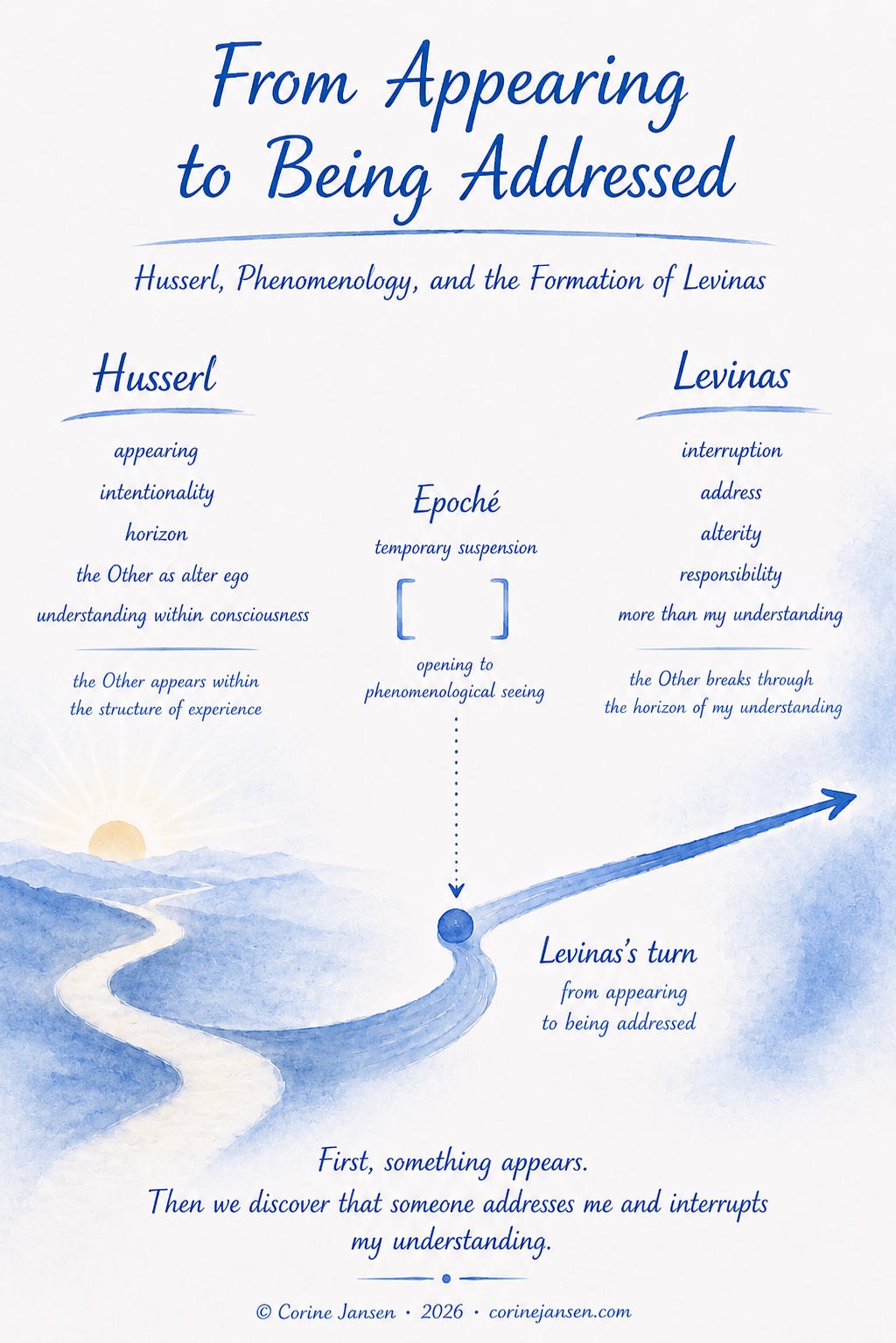
The relation between Levinas and Husserl cannot be described as a simple departure. Levinas remains too much of a phenomenologist for that. He continues to describe. He continues to search for the structure of experience. He remains sensitive to what shows itself before it is theoretically fixed. In his thinking, the phenomenological method remains active, even when he seeks out its limit.(12)
At the same time, Levinas shifts the question. In Husserl, consciousness remains the place where meaning appears. Meaning-giving remains connected to observing, constituting consciousness. According to Levinas, this leaves too little room for what truly exceeds consciousness: transcendence and alterity.(13)
In Levinas, consciousness itself is interrupted by an address it has not produced. The Other does not enter only as meaning for me. The Other places me in responsibility.
What is striking is that this turn is already visible in the thin little book of 1930. At the end of his study on Husserl, Levinas writes that the egological reduction, the reduction to the I, can at most be a first step. Concrete life is not an enclosed consciousness. Concrete life already opens onto others and onto an intersubjective world.(14) There, in germinal form, stands what he would later carry much further.
Some contemporary readers therefore rightly emphasize that Levinas’s relation to Husserl is more complex than a story of rupture. Levinas works with Husserlian means and puts them under pressure at the same time. He radicalizes the question of appearing by showing that the Other appears as the one who never fully allows themself to appear. Precisely there lies the ethical force.(15)
This makes his thinking fruitful for listening. It is about understanding that knows its own provisional character. About understanding that remains open after it has found a name, category, or explanation. About attention that recognizes its own need for certainty.
Perhaps that thin little book from 1930 gains another meaning here. Levinas wrote about intuition in Husserl: about the way in which something is given, how something shows itself, how meaning forms itself in consciousness. And precisely there, in the final pages, he already opens the door to the other and to the intersubjective world. The book that brought phenomenology to France already carried the interruption within itself.
What shows itself can unsettle my understanding. What I try to understand can disturb my understanding. That is the movement from Husserl to Levinas, and it begins, as often happens in philosophy, in a dissertation that went further than it knew.
In Freiburg, Levinas did not meet Husserl alone. He also attended lectures by Martin Heidegger, whose Sein und Zeit he would later call “one of the most beautiful books in philosophy.” Heidegger, in his own way, broke with the primacy of consciousness: being precedes knowing, the question of being precedes the question of the subject. For a moment, that seemed to be the path Levinas also wanted to take. Yet in the end, for Levinas, being as an all-encompassing horizon showed a related difficulty to Husserl’s consciousness: the Other was enclosed again, now within being itself. What Levinas sought lay beyond being. He would later name that shift autrement qu’être: otherwise than being. Heidegger was therefore a real turning point, one that Levinas took seriously and then consciously left behind. That deserves a separate part. Here it is enough to indicate that the path from Husserl to Levinas is not a straight one.
Emmanuel Levinas, La théorie de l’intuition dans la phénoménologie de Husserl (1930). See also Levinas’s later collection En découvrant l’existence avec Husserl et Heidegger.
Simone de Beauvoir recounts this anecdote in La Force de l’âge (The Prime of Life). The formulation about the cocktail is often used in the literature as a scene in which the French interest in phenomenology takes shape.
Levinas studied in Freiburg in 1928 and 1929, where he heard Husserl and also encountered Heidegger. His 1930 dissertation was one of the first major French studies on Husserl.
It is especially the phenomenological method that Levinas borrowed from Husserl and that, by his own account, he never abandoned. Even in his late work, he continues to use Husserl’s language and conceptual material, among other places in the 1979 lecture Notes sur le sens, included in De Dieu qui vient à l’idée (Paris, 1982). See also Th. de Boer, Van Brentano tot Levinas. Studies over de fenomenologie (Amsterdam, 1989), which carefully describes both the continuity and the shift in Levinas’s relation to Husserl.
Edmund Husserl, Ideen zu einer reinen Phänomenologie und phänomenologischen Philosophie I (1913), especially the passages on the natural attitude, the epochè, and phenomenological reduction.
Husserl’s concept of intentionality goes back to Brentano, but receives its own phenomenological elaboration in Husserl, among other places in Logische Untersuchungen and Ideen I.
Edmund Husserl, Cartesianische Meditationen, Fifth Meditation, on alter ego, analogy, body, and intersubjectivity.
Roger Burggraeve emphasizes that the face in Levinas does not coincide with the physical appearance or exterior of the other. The Other always exceeds every image, diagnosis, or representation.
See, among others, Janine Willis and Alexander Todorov, “First Impressions: Making Up Your Mind After a 100-Ms Exposure to a Face,” Psychological Science 17, no. 7 (2006), 592-598. See also Moshe Bar, Maital Neta, and Heather Linz, “Very First Impressions,” Emotion 6, no. 2 (2006), 269-278.
Emmanuel Levinas, Totalité et Infini (1961), especially the passages on the face, exteriority, and the appeal of the Other.
Roger Burggraeve, in personal correspondence and in his work on Levinas’s interpersonal ethics. Levinas uses both visage and face-à-face; the Hebrew panim is a plural form without a singular, expressing that the face exists only in encounter, face-to-face.
Levinas continues to use phenomenological description in his work, also when he explores the limits of intentionality and constitution.
In Levinas scholarship, this is connected with his critique of Husserl’s idealism: meaning remains too strongly tied to constituting consciousness in Husserl, which makes it difficult for transcendence and alterity truly to stand outside consciousness.
In the final movement of La théorie de l’intuition, Levinas writes that the reduction to the ego can only be a first step and that concrete life requires the discovery of others and of an intersubjective world.
Levinas sees the method of intentional analysis, the recherche du concret, as a building block for his own thinking. At the same time, he cannot follow Husserl in terms of content: because meaning-giving in Husserl ultimately remains a matter of observing consciousness, there is, according to Levinas, no real place for transcendence and alterity. See Levinas, En découvrant l’existence avec Husserl et Heidegger (Paris, 1949, expanded edition 1967), and the analysis of this in Th. de Boer, Van Brentano tot Levinas (Amsterdam, 1989).
No posts
Comments
Nothing yet. Say the first thing.
Sign in to join the conversation.