
A brief note: this essay was originally written in Dutch. English is not my native language, and this translation keeps something of the cadence of the language in which I first thought and wrote it.
There is something peculiar about the way we defend ourselves when communication breaks down. Often, a sentence appears very quickly: But I meant well.
That sentence is understandable. It belongs to our need to protect ourselves from guilt, shame, or misunderstanding. Yet something shifts as soon as intention becomes the point of departure. Attention moves back to me: to what I wanted, thought, meant, or hoped. The ethical question begins precisely where my intention reaches the Other.
Within my Architecture of Listening, one touchstone therefore stands at the centre: effect before intention.
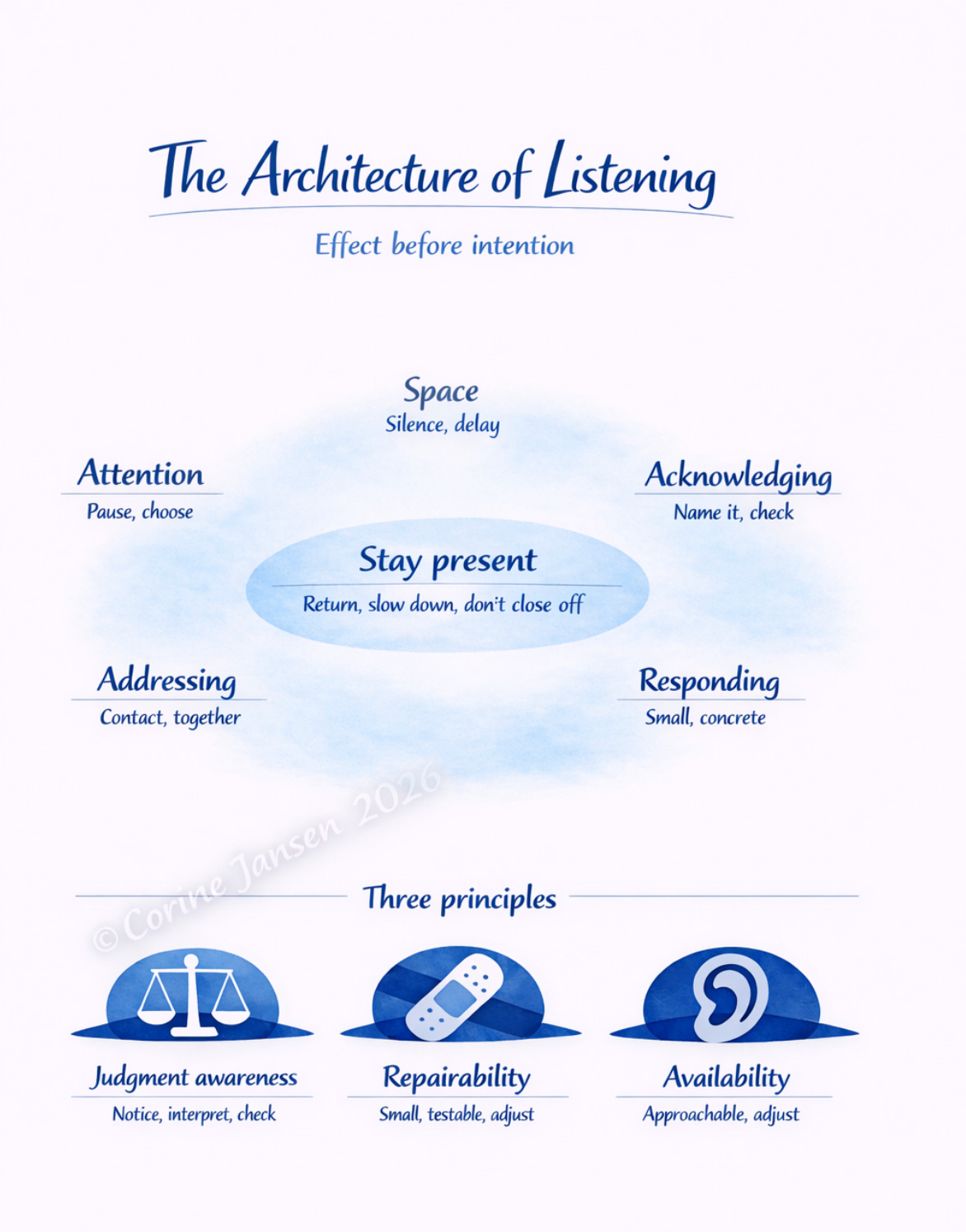
That touchstone asks what my presence did, even when my intention was pure. Was the Other given room to speak for themselves? Was there still room for hesitation, resistance, correction, or their own language? Or had that space already been filled by my understanding, my pace, my solution, my carefulness?
Intention belongs to me. Effect appears with the Other.
Good intentions are real. They can be warm, sincere, and careful. Yet they do not provide conclusive evidence of what happened in the encounter. A listener may think they are giving space, while the speaker experiences being constantly overtaken. Understanding may be offered so quickly that the speaker can barely remain with their own words. A helpful attitude may eventually take up more space than the story of the person who wanted to be heard.
Precisely there, listening becomes an ethical practice.
Levinas helps to make visible what is at stake here. The Other does not first appear as someone I try to understand. The Other addresses me before my interpretation of them. Even before my analysis, my goodwill, or my intention, responsibility arises. That is a radical thought, also in everyday conversations. It means that I am already doing something with the Other before I formulate anything. My presence is already at work. My gaze, my silence, my timing, my preparation, my haste, my certainty.
Listening therefore asks that I do not let the Other coincide with my understanding of that person.
A manager has a conversation with an employee about their performance. The preparation has been careful. Tone, timing, and wording have all been considered. The conversation begins with: “I really value you, and I am also concerned about a few things.”
The intention is sincere. Yet the effect may be that the employee immediately feels tension. The appreciation no longer really lands. It sounds like the prelude to criticism. Before the conversation has properly begun, the body has already reacted: shoulders slightly raised, breathing a little shallower, attention on alert.
The employee is still listening, while at the same time protecting themselves. This is where it becomes visible how words can be carefully chosen and still close something down.
It happens in care as well. A doctor, nurse, or support worker hears a few sentences and already thinks they know what the issue is. Experience is often the reason. A pattern is recognised. The file, the consultation, the next step are already being anticipated.
For the patient, this can feel different. They notice that the conversation is moving ahead of them. A summary is already being made before the story is finished. A direction has already been chosen before it is clear what matters to this particular person. The patient may still be speaking, yet senses that the story is no longer entirely their own.
Here, effect before intention becomes visible. The intention is carefulness. The effect may be that someone experiences less room to tell for themselves what is going on. The person is still speaking, yet feels that the meaning is already being established elsewhere: in a file, an explanation, a follow-up action.
The intention was care. The effect may be that someone loses themselves in another person’s understanding.
Effect before intention therefore asks for a different orientation. Beforehand, during, and afterwards. What is my presence doing here, in this moment, with this person? What does it open? What does it close? Where do I unknowingly take possession of the meaning? Where does my care become too large, my understanding too quick, my answer too final?
The same thing happens on a larger scale when public officials invite residents to share their concerns about safety or nuisance. People are listened to. Heads nod. Someone says: “We hear you.”
After that, silence follows. No feedback. No explanation of the considerations involved. No visible relationship between what was said and what was done with it.
The residents then miss more than a decision. They miss the experience that their words have gone somewhere. In that emptiness, something grows that is much harder to repair than disappointment about policy: the suspicion that listening was a procedure. A form without real receptivity. A gesture towards participation without the willingness to make one’s own course open to examination.
What disappears is trust. People withdraw. They are less likely to come forward next time. They speak among themselves, yet no longer bring their concerns to those who carry responsibility. In this way, a society slowly emerges in which the distance between citizens and government is measured through policy, interests, and the experience that speaking has become pointless.
That is the political weight of effect before intention.
In that context, listening is a democratic practice. It asks for visible return: showing what has been heard, what is being done with it, where the limits lie, which considerations are being made, and where the other can once again object. Without that return, listening becomes a ritual that protects itself.
Those who take seriously what their presence did begin to notice how much is appropriated without being noticed, especially by people with good intentions. Effect before intention is therefore an exercise in correctability: returning to what happened earlier, asking again, and testing what your presence did at the very moment you thought you had listened carefully.
When effect becomes central, our place in the conversation also shifts. We are no longer the one who completes the Other through understanding, help, or decisiveness. We temporarily carry a space in which something of the Other can be preserved. That is a more difficult position, because the outcome cannot be controlled. What my words do, what my silence evokes, what my presence makes possible or obstructs, ultimately appears with the Other.
That is why listening asks for humility that has consequences. The willingness to say, "This was my intention, and I want to know what it did to you.” The courage to let my actions be tested by the trace they leave behind.
Effect before intention is one of the foundational attitudes on which the Architecture of Listening rests, alongside judgment-awareness and repairability. Each of these foundational attitudes asks for the same inner discipline: to examine what my presence did, even when I meant well. Perhaps especially then.
No posts
Comments
Nothing yet. Say the first thing.
Sign in to join the conversation.