
A brief note: this essay was originally written in Dutch. English is not my native language, and I hope this translation keeps something of the cadence of the language in which I first thought and wrote it.
Last time, I wrote about Husserl. Today, it is Heidegger’s turn. He is the thinker who shaped Levinas most deeply, and at the same time the thinker from whom it was hardest for Levinas to detach himself. Anyone who wants to try to understand Levinas has to pass through Heidegger.
That is why, in this part, I want to look carefully at what Heidegger opened up for Levinas. What did Levinas see there? Why was Being and Time so important to him? And why did he later still have to say that he wanted to leave the climate of Heidegger’s thinking?
Heidegger (1889–1976) and Levinas (1906–1995) both begin from the phenomenology of Edmund Husserl, and both seek a return to experience itself, before it is fixed in abstract concepts. In Heidegger, Levinas discovers a philosophy in which the human being always already stands in the midst of the world: acting, finite, dependent on things, places, habits and others. That is where the affinity begins, and that is also where the break begins.
When Levinas travelled to Freiburg in 1928, he came to study with Husserl. There he also encountered the force of Heidegger’s thought. A year earlier, Being and Time had appeared, the book with which Heidegger would exert an enormous influence on twentieth-century philosophy.[1]
For Levinas, Heidegger was not a thinker one could simply bypass. He later spoke with great admiration about Being and Time. In Ethics and Infinity, his conversations with Philippe Nemo, he says that in the twentieth century one can hardly philosophise without having gone through Heidegger.[2] That is telling, especially given everything that would happen later.
What struck Levinas was the shift from consciousness to existence. For Heidegger, being human does not begin in a pure inner consciousness that looks at the world from a distance. Human existence, Dasein, is always already situated in a world. We move among things, tasks, habits, others, expectations and possibilities. We know a hammer in hammering. A door in opening it. A room in entering it. For Heidegger, the world appears primarily as a lived world.
The other also belongs to that world. Heidegger speaks of Mitsein, being-with. Human existence is shared from the very beginning. The other is already present in the structure of being-in-the-world, and is not added to my existence later.[3]
For Levinas, this was decisive. In his 1930 dissertation on Husserl, Heidegger’s influence is already noticeable, and especially toward the end a critique of Levinas’s own begins to emerge. Husserl’s reduction does not reach concrete life, Levinas writes, and in that concrete life the other human being, the intersubjective world, is already present. There the programme of his own thought announces itself.[4] He would never undo that step. Levinas does not later return to a philosophy in which consciousness once again receives the highest authority. Heidegger had genuinely broken something open.
In 1929, Levinas was present at the famous encounter between Heidegger and Ernst Cassirer in Davos.[5] Ernst Cassirer (1874–1945) was one of the best-known philosophers of his time, a thinker in the Kantian tradition. He understood the human being through symbolic forms: language, myth, art and science as the ways in which human beings give meaning to the world. Formally, the debate concerned Kant, but beneath that question lay a much greater tension.
Heidegger brought forward the question of finitude, thrownness and Being with tremendous intensity. Levinas at that moment stood on Heidegger’s side. In a student performance, he even played Cassirer, with powdered white hair. Later, that memory took on a different shadow.[6] Cassirer was Jewish and had to leave Germany after 1933. He died in exile in New York in 1945. Levinas played the Jewish humanist and, at that moment, chose the side of the thinker who would shortly afterwards join the Nazis.
In Davos, more happened than an intellectual duel. For many young thinkers, Heidegger seemed to embody the future. He spoke from a radicality that suddenly made the classical humanist language appear old. Philosophy had to begin again with the question of Being, of finitude, of time, of an existence that never stands outside its world.
That Levinas was drawn to this force makes his later break all the more complex. His break arose precisely from a thinking that had passed deeply through Heidegger.
In 1933, Heidegger joined the NSDAP and became rector of the University of Freiburg. As rector, he connected the university to the National Socialist revolution.[7] For Levinas, this became a wound that would permanently mark his relation to Heidegger. Levinas was Jewish, and the catastrophe that followed affected him in his own life and in his family.[8] None of this can simply be placed next to his philosophy, as if life and thought were two separate rooms. Levinas himself does not do that either. At the same time, he does not reduce Heidegger’s thought to Heidegger’s political failure. He continues to distinguish, however painfully, and he continues to acknowledge what he owes to Heidegger. Precisely because of that, his break carries weight.
How deep that wound goes becomes clear in his own hesitation. When François Poirié asks him how he explains Heidegger’s attitude toward National Socialism, Levinas offers no conclusive judgement. “I do not know… These are my darkest thoughts about Heidegger. I cannot possibly forget it,” he says. A little further on, he adds: “His firm and clear voice often returned to me when I heard Hitler on the radio.”[9] That hesitation is telling. Levinas refuses to pronounce a grand judgement where he does not have one. And at the same time, he shows how close admiration and horror lay within him: the voice of the thinker he admired echoed in the voice he abhorred.
In De l’existence à l’existant, written in the shadow of the war, Levinas speaks of the deep need to leave the climate of Heidegger’s philosophy.[10] That word matters. A climate is the air one breathes. It surrounds a thought before one can fully identify it. So Levinas wants to do more than improve Heidegger. He wants to leave the atmosphere in which the question of Being remains the highest question.
To understand why Levinas ultimately wants to leave Heidegger’s thinking, it helps to consider an image he himself uses. It is the image of the night.
When darkness falls, things lose their form. The chair, the table, the wall, the people around me, everything dissolves into the dark. And precisely when everything has disappeared, something remains. No thing, no person, no voice. Only the bare fact that there still is. Levinas calls this the il y a, the anonymous “there is.”
He also describes it as insomnia. I lie awake and want to sink into sleep, but I cannot. There is a wakefulness that will not cease, an attention without an object. The strange thing is that I no longer have it in my own hands. It is as though it watches in me, anonymously, without my being master of it. I am held in the mere fact that there is, without escape.
In De l’évasion from 1935, this unease can already be heard, even before it has a name.[11] In De l’existence à l’existant, written in the shadow of the war, it receives its own name: il y a. Presence without a face. No relation, no encounter, no name. Only the dull murmur of being that will not fall silent.
Here the question of Being changes tone. For Heidegger, the fundamental mood revolves around Angst, anxiety before nothingness, finitude, death. In Levinas, that movement is reversed. The shudder of the il y a arises from the realization that there is no nothingness into which I can disappear. Being cannot be escaped. Even emptiness offers no rest, because even in emptiness the “there is” remains. This makes visible why a thinking that takes Being as the ultimate horizon can become suffocating for Levinas. When being becomes detached from the concrete Other, it threatens to become an anonymous totality in which the human being disappears.
There lies the ethical stake of his critique of ontology. Levinas formulates it sharply in De l’évasion: a civilization that accepts Being with the despair and the crimes it can justify deserves the name barbaric.[12]
The decisive separation lies with the Other.
In Heidegger, the other appears as Mitdasein, as a fellow being within the shared structure of existence. Care for the other, Fürsorge, belongs to my way of being-in-the-world.[13] Heidegger himself makes subtle distinctions here. Care can take something out of the other’s hands, and care can also allow the other to become freer.
Yet for Levinas, something remains missing. In Heidegger, the other appears within the horizon of Being. Even when the other is important, he is understood from within the structure of Dasein: thrownness, possibility, finitude, care, death. The centre of gravity remains the question of how human existence understands itself.
Levinas shifts that centre of gravity.
For him, the Other is not part of my existential structure and not a derivative of my care. The Other comes toward me as face. That face is not an object I can calmly describe, not a visible form I can absorb into my understanding, not a case within my system. The face is the way in which the Other shows himself as more than what I can make of him.
In Totality and Infinity, this becomes the heart of Levinas’s thought. The face calls my power over the Other into question. It appears as vulnerable and commanding at the same time. In that appearance, the ethical demand resounds, which Levinas summarizes in the commandment: thou shalt not kill.[14]
We now know that this sentence must be heard broadly. It concerns physical violence, but also the subtler forms in which I reduce the Other to my understanding, my category, my plan, my system. The Other can disappear while I act in an orderly, careful and well-intentioned way.
This is where Levinas becomes so important for the theme of listening. Listening then begins with the question of whether I allow the Other to exist beyond my first understanding, and not with the question of whether I interpret him correctly.
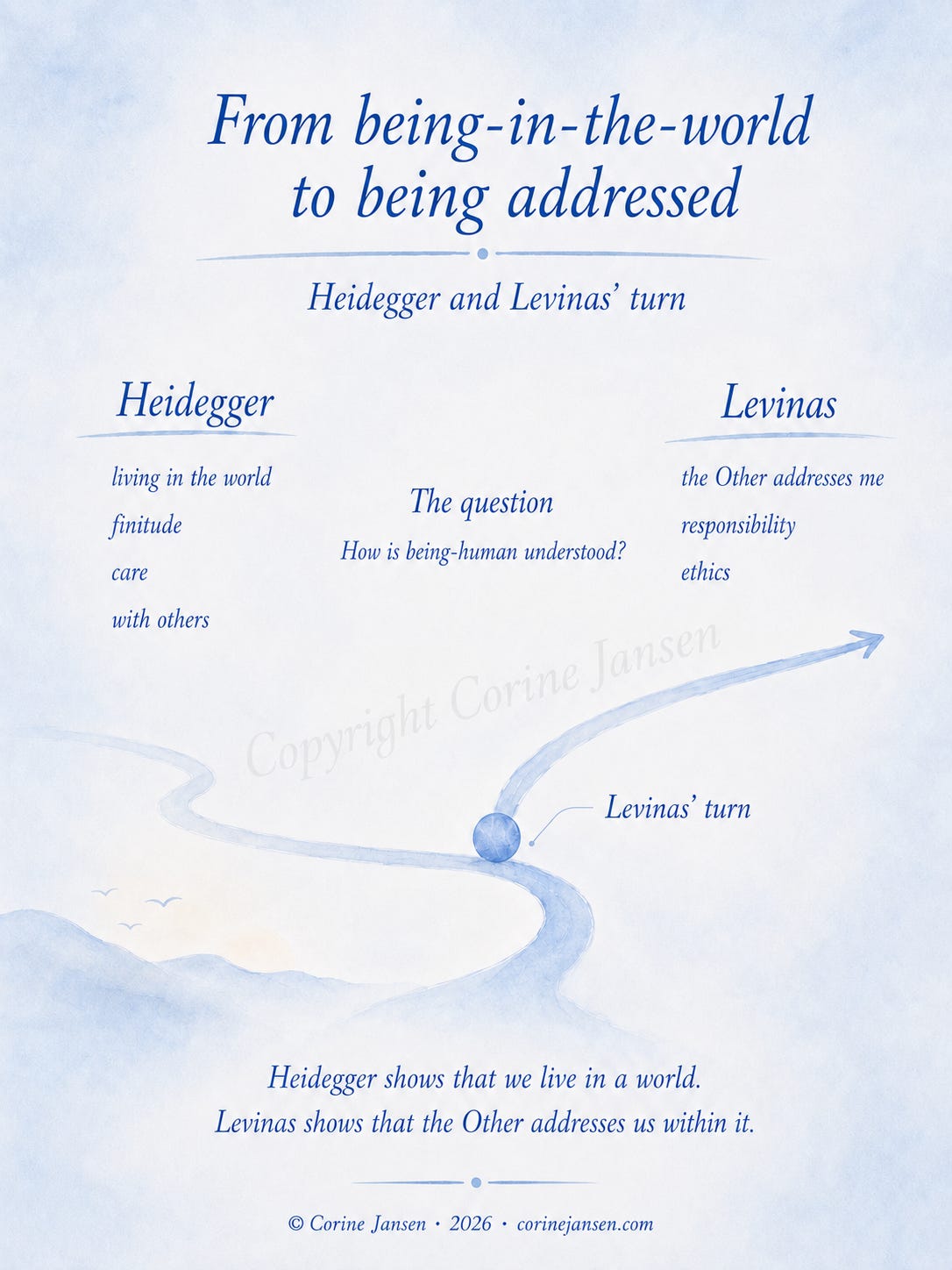
This is why the fundamental question shifts in Levinas. Heidegger reopens the question of Being. Levinas hears behind it another question: what does it mean that the Other addresses himself to me, even before I can understand him? That shift is small in formulation and enormous in consequence.
For Heidegger, the issue is the understanding of Being. For Levinas, the issue is responding to the Other. The subject, then, is not a free “I” who later takes responsibility upon itself. In Levinas, responsibility begins earlier than my conscious choice. The Other already makes a claim on me before I know exactly who I am, what I think or how I want to respond.
There lies the ethical interruption.
The Other does not first ask me to understand him. In his appearance, there is already an address: do not let me disappear into your ordering.
For my Architecture of Listening, this is a core point. Listening is giving attention, making space and receiving meaning. It is also the practice of suspending my first grasp of the Other. I have to be able to endure that the Other is more than the place he occupies in my thinking. Responsibility begins there. More as a small restraint than as a grand gesture. A refusal to complete my interpretation too quickly. A willingness to be addressed.
Levinas’s relation to Heidegger remains, through all of this, profoundly complex. He goes through Heidegger. He takes seriously Heidegger’s critique of abstract consciousness. He learns from Heidegger that human existence is concrete, temporal, thrown and embodied. He accepts that philosophy cannot fall back on a pure, detached subject. And yet he leaves the climate.
A world in which we dwell is not yet a world in which we listen. Heidegger teaches us that we are always already in the world. Levinas shows that in that world we are addressed. Heidegger gives an architecture of existence. Levinas shifts the question toward the address of the Other. The moment in which the Other crosses my world and asks me to keep my thinking open.
That is the movement from Being to being addressed. And perhaps that is also the movement that asks us, again and again, to listen. We begin in our world, with our language, our history, our habits and rituals, our good intentions. Then someone appears who does not quite fit. Someone who interrupts our ordering and does not coincide with what we already thought we knew. At that moment, listening begins as responsibility.
After this piece was published, Roger Burggraeve wrote to me about a point I had not yet developed here. He drew my attention to Levinas’s critique of the Da of Dasein itself.
For Heidegger, rootedness is something positive. The human being finds a place, a ground, a world to dwell in. Levinas already reads this same act of settling as an ethical problem. By standing here, by making this place my own, I take the place of the Other.
This is the crisis of the “I”. For Levinas, it coincides with the experience of the face. The face that addresses me and the awareness that, simply by existing, I may displace the Other belong together. That is why the critique of Heidegger concerns more than his image of the world. It also applies to his description of the subject. Levinas connects this crisis with the commandment: thou shalt not kill, thou shalt not possess the Other.
Leaving the climate thus takes on another meaning as well. It also means leaving behind the self-evidence with which I occupy my own place. There, once again, listening begins.
[1] Heidegger, Sein und Zeit (1927); Dutch translation Zijn en tijd, trans. Mark Wildschut (SUN).
[2] Levinas, Ethics and Infinity, conversations with Philippe Nemo (1982; Kok Agora).
[3] Heidegger, Being and Time, §§25–27 (Mitsein).
[4] Levinas, Théorie de l’intuition dans la phénoménologie de Husserl (Vrin, 1930); see also Duyndam & Poorthuis, Levinas (Lemniscaat, 2003).
[5] Peter E. Gordon, Continental Divide. Heidegger, Cassirer, Davos (Harvard, 2010).
[6] François Poirié, Emmanuel Levinas. Qui êtes-vous? (La Manufacture, 1987).
[7] Rüdiger Safranski, Heidegger en zijn tijd (Atlas, 1995).
[8] Duyndam & Poorthuis, Levinas (2003); Roger Burggraeve, Geen toekomst zonder kleine goedheid (2020).
[9] Poirié, Qui êtes-vous?, p. 40.
[10] Levinas, De l’existence à l’existant (Vrin, 1947).
[11] Levinas, De l’évasion (1935); Le Temps et l’Autre (1947).
[12] Levinas, De l’évasion (paraphrase); see Jan Keij, De structuur van Levinas’ denken (1992).
[13] Heidegger, Being and Time, §26 (Fürsorge).
[14] Levinas, Totalité et Infini / Totality and Infinity (1961; Boom).
No posts
Comments
Nothing yet. Say the first thing.
Sign in to join the conversation.