
A new paper in Long Range Planning studied 100 family firms in Pakistan and asked a simple question: does a CEO’s relationship to time — whether they’re anchored in the past, absorbed in the present, or oriented toward the future — indicate whether the firm reinvents its business model in the light of high dynamics in the market.
The past-focused finding is unsurprising. CEOs who cognitively live in “tried-and-true” recipes resist business model innovation, regardless of how turbulent the environment gets. They read volatility through the lens of old lessons and keep steering by memory.
The present-focused finding is a little more interesting. Under stability, these CEOs are indifferent to change. But hit them with real environmental dynamism, and they become the strongest drivers of innovation in the sample — reactive, improvisational, willing to tear up the business model to survive the storm.
Then there’s the finding that should make anyone who preaches long-term thinking sit up: future-focused CEOs — the ones anticipating trends, planning years ahead, treating the present as a resource to be deployed rather than protected — are the strongest innovators of all, but only in stable conditions. The moment dynamism spikes, their advantage doesn’t just shrink. It reverses. The same CEOs who steer confidently in calm water lose their nerve exactly when the water gets rough.
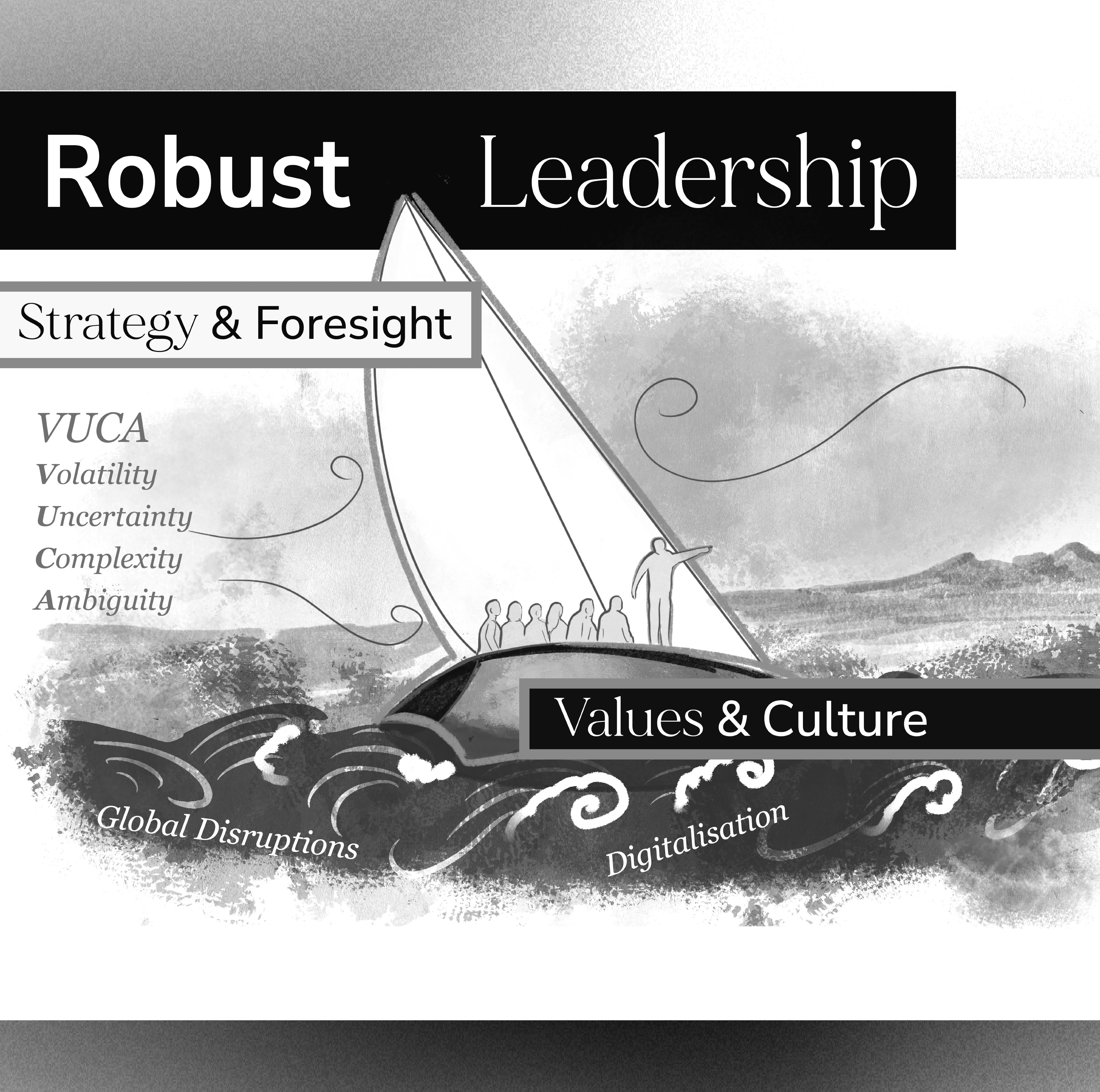
The authors’ practical recommendation, laid out through an extended sailing metaphor, is essentially a casting problem. Future-focused CEOs are captains who scan the horizon and adjust course for distant opportunity — brilliant in calm waters, but blinded once visibility collapses. Past-focused CEOs navigate by legacy maps, which stabilizes a firm in low-change markets but strands it when conditions turn. Present-focused CEOs, uncomfortable with instability, improvise their way through storms even at the cost of long-term direction — which the paper argues makes them the most adaptive choice when things get genuinely chaotic.
So: match the captain to the sea. Put a future-focused CEO in charge of a stable firm chasing renewal. Hand legacy protection to a past-focused successor in a slow-moving market. And when the environment turns volatile and unpredictable, the present-focused CEO is your best bet.
It’s a clean answer, and it fits neatly into how most family councils already think about succession — assess the candidate, assess the context, find the fit. But I think it solves the wrong problem.
Temporal focus, as this literature measures it, is a disposition — how naturally someone’s attention drifts toward yesterday, today, or tomorrow. It is not a method. And the paper’s own theorizing quietly reveals why that distinction matters.
Future-focused CEOs, the authors argue, engage in “anticipatory problem-solving”: they mentally simulate distant outcomes and break change down into “actionable, orchestrated steps.” That’s not foresight. That’s long-range planning — a single imagined future, extrapolated forward and executed against. It works beautifully right up until the environment shifts from what the paper calls “known unknowns” to “unknown unknowns,” at which point the whole simulation collapses, because it was only ever built to hold one future at a time.
I’ve made this exact distinction before, from the other direction. Robust leadership isn’t about predicting the future more accurately — it’s about staying effective across many possible futures instead of optimizing for one. And when I wrote about the blind spot in corporate boardrooms, the failure mode was identical to what’s showing up in this dataset: boards extending the present forward and calling it long-term thinking, then getting blindsided the moment reality stopped cooperating. A future-focused family CEO who was never taught to do anything other than extrapolate is, cognitively, doing exactly what those boards do. The paper just measured the moment that approach breaks.
It’s also worth being honest about what the paper crowns as the adaptive answer for volatile environments. Present-focused CEOs only start innovating once dynamism makes the current state “unsatisfactory” — once the threat is undeniable. That’s loss aversion flipping into risk-seeking under duress: reactive, improvisational, triggered by pain rather than by a signal read early. It’s a real and useful survival reflex, and in a crisis you want someone capable of it. But it isn’t preparedness. It’s the absence of a plan until the fire is already visible.
Go back to the robust leadership distinction: the question worth asking isn’t “what will happen,” it’s “what could happen — and how prepared are we.” Present-focused improvisation answers neither. It doesn’t anticipate multiple futures, and it doesn’t build the capacity to act before the damage starts; it just reacts faster than the past-focused CEO once the damage is undeniable. That’s a low bar to clear, and it’s a different thing entirely from the kind of foresight capability I wrote about in The Long Game — where the firms that outperformed years later weren’t the fastest to react, they were the ones whose foresight practices were already calibrated to the uncertainty they faced before the disruption hit. Calling present-focus “the most adaptive leadership style” for volatile environments isn’t wrong, exactly. It’s just describing the CEO who survives the fire, not the one who saw the smoke.
Family firms shouldn’t read this study as a mandate to sort CEOs by cognitive type and rotate them out when the market turns — succession doesn’t work on that timescale, and family businesses in particular can’t swap leaders every time volatility spikes. The more useful reading is a diagnostic one: if your future-focused CEO is thriving in calm conditions and stalling in disrupted ones, the problem probably isn’t their temporal focus. It’s that their future orientation was trained as forecasting, not as foresight.
That’s a fixable gap. Scenario planning, horizon scanning, and structured plural-futures thinking are learnable disciplines, not personality traits — and they’re precisely what’s missing from a future-focused mind that only knows how to simulate one path forward. Build that capability into succession planning and leadership development, and you get a CEO who keeps the long-term orientation that serves them well in stable years, without the collapse in confidence the moment the sea turns.
That, in the end, is the same gap I keep finding wherever I look — boardrooms, leadership frameworks, and now family CEO successions: not too little long-term thinking, but too little of the specific discipline that makes long-term thinking survive contact with an uncertain world.
No posts
Comments
Nothing yet. Say the first thing.
Sign in to join the conversation.