

Traveling has been a way for me to understand my world. To make sense of where I want to be, where I want to go, and who I am. Perhaps as a way to look at what is meaningful, to get inward, to discover what needs tending.
Yes. That is a lot for one journey. And perhaps that bar is high. But I have always made the bar high. And I trust the world will present to me what I need for my next steps.
So I was more than curious when I arrived in Mallorca. A sort of melancholy set in almost immediately. A desire for more. Scenery that was less than exquisite. Settings that were worn and tired. The airport alone was jarring. A duty free area forced upon you. Corridors and escalators and more moving sidewalks than one could care to know. One is used to seeing an airport like this in Chicago. But on the island of Mallorca, this was the first scene. The first idea. The first reminder that this place was built for tourism. And that is just it. A place built for tourists becomes less of who it is and more of what visitors want. That brings economic growth and assumptions of a better quality of life. But it made me stop and reflect on how it was that I was contributing to this. Here I was, exploring options to bring people to retreat, to teach them other cultures, to see how life is done through a different lens. And yet I was distracted. Disturbed. Anxious. Unimpressed. Missing my writing. Questioning my purpose. And yet melancholy is not something I suffer from. I seek. I like to put words to what I see. And there was one unsettling word that kept returning to me throughout this journey.
Melancholy.
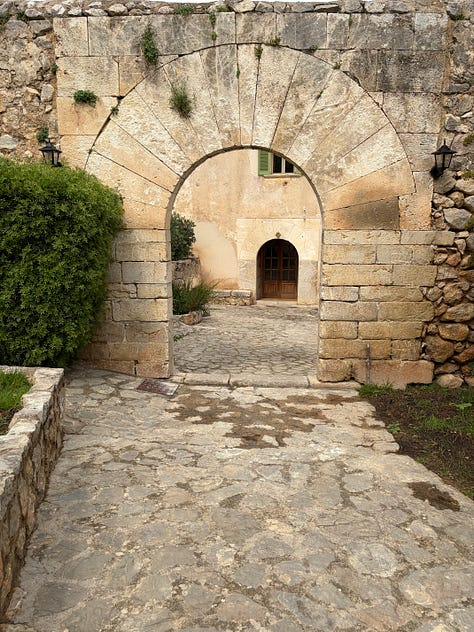
A place where one feels like a guest in a home that no longer belongs to its owners. Beauty without soul. Is there such a thing? Walking along the narrow roads, the cobbled medieval ways. The walls cave into impossible narrowness. Room for one. The place refuses the social. It folds you inward. You arrive thinking you will connect with something. Instead you connect only with the sound of your own footsteps. It is disconnection. Pure and complete.
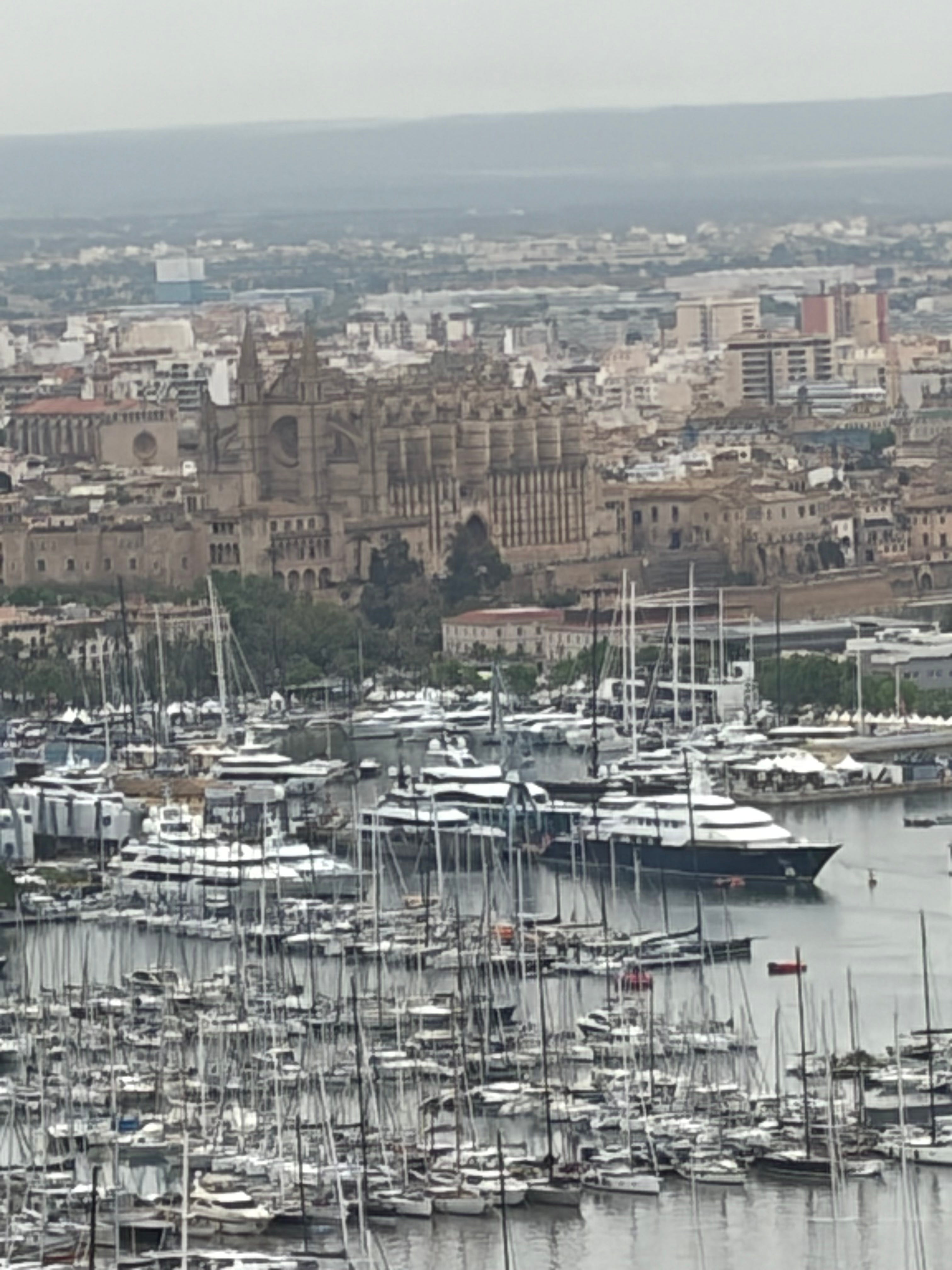
Palma, a hustle and bustle of a tired city. Active and young, full of college-aged people and bikers gathering at café tables at midnight. Scooters and students and the smell of coffee and something frying and, somewhere, always, music. And above it all, La Seu. The Cathedral of Santa Maria, standing at the edge of the sea as it has for eight centuries. Built where a mosque once stood. Built because a king was frightened in a storm and made a promise to the Virgin Mary. Three hundred and seventy-two years in construction. Gaudí’s wrought iron crown of thorns suspended above the altar. The great rose window which is nearly fourteen meters across, has over a thousand pieces of colored glass. The Eye of the Gothic, watching everything below. I visit because perhaps I will reconnect to something that was once a part of my life and now I access my soul through nature, trees, humility, and quietude.
And it is in these narrow streets that I come to understand what this island is doing to its people. Palma’s residents have retreated behind locked doors. The only evidence that anyone actually lives here, that perhaps there are kitchens and meals and ordinary Tuesday evenings, is a black plastic bag on a doorstep. One evening, before trash day, I watch a man open a door just wide enough to deposit his bag at the threshold. The door closes. Standing back, there is nothing. All the windows shuttered. Silence. The black bags are the only confession this city makes. One bag per household, placed just beyond the threshold, charming actually that one bag holds a weeks worth. The sum total of a life made briefly visible. By morning they are gone. The walls resume their silence. You would never know that behind that sun-bleached door with its iron lock, someone ate breakfast this morning, someone laughed, or someone grew old. The shopkeeper unlocks her blue shutters and folds them back, and an entire ancient alleyway exhales into a grand store. I think of Dorothy, how the world went from grey to color in a single step. I am still in that step. Still somewhere between the grey and whatever comes next.
Two groups haunt the same narrow streets and never quite meet. The tourists and the people who live here. Both, in their way, invisible to each other.
Seeking something more, something beyond the map, beyond the brochures, which I don’t even open, I left Palma.
The east coast of this grand island is a witness to the impeccable replacement of one life with another. The fishing inlets of Cala Morlanda and Porto Colom. Those arched stone boathouses at the water’s edge that once sheltered working boats and the smell of fish and salt and diesel are now holiday rentals. The harbor has shifted from working boats to grand luxury yachts and wooden sailboats. They remind me of home. Our boat builders, Gannon and Benjamin. But these boats are a little more precious. Almost child-sized, charming, and crafted wooden boats lined up perfectly in stillness on the quiet morning waters. There is a quiet melancholy here too. Men gathering in the square of what was once a hub of wine exporting. They sit in dark cafes drinking espresso and shots of red wine, and they have so much to say.
The colorful homes along Porto Colom’s waterfront were never meant to be picturesque. They were painted so the fishermen could identify their own house from the sea. Navigation by domesticity. Now they are photographed ten thousand times a summer by people who find them charming without knowing what they meant.
Not unlike our little campground in Oak Bluffs.
You can still find the fishermen. But they move among paddleboarders and kayak rentals and café menus offering guacamole and fish tacos. The sea is right there. Men still know how to fish it. But the restaurant serves what the tourist expects the Mediterranean to taste like. There is a longing in that. A dish that has forgotten what it once was.
But then I stop myself. How is my island any different? Forty years ago Menemsha was a working harbor. Giant swordfish brought in daily. Fish cut to order at the dock. A dozen vessels or more, filled our small perfect harbor. Today it is a village set for visitors. A gas station selling candy bars and soda. A fish market selling t-shirts and hats alongside the catch. Our world too is moving toward the visitors and away from nourishing the culture that made it worth visiting in the first place. Mallorca did not invent this. It only made it impossible to ignore. And I wonder. How do we stop it? Can we? Do we even want to, those of us who came from elsewhere and fell in love with what we found? I have my one wild precious life, thank you, Mary Oliver, and I am standing in someone else’s Menemsha wondering why it feels so familiar.
This island is a museum of its former self. And the curators don’t know it. But then, so is mine.
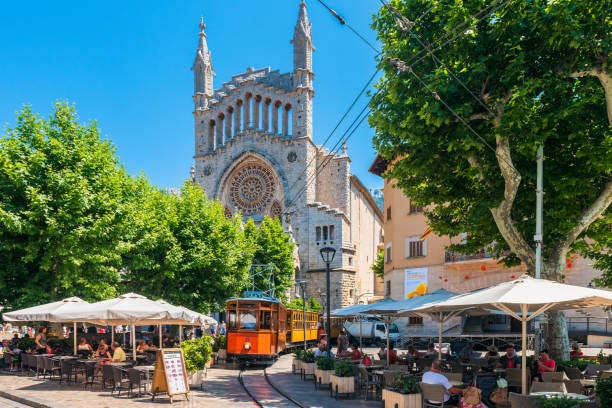
And I visit a little village. Sóller. It has a park and narrow streets, all leading to a square where the church is grand and beautiful, more gold than most of the smaller villages. And it is connected by a train. The Tren de Sóller. The Orange Express, built on the profits of the citrus trade so farmers could move their fruit through the impossible Tramuntana Mountains when the only alternative was a mule and donkey cart. And this reminds me of the collapse ofour own citrus trade in Florida that I witnessed in Vero Beach. The train with mahogany carriages, original tracks, and a bell the driver rings to warn those who have stepped onto the rail.
The train that once fed the people now carries people photographing the moment.
.
It is melancholy. But unlike Palma, Sóller seems to have made a different peace with being seen. All the cafés are full. There are so many that it seems it‘s a holiday. Germans, British, the occasional American, and families…. Children race through the center of town, up and down the long stone steps on their bicycles while a guitarist plays Spanish music. Later, that guitarist will pass his torn and tattered hat. The children don’t perform. They just are. Racing down steps their grandparents raced down, their grandparents’ grandparents raced down, steps smoothed by centuries of small feet. The tourists photograph them. The children don’t notice. They are too busy being alive.
The indifference of the very old and the very young. It is warming and complicated.
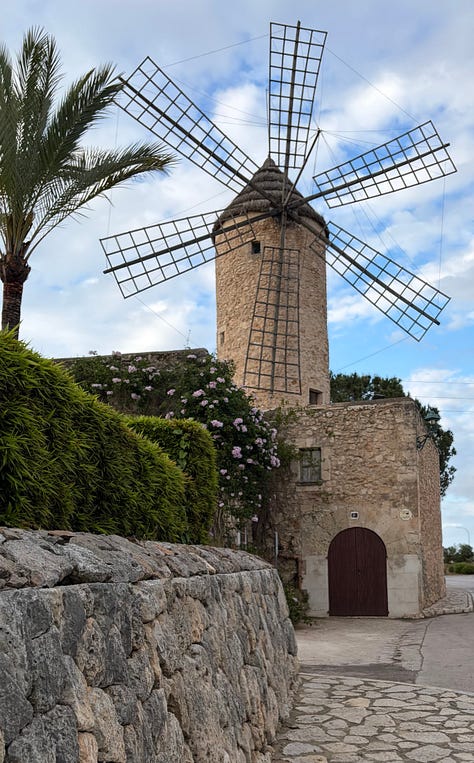
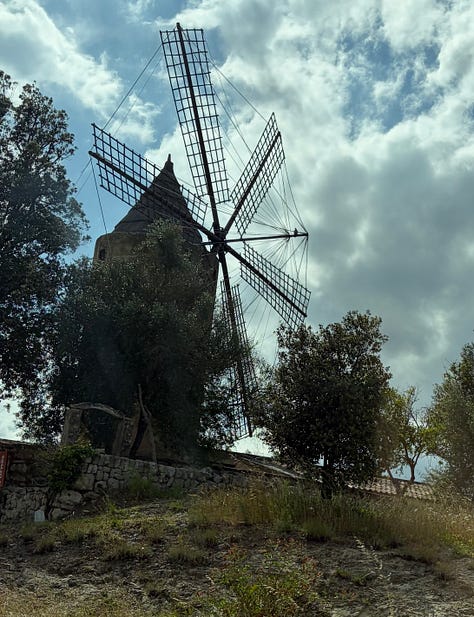
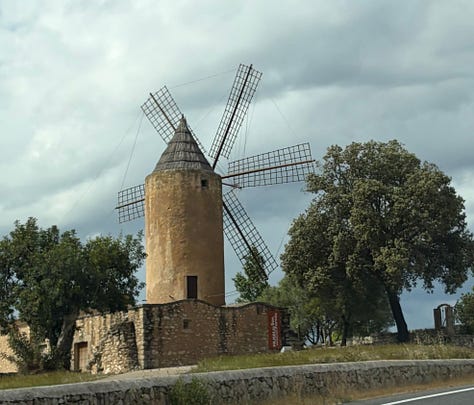
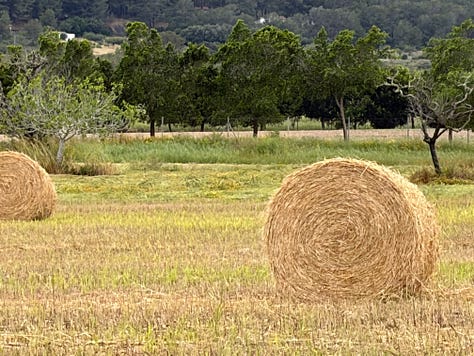
And it took me a few days to get the windmills. A cemetery of utility scattered across the plains of this island. What was once absolutely essential. Turning wings pulling water up from deep aquifers, keeping the land alive, feeding the people. Now their sails are gone, the wood rotting, the wires warped and twisted. Crumbled towers in the middle of roundabouts, hotels, car parks, and fields of rolled wheat. Standing like old men at the edge of a party, they are present, unacknowledged, remembering when they were the reason for everything. There is a solitude to them that is different from sadness. It is the solitude of things that have outlived their purpose. Others look as though one good gust of wind could bring them back to life. There is a quiet beauty I see between the slates of the blades, the vanes. There is the azure blue sky and the perfectly bubbled clouds, and it takes my breath.
One breath standing among them and you could inhale a whole century of time. Time stopped.
Further north, it takes thirty minutes to drive to the very top. Switching back and forth, hairpin after hairpin, thirty times to reach the edge. The road is steep. It seems impossible that the big buses fit. They don’t fit. Drivers must stop before taking each turn, leaving only inches from the edge. This is Cap de Formentor, the northernmost tip of the island, where the winds from the Iberian Peninsula, the Alps, the Atlantic, and North Africa all converge.
The lighthouse was built in 1863 to stop the ships that had broken on these rocks for centuries. It was automated in 1962. The keeper’s houses stand empty now. A light that turns every night for ships, tended by no one. Like the windmills. Things that once kept something alive are now simply standing.
The poet Miquel Costa i Llobera owned this peninsula. He wrote his most beloved poem here. The Pine of Formentor. Becoming the tree itself, rooting in rock and cliff, drawing sustenance not from a gentle fountain but from the immense sea. After he died, the land was divided and sold. The poem survived. But when I went to locate the poem in either the title of a book or in a bookstore, but I could not find it.
Today it is a restaurant for cyclists who dare to ride the roads to the very top. We arrive before nine and are glad for our timing. On the way down, the road is a snail’s pace. Bikers and buses and cars navigating the hairpins together as they climb to the top of the peninsula.
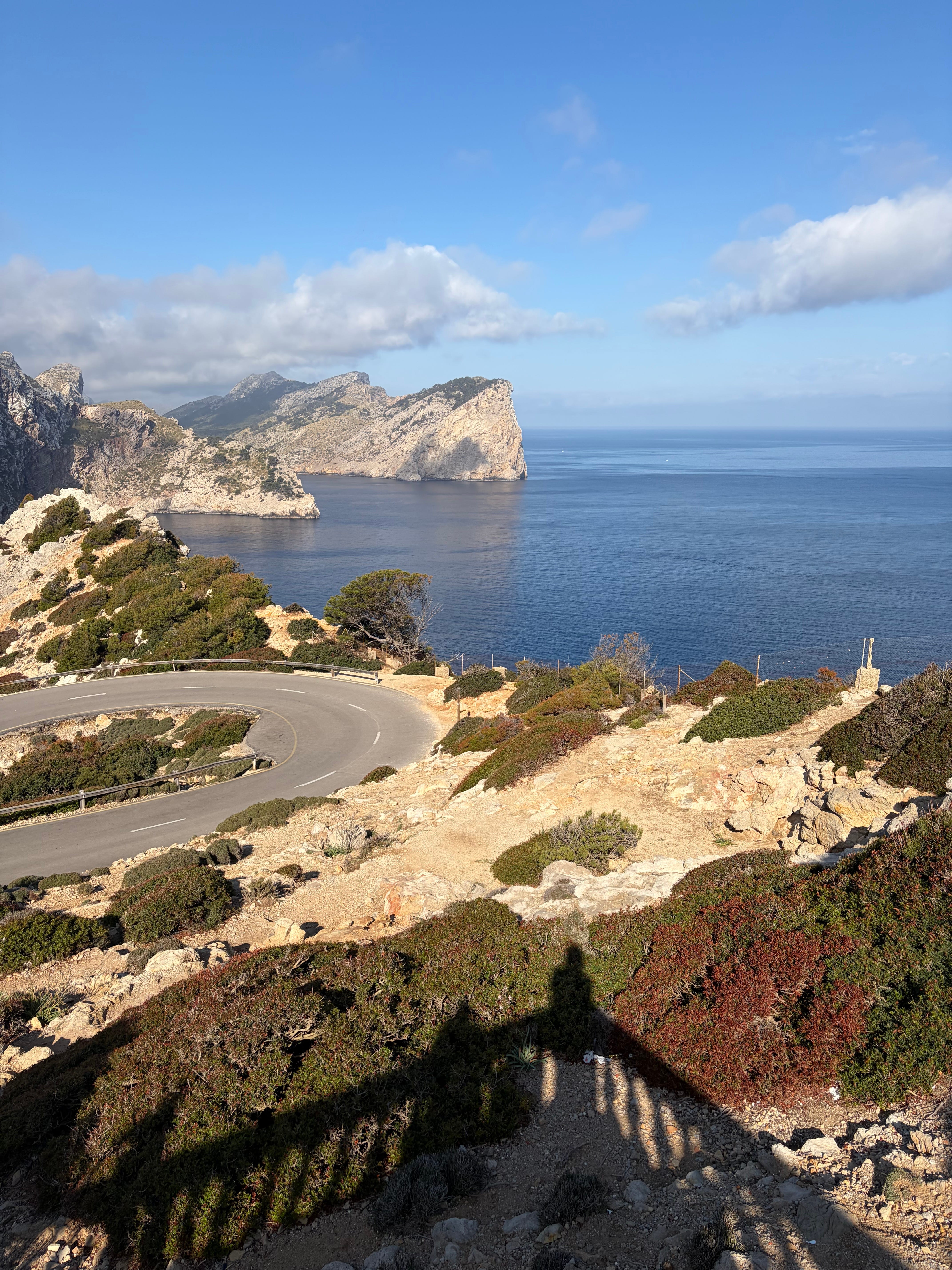
And the cyclists. There are hundreds of them. Actually, there are thousands! They arrive every April, long before the summer crowds. At the airports there are bike bags and hard cases showing the outline of a disassembled cycle. These ancient roads, once connecting farmers and their harvests, are now training grounds for professional athletes preparing for the Tour de France or just a week with friends. Musical in their neon colors, riding in packs in complete unison. A leader signals the group and the sweep signals the cars behind, and all become part of the procession. Ten kilometers. Seven percent grade. Twenty-six hairpins. Rock tunnels. Energy packs. Clipless shoes, more melancholy, and curiosity.
The bikers, they see gradient and watts per kilogram. They fly past the green doors without wondering what lies behind them. They pedal past the windmill headstones without looking up. A history, loss, olive trees, the ghost of a lighthouse keeper, and a poet who owned this peninsula. Numbers and effort and personal records.
And then there is the olive grower. A family running an inn and growing olives, turning them into oil. This is an operation of both deep tradition and modern precision and love. Joan, the patriarch, greets visitors and tells the story. I look for the ancient stone grinder, but it is long gone. No tombstones here. He uses computerized machinery because it ensures a consistent, pure product. He speaks at length about quality. He teaches of the label “extra virgin.” He seeks perfection of taste. And tells the stories of corruption, how just a few drops of pure oil can be blended into something lesser and still carry the name. It is inconsistent. It is not right. There is a tasting. He teaches you to inhale first, to identify the aroma, then to feel the oil on the tongue. The spice, the acidity, the minerals, the fat, all coming together in perfect balance.
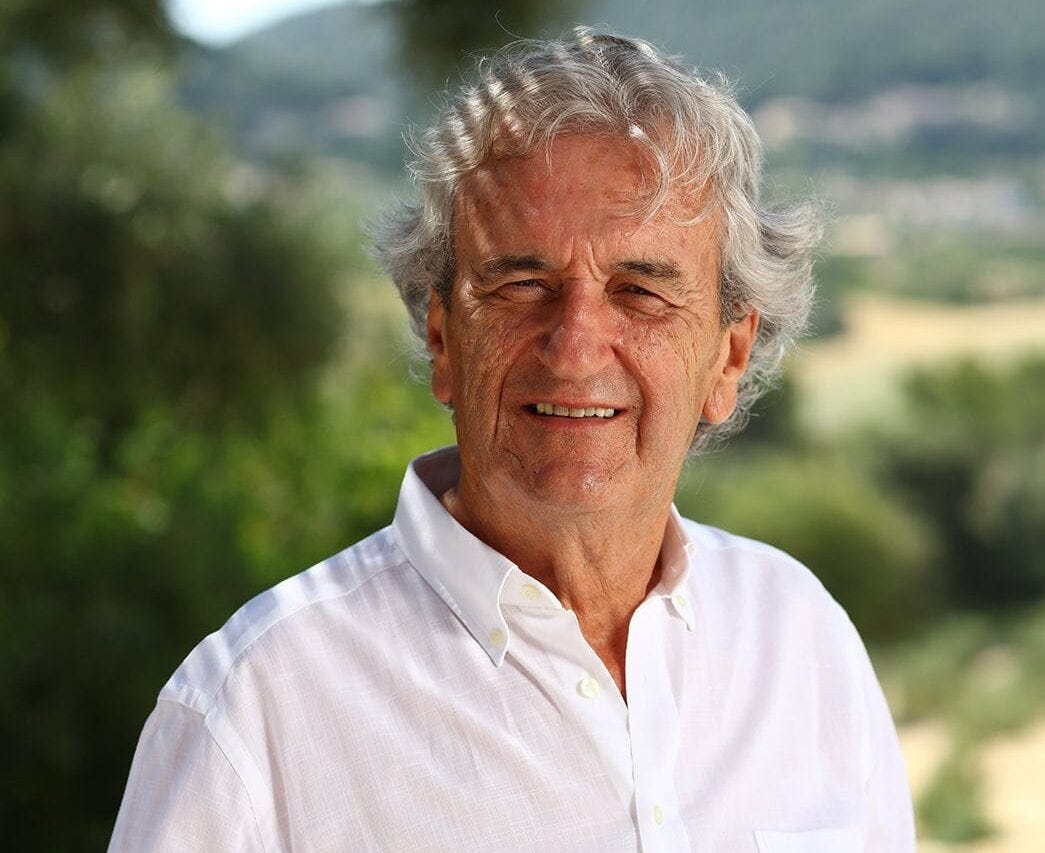
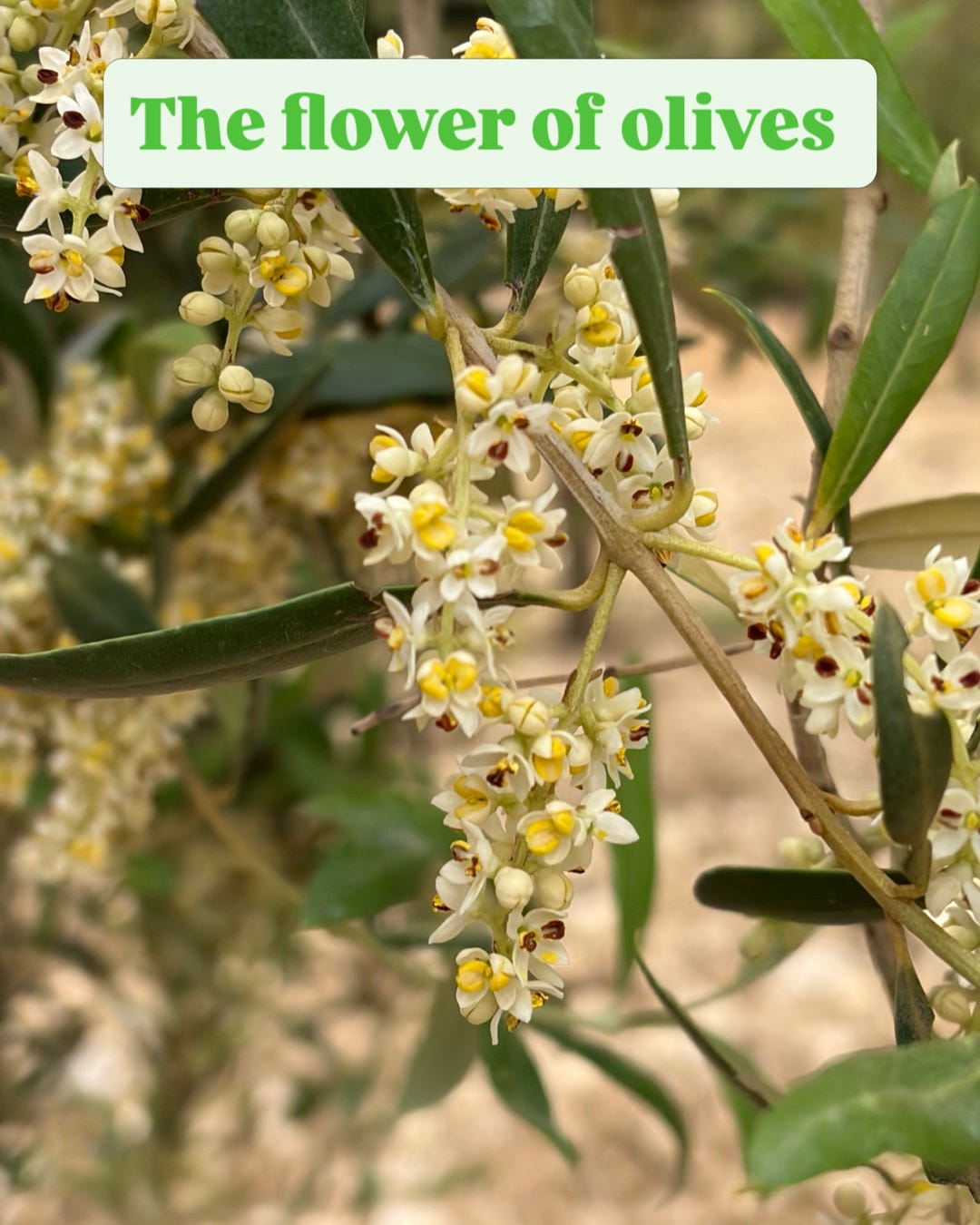
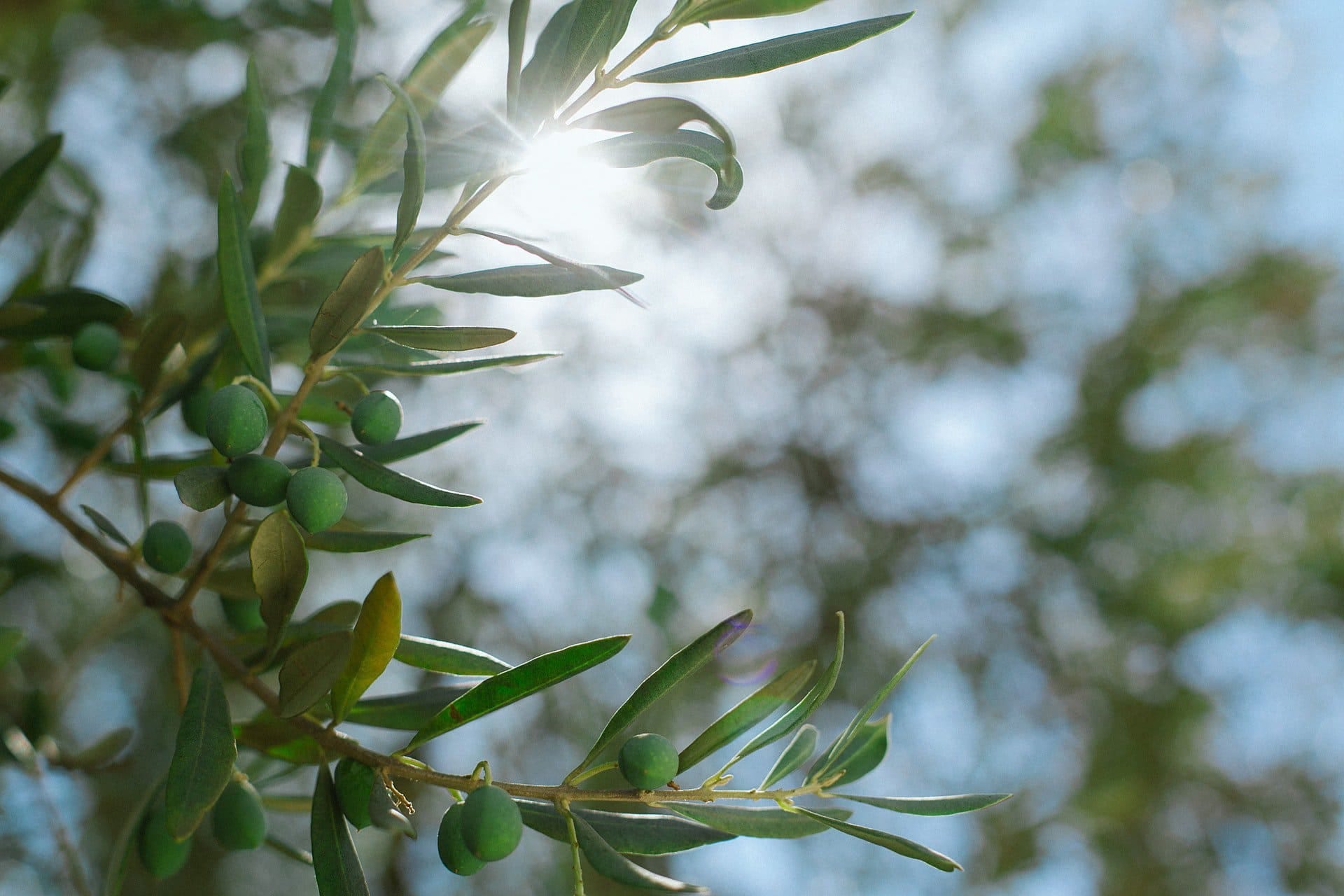
And then he leads us to her. A six hundred year old olive tree overlooking the valley below. She is gnarled and absolutely still. Her roots in rock. Her branches reaching. She has outlived kingdoms, poets, lighthouse keepers, and tourists. She does not flower for beauty’s sake. She flowers for a purpose. This tree brings small olives that are cured and eaten… To bring health to the living. To continue. Joan stands beside her the way a man stands beside something he has spent his life trying to understand. She is his cathedral. Not unlike La Seu rising above the noise of Palma, she presides over everything quietly and without need of an audience.
Standing beneath her in May, the tiny cream and yellow blooms almost invisible above me, something loosened in me. Something small. Something I could not yet name. These trees may be five hundred years old. A thousand. They were here before the windmills, before the lighthouse, before the road to Cap de Formentor. They will be here after every tourist has gone home. They flower with intention. They flower with purpose. They do not wonder why they are here.
I carried that unnamed feeling into the next day. Into Sineu. Into the market.
And then... Sineu. Wednesday morning. It is May in Mallorca. The grape leaves are still young enough to eat. The market.
I heard it before I saw it. Yapping puppies outside my hotel door. I had to look. I was sorry I did. Puppies in need of homes, not cages. Miniature Dobermans, one jumping straight up and down as though it could get high enough for a touch, barking all morning. Over them, I could hear roosters. Lambs. Sheep. Six ponies lined up, all saddled, ready to give rides to small children.
And in this ancient square, among the animals and the tourists looking for a deal, I find a man from Senegal with a blanket of designer knockoffs. The same blanket you would find on Canal Street, on Oxford Street, in every city that has tourists and men who need to eat. African wrap fabrics in the morning light, beside the animal pens. He has crossed an ocean to stand here. I have crossed another to stand beside him. The ancient and the displaced, sharing the same cobblestones, neither acknowledging the strangeness of the arrangement.
The streets of New York City. Minus the farm animals.
His eyes caught mine.
“Please, Madam, he said. I need to eat.”
And there we were. In an ancient square in May. Both of us displaced. Both of us longing. Both of us looking for a little something.
He knew hunger. I knew melancholy. He knew displacement from home. I knew displacement from myself. There is not so much of a difference between the two. Both are kinds of emptiness. Both make you reach toward a stranger.
I bought the bag. I didn’t need the bag, but when he asked for cash, I said of course.
I did not find what I came looking for in Mallorca. What I found instead was a mirror of my own life, my own community. A place so committed to being what visitors want it to be that it has slowly forgotten what it was. And in that forgetting, I recognized something in myself.
I have a life right here to create. A garden to tend. A summer home. Words to write, people to teach, and a daily life of meaning and groundedness that I keep leaving in search of something I already have.
The Atlantic is my home. I live where the light falls on water I know by name.
Why would I go elsewhere?
The locket was never in Mallorca. It was never lost. It was here all along, worn close to the skin, waiting for me to stop searching long enough to feel its weight. Not unlike Dorothy, who fell asleep and dreamed of other places. A little distracted by the wandering.Instead,
Two souls in an ancient square on a Wednesday morning in May.
Looking for a little something.
And briefly, just briefly, we found it.
No posts
Comments
Nothing yet. Say the first thing.
Sign in to join the conversation.