
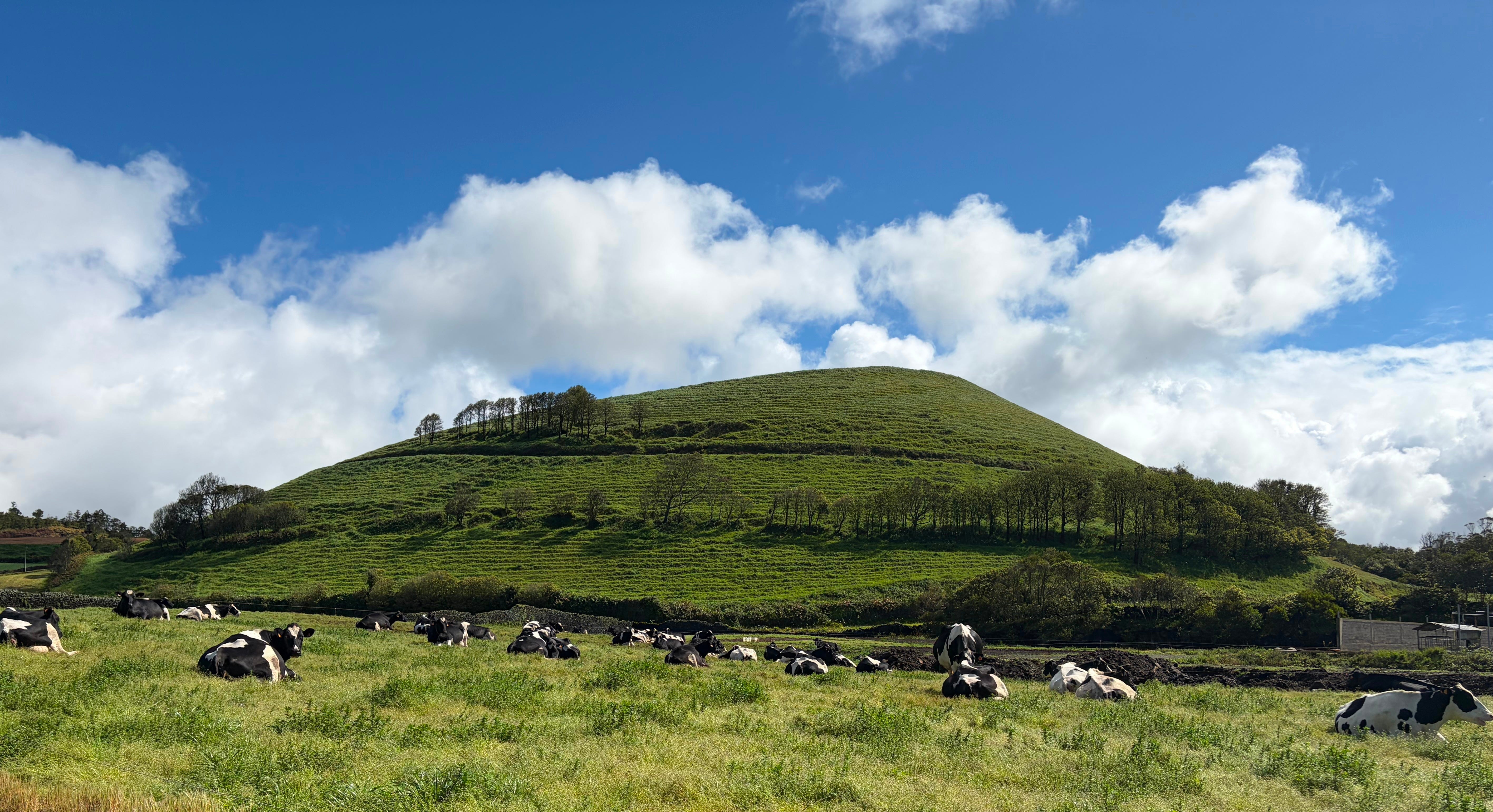
Last week I wrote about ferns and the volcanic beauty of São Miguel. This week, I want to talk about cows. The cows of the Azores. The ones that make you question gravity. And also ones that are happy.
I have been traveling and learning from farmers and food producers for years. I find the chefs of Italy, the grain farmers of California, the small intimate coffee shops, and now, again, the ones here in the Azores. These are the places that remind me there is so much that is good. But it never ends, and just when I think I have completed my discoveries, more unfold. My search for food and food sources, for knowing who grew it and how, is what I seek. And while the curiosity leads me down paths, the paths tend to get wider and reveal more just when I think I have come to the end. I guess that’s it—the search never ends and the story just keeps revealing itself.
This is my fifth trip to the Azores, and here I am; I am bewitched , helplessly enchanted, and curious. There have been moments of complete wholeness, surrendering to the power of walking in the crater of a long-ago volcano, feeling the energy of sheer green walls rising into a living cathedral. The hikes, the tropical air, the life that centers around real food. These things are me.
And in the Azores, you can’t help but notice the Happy Cows.
A happy cow is often seen as a slogan on our souvenirs, but she is an animal on pasture, moving through grasses and clover, grazing a living landscape. She lies down when she wants and eats a varied salad bowl of plants. In the Azores, this comes alive in a way that feels almost whimsical: cows scattered across impossibly steep emerald hillsides, grazing as if gravity were optional. Silhouetted at the very top, before the heavens. You just can’t help but wonder if they’ll fall. They belong to that landscape in a way that feels both improbable and completely right.
This matters, because the health of the cow is inseparable from the quality of the milk.
Milk is a translation of a system. When cows graze on diverse pasture, their milk reflects it. Grass-fed milk brings the omega-6 to omega-3 ratio to nearly 1:1, compared to 5.7:1 in conventional milk, and carries an unmistakable depth of flavor. Milk from cows on pasture contains higher levels of beta-carotene and vitamin E. These nutrients ar not added but grown, rooted in the soil, and shaped by sunlight. These qualities shift with the season, how much time the animals spend outside, and whether they’re eating fresh grass or stored silage. The milk is an expression of the weather, the sun, soil, care, and time.
But wait there is more; the path continues… understanding: A2A2 milk.
Milk contains a protein called beta-casein, and there are two common forms :A1 and A2. Most modern dairy includes a mix of both. But some cows carry only the A2 gene, producing what’s called A2A2 milk. For some people, the A1 form breaks down into a peptide that contributes to bloating, heaviness, or what gets broadly labeled as lactose intolerance. A2 protein behaves differently in the body and, for many, is simply easier to digest.
This doesn’t make A2A2 milk a cure-all. But it points to something important: not all milk is the same. Genetics matter.
When people refer to a “gold standard” in dairy, they’re sometimes many things: : A2A2 genetics, breeds like Jersey and Guernsey known for rich golden milk, animals raised on pasture (100% is the ultimate). On labels in markets across mainland Portugal and Spain, Azorean dairy is referenced as exactly that. And like so much of the food world, here and at home, the labels multiply, and confuse the buyers.But in Portugal, the one true mark of quality is simple and honest: leite de pastagem. Pasture milk. Backed by the Vacas Felizes: Happy Cows program, certified against nearly 200 standards, with one requirement that says everything: the cows must live on pasture every single day of the year.
And there is more…. Every morning and evening, farmers on São Miguel bring the milking parlor to the cows, not the other way around. It is common to see a farmer on the side of the road, milking his cows, who have come down from the hills to the roadside to the portable milk pparlour. The milk is collected into a bulk tank, trucked to the village, then sent to a processing plant. A working, living, intimate system. There are only two examples of this mobile milking model in the United States. It’s a model our own Allen Healey at Mermaid Farm hopes to one day bring to the Vineyard. Standing on those hillsides, I thought of Allen. The dream is the same.
That is what we’ve lost sight of in much of modern agriculture. Efficiency has replaced intimacy. Volume has replaced variability. And yet, when you taste milk from a system like this, the earth is restored. And yes, you taste it and there is an intimate connection to the soil, grass, cow, milk, human. Each part supporting the next.
The path widens and diverges.. and yes there is more- I know- all this for a little cheese. Stay with me.
Raw milk, at its best, is an expression of that system in its most complete form — naturally occurring enzymes, intact proteins, beneficial bacteria, the full spectrum of fat-soluble vitamins shaped by pasture and season. But raw milk asks something in return: discipline. Clean animals, clean milking, rapid cooling, careful handling. Without that level of attention, it carries real risk. With it, it can be extraordinary.
Pasteurization changes milk, but not all pasteurization is the same. At its most thoughtful, milk is gently heated using HTST briefly, to about 161.6°F for 15 seconds. This reduces harmful pathogens while largely preserving flavor and nutritional integrity. The milk is no longer “living” in the same way, but it remains close to its original character.
This stands in sharp contrast to ultra-high temperature processing, where milk is heated far higher for a longer shelf life. Stable, but the taste flattens, and much of what makes milk expressive is lost.
In the Azores, most milk sold here is pasteurized. Although it easy tofind raw milk. The pastuization in the Azores is that of using this gentler method. More importantly, the system behind the milk remains intact: cows on steep green hillsides, grazing year-round on mineral-rich volcanic soils. Even after pasteurization, that quality carries through.
Raw milk from healthy cows, grazing green pastures year-round, produced with rigor and respect, remains the gold standard. And when that same milk is gently pasteurized, (minimally) It is the next best expression of that same system: safe, accessible, and still deeply connected to the land.
And Still, the Path Continues… and widens!
I wanted to write about cows this week. The cows of the Azores, but also the whole winding system that surrounds them. I woke this morning to rain ponding and then the quiet of nature and the mist settled and found myself still thinking about milk. Still walking the same path. And I am certain that tomorrow I will wake with still more to say.
But this morning, before anything else, I kept coming back to a simple question: why, if the Jersey and the Guernsey produce such extraordinary milk, do we see Holsteins almost everywhere we look? The answer, honestly, comes down to efficiency.
Holsteins were bred for volume. Jerseys and Guernseys were bred for richness. That difference shows up immediately and unmistakably in the milk. Jersey and Guernsey milk carry significantly more butterfat. Butterfat that is often between four and a half to five and a half percent, sometimes higher (depending on the season!) along with more protein. Holstein milk typically hits around three and a half percent fat, a little lower in protein. Small distinction, perhaps! But one can taste fat in the glass, in the cheese, in the butter, and in yogurt, for anything cultured. We all know more fat, more everything, including luxuriousness.
But the idea that Jersey and Guernsey milk is “better” isn’t really about one being good and the other bad. It’s about what each cow was designed to do. Holsteins are extraordinary at what they were bred for. The question worth asking is whether volume, on its own, was ever the right thing to optimize for.
Happy cows, 365 days on steep lush hills, and the mobile milking parlor coming to them, and the milk gently pasteurized and full of everything the land gave, it is more than breeds and butterfat. The stubborn reality is always the same: it comes back to price. It comes down to what the industry will actually pay.
There is a shared understanding across the European Union that animal welfare matters. Policies, certifications, public messaging, likeourcountry, all of it points toward a desire for higher standards. Cows on pasture, living well, producing milk in systems that respect both land and animal. The intention is real. But there is a disconnect.
The market does not consistently pay for that difference. A liter of milk from cows grazing year-round on the steep green hills of the Azore, animals living in fresh air, eating grass, expressing their natural behavior, often enters the same pricing structure as milk from large-scale confinement systems. The conditions are worlds apart. The compensation rarely reflects that.
And so farmers adapt.
Even when their cows are grass-fed, even when they may naturally produce A2-type milk, many turn to Holsteins because volume is what the system rewards. Not because the milk is better, but because more of it pays the bills. Jerseys and Guernseys, whose richer milk is so deeply tied to pasture and place, become harder to justify economically when that quality goes unrecognized in price.
This is what modern dairies are. We say we value quality. Until farmers are paid what the milk is actually worth, the rest of us drink the consequences.
I hate to leave you sin the mnist if this lush verdant green valley overlooking the mighty Atlantic with an impossible problem and also on a littlebit of a downer… A problme to solve: There is something we can do. Every single day, every single time we shop, we can change a system becasue we vote with what we put in our cart.
When you choose high-quality milk, cheese, butter, and yogurt, look for signs that tell you how that animal actually lived. The labels can be bewildering. I know! But a few honest ones are worth knowing and worth seeking out.
In New England, Maple Hill Creamery is the real deal:100% grass-fed, certified organic, no grain, no shortcuts, distributed widely across the Northeast. Organic Valley works with a cooperative of small family farms and holds to genuine pasture standards. Brookford Farm in Canterbury, New Hampshire raises 100% grass-fed A2/A2 cows and delivers raw dairy directly to your door. And closer to home, Appleton Farms in Ipswich, Massachusetts, the oldest continuously operating farm in America (part of the Trustee of Reservaions and availabel at markets) milks Jersey cows on pasture and makes their own cheese and yogurt on site.
For butter, there is Butterworks Farm in Vermont has been doing this quietly and beautifully for decades. Organic Valley Pasture Butter is another one worth reaching for. Both come from cows that actually live outside.
A brand I have often turned to because it says: Grass fed is not the gold standard: Vital Farms butter comes from cows that are 90% grass-fed with outdoor access an average of 200 days a year. That's solid but not the gold standard
And here is a printablesheet to carry with you and if you don;tsee it on the shelf? ASK your grocer to find a brand that has these qaulitie
!
.This is about the planet, and it is about you. Pasture-raised dairy is measurably richer in omega-3s, in beta-carotene, in vitamin E. The cows live healthier lives. And the land holds carbon instead of releasing it because when cows graze, their manure returns directly to the earth, feeding the soil, building organic matter, sequestering carbon right where it belongs. Pasture-raised cows are not the villain of the climate story. Confinement dairy is: the methane, the manure lagoons, the degraded soil. Cows on grass, managed well, can actually be part of the solution. That is a whole conversation for another misty morning, but know this: the system, when it works the way it is supposed to, gives back more than it takes.
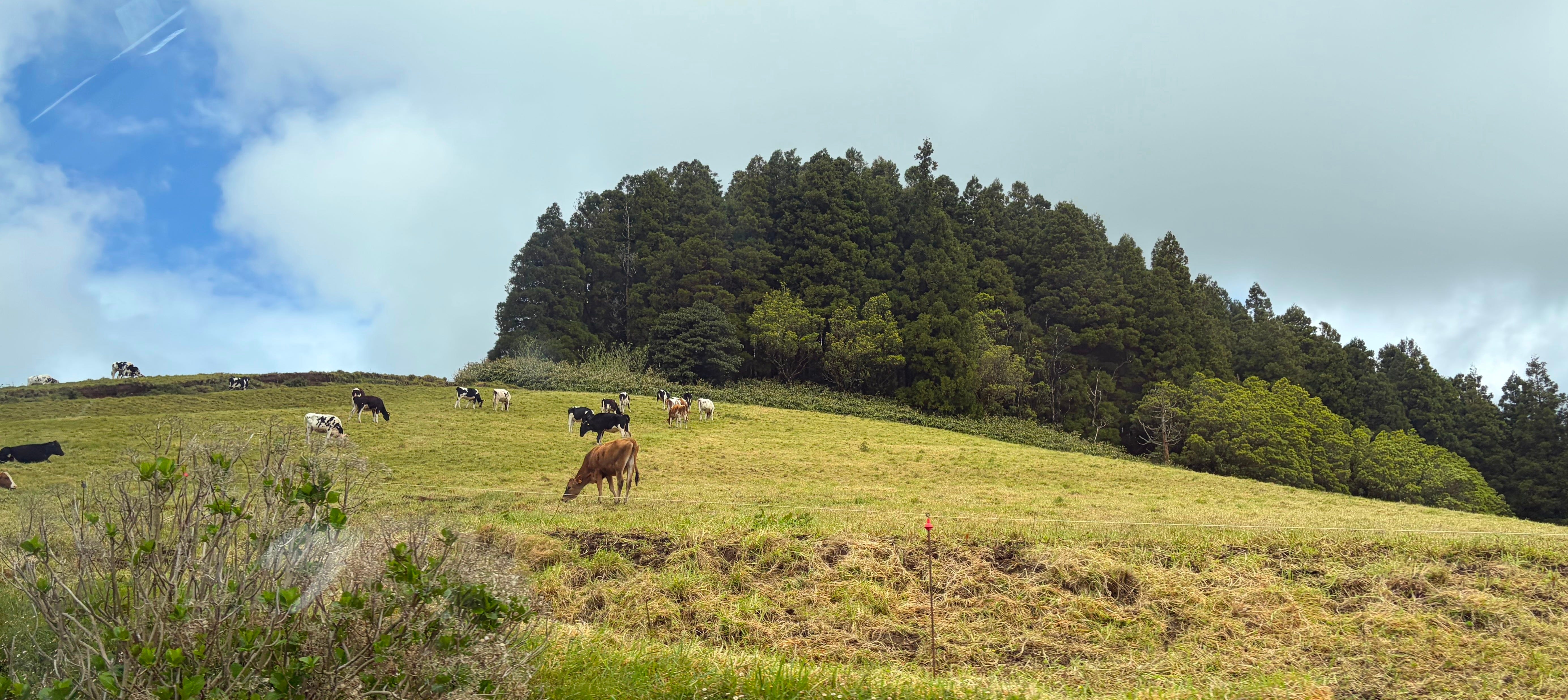
Watching cows graze as if gravity were optional, I felt what a food system can be when it is built around the right things. It exists. It is possible. And every time we choose it, we make it a little more so.
Frm my heart to yours,
Jan
No posts
Comments
Nothing yet. Say the first thing.
Sign in to join the conversation.