
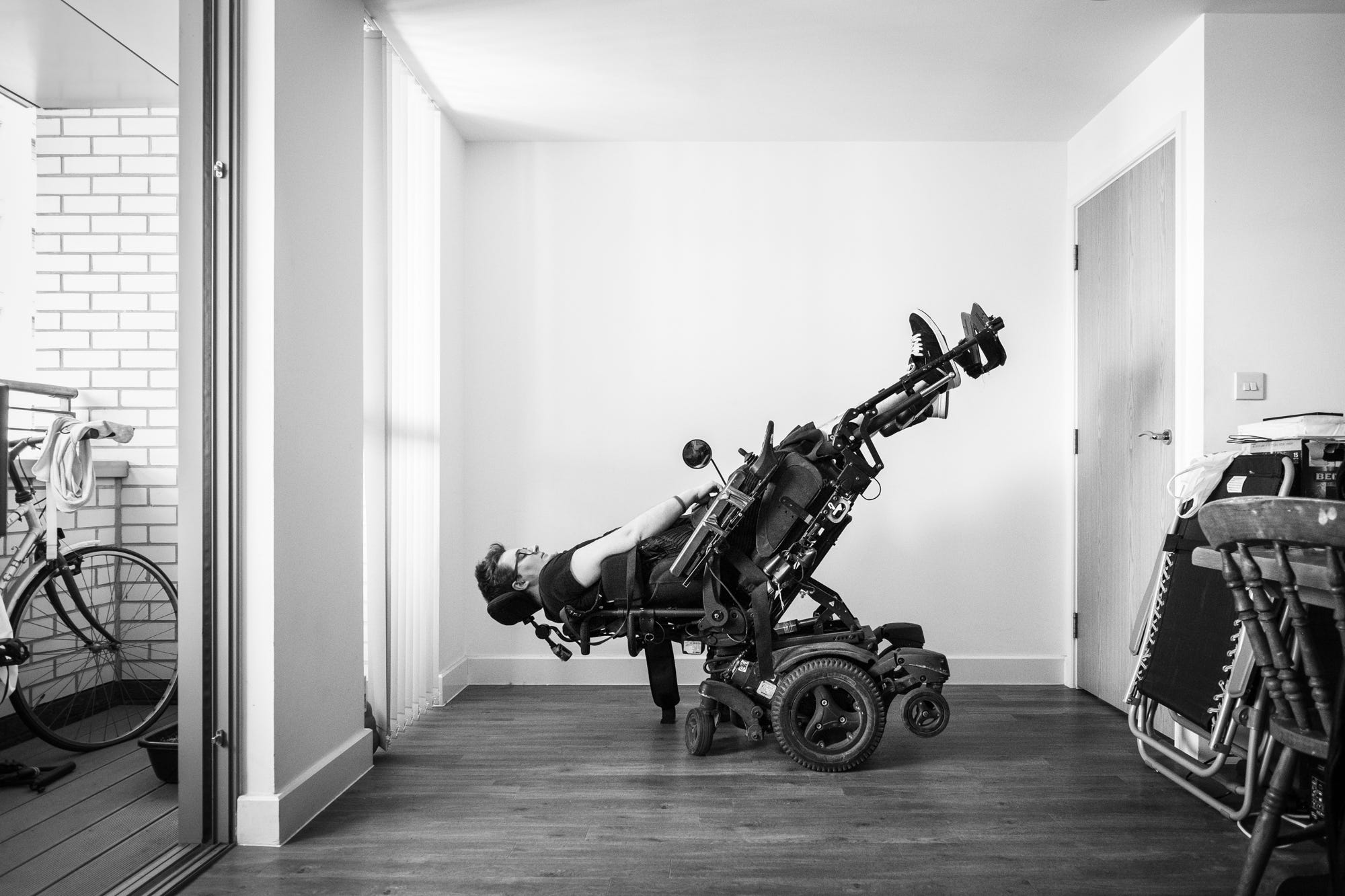
There are so many experiences in the disability community, and so many different groups with individual experiences. Even within the smaller cohort that is wheelchair users, our experiences are radically different. Ambulant or non-ambulant? Powerchair or manual? Folding or rigid-frame manual? Power-assist manual or no power assist? Folding powerchair or full-size power chair? These questions seem almost petty, but are fractures through the heart of the wheelchair user community - because they affect the freedom people have, and the barriers people face, in ways I don’t think people always recognise. We have so much in common, and there are so many myths we believe about different experiences as well.
I went from being ambulatory to non-ambulatory over a few years, eventually falling for the last time and accepting I could no longer walk. As my walking deteriorated, I initially used a rigid-frame manual wheelchair, convenient when I could walk and put it in a car boot before stumbling round to the seat, and still convenient when I could no longer walk, but could transfer into a taxi and have a friend fold it into the car. I went from that to a powerchair - not one of the small folding ones, but one of the big NHS ones. I still used my manual sometimes, when I had someone to push me, but I was no longer strong enough to self-propel. Over time, sitting in the manual became increasingly hard, and I had to use my NHS electric more and more - even if there would have been someone to push me. Eventually the manual became an artefact, and I was living my life from an electric wheelchair. Nowadays I live in a very customised specialist electric wheelchair.
The reason I tell you this is that I’ve had the rare experience of living a lot of different lives - from being invisibly disabled to using crutches, to being hoist-dependent in a high-spec electric wheelchair, and it’s shown me that many of the things we believe, and the myths we share about disability, aren’t quite as universally true as they seem to be. I’m not saying that any one position is the hardest to be in - if anything it’s the opposite; I’m trying to unpick how hard every position is - how nobody is winning here.
And I’m doing it knowing that I held many of the positions I pick apart now - that I thought these things about other disabled people, that I didn’t know how different our experiences were until mine changed, that I sometimes felt destroyed by how much I believed these myths were completely true, believed that the grass would always be greener. Believing them doesn’t make you a bad person, it makes you human.
1 You’re lucky you got a chair on the NHS
NHS wheelchair funding is incredibly difficult. If you can use a manual around your house, you won’t usually get an electric wheelchair. If you can walk around your house, you won’t get a manual. Qualifying for a lightweight manual or a high-spec electric is very difficult, and relies on you really having no other option. For my NHS chair to have everything I needed to be safe and independent, I had to spend over £1000; with and then had to spend a further £1000 on additional elements to attach to it, like a tray table and laptop mount. That £2000 I had to contribute to the cost of my chair is similar to the cost of a wheelchair purchased outright, for many people. The NHS route doesn’t necessarily mean a free chair, at all. And this chair isn’t suitable for my needs everywhere, and it breaks down a lot, so I have to own a backup manual wheelchair I can be pushed in, and a backup electric wheelchair. Those, I had to purchase outright.
Nobody should be forced to buy a necessary wheelchair, but having one on the NHS doesn’t protect you from having to buy one. I had to buy my own when my impairment was less profound, and I remember how bitter it was how expensive they were, but my impairment progressing to the point where the NHS will fund my main chair doesn’t mean my wheelchair budget decreases. Let alone how much is cost to get a car I can travel in it, or a house I can move around it in.
2 Having a wheelchair is all about freedom - or all about loss
Inside the community, we’re often only able to talk about a wheelchair as a positive thing that opened doors and removed barriers, that it was liberation, mobility, and freedom. Expressing grief about it is corrected as internalised ableism or tragedy model thinking. Outside the community, it’s an entirely negative thing - we’re not allowed to talk about a chair as a positive step that enables us to achieve the things we want to achieve - it’s just an example of our inevitable deterioration towards the grave. For me, the chair has been both freedom and loss - I fell for the last time. I accepted I could no longer even stand to transfer safely. The chair let me continue living my life, but it is not a betrayal of my politics or the social model to say that I mourn the change.
3 Wheelchair users just need wheelchair access
But what do you mean by wheelchair access? Not every wheelchair user needs the same thing at all. Some wheelchair users can manage a small step, others can’t. Some can manage a long ramp, or a steep ramp; others can’t. Some can fit into a small adapted toilet, and guess what, others can’t. The same with platform lifts, tight turns, and long distances. We may all need very different things, and knowing someone’s in a wheelchair doesn’t necessarily tell you what they’d need from a physical space at all. This is why when you’re talking about a space being accessible it’s important to give actual measurements, not just to say “fully accessible” - when that means different things to different people.
4 It’s better to be visibly disabled
I’ve lived both ends of this, from invisibly disabled to ambulatory wheelchair user, to having high physical support needs dependent on 24/7 care, and what I know is that visibility doesn’t buy belief; it buys a different kind of disbelief. I used to be met with a polite disbelief, questions about “do you really need that chair?”, people staring if I moved my legs, or got up (while I still could). Now, my need for the chair is less likely to be questioned, but in it, people assume I’m incompetent, I’m talked over, I’m infantilised, I’m reduced to the chair, I’m never read as anything before I’m read as disabled. I’m believed about my body but disbelieved about my personhood, and these two things come together.
Being believed isn’t being accommodated - whether we’re visibly disabled or not, disabled people well know what it’s like not to have our access needs met. For me, when I was in a manual wheelchair and had more physical strength, I was able to access far more spaces than I can now, and as my impairment has become increasingly visible, the number of places I can access has decreased.
5 Your needs are undeniable - at least you get benefits and support
There’s an assumption that if someone has a very obvious set of high support needs, they won’t be questioned by an assessor when trying to access benefits or supports in the same way that someone with lower support needs who has to defend their right to access benefits will. In my experience, people with high support needs attract a huge amount of scrutiny when it comes to care funding and support - assessments and cuts, and more assessments and cuts. They try to ration you even if they do believe you, and being visibly expensive means you’re just the expensive care package, the costly budget line they’re trying to cut. I am less likely to get questions when I’m applying for PIP, but let’s not talk about the Continuing Healthcare process and how invasive that is.
I have been the person that all of these myths are about. I have been invisibly disabled, and I have been unmistakably physically disabled. I have used a manual wheelchair, been pushed in one, and lived out of a power chair. I have dragged myself up steps and hills, and I have been hoisted into a chair I cannot get out of.
In all of these positions, there was a myth telling me that some other disabled person (someone with a lighter chair, someone who could still walk, or someone whose needs were too obvious to question) had it easier than me, or that I had it easier than them. But from inside all of these lives, I have realised that each comes with its own barriers, its own losses, and its own particular ways of being failed.
All of these myths come down to a comparison - at least you, at least them - asking me to weigh my disabled life out against another disabled life and decide who is winning. This game is rigged because while we are busy deciding which of us is the deserving one, which of us is the real wheelchair user, or which of us has the most undeniable needs, nobody is looking up at the social structures that decide how little we all get. This hierarchy keeps us staring at each other rather than staring at the world we want to change.
These hierarchies were given to us by a system that rations chairs, and care, and belief and access - teaching us to fight over the scraps while it walks away with the five-course meal. And I am furious about it. Not with the other disabled people who are, and should be, my natural allies, but with the system that told us all that there wouldn’t be enough, and abandoned us. These myths and the way they hurt us aren’t the fault of the disabled community; they’re the result of enforced scarcity. I’m not interested in working out who has it worst - I want to know who’s holding the budget instead.
Comments
Nothing yet. Say the first thing.
Sign in to join the conversation.