
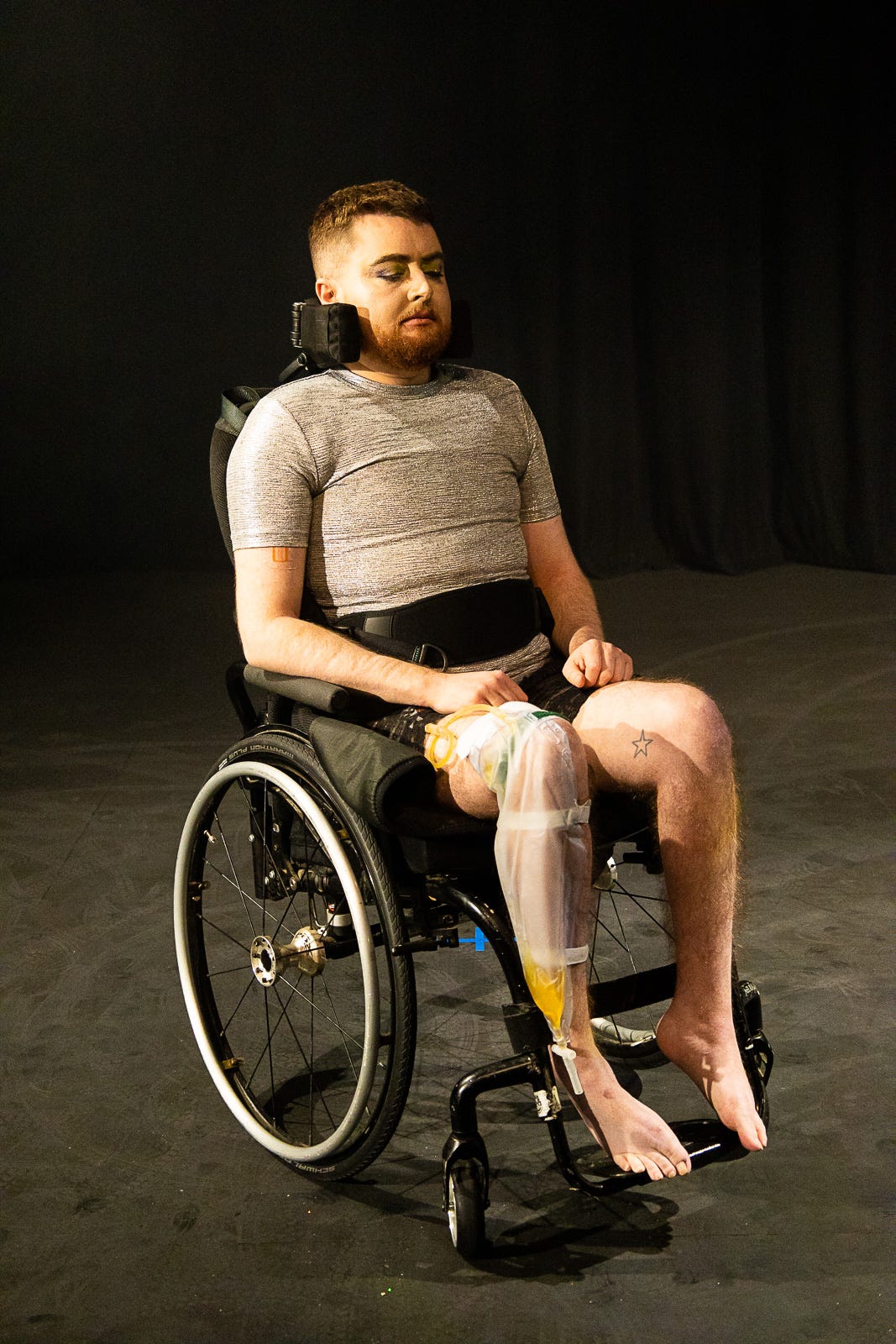
Sometimes when I say I’m going for a walk, I get a bit of a double take. People are confused about whether I can therefore walk, or confused about how a wheelchair user could go for a walk. Their disorientation always surprises me.
Language of ambulation
The phrase ‘going for a walk’ in many ways seems like a dead idiom to me. It stops meaning legs. I don’t use it only for people to think about my legs (or perhaps they do when I use it), but when someone else uses it, it isn’t an invitation to contemplate their lower limbs. It’s simply a shorthand for motion, often unpowered.
I think it would be an error to try and remove the word ‘walk’ from my vocabulary. It would feel strange to never speak of myself as going out for a walk when that feels like such a natural use of language., I’m not here to police the word ‘walk’.
I don’t think people should feel they have to stop referring to wheelchair users with language that can imply ambulation. I think that’s unnecessary, and I think it puts a lot of pressure on people to change their use of language when often the use of language isn’t the problem. The problem is actions, not words. I don’t want to waste what energy my allies have on the word ‘walk’.
Moral value and the disabled body
There is language that I feel differently about, however. If someone says, ‘He needs to learn to stand up for himself’, or ‘Don’t let them walk all over you’, or ‘Taking a step in the right direction’, or ‘He won’t take this lying down’, then that’s a very different set of idiomatic language around bodies, movement, and particularly walking.
Going for a walk is neutral language; it doesn’t imply that being able to walk is somehow better than not being able to walk. Whereas that set of idioms carries value judgments with them. Being upright and moving is seen as courage, integrity, and strength, whereas being still or prone is weakness, defeat, and passivity.
When we use idioms like “stand up for yourself”, we are reinforcing a value judgement that enhances the social status of people who can carry out the physical tasks desired, and diminishes the social status and existence of people who cannot.
How it feels
Those types of idioms are surprisingly difficult to hear, not necessarily for themselves, but also because I think hearing them betrays something of the underlying views that the person stating them holds: views that, ultimately, it is better to be non-disabled than to be disabled.
It is not something that offends me. It is more just that all of this recurring information about the ‘good existence’ is very much based on the existence of the body I don’t have, and it hurts. And yet I’m sure I un-noticingly use them as well.
Language builds the world
We don’t just use language to describe the world; we use language to make the world around us. When we use those kinds of idioms, we’re not only describing how people are valued at present, but we are also training ourselves to accept a set of norms that I don’t think we want to accept: that walking and standing are not just the unmarked human default, but the ideal. Anything else is seen as a deviation and something outside of what one should choose. These idioms help make a world that values non-disabled bodies over disabled bodies.
I’m not saying these phrases are slurs by any stretch of the imagination, nor am I claiming to experience deep harm from them. The mechanism of harm they create is the compiling of happenings over and over again, and how that combination, as a group, shows me what the world thinks of me.
We don’t actually need that language. Many loaded words associate abledness with value, and we can replace them with synonyms that are neutral, far more precise, and less costly. ‘Stand up for himself’ could become ‘assert himself’. ‘A step forward’ could become ‘progress’ or ‘improvement’. There are always ways of taking these phrases and finding a swap that works better. I’m not suggesting that you scan every sentence for the presence of feet so much as that you notice those instances in which there is a metaphor doing moral work on top of a disabled body.
Decentering abledness
Reflecting on the language of ‘going for a walk’, it is not doing its work on the back of a disabled body, as some of those other metaphors did. However, it is not neutral either. I defended it that way, but fundamentally, it quietly keeps ‘walking’ as the standard verb to describe the way we move as a species. It is the way that most of us move, but for those of us who don’t, is there actually an argument for us to think about de-centring the language of ambulation? Perhaps we could replace it with a crip-centred vocabulary that reflects our own experiences in the world.
Can we make it ordinary to say ‘going for a roll’ alongside ‘going for a walk’? These are two equally ordinary things. I don’t mean this as a standout correction or a deliberate jab at how people use language, but just to normalise the ways that we exist in the world. I am not going to pretend I do that. It is far easier to say ‘go for a walk’, and somehow ‘go for a roll’ or ‘go for a wheel’ trip off my tongue uncomfortably. They feel overly self-centred, overly focused on me and the body I am in, and that itself makes me uncomfortable.
Coming away from this, it strikes me that for abled and disabled people alike, we should try to reimagine our vocabularies such that we stop centring abledness and start thinking about the constructions of the body that we’re discussing. When we use language like “stand up for oneself”, what are we saying about people who can’t - and do we really want to be saying that?
Comments
Nothing yet. Say the first thing.
Sign in to join the conversation.