
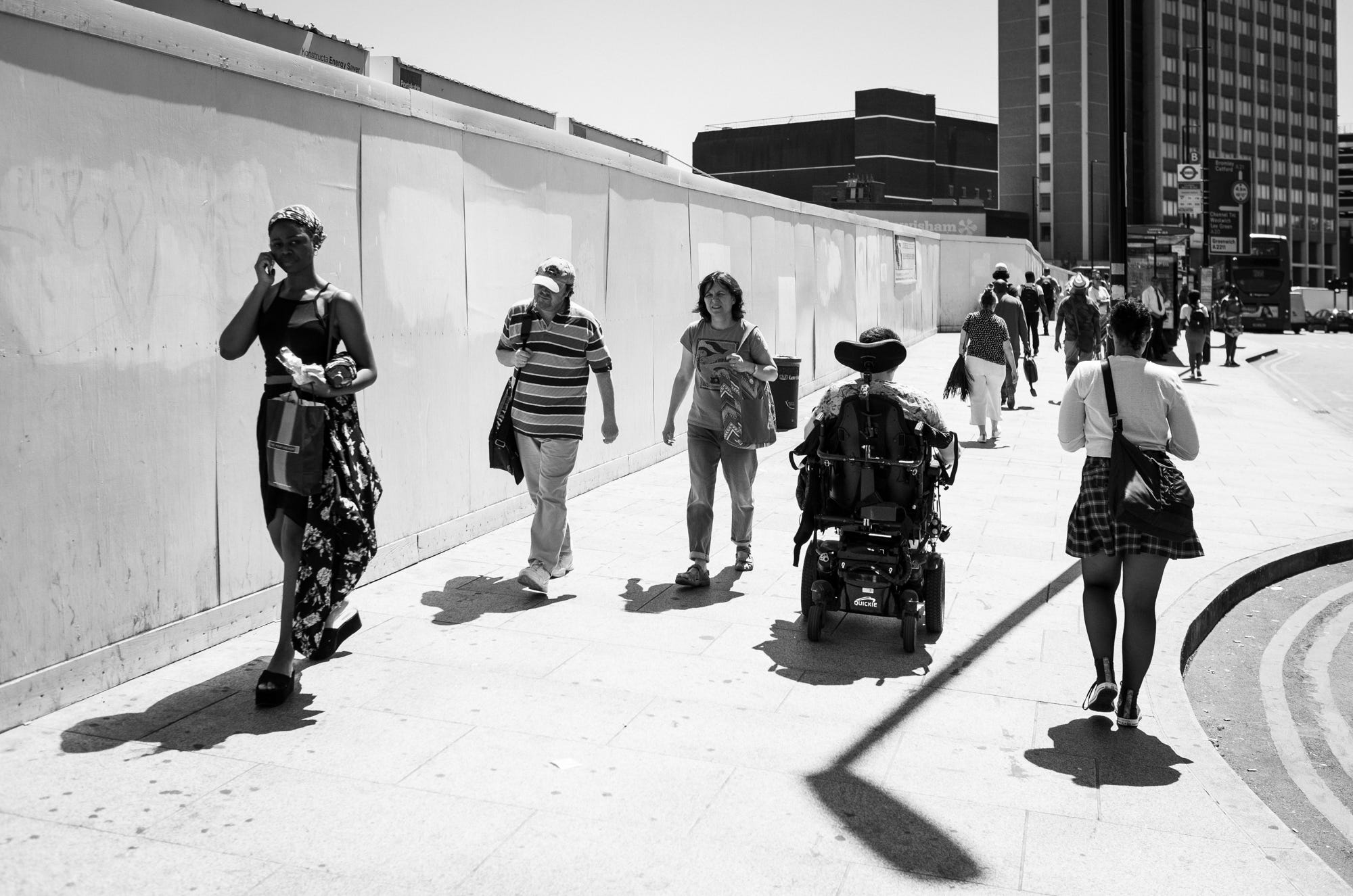
Care is not a one-directional drain that flows towards the disabled body before vanishing. It’s the water in which our lives flow.
I sometimes try and add up my costs to the state.
Inevitably, I reach a point where I have to stop. I can quantify my benefits (PIP) and even my care package. Still, it’s harder to capture the hospitalisations, or the prescription costs, or the appointments I have at the rate of several a week, some weeks. An economist could probably work it out, and give me a number that equates to the value of what the state is spending to keep me alive. I am constantly trying to work out for myself if I’m worth it.
The economics of it all
What makes me uncomfortable isn’t (just) how large the number is; it’s that the question has an answer. The fact that I haven’t presented you with the amount I cost is a simple failure of arithmetic on my part. How much is a life worth?
Underneath that question is another one, possibly more sinister.
The original question of “what do you cost?” really turns into “is this life worth what it costs?”, and even more brutally “does this life pay for itself?” - an accountant asking me what I’m worth before deciding whether to keep me alive.
This is one of the oldest questions disabled people face - running through the workhouse means test, through “lives unworthy of life”, and now in the language of “value for money” and “sustainability”. And refusing to engage with that question at all would look like the coward’s way out, so it’s where I’m going to start - how do we financially value life?
How do we financially value life?
Quality Adjusted Life Years (QALY) are how the National Institute of Clinical Excellence assesses and puts a price on a year of life. In theory, a treatment is funded if, and only if, its cost per QALY (a year of life in perfect health) falls under a set threshold. That basic threshold is £20,000 - £30,000, and hasn’t been changed since it was set more than two decades ago. In April 2026 this threshold rose to £25,000 - £35,000 - not because there was any kind of reassessment of the value of life, but because of a UK-US pharmaceutical trade deal - and this increase comes with Ministers being able to change what treatments are funded at their own will through secondary legislation, without even asking NICE. So the price of a year of life can be adjusted by a politician at will.
That threshold is brutal, and complicated. There are far higher thresholds used for end-of-life care, very rare conditions, and severity modifiers, that in some cases can bring the cost of a QALY up to £300,000. And that turns the knife - because if you accept the QALY as a reasonable metric for deciding what treatments should be funded - and therefore who should live or die - the NHS actually spends £13,000-£15,000 per QALY. If it approves a treatment at £30,000 per QALY then it actually removes two QALYs of health from the NHS - because that money is taken from services generating QALYs at half the cost.
“What is a life worth?” isn’t an abstract question. Not when there’s a numerical answer. The QALY turns the unanswerable value of life into an answerable, banal, filed, bureaucratic figure to a question that should surely be about so much more than money.
Paying the bill
The cost of keeping me alive isn’t intrinsic to me, and much of it is instead the cost of a world built as if I wasn’t going to be in it. If the stairs are built, then a lift has to be. If an appointment is made miles away, I need transport to be there. If I have to do paperwork in relation to my care, I need someone to help with that paperwork. All the hours that have been burned, fighting for routine needs to be met in a routine way. The administrative cost of contesting my own care is itself a line from the ledger that I will never have paid by the system.
Fine. If we’re bringing the cost of keeping me alive to the table, we’ll do that for everyone. If we’re itemising the cost of a life, why is it only ever mine that we itemise? Why do we only consider the cost of disabled people?
We all live in an interconnected world, and actually nobody is self-sufficient, solvent on their own terms. The roads we drive, the education that makes us employable, pension tax relief, the bank bailouts with our savings inside, flood defences, clean water, and the NHS held in reserve, waiting for the next non-disabled person who is one diagnosis away from costing exactly what I do. The “individual taxpayer funding my benefits lifestyle” is a comfortable fiction. Have any of the non-disabled people questioning our right to life ever looked at their balance sheet? If not, why can they look at mine?
The difference between their state subsidy and mine isn’t actually arithmetic; it’s what we call it. When the state spends money on non-disabled people, it’s framed as being about infrastructure, investment, public good, dignity, and when it spends money on me, it’s discussed as cost, burden, drain, and the constant demand for gratitude and evidence. The money flows in the same direction, but money on non-disabled people is good; money on disabled people is bad. Their subsidy is ambient and unit-less, and mine is itemised. Am I even being subsidised more than the average citizen? I don’t know. I am, however, being subsidised legibly, and legibility is what gets me punished. The shame is manufactured by the accounting that questions my worth, and then pushed onto me.
Interdependence is universal. Abled people aren’t a different category of person; we were all born dependent, most of us will die dependent, and in between these, there’s often a stretch of apparent self-sufficiency. This time period is the exception in one’s life, mistaken for a rule, and we’ve built a whole moral framework on top of an assumption about able-bodied self-sufficiency. You’re not independent; you’re in between the points in your life where you have your dependency measured.
The value of productivity
This is where I’m tempted to play my cards and win. This is where I want to produce the receipts - the impact CRIPtic has had, the places my creative work has reached, the productions I’ve made, the lives I’ve changed, the amount my care package brings into the economy even, and prove my value that way. The desire to do this is strong, because I become convinced I could win on their terms by proving I was productive enough to be worth it, and that’s why I won’t do this.
Because the minute I itemise what I’ve given back, I’ve signed the contract stating a life must give back and have therefore sold out everyone disabled who is less able to compete under capitalism than I am. If I say that my life has worth for those reasons above, I am buying into an argument that I am the good and worthwhile disabled, they are the bad disabled, their worth contingent on a portfolio that they cannot assemble. Playing the productivity defence rescues me, but it does so by condemning other disabled people, which I won’t do.
Weighing scales
What if the economist’s calculation is measuring the wrong thing. How would you weigh a marriage in kilograms? How do you calculate someone’s value to society in pounds?
Care is not a one-directional drain that flows towards the disabled body before vanishing. It’s the water within which our lives flow. The question is, who is currently visible as the one giving or the one receiving care? That is unstable, temporary, and largely down to luck. This ledger can’t measure what care produces because care doesn’t only produce outputs - it produces the conditions under which there’s anyone left to produce anything. It’s about making and sustaining the infrastructure of the world
I choose not to complete those sums to value my life. The economist can, and the state has, but I have chosen that I won’t try and weigh my life on their terms. To do so tacitly accepts that there is a sum at which I shouldn’t be spent on, a sum at which I am no longer worth keeping alive - a sum at which it is better just to kill me. There is no such figure and the implication that there might be one is what causes the harm. The violence was in searching a ledger for people. My life isn’t justified despite its cost, because cost should never have come into the equation.
I’m putting those sums away, because whatever they say, I am worth it.
Thanks for reading! This post is public so feel free to share it.
Comments
Nothing yet. Say the first thing.
Sign in to join the conversation.