
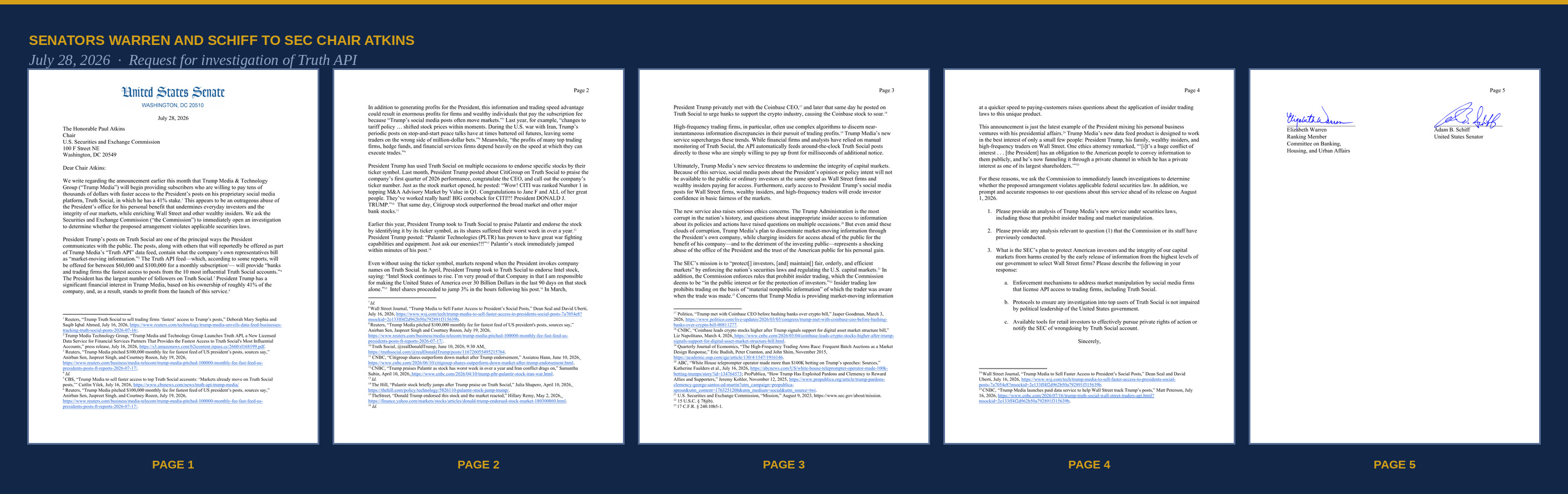
On July 16, Trump Media & Technology Group announced Truth API, a data feed delivering posts from the highest-profile Truth Social accounts to trading firms in milliseconds. On July 28, Senators Elizabeth Warren and Adam Schiff wrote to SEC Chair Paul Atkins asking the Commission to investigate. It reached institutional customers on August 1.
Most coverage has framed this as an insider trading question. It probably isn’t one. But that doesn’t mean it’s not problematic. Let’s dig in.
A machine-readable feed of posts from the ten most-followed Truth Social accounts. The President’s is the largest.
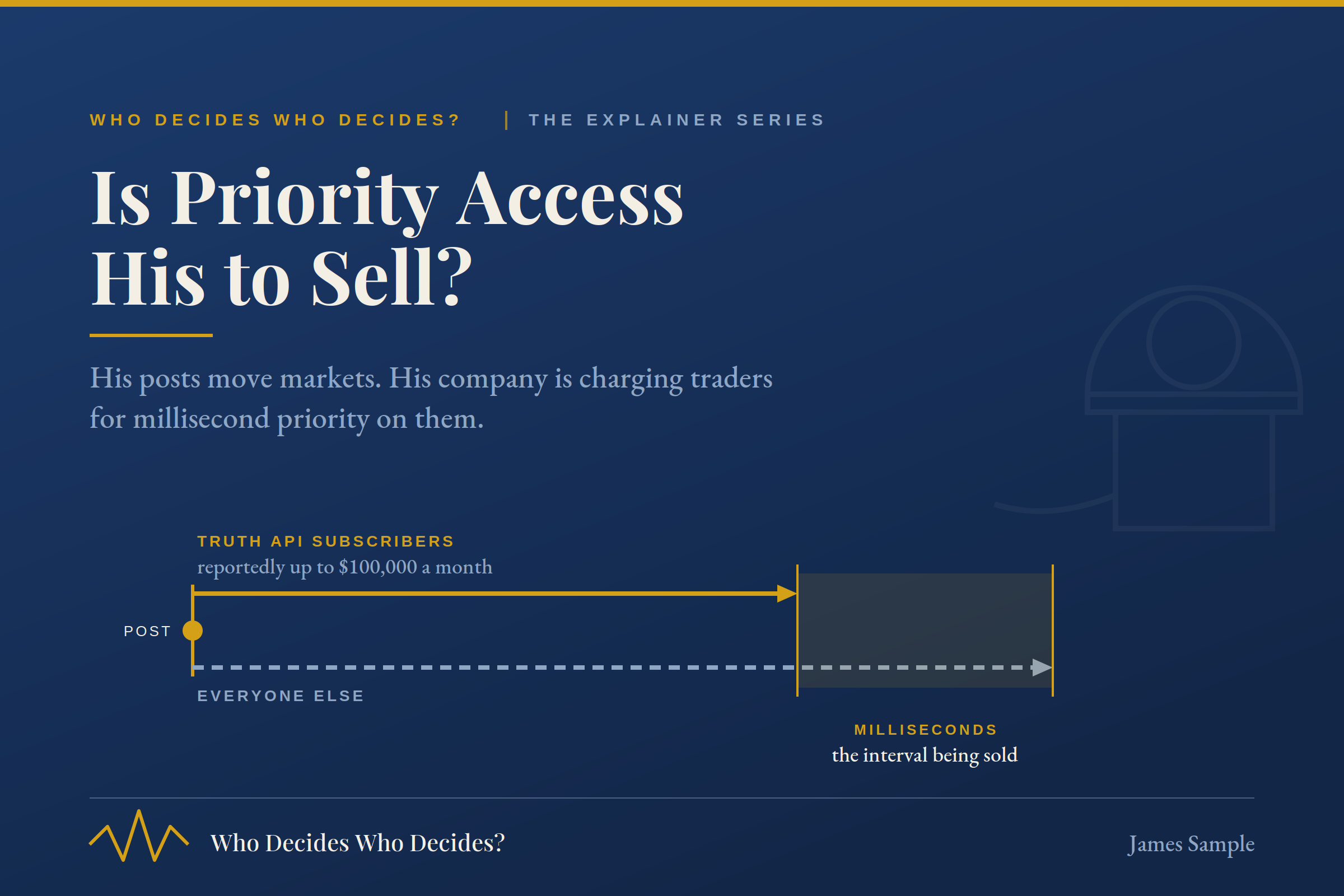
Speed. The company’s own language is “fastest access” and delivery “in milliseconds.” Trump Media has said the posts stay publicly visible to everyone at the same moment.
A back catalogue. The release states the product includes an archive going back to 2022, which lets a firm study four years of price reactions before trading on a single new post.
Reported pricing of $60,000 to $100,000 a month, according to Reuters citing unnamed sources. The company hasn’t published a rate.
The stated customers are high-frequency and algorithmic trading firms. Trump Media says it signed subscribers before launch and has named none of them.
Trump Media’s own pitch is that markets already move on Truth Social posts. The White House has nonetheless denied that the service creates any conflict of interest for the President.
Private companies sell early access constantly. Banks give clients research before the public sees it. Retailers open sales to cardholders first. Media outlets put stories behind paywalls. All of that is ordinary commerce, and none of it resembles this.
The seller, the source, and the actor are the same person. A bank’s analysts don’t set the Federal Reserve’s rate. A retailer’s early-access sale doesn’t let insiders buy before the retailer decides what to charge. Here the product is advance notice of decisions the owner is about to make and can time at will. Every legitimate version of selling speed depends on a separation between the party with the information and the party creating it. That separation is absent.
These posts are official government conduct. In Lindke v. Freed (2024), the Supreme Court held that an official’s social media activity counts as state action where the official has authority to speak for the government and is exercising it. A post announcing tariff changes or military operations satisfies that test on its face. What’s being sold is priority notice of official acts of the United States government.
The archive is a research product, not a news feed. Four years of labeled, machine-readable presidential utterance paired with market data is a training set. It lets a firm model the relationship between what this president says and what prices do, then act on the next post in microseconds. Nothing about that resembles a subscriber getting a newsletter early.
The equal-access practice runs the other way. Market-sensitive federal data has traditionally been released under lockup conditions, with reporters sealed in a room until the moment of publication so nobody gets a head start. Federal Reserve embargoes work the same way. The design premise of both is that when the government’s words move prices, no one buys priority. This is the first time an official has monetized the inverse.
The API industrialized something already in plain view.
In March, the President met privately with Coinbase’s chief executive and posted the same day urging banks to support the crypto industry. Coinbase shares rose.
In April, he praised Palantir by ticker symbol. The stock jumped within minutes.
Also in April, he posted about Intel’s rising share price. It climbed roughly three percent in the hours after.
In June, he congratulated Citigroup by name at the opening bell. It outperformed the market that day.
He has repeatedly told the public to buy Dell computers, having reportedly purchased at least $1 million of Dell stock about a week before the first time he said it.
A president naming individual securities is not policy speech that incidentally moves prices. Under the ordinary federal conflict of interest statute, 18 U.S.C. § 208, an official taking actions that affect his own holdings is an easy case. A separate provision, § 202(c), exempts the President and Vice President by its terms.
That exemption was written on an assumption. Every modern president had placed holdings in a blind trust or sold them, so Congress saw no need to compel what everyone already did. The statute relied on a norm, and the norm was the entire mechanism.
American insider trading law turns on betrayed trust. The question is whether a trader owed a duty to someone and broke it to obtain the information. Simply knowing more than the person on the other side of a trade has always been permitted.
Chiarella v. United States (1980) threw out a conviction because trading on nonpublic information isn’t fraud unless the trader owed a duty to disclose it.
United States v. O’Hagan (1997) upheld liability for a lawyer who traded on his client’s secret. The fraud was the theft. He owed a duty to the source and broke it.
A president posting his own intentions owes no duty of confidence about his own plans. There’s nobody he’s deceiving and nothing he’s taking.
Congress hit this wall in 2012. Members trading on their own legislative knowledge fit no existing theory either, so the STOCK Act manufactured the missing piece by declaring that members owe a duty of trust arising from their positions. Congress never did that for the presidency.
The Warren and Schiff letter reflects the difficulty. It asks the Commission to “provide an analysis” and says the arrangement “raises questions.” It never alleges a violation, never uses the word duty, and never cites Chiarella or O’Hagan.
The gap shows up most clearly in a story that broke the same day Truth API was announced. ABC News reported that a White House teleprompter operator made more than $100,000 betting on the President’s speeches. That staffer has a serious legal problem: a government employee trading on advance knowledge of what the President will say has misappropriated information from his employer, and has likely violated the STOCK Act besides.
The President can do the same thing at vastly greater scale and remain in the clear. The reason is structural. Misappropriation requires taking something from someone else, and he can’t take from himself. Such is a legal system that punishes minnows and exalts sharks.
Trump Media’s defenders point out that exchanges already sell speed. Co-location (renting space for a firm’s servers inside the exchange’s own data center, so its orders travel a shorter physical distance and arrive a fraction of a millisecond sooner) is legal, widespread, and openly priced. The comparison is accurate and incomplete.
Exchanges are self-regulatory organizations registered with the SEC.
Their market data fees must be filed with the Commission, which has rejected filings it found unfair.
Federal law requires access on terms that aren’t discriminatory. An exchange can’t refuse to sell you the feed because it doesn’t like you.
Trump Media is subject to none of that. No filed rate, no review, no obligation to serve all comers, no published subscriber list.
Grant the strongest version of the defense. Assume a private company should be free to price its data however it likes and sell to whomever it chooses. That freedom is precisely what makes this arrangement worse rather than better. Discretion over customers becomes discretion over who learns of official government action first.
The President controls the company, controls the government conduct being sold, and controls the timing of both.
Nothing requires the subscriber list to be disclosed.
Nothing prevents a foreign sovereign wealth fund or a state-owned bank from appearing on it, and if one does, the payments run to a company the President owns.
The Foreign Emoluments Clause forbids federal officeholders from accepting any present or emolument from a foreign state without the consent of Congress.
Whether that describes a Truth API subscription is a question nobody outside the company is positioned to answer, because nobody outside the company knows who is paying.
When a private firm picks its clients, the stakes are commercial. When a company the President owns picks its clients, it is allocating advance notice of United States government conduct to buyers of his choosing.
Co-location demonstrates that entities can sell speed under conditions a regulator polices. It says nothing about a president selling priority on his own official acts.
The SEC. Chair Paul Atkins was selected by the President, and after Trump v. Slaughter (which we explored here) the President can remove him at will. Warren and Schiff ask Atkins to describe his protocols for keeping an investigation free of interference by political leadership. They are asking the fox to submit a written security plan for the henhouse.
The courts. Emoluments suits in the first term died on standing and mootness, which meant the doctrine governing who may sue disposed of the question before anyone reached what the Constitution means. In plain language: When it comes to self-enrichment, Trump 1.0 narrowly outran the courts. Trump 2.0 is Usain Bolt racing against snails.
Congress. Extending the STOCK Act to the presidency, or repealing the § 202(c) exemption, requires ordinary legislation and nothing more. Nothing is going to move while the President’s party holds both chambers. The remedy that would be easiest to enact is the one least likely to be attempted.
In combination? Conduct that is visible, profitable, and even announced by press release, proceeds apace with no institution positioned to subpoena the subscriber list, order the practice halted, or require anyone to answer for it.
The securities laws probably permit this. The criminal conflict of interest statute exempts him outright. Neither reaches the objection. When the President speaks as the President, the words are the government’s, and the government’s words belong to the public. Priority access to them was never his to sell. Call that an emolument, call it a norm, or call it a claim the Supreme Court will never agree to hear. The head of the United States government is charging for a head start on the United States government’s announcements, and the citizens who get it are the ones who can pay as much as a hundred thousand dollars a month.
Process that prior paragraph one more time. Lawyerly, substantive analysis has a place. I believe in it. That’s why we’re here. Still, common sense and moral instinct are important democratic values too. And on that score, the patent corruption calls to mind Ty Webb and Danny Noonan . . .

I’m glad you’re here. I’m grateful you’re engaged. Here and everywhere. — James
Comments
Nothing yet. Say the first thing.
Sign in to join the conversation.