

What did the committee vote on?
A resolution finding that Fauci refused to answer questions pertinent to the committee’s inquiry after being subpoenaed to appear. Every Democrat opposed it. The resolution asks Vice President Vance, as president of the Senate, to certify the report to the U.S. Attorney for the District of Columbia. Contempt of Congress is a misdemeanor carrying up to a year.
Senator Rand Paul framed the question this morning: not Dr. Fauci’s policies, but “whether a witness, who has received the benefit of a sweeping federal pardon, can be ordered by this committee to answer questions — and then defy that order without consequence.”
What happened at the hearing that led to this?
Fauci appeared under subpoena on July 29 and invoked the Fifth Amendment 111 times over three hours. He answered nothing. Paul ruled during the hearing that the privilege didn’t apply because Fauci had been pardoned, and that he had waived it in any event by delivering an opening statement. Even Paul, however, has acknowledged that his legal theory is untested.
Why would a pardoned man need the Fifth Amendment?
The Republican position is that a pardoned man has nothing left to fear, so he has nothing left to invoke. Republicans on the committee have put it to Fauci directly: you have no rights under the Fifth Amendment because you’ve been pardoned. Brown v. Walker, decided in 1896, holds that a witness who has already been pardoned stands as though the offense had never been committed, and so can’t claim the privilege.
So what’s the counterargument?
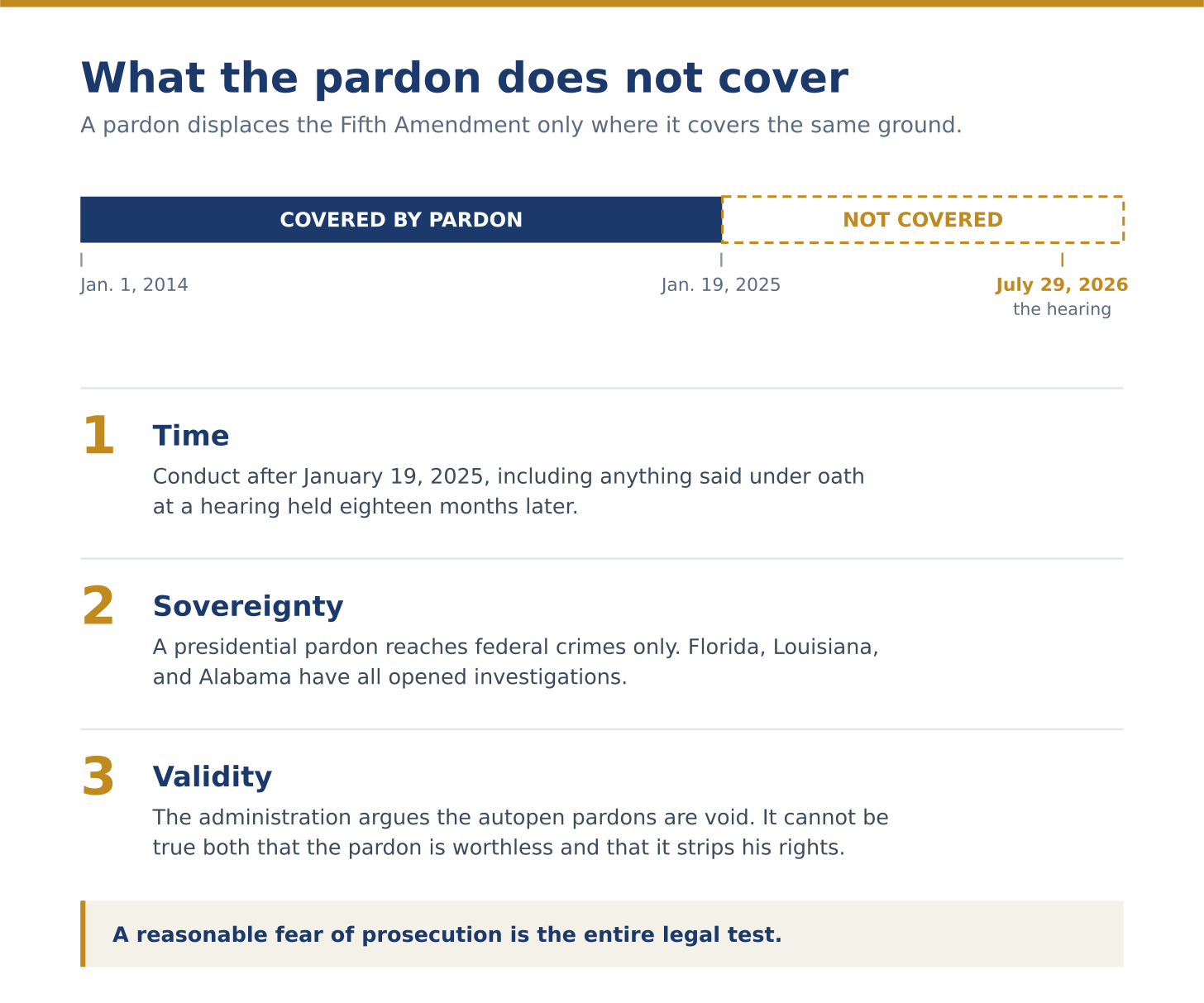
A pardon replaces the privilege only where it covers the same ground the privilege covers. Where it falls short, the privilege survives in the gap. There are three gaps here.
Time. Biden’s pardon runs from January 1, 2014 through January 19, 2025. It does nothing for conduct after that date, including anything said under oath at a hearing held eighteen months later.
Sovereignty. A presidential pardon reaches federal crimes only. The Fifth Amendment reaches state exposure too.
The administration’s own position on the pardon. The administration has spent more than a year arguing that Biden’s autopen pardons are invalid.
Is the state exposure real or theoretical?
Real, and it predates this morning’s vote. Florida’s attorney general opened an investigation the day of the hearing. Louisiana’s AG announced Saturday that her state would join Alabama and Florida. Three announced criminal inquiries, by three sovereigns a presidential pardon cannot touch is real exposure. My friend and mentor, Michael Dorf makes this point on his indispensable Dorf on Law site as follows:

How can the pardon be void and disqualifying at the same time?
It’s a contradiction.
The position is that Biden’s pardon of Fauci is void, and that the same pardon eliminates Fauci’s right to remain silent. Both cannot be true. A witness told by one arm of the government that his protection is worthless, and by another that his protection strips him of his rights, has a reasonable fear of prosecution almost by definition. That fear is the whole legal test.
As to that the reasonableness of that fear, Paul has spent years saying publicly that he wants Fauci in prison. Senator Richard Blumenthal made the point this morning.
Did giving an opening statement waive the privilege?
The closest precedent is a Justice Department declination.
In 2014 the House held Lois Lerner in contempt on precisely this theory, after she declared her innocence to the Oversight Committee and then invoked the privilege. The U.S. Attorney refused to prosecute, concluding that general claims of innocence don’t waive the privilege and that the Fifth Amendment would give her an absolute defense.
Fauci’s case is easier than Lerner’s, not merely comparable. She asserted her innocence. He talked about why he believed he’d been summoned, calling Paul’s interest in him an “unhinged obsession” and suggesting the hearing was staged to get him to say something that would put him behind bars. A statement about the motive of a proceeding is further from a substantive disclosure than a denial of wrongdoing.
Is there a good argument against Fauci?
Yes, and it has nothing to do with the pardon.
Courts require the privilege to be asserted question by question. Fauci declined to identify the color of his tie and declined to acknowledge a folder sitting in front of him. Blanket refusals covering everything regardless of subject usually fail. A judge would have to work through the questioning area by area, deciding where the danger was real and where it wasn’t.
Senator Josh Hawley made the point this morning.
Could the committee have simply gotten answers?
Yes. Congress has a tool built for this situation. A committee can go into federal court and obtain an order compelling a witness to testify under immunity. It takes a two-thirds committee vote or a chamber majority, ten days’ notice to the Attorney General, and the court is required to grant it. That immunity binds the states as well as the federal government, which is the one thing a presidential pardon can never do.
Paul had the votes. He never sought the order.
The tradeoff is real: immunized testimony makes a later prosecution much harder. But a committee insisting a witness faces no exposure, while declining to grant the immunity that would actually eliminate his exposure, has revealed which one it wanted. Answers were available. The committee chose the referral.
Does this now go to the full Senate?
Paul says no. He intends to send the resolution straight to the Justice Department.
The contempt statute contemplates the refusal being reported to the chamber when Congress is in session. Every modern Senate referral has gone through a floor resolution, most recently the contempt of hospital executive Ralph de la Torre in 2024. Skipping that step hands any eventual defendant a threshold defense before anyone reaches the constitutional question at all.
The reason for skipping it is arithmetic. A floor vote would need sixty.
Who decides whether Fauci is actually charged?
Jeanine Pirro, the U.S. Attorney in Washington, who has spent this week absorbing presidential anger for dropping the Reflecting Pool vandalism prosecutions after her office concluded the damage came from a flawed installation rather than vandals. Trump said she made a mistake, that she choked, that she folded like an umbrella. Asked Tuesday whether her job was safe, he said he hadn’t made a determination.
A contempt referral is a request that a prosecutor exercise discretion. This one arrives at an office whose head has just declined a case the president wanted brought, and who is paying for it.
And if she charges him?
The path runs from the U.S. Attorney to a grand jury to a federal judge in Washington, who decides whether the case proceeds. That judge, not the committee, answers the Fifth Amendment question.
History suggests where this lands. Between 1983 and 2021 there were no criminal contempt prosecutions at all. Steve Bannon and Peter Navarro were charged in 2022, and neither of them showed up. Mark Meadows, Dan Scavino, Eric Holder, and Lerner were all referred, and none were charged. The line across administrations of both parties has been whether the witness asserted a colorable privilege or simply defaulted. Fauci appeared, sat for three hours, and claimed a constitutional right.
What’s actually at stake?
The privilege exists for exactly the witness whose government has announced, repeatedly and in public, that it intends to prosecute him. A protection that disappears when the pressure is greatest isn’t a protection.
I’m glad you’re here. I’m grateful you’re engaged. Here and everywhere. — James
Comments
Nothing yet. Say the first thing.
Sign in to join the conversation.