
On November 13, 2024, eight days after the election, the President-elect announced his choice to run the Justice Department:
“It is my Great Honor to announce that Congressman Matt Gaetz, of Florida, is hereby nominated to be The Attorney General of the United States… Few issues in America are more important than ending the partisan Weaponization of our Justice System. Matt will end Weaponized Government… He is a Champion for the Constitution and the Rule of Law…”
Eight days after that, Gaetz was gone.
Weaponization is the organizing promise of that announcement. Twenty months later it is the name of a $1.776 billion fund that the Senate Judiciary Committee has spent two weeks fighting over. The word survived. It began as a description of what the Department would stop doing and ended as the label on an account for paying the President’s supporters with public money.
Tuesday morning at nine, the committee votes on the man who created that account.
Pam Bondi got the job Gaetz didn’t. In the reflected light of a Gaetz nomination, she looked like Atticus Finch. She was not.
Her deputy was Todd Blanche, who arrived with a specific credential. In the spring of 2024 he served as lead defense counsel for Donald Trump in the Manhattan criminal trial. That trial ended in conviction on 34 felony counts. Ah, but loyal! He was confirmed as Deputy Attorney General on March 5, 2025.
The record, in order.
April 5, 2025. Erez Reuveni, a career Justice Department lawyer, acknowledges in open court that the government deported Kilmar Abrego Garcia in error and declines to defend it. Blanche places him on administrative leave within days, writing that he failed to follow orders and engaged in conduct prejudicial to “your client.” Reuveni’s client was the United States.
July 24, 2025. Blanche personally interviews Ghislaine Maxwell in prison. She is subsequently moved to a minimum-security facility with special privileges. No deputy attorney general in memory has conducted an interview like this himself.
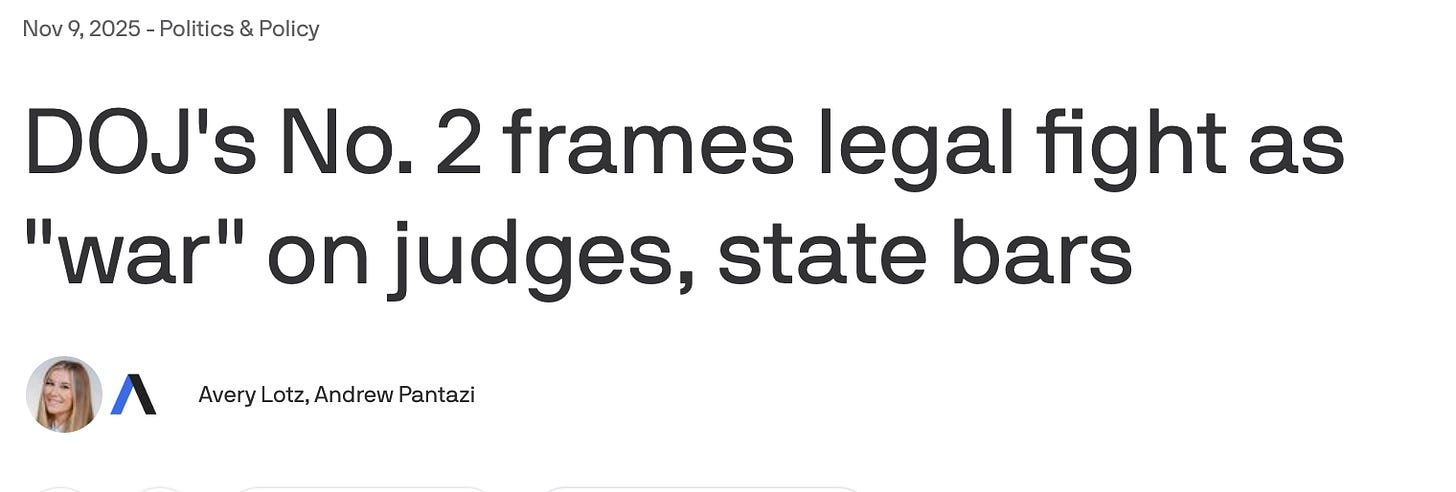
November 7, 2025. At a Federalist Society conference, Blanche casts the federal judiciary as an enemy and asks the young lawyers in the room to enlist against it. “It is a war,” he says, “and it is something we will not win unless we keep on fighting.” Judges, he adds, “have a robe on, but they are more political, or as political, as the most liberal governor or DA.” The New York City Bar condemns the remarks. So does a coalition of fifty former federal judges appointed by presidents of both parties.
November 7, 2025. The same day, Judge Mark Wolf resigns from the federal bench. Reagan appointed him in 1985. He had given more than fifty years to the Justice Department and the courts, including four years running the public corruption unit in Boston. He surrenders a lifetime appointment in order to speak, writing days later in The Atlantic that the assault on the rule of law has left him no choice: “Silence, for me, is now intolerable.” What Nixon did occasionally and in secret, he argues, this president now does routinely and in the open.
January 7, 2026. Renee Good, 37, a mother of three with no criminal record, is shot and killed by an ICE agent in Minneapolis.
January 13. Blanche announces there is “no basis for a criminal civil rights investigation” into her death.
January 14. He posts that Governor Tim Walz and Mayor Jacob Frey are “encouraging violence against law enforcement,” calling their conduct terrorism.
January 23. Reporting reveals that Blanche directed prosecutors and the FBI to shut down the civil rights investigation into Good’s killing and to investigate Good instead, for potential assault. She was already dead.
January 24. Alex Pretti, 37, an ICU nurse at a VA medical center, is shot and killed by federal officers two miles from where Good died. Blanche opens a civil rights investigation six days later, after first declining. The team assembled to conduct it excludes the career attorneys who specialize in excessive force.
February 10. The Deputy Attorney General’s office asks the leaders of all 93 U.S. Attorney’s Offices to send examples of judicial activism, for use in potential impeachment referrals.
February 19. A top Blanche aide tells those same 93 offices that the President is their “chief client.”
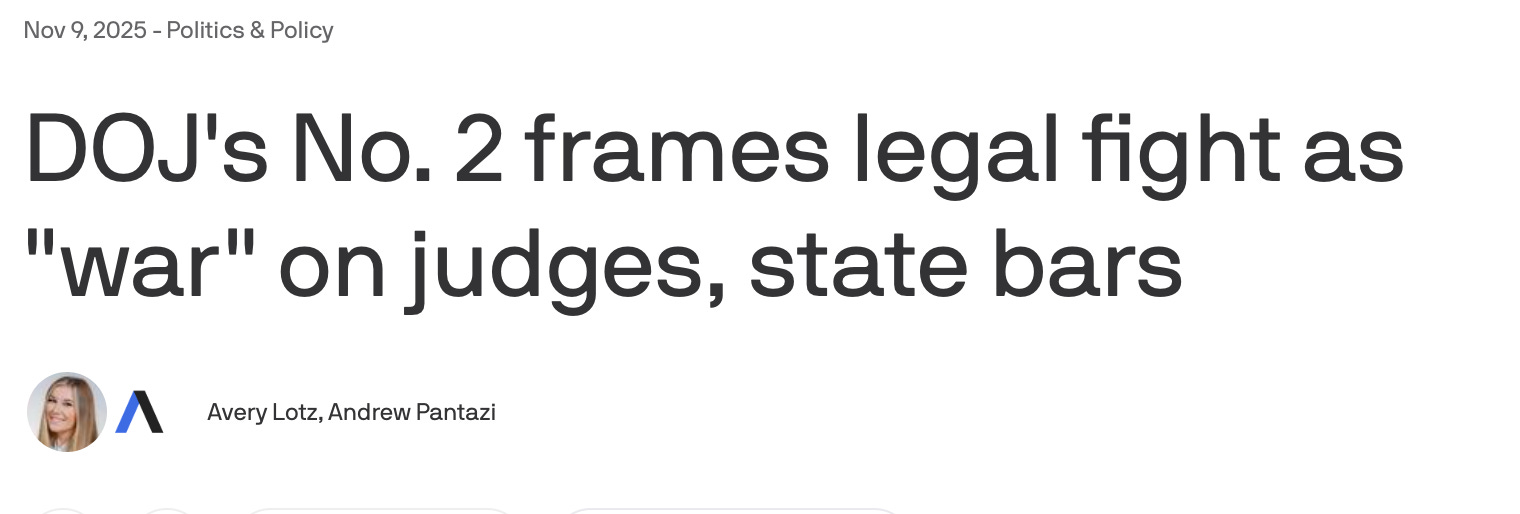

The Attorney General of the United States represents the United States. The client is the public. Tell 93 offices that the President is the chief client and you have not just changed a policy. Everything after February 19 is that sentence being carried out.
February 11, 2026. Attorney General Bondi testifies before House Judiciary for more than five hours. Asked by Rep. Jerrold Nadler how many of Epstein’s co-conspirators have been charged or investigated, she answers: “The Dow is over 50,000 right now.” Survivors are seated directly behind her, some in white shirts printed with blacked-out text standing in for the redactions in the files. Rep. Pramila Jayapal asks them to raise their hands if the Justice Department has never invited them to meet. Every hand goes up. Jayapal then asks Bondi to turn around and apologize for the release of their names and the details of their abuse. Bondi does not turn around. She calls the request theatrics.
March 27. At CPAC, Blanche boasts that the Department has fired more than 200 prosecutors and agents who worked on cases involving Trump: “there is not a single man or woman at the Department of Justice who had anything to do with those prosecutions.” Over his tenure, more than 16,000 Justice Department employees have left, including roughly a quarter of its lawyers. The Department has begun recruiting criminal prosecutors directly out of law school and offering signing bonuses.
April 2. Trump fires Bondi. Blanche becomes Acting Attorney General.
April 11. Blanche tells NBC that Americans should be “happy” the President is deeply involved in Justice Department matters, and says that if Trump nominated someone else, his answer would be “thank you very much. I love you, sir.”
April 28. The Department indicts former FBI Director James Comey for arranging seashells on a beach to read “86 47.” That is the case. Shells. On a beach.
May 18. Blanche establishes the $1.776 billion Anti-Weaponization Fund, and declines to rule out payments to January 6 defendants who assaulted police officers.
May 19. Blanche signs a one-page addendum barring the IRS from auditing past returns filed by Trump, his family, and their companies. No one from the IRS signed it. The IRS reports to Treasury.


On July 13, Judge Kathleen Williams voided the settlement that produced all of it. I wrote about that ruling here. Her holding was that there had never been a lawsuit at all, because there had never been two sides. The plaintiff controlled the defense. She declined to let the courthouse serve as a notary.
She was not alone. Judge Waverly Crenshaw dismissed the Abrego Garcia prosecution as a vindictive abuse of power built on a tainted investigation Blanche led. Judge Patrick Schiltz quashed grand jury subpoenas in Minnesota as part of a broader campaign to coerce. A judge in Chicago said her trust in the government’s lawyers had been broken. Courts found the U.S. Attorney installed to pursue Comey had been improperly appointed and threw out that case and the case against Letitia James.
Last week, ProPublica put a number on it. Reviewing hundreds of cases, its reporters found more than forty in which federal judges explicitly invoked something most Americans have never heard of and every litigator relies on: the presumption of regularity.
When the government tells a court something — that it followed its own procedures, that a document is what it purports to be, that an investigation was opened for the reason given — the judge presumes it is true.

It is being overcome now, by judges appointed by presidents of both parties.
Judge Paula Xinis, an Obama appointee, told the government in the Abrego Garcia case: “You have taken the presumption of regularity, and you’ve destroyed it.”
Judge Mary McElroy, a Trump appointee in Rhode Island, quashed subpoenas in May after finding that Department lawyers had withheld information and misrepresented facts about an investigation into a hospital’s care of transgender children. She referred them for possible discipline, writing that the Department had proven unworthy of that trust at every point in the case.
Magistrate Judge Zia Faruqui in Washington wrote that mistrust of prosecutors, once unthinkable, is deepening, and that the irregular is now the regular. The Department says he was wrong on the law and was overruled.
Judge Christine O’Hearn in New Jersey announced she would no longer accept the government’s statements of fact unless sworn by someone with personal knowledge.
Judge Patrick Schiltz, a Bush appointee who clerked for Justice Scalia, found the grand jury process had been used to harass political opponents and coerce official action.
A former federal judge appointed by George W. Bush told ProPublica that nothing in the Department’s history compares. Just Security has been tracking the cases. Separately, The Economist counted roughly 100 instances of the Department giving courts inaccurate information in the administration’s first fourteen months.
This is what changing the “chief client” costs. The presumption of regularity is not a courtesy. It is capital. It was accumulated over decades by government lawyers who told judges the truth in unglamorous cases nobody covered, and it is spent by everyone who comes after. The next administration inherits the deficit. So does the next honest prosecutor who stands up in a courtroom where the presumption used to do significant work work for him or her, and finds that it does not anymore.
Then came the Lincoln Memorial Reflecting Pool, which is the same story told small enough to see all at once. The President said vandals ruined the liner. The U.S. Attorney indicted a 67-year-old former Olympic canoeist on a felony carrying ten years and announced it at a news conference. On July 31 her own office moved to dismiss, stating that the damage came from a botched installation and that the Interior Department had told prosecutors otherwise. An internal email had documented the peeling eight days before the arrest. The President spent Saturday criticizing the prosecutor for correcting the record. Monday, he said she “choked.”
A prosecution proceeded on a false premise because no one inside the executive branch was positioned to contradict the President’s account of a swimming pool.
Late Sunday night, Blanche produced paper. One document rescinds the fund. A second says the Department will read the audit order to cover only the named plaintiffs, and confirms that future returns remain auditable. Senators Cornyn and Tillis, both leaving office in January, announced Monday morning that they look forward to voting his nomination out of committee.
The audit order still tells the IRS to abandon examinations of the President’s past returns, examinations a single one of which could have cost him north of $100 million. It still bears one signature, and it belongs to his former defense lawyer. A federal judge has already found that it contravenes the statute barring political direction of IRS audits. Narrowing the list of beneficiaries does not answer the judge.

The courts have now said what they can say. Tuesday it is nineteen senators in a committee room, and after that, one hundred. They represent the people. Not the President.
In November of 2024 we were told the nominee would be a champion for the Constitution and the rule of law. We have twenty months of evidence now about what that promise was worth. It is in the orders of judges appointed by Ronald Reagan, by George W. Bush, by Barack Obama, by Joe Biden, and by Donald Trump, who have concluded one by one that they can no longer take the government at its word.
A department’s credibility is built slowly by people whose names nobody knows and spent quickly by people whose names everybody does. Tuesday’s vote will be favorable to Blanche. It will be favorable for his “chief client.” Yes, Blanche is better than Matt Gaetz. Alas, that’s not much of a benchmark.
I’m glad you’re here. I’m grateful you’re engaged. Here and everywhere.
— James
Comments
Nothing yet. Say the first thing.
Sign in to join the conversation.