
I stumbled across this post from Juan on LinkedIn the other day, comparing working with AI agents to being a restaurant chef.
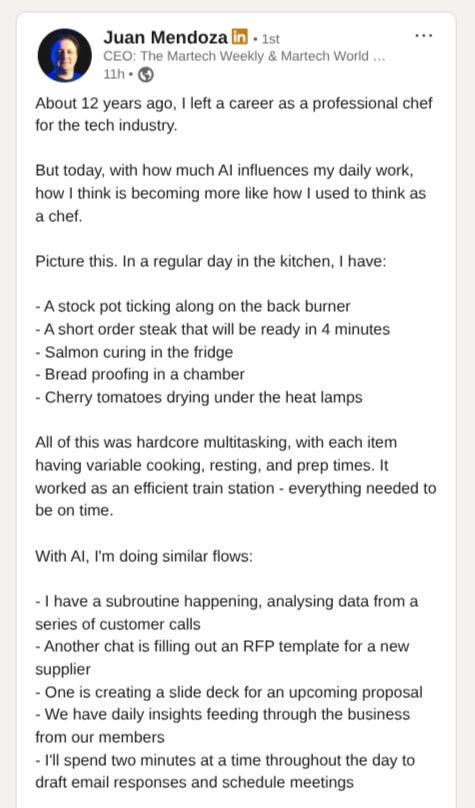
It’s a novel, thought-provoking, and accurate analogy. To be clear, I’ve never been a professional chef, though I did work at Domino’s in my teenage years. Funnily enough, I found it incredibly relaxing. Coming in early, alone with my music, methodically prepping a terrifying volume of dough.
Working with agents is like the exact opposite of that kind of zen. It’s peak dinner rush. It is mind-boggling just how much you can achieve working with agents, but there is a mental toll. Some are calling it “AI Brain Fry”. I’ve felt it, and I’m sure you have too.
“What I found especially interesting is that the most mentally taxing form of AI engagement was not simply using AI, but overseeing AI. Workers who reported high levels of AI oversight also reported more mental effort, more mental fatigue, and more information overload. In other words, when people have to constantly monitor, check, compare, correct, and coordinate AI tools, AI can become another layer of work rather than a reduction in work.”
By now, we instinctively understand why working with AI is so cognitively-taxing. When you shift from doing the work to coordinating the work, your job becomes “Director of Quality Control”. You aren’t in the flow of writing or building, you are endlessly context-switching between reviewing outputs, catching hallucinations or drift, steering your agents and stitching disconnected results together. “Loops” is a popular idea in AI engineering circles now days, yet managing AI agents means your own brain is the one running endless loops, all day long.
There’s something about working with agents that doesn’t feel like the traditional idea of “flow state”, despite how productive it can feel. Cal Newport’s idea of “deep work” is about solitude, single-threading, and eliminating distractions.
“Deep work is also an activity that generates a sense of meaning and fulfillment in your professional life. Few come home energized after an afternoon of frenetic e-mail replies, but the same time spent tackling a hard problem in a quiet location can be immensely satisfying.”
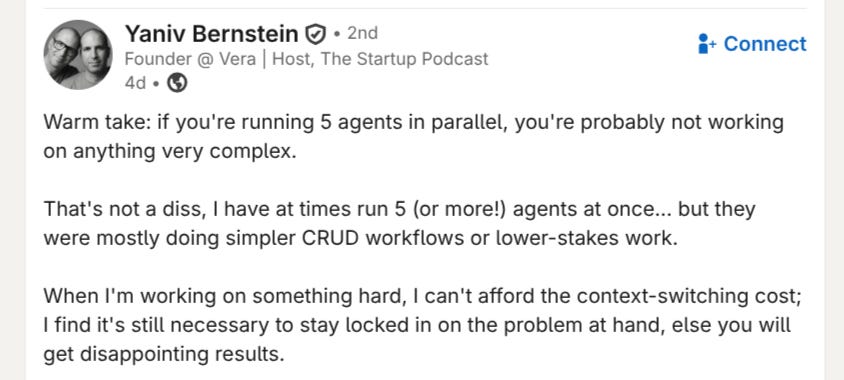
Agentmaxxing, whilst exhilarating and fun, does run much counter to much of the prevailing “best practice” around deep work, impact and focus. I thought Yaniv Bernstein summarised this conflict nicely below.
The question for knowledge work in the AI era isn’t how to avoid the heat of the kitchen all together, but just how we manage it. If we aren’t careful, we just end up burnt out, drowning in open tabs and agent windows. However, if we can adapt to this new kind of multi-threaded pace, learn when to use AI and when to “go deep”, we can leverage agents to be truly prolific, not just productive.

No posts
Comments
Nothing yet. Say the first thing.
Sign in to join the conversation.