
Fresh data on AI adoption from Linear makes for very interesting reading.
There was a lot of online chatter throughout 2024 and 2025 as to whether the promise of coding agents was materialising.
Was the juice worth the squeeze tokens?
The most famous viral takedown came from a guy called Mike Judge who wrote a piece here on Substack in September 2025 called “Where’s the Shovelware? Why AI Coding Claims Don’t Add Up”. This post attracted almost 500 comments on Hacker News and did the rounds in online tech circles. The thing is, his argument, at least at the time, made sense, but it made the grave mistake of assuming AI tooling would remain static. AI is filled with hyperbole, but this brutal-takedown™️ was no less hyperbolic. Take the excerpt below for example.
“It turns out, though, and I’ve collected a lot of data on this, it doesn’t just not work for me, it doesn’t work for anyone, and I’m going to prove that”.
I made the same point at the time, so this isn’t revisionism, but it was so abundantly obvious that the promise of coding agents was real, but that sure, it would just take time for us figure out how to actually be productive (prolific?) with these new tools.
Cynics hate this argument by the way, that the big exciting future is just around the corner. It’s easy to call bullshit on it, because sometimes it is bullshit. Self-driving cars have been “2 years away” for 10 years. But! Cynicism is a road to hell/nowhere. “The new needs friends” and all that. Oh and self driving cars are here by the way! Waymo, anyone?
Back to the Linear data. “Pull requests opened per workspace” is, all things considered, a decent proxy for measuring, not only AI adoption, but AI “usefulness”. Sure, output doesn’t map perfectly onto outcomes, and you can spam PR’s (many will be), but even so, this metric is still, despite this, a measure of utility. Someone has used AI to identify problems, bugs, fixes and improvements. The code quality might not be great (but it probably is “fine”, let’s be honest), but the use case is real. The utility is real.
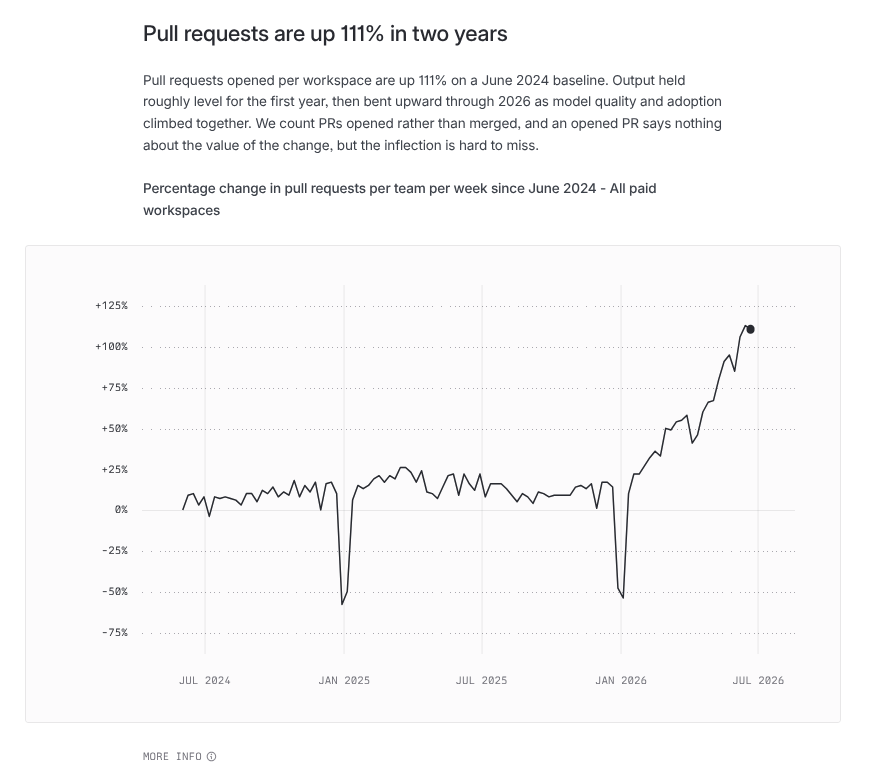
Fascinatingly, you can see this metric was essentially flat for the best part of 18 months. This was not some ice age of AI by the way! This was the time period in which we were delivered Claude Code, Nano Banana, Opus-4 and Deepseek-R1. New models, harnesses, skills, products and primitives dropping every week.
It’s just that, it has taken time to figure this stuff out. “Diffusion” into the market has been slow, but ultimately fairly steady. Harnesses are getting better, models are getting better and the “art” of context engineering is evolving all the time. The use case exists, adoption is there, it will just continue to take time to understand fully what this all means.
It seems to me, from in the trenches, that “practical” AI progress isn’t purely linear. We figure out a bunch of techniques and tactics for using these tools to build product faster, make a bunch of progress that feels like a “break through”, and then we hit plateaus again for a while. Almost everyone I speak to in software has experienced this. There are days and weeks that feel like living in the future, and times where it all feels kinda “meh” again. Kinda reminds me of that (perhaps mis-attributed?) Lenin quote, “there are decades where nothing happens; and there are weeks where decades happen.”
One explanation for this is the “shifting bottleneck” theory. We generate code faster now, but spend more time reviewing code. We feel just as “blocked” as before, just in different places. Another possible explanation is ever increasing technical debt around context engineering. We’re expending lots of energy on our context engineering—writing and pruning the skills and instructions to better work with the AI tools, but this energy has a toll. First it was CLAUDE.md files, then AGENTS.md, then it was Skills, then it was… Sometimes you feel like you’re spending more time building the machine than building the product.
Pondering this all, I’m reminded of Amara’s Law: “We tend to overestimate the effect of a technology in the short run and underestimate the effect in the long run”.
I guess all you can do as a technologist is keep focused on the long run. Keep learning, keep building, remain curious and stay optimistic. Ignore the hype, don’t burn out and remember the discourse isn’t the work.
100 years ago, Hemingway penned his famous line “gradually, then suddenly”. Step by step, the future is arriving.

No posts
Comments
Nothing yet. Say the first thing.
Sign in to join the conversation.